eBook - ePub
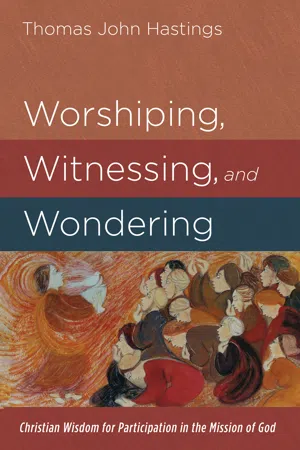
Worshiping, Witnessing, and Wondering
Christian Wisdom for Participation in the Mission of God
- 124 pages
- English
- ePUB (mobile friendly)
- Available on iOS & Android
eBook - ePub
Worshiping, Witnessing, and Wondering
Christian Wisdom for Participation in the Mission of God
About this book
Focusing on educational ministries, Hastings offers a postcritical, synthetic approach to worshiping, witnessing, and wondering, grounded in scriptural ways of knowing God in Jesus Christ and in the power of the Holy Spirit. Here, lives marked by worship, witness, and wonder are understood not only to be harmonious with the evolutionary endowments of perception, action, and cognition, nor as well-attested practices of corporate and personal religious life, but also as a tripartite gestalt contingent on divine agency and mediated through participation in Jesus Christ in the power of the Holy Spirit. Hastings describes worship, witness, and wonder as ways Christians participate with a sense of common cause in the mission of the God of love and life, who comes to us in Jesus Christ "clothed in his gospel" and in the power of the Holy Spirit, who has been "poured out upon all flesh."
Information
Topic
Theology & ReligionSubtopic
Christian Ministry1
The “Culture Wars” and Protestant Educational Ministry Today
I begin by commenting on how I see the confusion about educational ministries in the Protestant churches today. Imagine the following thought experiment. You and I are friends who reside in the biblical city of Babel just after the Lord has come down and “confused the language of all the earth” (Gen 11:9). Trapped within our distinct linguistic walls, we have suddenly lost all ability to communicate with each other. You try to speak, and I see your lips moving and feel the vibration of your voice tingling in my inner ear, but your words come across as so much gibberish. I then start to speak, but you have no idea what I am trying to say. In this post-Babel confusion, we cannot even communicate our puzzlement to each other, but we both know something has gone wrong. It feels like we are reliving our first encounter with a new language as infants or as foreigners.
In our frustration, we leave off words and test out facial expressions and gestures, but immediately we discover that even embodied speech has been confused. We are then plunged helplessly back into silence, separation, and frustration. We become increasingly irritated with our inability to articulate, share, and verify our intended meanings. Even though we are both conscious that we share a treasured memory of the pre-Babel world, we are now left to interpret those memories on our own, within our completely distinct language worlds. In the absence of any mutual attestation of our distinct interpretations of this pre-Babel history, the menacing specter of absolute atomization overshadows all hopes for a shared future. In this post-Babel world, hardened opinion replaces open-ended explorations of truth with a small “t”—the fallible kind of truth claims that both the sciences and humanities like theology rely on—and all that remains is an increasingly boisterous and nasty competition of self-interest and deepening misunderstanding. In this condition, we may succeed in passing on our personal prejudices to the next generation or to new initiates but, having lost any way to adjudicate the views of others beyond our individual linguistic and cultural silos, our transmission of what our particular group “knows” and “values” loses its richness, depth, and nuance. A menacing cloud hovers over this post-Babel world.
I suggest that this thought experiment about the confusion of tongues and the loss of consensus about the rich and broad tradition of Christian faith is one way to think about the crisis facing Protestant churches in North America today. In the churches and in our social media and cable news “echo chamber” culture, this loss of consensus has given birth to a fierce and seemingly irreconcilable rivalry between ideological camps. The breakup of the churches rooted in the Reformation into hardened factions on the right and the left has contributed both to the internal division and weakening of our communities of faith and to a coherent public witness. One might say that embattled North American Protestants are in peril of losing their last vestige of catholicity, which of course was a shared historical and cultural presupposition when this movement first emerged out of the reforms of the sixteenth century.10
The post-Babel Protestant churches divide up into three identifiable approaches to the Christian faith,11 which may be called subjectivist, activist, and objectivist orientations. What makes this situation so challenging for pastors and church educators is that all three of these orientations are often present within a single local congregation. These three faith styles, which may change dramatically for individuals over a lifetime, also reflect the increasingly fluid boundaries between individual identity and social belonging in postmodern societies.12 As work in the sociology of religion has shown, the number of groups Americans have to choose from has grown, even while the demands of group belonging have declined. Furthermore, our fragmented groups are ideal ecosystems for the growth of what Robert Jay Lifton calls the “Protean self.”13
As an intercultural pastoral educator who has spent much of my career in Japan, where Protestant Christianity was introduced only about 160 years ago, I have observed and struggled with the loss of Protestant consensus on both sides of the Pacific. In Japan and the United States, the fragmenting drift of the Protestant churches—and here I would include mainline, evangelical, Pentecostal-charismatic, and independent churches—into subjectivist, activist, and objectivist orientations is reflected in all areas of church life. While I will focus on how these divisions have affected the church’s educational ministries and spiritual formation of children, youth, and adults, one could also examine this problematic by looking at approaches to preaching, pastoral care, mission, or evangelism. My particular interest is educational ministry and spiritual formation, because it is here that I see the key question of growth in the mission of God in Jesus Christ is dealt with most directly.14
In my participation in and reflection on the educational ministries of Protestant congregations in the United States and Japan, I have noticed the following three patterns that correspond to the subjectivist, activist, and objectivist orientations introduced above:
1.Subjectivist orientation to educational ministries and spiritual growth: Emphasis on the experiential, affective, intuitive, or mystical dimensions of faith (i.e., through individual religious experience, conversion, spiritual practices, etc.).
2.Activist orientation: Emphasis on the active or vocational dimension of Christian faith (i.e., through consciousness of and participation in contemporary movements seeking social justice, political reform, and peace).
3.Objectivist orientation: Emphasis on the cognitive or propositional dimensions of faith (i.e., through mastering a particular church tradition’s interpretation of Scripture and/or doctrine, perhaps with the aid of confessions of faith and catechisms).
While each of these orientations finds support in Scripture and church tradition, I have observed that educational ministries in congregations tend to seize upon one core orientation, often to the relative neglect of the other two. Depending on the convictions of those in charge of educational ministries at any given time, there is a propensity for congregations to bounce around willy-nilly between the three core orientations. A neutral observer may get the impression that there is an irreconcilable conflict between subjectivists, who emphasize religious experience, conversion, or spirituality; activists, who stress awareness of and engagement in emancipatory social or political causes; and objectivists, who focus on biblical or doctrinal study according to a specific interpretive tradition. In North America today, cable news and social media, which gleefully promote and profit from the “niche-centered culture wars” that pit the left and the right against each other, have exacerbated the rivalry between these three basic orientations to the Christian faith.15 Conversely, in this era of “reality TV” politicians, cable newscasters, and the social media echo chamber, one wonders whether the bitter antagonism between these orientations within religious communities themselves may be one source for the bitter culture wars.
The claim I wish to make here is that the crisis of contemporary American Protestantism is due to a loss of an inherent, holistic interplay between so-called subjectivist, activist, and objectivist orientations to faith. In the face of the breakup of communities of faith into mutually exclusive camps, I find myself—and many others with whom I have worshiped, witnessed, and wondered—longing for some way to reintegrate the strengths of all three orientations into educational ministries. Perhaps, like all the king’s horses and all the king’s men who could not put Humpty Dumpty together again, the deep ideological rifts in today’s churches are beyond healing. Or perhaps, in times such as the COVID-19 pandemic, the awareness of the glaring limitations of our human resources may lead us back again, as it has in many other crises across the generations, to broader, more hopeful horizons we may have overlooked.
For Chri...
Table of contents
- Title Page
- Introduction
- Chapter 1: The “Culture Wars” and Protestant Educational Ministry Today
- Chapter 2: The Biblical Basis of Christian Worship, Witness, and Wonder
- Chapter 3: Pathos and Christian Worship:Renewal in Word and Sacrament for Participation in God’s Mission
- Chapter 4: Logos and Christian Witness:Ethical Discernment for Participation in God’s Mission
- Chapter 5: Ethos and Christian Wonder: Identity Formation and Renewal for Participation in God’s Mission
- Concluding Comments on the World Christian Movement
- Postscript on Practical Theology and Catechesis
- Appendix: Additional Thoughts on Worship, Witness, and Wonder across the Ages
- Bibliography
Trusted by 375,005 students
Access to over 1.5 million titles for a fair monthly price.
Study more efficiently using our study tools.
Frequently asked questions
Yes, you can cancel anytime from the Subscription tab in your account settings on the Perlego website. Your subscription will stay active until the end of your current billing period. Learn how to cancel your subscription
No, books cannot be downloaded as external files, such as PDFs, for use outside of Perlego. However, you can download books within the Perlego app for offline reading on mobile or tablet. Learn how to download books offline
Perlego offers two plans: Essential and Complete
- Essential is ideal for learners and professionals who enjoy exploring a wide range of subjects. Access the Essential Library with 800,000+ trusted titles and best-sellers across business, personal growth, and the humanities. Includes unlimited reading time and Standard Read Aloud voice.
- Complete: Perfect for advanced learners and researchers needing full, unrestricted access. Unlock 1.5M+ books across hundreds of subjects, including academic and specialized titles. The Complete Plan also includes advanced features like Premium Read Aloud and Research Assistant.
We are an online textbook subscription service, where you can get access to an entire online library for less than the price of a single book per month. With over 1.5 million books across 990+ topics, we’ve got you covered! Learn about our mission
Look out for the read-aloud symbol on your next book to see if you can listen to it. The read-aloud tool reads text aloud for you, highlighting the text as it is being read. You can pause it, speed it up and slow it down. Learn more about Read Aloud
Yes! You can use the Perlego app on both iOS and Android devices to read anytime, anywhere — even offline. Perfect for commutes or when you’re on the go.
Please note we cannot support devices running on iOS 13 and Android 7 or earlier. Learn more about using the app
Please note we cannot support devices running on iOS 13 and Android 7 or earlier. Learn more about using the app
Yes, you can access Worshiping, Witnessing, and Wondering by Thomas John Hastings in PDF and/or ePUB format, as well as other popular books in Theology & Religion & Christian Ministry. We have over 1.5 million books available in our catalogue for you to explore.