ITIL® 4 Drive Stakeholder Value (DSV)
eBook - ePub

ITIL® 4 Drive Stakeholder Value (DSV)

Your companion to the ITIL 4 Managing Professional DSV certification

  1. 270 pages
  2. English
  3. ePUB (mobile friendly)
  4. Available on iOS & Android
eBook - ePub

ITIL® 4 Drive Stakeholder Value (DSV)

Your companion to the ITIL 4 Managing Professional DSV certification

About this book

ITIL® 4 Drive Stakeholder Value (DSV)

If you've achieved your ITIL 4 Foundation certificate, you're probably planning the next stage in your ITIL journey and deciding which qualification to work towards. ITIL 4 DSV provides essential knowledge and capabilities for service management professionals, focusing on the engagements between a service provider and its customers, users, suppliers and partners, and how demand is converted into value via IT-enabled services.

DSV is one of the ITIL 4 advanced level modules that leads to the MP (Managing Professional) certification. The module is aimed at managers and aspiring managers at all levels, providing them with the practical skills to build effective relationships across the SVS.

An excellent supplement to any ITIL 4 DSV training course

The majority of this book is based on the official AXELOS ITIL ® 4: Drive Stakeholder Value publication and the associated Drive Stakeholder Value Managing Professional syllabus. It provides students with the information they need to pass the DSV exam, and help them become a successful practitioner.

This book is suitable for ITIL v3 Experts, ITIL 4 MP students, ITSM (IT service management) practitioners who are adopting ITIL 4, approved training organisations, IT service managers, IT managers and those in IT support roles.

The guide focuses on:

  • The customer journey;
  • Fostering stakeholder relationships;
  • How to: shape demand and define service offerings, and align expectations and agree service details;
  • Onboarding and offboarding;
  • Continual value co-creation;
  • Realising and validating service value; and
  • Exam preparation.

A useful tool throughout your career

In addition to being an essential study aid, the author — a seasoned ITSM professional — also provides additional guidance throughout the book, which you can lean on once your training and exam are over. The book includes her own practical experience, from which she gives advice, and points to think about along the way, so that you can refer back to this book for years to come – long after you've passed your exam.

ITIL® is a registered trade mark of the PeopleCert group. Used under licence from PeopleCert. All rights reserved.

Frequently asked questions

Yes, you can cancel anytime from the Subscription tab in your account settings on the Perlego website. Your subscription will stay active until the end of your current billing period. Learn how to cancel your subscription.
No, books cannot be downloaded as external files, such as PDFs, for use outside of Perlego. However, you can download books within the Perlego app for offline reading on mobile or tablet. Learn more here.
Perlego offers two plans: Essential and Complete
  • Essential is ideal for learners and professionals who enjoy exploring a wide range of subjects. Access the Essential Library with 800,000+ trusted titles and best-sellers across business, personal growth, and the humanities. Includes unlimited reading time and Standard Read Aloud voice.
  • Complete: Perfect for advanced learners and researchers needing full, unrestricted access. Unlock 1.4M+ books across hundreds of subjects, including academic and specialized titles. The Complete Plan also includes advanced features like Premium Read Aloud and Research Assistant.
Both plans are available with monthly, semester, or annual billing cycles.
We are an online textbook subscription service, where you can get access to an entire online library for less than the price of a single book per month. With over 1 million books across 1000+ topics, we’ve got you covered! Learn more here.
Look out for the read-aloud symbol on your next book to see if you can listen to it. The read-aloud tool reads text aloud for you, highlighting the text as it is being read. You can pause it, speed it up and slow it down. Learn more here.
Yes! You can use the Perlego app on both iOS or Android devices to read anytime, anywhere — even offline. Perfect for commutes or when you’re on the go.
Please note we cannot support devices running on iOS 13 and Android 7 or earlier. Learn more about using the app.
Yes, you can access ITIL® 4 Drive Stakeholder Value (DSV) by Claire Agutter in PDF and/or ePUB format, as well as other popular books in Computer Science & Project Management. We have over one million books available in our catalogue for you to explore.

Information

CHAPTER 1: THE CUSTOMER JOURNEY

In this introductory chapter, we’ll review a key concept for DSV – the customer journey. The content includes:
The concept of the customer journey; and
How to design and improve customer journeys.
ITIL 4 describes a customer journey as “the complete end-to-end experience customers have with one or more service providers and/or their products through the touchpoints and service interactions”.

Value streams and customer journeys

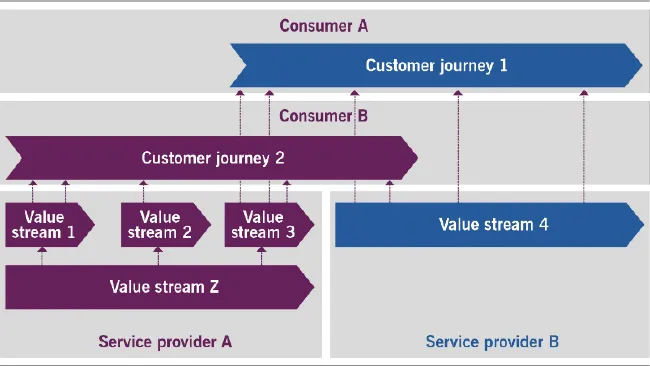
Figure 1 shows the relationships between value streams and customer journeys.
image
Figure 1: Relationships between value streams and customer journeys1
A customer journey will always rely on one or more value streams from one or more service providers. A customer journey can include multiple value streams from one service provider, or value streams from different service providers.
A value stream can support multiple customer journeys. The customer journey includes value stream activities that are part of what is known as the ‘band of visibility’. There will be other value stream activities that are not visible to the customer, so these value streams don’t form part of the customer journey.
The customer journey isn’t always linear. It can involve moving around between different touchpoints, and repeated contact at some touchpoints. The customer might start in the middle of the expected customer journey, so the service provider needs to continually monitor customer journeys and improve its understanding of customer behaviour.
image
Think about your own customer journeys for the services you use every day. For example, a TV streaming service, or an insurance product. Where did your customer journey start? Has it finished? What value streams have supported your journey? You could think about new user onboarding, billing, customer service, etc. as examples of value streams.
Customer journeys are an important part of the overall customer and user experience. Customer experience (CX) is “the sum of functional and emotional interactions with a service and service provider as perceived by a customer”. User experience (UX) is “the sum of the functional and emotional interactions with a service and service provider as perceived by a user”.
The customer journey forms part of the customer’s overall perception of a service provider, along with other influencing factors like brand, reputation, previous experiences, etc.
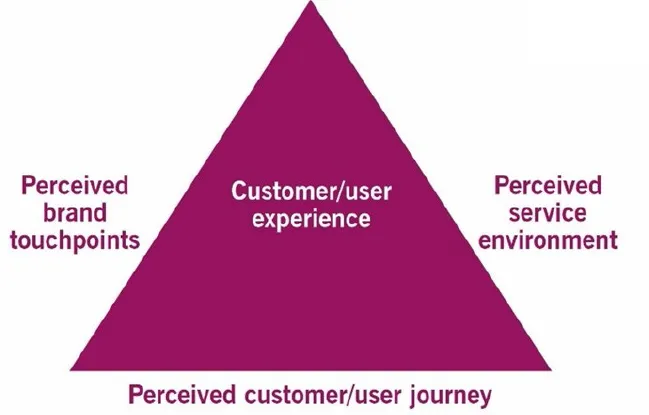
Figure 2 shows the three aspects of customer and user experience.
image
Figure 2: Three aspects of the customer and user experience2
image
The definitions for both customer and user experience mention ‘emotional interactions’. This is an important point for you to consider as a service provider or in a service management role. In the past, we’ve not always considered the human element of service interactions. I’ve worked with organisations where there has been fierce resistance to change because the end users have an emotional attachment to a system they are using. It might not work very well, the new system might be a huge improvement, but I’ve seen a real sense of affection for older systems that can lead to a reluctance to change.
As service providers, we can focus too much on the facts (“Why wouldn’t you want this? It’s twice as fast!”) and miss the emotional elements. It’s really important to have proper conversations with end users and customers so that we have the full picture and can carry out our role more effectively.

Customer journey design

Customer journey design is based on these principles:
How you deliver a service is as important as what is delivered.
The overall journey is more important than each individual touchpoint.
Understanding the customer journey allows providers to focus on maximising value, and on experiences over outcomes.
The ITIL 4 Specialist: Drive Stakeholder Value syllabus and related publication are based around the steps in a customer journey.
These steps are:
Explore
Engage
Offer
Agree
Onboard
Co-create
Realise
image
Before you move on and learn about the customer journey in more detail, why not try creating your own customer journey map? You can use a product or service from your own organisation, or perhaps use Mortbank from the Banksbest case study. Note down what happens in each step of the customer journey, and refer back to it when we study the customer journey in more detail.

Customer journey key concepts

The key concepts related to a customer journey are:
Benefits
Stakeholder aspirations
Journey mapping
Personas
Scenarios
Maps
Understanding the customer experience
We’ll review them one by one in this section.
Benefits
Understanding the customer journey delivers benefits for the service consumer and the service provider, as shown in table 1.
Table 1: Customer Journey Mapping Benefits
For the service consumer
For the service provider
Facilitate outcome
Gain optimal service value and experience
Get what you need, not just what you asked for
Identify and support service consumer behaviours and outc...

Table of contents

  1. Cover
  2. Title
  3. Copyright
  4. About the Author
  5. Contents
  6. Introduction
  7. Chapter 1: The customer journey
  8. Chapter 2: Targeting markets and stakeholders
  9. Chapter 3: Fostering stakeholder relationships
  10. Chapter 4: How to shape demand and define service offerings
  11. Chapter 5: How to align expectations and agree service details
  12. Chapter 6: Onboarding and offboarding
  13. Chapter 7: Continual value co-creation
  14. Chapter 8: Realising and validating service value
  15. Chapter 9: Exam preparation
  16. Appendix A: Banksbest case study
  17. Further reading