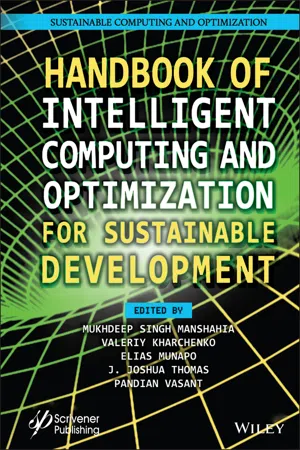
Handbook of Intelligent Computing and Optimization for Sustainable Development
eBook - ePub

Handbook of Intelligent Computing and Optimization for Sustainable Development

  1. English
  2. ePUB (mobile friendly)
  3. Available on iOS & Android
eBook - ePub

Handbook of Intelligent Computing and Optimization for Sustainable Development

About this book

HANDBOOK OF INTELLIGENT COMPUTING AND OPTIMIZATION FOR SUSTAINABLE DEVELOPMENT

This book provides a comprehensive overview of the latest breakthroughs and recent progress in sustainable intelligent computing technologies, applications, and optimization techniques across various industries.

Optimization has received enormous attention along with the rapidly increasing use of communication technology and the development of user-friendly software and artificial intelligence. In almost all human activities, there is a desire to deliver the highest possible results with the least amount of effort. Moreover, optimization is a very well-known area with a vast number of applications, from route finding problems to medical treatment, construction, finance, accounting, engineering, and maintenance schedules in plants. As far as optimization of real-world problems is concerned, understanding the nature of the problem and grouping it in a proper class may help the designer employ proper techniques which can solve the problem efficiently. Many intelligent optimization techniques can find optimal solutions without the use of objective function and are less prone to local conditions.

The 41 chapters comprising the Handbook of Intelligent Computing and Optimization for Sustainable Development by subject specialists, represent diverse disciplines such as mathematics and computer science, electrical and electronics engineering, neuroscience and cognitive sciences, medicine, and social sciences, and provide the reader with an integrated understanding of the importance that intelligent computing has in the sustainable development of current societies. It discusses the emerging research exploring the theoretical and practical aspects of successfully implementing new and innovative intelligent techniques in a variety of sectors, including IoT, manufacturing, optimization, and healthcare.

Audience

It is a pivotal reference source for IT specialists, industry professionals, managers, executives, researchers, scientists, and engineers seeking current research in emerging perspectives in the field of artificial intelligence in the areas of Internet of Things, renewable energy, optimization, and smart cities.

Trusted by 375,005 students

Access to over 1.5 million titles for a fair monthly price.

Study more efficiently using our study tools.

Information

Year
2022
Print ISBN
9781119791829
Edition
1
eBook ISBN
9781119792628

Part I
INTELLIGENT COMPUTING AND APPLICATIONS

1
Assessing Mental Workload Using Eye Tracking Technology and Deep Learning Models

Souvik Das*, Kintada Prudhvi and J. Maiti
Indian Institute of Technology, Kharagpur, India
Abstract
The current study has proposed a mental workload prediction model using neural network and Bernoulli Boltzmann machine. For measuring mental workload, eye movement metrics were considered. The eye metrics were computed from the raw eye movement data, which were recorded using eye tracking device while solving a coding problems. We have found that the Bernoulli Boltzmann machine provides better accuracy in prediction of mental workload from eye metrics. The reason of providing low accuracy by neural network model may be attributed to less data. In future, the sensitivity of the neural network model can be observed by collecting more eye movement data.
Keywords: Mental workload, eye tracking, coding, deep learning model, artificial neural network, Bernoulli Boltzmann machine

1.1 Introduction

Mental work load or cognitive work load analysis is very important in analyzing the performance of a person. It is one of the most important construct in cognitive ergonomics for correct understanding the performance of a person. One other way to describe the mental work is that it is obtained by collective functioning of all the factors that contribute for the work load efficiency for a given task load. Workload can be described as a mental construct which reflects the mental strain resulting from performing a task under specific environmental and operational conditions which are coupled with the capability of the operator to respond to those demands. Workload is not only task specific, but it is also person specific. Work load not only involves individual capacities but also motivation to perform a task. Task can be said as a demand placed upon the humans. There are many ways to measure the mental work load; some of them are as follows:
  1. 1) Galvanic skin response or electromodal activity
  2. 2) Heart rate
  3. 3) Electroencephalogram
  4. 4) Eye tracking
Many accidents which occur in the production or manufacturing sector industries are mainly due to the human related factors rather than the machines. The research on the mental work load is started well before 21st century as Sweller et al. [1] in his paper described about the concept of how skill acquisition is related to the mental workload. Similar to their work, Borghini et al. [2] pursued the work of Sweller et al. [1] further and said that making skills will help in reducing the task load. From the work of these two, we can say that the mental work load depends not only on the complexity of the task but also on the skill level of the person who is doing the job. Wang et al. [3] worked on how the mental work load of a person is related to the accidents caused by performing experiments on people solving n-back tasks. Many machine learning deep learning and other generative types of algorithms are used to predict the mental work load like support vector machines [4], hidden Markov model [5], and artificial neural networks [6]. Apart from the behavioral measures like the skill set, many tried to relate the physiological measure like eye pupil diameter, fixation, and gaze [7, 8]. The results of the study have shown that how well the mental work load data can be predicted by neural networks and Bernoulli Boltzmann machines using the eye tracking data and also how well neural networks perform in these types of tasks.

1.2 Data Acquisition Method

We recorded the eye tracking data of student while he debug a coding related question. There are a total of seven coding questions with two types of difficulty, easy or hard, and one question with unknown difficulty. The data acquired from the eye tracker was cleaned and processed to get the required features.

1.2.1 Data Acquisition Experiment

The experiment took place in the Virtual Reality Lab, Department of Industrial and Systems Engineering IIT Kharagpur. The experimental process goes as follows. A student was fixed with eye tracking device and was asked to debug seven coding related questions of known difficulty. Before solving every question, the student was asked to stare at a white blank screen to get the base coordinates. In this experiment, the eye tracker recorded the student’s data of gaze coordinates, gaze direction, pupil diameter, and fixation coordinates.

1.3 Feature Extraction

The data acquired from the eye tracker was cleaned of illegal values and null values and was processed to get the following: (1) saccadic amplitude in the X and Y direction, which is the difference between the gaze and fixation in particular direction; (2) rate of change of saccadic amplitude, in the X and Y direction, which is the saccadic amplitude divided with time difference from one fixa...

Table of contents

  1. Cover
  2. Table of Contents
  3. Title Page
  4. Copyright
  5. Dedication
  6. Foreword
  7. Preface
  8. Acknowledgment
  9. Part I INTELLIGENT COMPUTING AND APPLICATIONS
  10. Part II OPTIMIZATION
  11. Part III META-HEURISTICS: APPLICATIONS AND INNOVATIONS
  12. Part IV SUSTAINABLE COMPUTING
  13. Part V AI IN HEALTHCARE
  14. Index
  15. End User License Agreement

Frequently asked questions

Yes, you can cancel anytime from the Subscription tab in your account settings on the Perlego website. Your subscription will stay active until the end of your current billing period. Learn how to cancel your subscription
No, books cannot be downloaded as external files, such as PDFs, for use outside of Perlego. However, you can download books within the Perlego app for offline reading on mobile or tablet. Learn how to download books offline
Perlego offers two plans: Essential and Complete
  • Essential is ideal for learners and professionals who enjoy exploring a wide range of subjects. Access the Essential Library with 800,000+ trusted titles and best-sellers across business, personal growth, and the humanities. Includes unlimited reading time and Standard Read Aloud voice.
  • Complete: Perfect for advanced learners and researchers needing full, unrestricted access. Unlock 1.5M+ books across hundreds of subjects, including academic and specialized titles. The Complete Plan also includes advanced features like Premium Read Aloud and Research Assistant.
Both plans are available with monthly, semester, or annual billing cycles.
We are an online textbook subscription service, where you can get access to an entire online library for less than the price of a single book per month. With over 1.5 million books across 990+ topics, we’ve got you covered! Learn about our mission
Look out for the read-aloud symbol on your next book to see if you can listen to it. The read-aloud tool reads text aloud for you, highlighting the text as it is being read. You can pause it, speed it up and slow it down. Learn more about Read Aloud
Yes! You can use the Perlego app on both iOS and Android devices to read anytime, anywhere — even offline. Perfect for commutes or when you’re on the go.
Please note we cannot support devices running on iOS 13 and Android 7 or earlier. Learn more about using the app
Yes, you can access Handbook of Intelligent Computing and Optimization for Sustainable Development by Mukhdeep Singh Manshahia,Valeriy Kharchenko,Elias Munapo,J. Joshua Thomas,Pandian Vasant in PDF and/or ePUB format, as well as other popular books in Technology & Engineering & Electrical Engineering & Telecommunications. We have over 1.5 million books available in our catalogue for you to explore.