Learn how to overcome distraction in meditation practice and develop clarity in your relationships, work, and activities with this new guide from a beloved meditation teacher.
The mind can be a potent tool, used to guide extraordinary achievements, inspire good works, and incline your spiritual path toward peace and awakening. But the mind can also produce thoughts that lead to suffering. For many people, thoughts run rampant and seem to oppress or control their lives. Even the Buddha tells us that before his enlightenment, he sometimes found his mind preoccupied by thoughts connected with sensual desire, ill will, and harm. But he figured out how to respond to thoughts skillfully and developed a step-by-step approach to calm the restless mind. Now, Insight Meditation teacher Shaila Catherine offers an accessible approach to training the mind that is guided by the Buddha’s pragmatic instructions on removing distracting thoughts. Drawing on two scriptures in the Middle Length Discourses of the Buddha, Shaila shows you how to overcome habitual modes of thinking, develop deeper concentration, and discover the insights into emptiness that are vital for a liberating spiritual path.
Following the Buddha’s pragmatic approach, Shaila guides you through five steps for overcoming distraction and focusing the mind:
1. Replace unwholesome thoughts with wholesome thoughts. For example, if you find yourself thinking thoughts of ill will toward a person, try thinking instead of their good qualities as an antidote.
2. Examine the dangers of distracting thoughts. Weigh the costs of allowing thoughts of ill will, lust, greed, and so forth to obsess your mind. The costs of dwelling on distracting thoughts nearly always outweigh any supposed benefits.
3. Avoid it, ignore it, forget it. Develop the skill to turn your attention away from habitual distractions. Remove the fuel and let the fires of distraction die out.
4. Investigate the causes of distraction. By understanding the conditions that perpetuate habitual thoughts, you can learn to free yourself from those patterns.
5. Apply determination and resolve. Supported by wisdom, you can make a firm decision to stop dwelling on patterns of thought that are not supporting your deepest values and goals in life.
Each chapter includes exercises and reflections to help you cultivate the five steps to deeper concentration. You’ll learn about your mind and develop your ability to direct your attention more skillfully in meditation and daily activities.
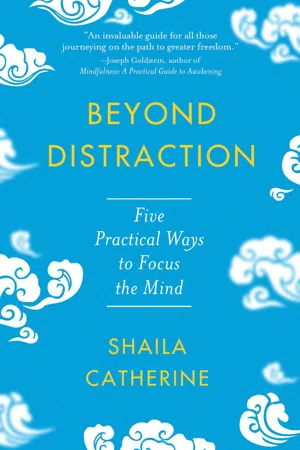
- 240 pages
- English
- ePUB (mobile friendly)
- Available on iOS & Android
eBook - ePub
About this book
Information
Topic
Theology & ReligionSubtopic
BuddhismTable of contents
- Cover Page
- Advance Praise for Beyond Distraction
- Title Page
- Contents
- Introduction: Lost in Thought
- 1. Knowing Your Own Mind: Many Kinds of Thoughts
- 2. Thoughts That Help and Thoughts That Hurt: What Intentions Do You Nurture?
- 3. Antidotes and Alternatives: Strategy #1 — Replace Unwholesome Thoughts with Wholesome Thoughts
- 4. Weighing the Costs: Strategy #2 — Examine the Dangers of Distracting Thoughts
- 5. Withdrawing the Fuel: Strategy #3 — Avoid It, Ignore It, Forget It
- 6. Unraveling the Causes: Strategy #4 — Investigate the Causes of Distraction
- 7. Saying No and Meaning It!: Strategy #5 — Apply Determination and Resolve
- 8. Applying the Five Strategies: A Complete Training Sequence
- 9. Mastering Your Mind: Moving toward Liberation
- Appendix 1: Dvedhāvitakka Sutta: Two Kinds of Thought
- Appendix 2: Vitakkasaṇṭhāna Sutta: The Removal of Distracting Thoughts
- Acknowledgments
- List of Abbreviations
- Notes
- Bibliography
- Index of Exercises
- General Index
- About the Author
- What to Read Next from Wisdom Publications
- About Wisdom Publications
- Copyright
Trusted by 375,005 students
Access to over 1.5 million titles for a fair monthly price.
Study more efficiently using our study tools.
Frequently asked questions
Yes, you can cancel anytime from the Subscription tab in your account settings on the Perlego website. Your subscription will stay active until the end of your current billing period. Learn how to cancel your subscription
No, books cannot be downloaded as external files, such as PDFs, for use outside of Perlego. However, you can download books within the Perlego app for offline reading on mobile or tablet. Learn how to download books offline
Perlego offers two plans: Essential and Complete
- Essential is ideal for learners and professionals who enjoy exploring a wide range of subjects. Access the Essential Library with 800,000+ trusted titles and best-sellers across business, personal growth, and the humanities. Includes unlimited reading time and Standard Read Aloud voice.
- Complete: Perfect for advanced learners and researchers needing full, unrestricted access. Unlock 1.5M+ books across hundreds of subjects, including academic and specialized titles. The Complete Plan also includes advanced features like Premium Read Aloud and Research Assistant.
We are an online textbook subscription service, where you can get access to an entire online library for less than the price of a single book per month. With over 1.5 million books across 990+ topics, we’ve got you covered! Learn about our mission
Look out for the read-aloud symbol on your next book to see if you can listen to it. The read-aloud tool reads text aloud for you, highlighting the text as it is being read. You can pause it, speed it up and slow it down. Learn more about Read Aloud
Yes! You can use the Perlego app on both iOS and Android devices to read anytime, anywhere — even offline. Perfect for commutes or when you’re on the go.
Please note we cannot support devices running on iOS 13 and Android 7 or earlier. Learn more about using the app
Please note we cannot support devices running on iOS 13 and Android 7 or earlier. Learn more about using the app
Yes, you can access Beyond Distraction by Shaila Catherine in PDF and/or ePUB format, as well as other popular books in Theology & Religion & Buddhism. We have over 1.5 million books available in our catalogue for you to explore.