- 266 pages
- English
- ePUB (mobile friendly)
- Available on iOS & Android
eBook - ePub
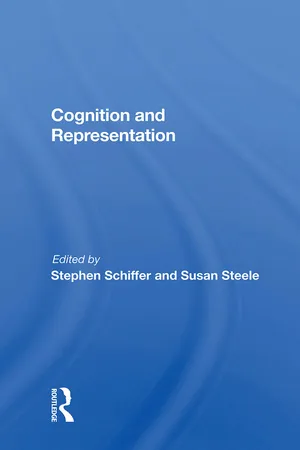
Cognition And Representation
About this book
This book is a result of a Cognitive Science program conducted to identify some of the leading issues and approaches that dominate in cognitive science research. The discussion is organized under four groups: psychological theories, mental representation, cognitive development, and semantic theory.
Information
PART ONE The Nature and Content of Psychological Theories
DOI: 10.4324/9780429042553-2
1 Wide Functionalism
DOI: 10.4324/9780429042553-3
Gilbert Harman
Psychological explanation is a kind of functional explanation1 in the way that some biological explanation is. We explain the maintenance of bodily functions by appeal to processes involving heart, blood, lungs, arteries, veins, nerves, brain, stomach, and other organs. Organs are defined by their function, not their shape or physical constitution. A heart is an organ that pumps a creature’s blood: it need not be any particular shape, nor does it have to be made from any particular material, as long as it serves that function. Similarly, psychological events and states can be physically realized in different ways in different creatures, as long as they play the relevant functional role in those creature’s psychology. Pain is not be identified with a particular physical event, such as the stimulation of C-fibers, because other sorts of physical event might function as pain does, for example, as a kind of alarm system indicating that something wrong is going on at a particular place in the organism. (See Place 1956.) Beliefs and desires have distinctive functions, beliefs recording information about the world, desires specifying the goals of the system. Both sorts of states can be physically realized in various ways, perhaps even as states of intelligent machines.
I claim that psychological explanations are typically wide functional explanations. That is, I claim that such explanations typically appeal to an actual or possible environmental situation of the creature whose activity is being explained. A narrow functional explanation appeals only to internal states of the creature and says nothing about how the creature functions in relation to an actual or possible environment. I claim that there are few (if any) narrowly functional psychological explanations of this latter sort.
In arguing for this, I disagree with Jerry Fodor 1980 and others who hold that the relevant psychological explanations are always narrow functional explanations.
I begin with a short history of the issue. Then I say why most psychological explanations are wide functional explanations. Finally I indicate why twin-earth arguments do not show that all such explanations must be narrowly functional.
HISTORY OF THE ISSUE
Functionalism emerged from a behaviorism which identified psychological states and events with dispositions to respond in an appropriate way to appropriate stimuli, where a stimulus was usually conceived as a perceivable aspect of the environment and a response was usually identified with behavior appropriately affecting the environment. (See e.g. Morris 1946.) Such dispositions were "functionally" defined in the sense that they were compatible with various physical bases for the relevant stimulus/-response relations. Since stimulus and response were usually defined partly in terms of events in the environment, behavioristic theories tended to be instances of wide functionalism.
Nonbehavioristic functionalism allows psychological explanations appealing to internal states and events that mediate perceptual input and behavioral output. Many versions of nonbehavioristic behaviorism retained the wide functionalism characteristic of behaviorism by continuing to conceive of the relation between perceptual inputs and behavioral outputs in terms of actual or possible environmental occurrences.
For example, in 1954 Wilfrid Sellars argued that we can think of the relevant intervening states and events as analogous to linguistic acts. He distinguished three sorts of functional "transitions" involving mental states and events -- entry transitions from events outside the system to states and events of the system, exit transitions from states and events in the system to outside events, and purely internal transitions between states and events of the system. The entry transitions represented the influence of perception on the system, the exit transitions represented the influence of the system on action, and the purely internal transitions represented inferences. All transitions were to be governed by rules of a Mentalese language game that a person has been conditioned to follow. Rules for entry into the system and exit from it referred explicitly to the environment. For example, a person might be conditioned to think, "That’s red," on seeing something red under standard conditions or a person might be conditioned to interpose a pawn on having the thought, "I shall interpose my pawn now!" (See Sellars 1954 and 1963:321-358.)
Fifteen years later in 1969 Daniel Dennett argued that psychological explanation is explanation within an "Intentional system" and "for any system to be called Intentional it must be capable of discriminating and reacting to fairly complex features of its environment." For example, an animal has thoughts about food only if the perception of food under certain conditions can lead it to act appropriately toward the food, by eating it. (See Dennett 1969:72-73.) In 1973 I endorsed this claim of Dennett’s and remarked on the way in which the attribution of psychological states makes implicit reference to a "normal case". (I observed that the point applies also to representational states of artificial devices such as a radar aimer used for shooting at enemy planes). I also argued that animals’ mental representations must in part represent the satisfaction of their needs by means of appropriate behavior, so "those representations involve representation of a public world."
In 1976 Jonathan Bennett argued in elegant detail that the only likely strategy for explicating psychological notions like belief and desire takes the following form.2 We must start with the notion of a teleological system. Such a system has an associated goal. To say that the system has such a goal is to say that the laws or principles of the system are such that it does what it can to ensure that the goal is secured.
Next, we need to observe that a system may or may not "register" certain information in its environment concerning what changes are needed in the environment to achieve its goals. The system will not do what is needed to ensure that its goal is secured unless it registers the information that this is needed to ensure that the goal is secured. To say that the system can register such information is to say that there are states of the system (1) that arise from the environment’s being such that a certain action is needed in order to achieve the system’s goal and (2) that lead the system to act in the required way.
Finally, we need to consider further complications. For example, a system will make mistakes when a state that normally would register a certain environmental situation is caused in an abnormal way and the system might therefore act in ways that will not satisfy its goals but would if the environment were as the system takes it to be. A system can have more than one goal at a time. And so on. Bennett argues that a system has states that are more and more like beliefs and desires as these and other complications are allowed for.
For our purposes, we can ignore the complications. What concerns us is Bennett’s claim that psychological notions ultimately must be understood by appeal to concepts of teleology and registration that make reference to an actual or possible environment.
Robert Stalnaker 1984 has recently defended a similar account using a notion of "indication" that resembles Bennett’s "registration". Stalnaker stresses that such an account presupposes a notion of "normal conditions." The perceptual belief that P is a state that occurs under normal conditions only if it true that P.3 And other writers have advocated similar ideas with varying emphases. For example, Fred Dretske’s theory (Dretske 1981) places stress mostly on the input or information side.
On the other hand, several writers have opted for a narrower functionalism. In 1960 W.V. Quine advocated a narrow behaviorism that identified a stimulus with a pattern of stimulation of sensory nerves. In a series of papers shortly afterward, Hilary Putnam 1960, 1964, 1967a, and 1967b argued for a nonbehavioristic narrow functionalism, which identified systems of mental states first with something like Turing machines possessing paper tape input and output and then, more realistically, with probabilistic automata possessing "motor outputs and sensory inputs."
Putnam soon abandoned this narrow functionalism because of its commitment to what he called "methodological solipsism." According to Putnam 1975:220, "When traditional philosophers talked about psychological states or ’mental’ states), they made an assumption which we may call the assumption of methodological solipsism. This assumption is the assumption that no psychological state, properly so called, presupposes the existence of any individual other than the subject to whom that state is ascribed... This assumption is pretty explicit in Descartes, but it is implicit in just about the whole of traditional philosophical psychology." Putnam then rejected methodological solipsism with the enigmatic remark that "the three centuries of failure of mentalistic psychology is tremendous evidence against this procedure in my opinion."
Jerry Fodor 1981 commented, "I suppose this is intended to include everybody from Locke and Kant to Freud and Chomsky. I should have such failures." Fodor suggested that Putnam himself had provided an argument for methodological solipsism, roughly, the notorious twin-earth argument to be considered below. For that and other reasons Fodor claimed that mental states and processes are "computational", where computational operations are both symbolic and formal, "symbolic because they are defined over representations and ... formal because they apply to representation in virtue of (roughly) the syntax of the representations... Formal operations are the ones that are specified without reference to such semantic properties of representations as, for example, truth, reference, and meaning" (1981:226-227). The upshot is a narrowly functionalistic psychology.
Acceptance of methodological solipsism has led several writers to advocate so called "two-level" theories of meaning. These theories attempt to give an account of meaning by combining "conceptual role semantics" with a specification of conditions of truth and reference. Conceptual role semantics holds that the content of mental representations is partly or wholly determined by the functional role the representations play in the perception-inference-action language game of thought. The theory takes different forms depending on whether functional role is conceived widely or narrowly. Those who conceive functional role widely (Sellars 1954, Harman 1973 and 1987) argue that meaning can be identified with functional role. Other writers suppose that functional role must be conceived narrowly and therefore cannot account for all of the content of mental states. These writers include Hartry Field 1977, Brian Loar 1981, Stephen Schiffer 1981, and William G. Lycan 1984.
CONSIDERATIONS FAVORING WIDE FUNCTIONALISM
Wide functionalism is more plausible on its face than narrow functionalism. Ordinary psychological explanations are not confined to reports of inner states and processes. They often refer to what people perceive of the world and what changes they make to the world. Although some ordinary explanations refer to sensory input and some refer to motor output -- a hallucination, an attempt to move that fails -- even in these cases there is normally implicit reference to a possible environment. A hallucination of a pink elephant is a hallucination of something in the environment. An unsuccessful attempt to pick up the telephone is an attempt to move something in the environment. Furthermore, the explanation of someone’s reaction to a hallucination is normally parasitic on explanations of how people react to veridical perception. And, explaining why someone made an unsuccessful attempt to do something is normally parasitic on explanations of successful action.4
Consider the hand-eye coordination involved in drawing a picture. This involves a complex interplay between perception and action. What is done next depends on the perception of what has been done so far as well as the perception of hand and pencil. No explanation of what the agent is doing can avoid reference to the effects the agent’s act has on the world and the agent’s perception of these effects.
Functional explanations in perceptual psychology often appeal to relations between sense organs and the environment, for example, when certain systems of neurons in the eye are identified as "edge detectors." The relevant explanation appeals to facts about edges in the external world, in particular, facts about the way light is differentially reflected to the eye from differently oriented surfaces that meet in an edge.
In Psychological Explanation Jerry Fodor (pp. 111-119) compares psychological explanation to automotive explanation. If we explain how an automobile works by appealing to valve-lifter, carburator, throttle, brakes, speedometer, and so forth, we appeal to parts of the automobile that are functionally defined. For present purposes it is useful to notice that some of these parts have a relatively internal function within the system, for example, the valve lifter and the carburator, whereas others have a function in relation to things outside the system, for example, the brakes are used to stop the automobile, and the speedometer functions to indicate to the driver what the speed is. This parallels the psychological case, in which edge detectors have a function in relation to external things and pain has a more internal function.
Functional explanations of automobiles and of people require the wide view. You do not understand what an automobile is and how it functions if you know only its internal operation independently of the fact that automobiles are vehicles that travel on roads to get people from one place to another, that the accelerator is pressed in order to make the car move, that the brake pedal is pressed in order to stop the car, that the gearshift is moved to a certain position in order to put the car "into reverse" so that it goes "backwards", and so forth. Similarly, you do not understand how people operate psychologically unless you see how their mental states are related to perception of the environment and to action. You do not understand what is going on in the eye unless you understand that the eye is an organ of perception, that certain systems of neurons in the eye function as edge detectors, and so on. If you understand only the uninterpreted program indicating the flow of information or energy in the system without saying what information is flowing, then you do not understand what is going on in the eye or in the brain.
Consider the following uninterpreted program: there are three possible input states, A, B, and C. A leads to output X and C leads to output Y; B has no effect. Do you understand what is going on? No. You need to know how this system is functioning. In fact, the system is a thermostatically controlled airconditioner. A is normally the result of a temperature greater than 72 degrees Farenheit. B is normally the result of a temperature between 68 and 72 degrees. C is normally the result of a temperature below 68 degrees. The output signal X turns on the airconditioner, if it is not already on. Otherwise it leaves it on. The output of Y turns off the airconditioner if i...
Table of contents
- Cover
- Half Title
- Title
- Copyright
- Contents
- List of Contributors
- Introduction
- PART 1 THE NATURE AND CONTENT OF PSYCHOLOGICAL THEORIES
- 1. Wide Functionalism
- 2. Cognition and Causality
- PART 2 MENTAL REPRESENTATION
- 3. Compositionality and Typicality
- 4. The Role of Spatial Representations in Complex Problem Solving
- 5. Perceptual Representations: Meaning and Truth Conditions
- PART 3 COGNITIVE DEVELOPMENT
- 6. Cognitive Development in Childhood
- 7. Formal and Substantive Features of Language Acquisition: Reflections on the Subset Principle and Parametric Variation
- PART 4 SEMANTIC THEORY
- 8. Semantics and Semantic Competence
- 9. Sources and Structures of Linguistic Prominence in English
- References
Trusted by 375,005 students
Access to over 1.5 million titles for a fair monthly price.
Study more efficiently using our study tools.
Frequently asked questions
Yes, you can cancel anytime from the Subscription tab in your account settings on the Perlego website. Your subscription will stay active until the end of your current billing period. Learn how to cancel your subscription
No, books cannot be downloaded as external files, such as PDFs, for use outside of Perlego. However, you can download books within the Perlego app for offline reading on mobile or tablet. Learn how to download books offline
Perlego offers two plans: Essential and Complete
- Essential is ideal for learners and professionals who enjoy exploring a wide range of subjects. Access the Essential Library with 800,000+ trusted titles and best-sellers across business, personal growth, and the humanities. Includes unlimited reading time and Standard Read Aloud voice.
- Complete: Perfect for advanced learners and researchers needing full, unrestricted access. Unlock 1.5M+ books across hundreds of subjects, including academic and specialized titles. The Complete Plan also includes advanced features like Premium Read Aloud and Research Assistant.
We are an online textbook subscription service, where you can get access to an entire online library for less than the price of a single book per month. With over 1.5 million books across 990+ topics, we’ve got you covered! Learn about our mission
Look out for the read-aloud symbol on your next book to see if you can listen to it. The read-aloud tool reads text aloud for you, highlighting the text as it is being read. You can pause it, speed it up and slow it down. Learn more about Read Aloud
Yes! You can use the Perlego app on both iOS and Android devices to read anytime, anywhere — even offline. Perfect for commutes or when you’re on the go.
Please note we cannot support devices running on iOS 13 and Android 7 or earlier. Learn more about using the app
Please note we cannot support devices running on iOS 13 and Android 7 or earlier. Learn more about using the app
Yes, you can access Cognition And Representation by Stephen Schiffer,Susan Steele in PDF and/or ePUB format, as well as other popular books in Philosophy & Philosophy History & Theory. We have over 1.5 million books available in our catalogue for you to explore.