A study reconstructed through a wide range of ancient sources, from histories to documentary papyri and inscriptions to archaeological finds.
The Ptolemaic Dynasty ruled Egypt and much of the eastern Mediterranean basin for nearly 300 years. As a Macedonian dynasty, they derived much of their legitimacy from military activity. As an Egyptian dynasty, they derived much of their real wealth and power from maintaining a secure hold on their new homeland. As lords of a far-flung empire, they maintained much of their authority through garrisons and the threat of military action. To achieve this they devoted much of their activity to the development and maintenance of a large army and navy.
This work focuses on the period of the first four Ptolemies, from the acquisition of Egypt after the death of Alexander the Great to the great battle of Raphia more than a century later. It offers a study of the Ptolemaic army as an institution, and of its military operations, both reconstructed through a wide range of ancient sources, from histories to documentary papyri and inscriptions to archaeological finds. It examines the reasons for Ptolemaic successes and failures, the causes and nature of military change and reform, and the particular details of the Ptolemaic army's soldier classes, unit organization, equipment, tactics, and the Ptolemaic state's strategy to compile a military history of the golden age of one of the classical world's significant forces.
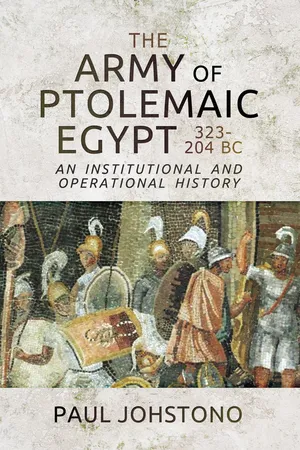
eBook - ePub
The Army of Ptolemaic Egypt 323–204 BC
An Institutional and Operational History
- 320 pages
- English
- ePUB (mobile friendly)
- Available on iOS & Android
eBook - ePub
About this book
Information
Chapter 1
The Ptolemaic Army at Raphia
A Brief Institutional History
The aforementioned Battle of Raphia was among the largest engagements in all of ancient history and a decisive victory for the Ptolemaic army. Fought in 217 BC, it assured the Ptolemaic recovery of the kingdom’s province of ‘Syria and Phoenicia’, that stretched from the area around Gaza in the south to the Dekapolis region in the Transjordan to the east, and around Tripolis in Phoenicia, the northern end of the Bekaa and probably Damascus in the Syrian plain. This chapter is not so much a discussion of the battle or the larger Fourth Syrian War, both of which shall be treated in more detail later in this book. In a study of the Ptolemaic army, the surprising thing is that, in spite of nearly 300 years of military campaigns and numerous significant engagements, Raphia is the only battle for which we possess a detailed breakdown of the Ptolemaic army. Polybius’ ‘autopsy’ of the Ptolemaic army in Book 5, chapter 65, of his Histories contains more detail than all the other descriptions combined. In reconstructing the structures of the Ptolemaic army – the regular units, national units, elite units, infantry, cavalry and mercenaries, settlers, reservists, allies and professionals – no other narrative account can come remotely close to what is offered in Polybius 5.65 and 5.82.
The singularity of the Raphia account for the history of the Ptolemaic army is an artefact of the contingency of source preservation. Only a few fragments survive from the histories of the third century BC, and of Polybius’ surviving books, none contain what were surely at least similarly detailed descriptions of the Ptolemaic forces at the battles of Panion in 200 BC or Kasios and Pelusium in 169 BC. By comparison, three detailed descriptions survive for the Seleucid army and six for the Antigonid army. On the other hand, the documentary evidence from Egypt, especially from papyri, makes it possible to flesh out Polybius’ description of the Ptolemaic army at Raphia in ways that surpass the many descriptions of the other kingdoms’ armies. The purpose of this chapter is to examine the army as described in Polybius, using documentary evidence in places to supplement, correct and extend the information from the eminent Hellenistic historian.
Let us begin with the two passages in question. Polybius described the Ptolemaic preparations for war as a massive military reform, but the documentary evidence reveals that narrative to be deeply problematic. In fact, the army at Raphia, apart from a couple of elements – chiefly the Egyptian phalanx – would have been much the same army if it had marched from Egypt a decade earlier. Aside from the reform narrative, the two passages describe, first, the various contingents of the army as it coalesced in Egypt, and second, their positions in the battle line at Raphia:
‘Eurylochos of Magnesia commanded a body of about three thousand men known as the Royal Agema, Sokrates the Boeotian had under him two thousand peltasts, [3] Phoxidas the Achaean, Ptolemaios the son of Thraseas, and Andromachos of Aspendos exercised together in one body the phalanx and the Greek mercenaries, [4] the phalanx twenty-five thousand strong being under the command of Andromachos and Ptolemaios and the mercenaries, numbering eight thousand, under that of Phoxidas. [5] Polykrates undertook the training of the Royal Cavalry, about seven hundred strong, and the cavalry from Egypt and Libya; all of whom, numbering about three thousand, were under his command. [6] It was Echekrates the Thessalian who trained most admirably the cavalry from Greece and all the mercenary cavalry, and thus rendered most signal service in the battle itself, [7] and Knopias of Allaria too was second to none in the attention he paid to the force under him composed of three thousand Cretans, one thousand being Neocretans whom he placed under the command of Philon of Cnossus. [8] They also armed in the Macedonian fashion three thousand Libyans under the command of Ammonios of Barce. [9] The total native Egyptian force consisted of about twenty thousand heavy-armed men, and was commanded by Sosibios, [10] and they had also collected a force of Thracians and Gauls, about four thousand of them from among settlers in Egypt and their descendants, and two thousand lately raised elsewhere. These were commanded by Dionysios the Thracian.’ (Polybius, Histories 5.65)
‘[1] The kings, after remaining encamped opposite each other for five days, both resolved to decide matters by a battle. [2] The moment that Ptolemy began to move his army out of camp, Antiochus followed his example. Both of them placed the phalanxes of the picked troops armed in the Macedonian fashion confronting each other in the centre. [3] Ptolemy’s two wings were formed as follows. Polykrates with his cavalry held the extreme left wing, [4] and between him and the phalanx stood first the Cretans, next the cavalry, then the Royal Agema, then the peltasts under Sokrates, these latter being next those Libyans who were armed in the Macedonian manner. [5] On the extreme right wing was Echekrates with his cavalry, and on his left stood Gauls and Thracians, [6] and next them was Phoxidas with his Greek mercenaries in immediate contact with the Egyptian phalanx. [7] Of the elephants forty were posted on the left where Ptolemy himself was about to fight, and the remaining thirty-three in front of the mercenary cavalry on the right wing.’ (Polybius, Histories 5.82)
The Left Wing
The 3,000 cavalry on the left wing represent two groups. The first, the palace squadron (or ‘cavalry around the palace’), numbered 700, and they held the far left. The number 700 is an unusual total for a royal squadron. Alexander’s royal squadron was probably about 200 strong at the start of his campaign, and was eventually increased to 300. Several of the Successors fielded similar numbers, and in Hellenistic Macedonia the Antigonid kings several times led royal squadrons 300 or 400 strong. Documentary sources partially resolve the odd size of the palace cavalry: this body of 700 cavalrymen was not one elite unit, but several elite cavalry units brigaded together. Some of the units are known because of their settlement zones in Middle Egypt; others are known from members of the units active at Alexandria or in the countryside. Some of the attested elite cavalry were in the cavalry peri Aulēn (‘at the palace’) or in the ‘royal squadron’, Basilikē ilē, and the cavalry unit called the Archaion Agema (the ‘veteran guards’) seems to require that there was also an Agema, or ‘Guards’ squadron to feed the ranks of the veterans. The veterans may have functioned as a reserve unit, even in wartime. This surmise is possible because in the middle of the Third Syrian War, the hipparch (cavalry commander) of the Archaion Agema was still in Egypt while much of the army was in Asia (P.Cair.Zen. 3.59347). The Palace Squadron, the Royal Squadron and the Guard Squadron – three distinct units – probably comprised the whole 700 at Raphia. Narrative sources referred to a unit of ‘bodyguards’, or somatophylakes; whether these were identical with the whole unit or one of its components is unclear.1 Perhaps one – which is impossible to say – was 300 strong, and the other two about 200 apiece. At least some of them were cleruchs, since neighbourhoods of the Herakleopolite nome, a province of Middle Egypt just above (or south of) Memphis, were named Agema, Peri Aulēn and Archaioi (although this latter name may not have appeared until the middle of the second century BC). Many guard cavalrymen whose names survive were Alexandrian citizens. Even as cleruchs, their elite status probably afforded them the means to live at Alexandria part of the year, and at least some of them were posted to the palace as part of the royal guard.
They, like most of the cavalry at Raphia, probably fought in the fashion of Argead Macedonian cavalry, with finely wrought armour protecting their chests, helmets in Boeotian or other cavalry styles, a xyston thrusting spear about 12ft long and a cavalry sabre (see plate 2 fig. 2, plate 11 fig. 19). Some may have worn greaves for leg protection; others may have worn boots. Their tactical disposition probably reflected the existence of three distinct units, although Polybius offered no details on that sort of thing in his account. It is easiest to imagine the three units, and 700-rider brigade, in a simple linear formation. If Polycrates of Argos, who commanded at Raphia, was a poor battlefield leader, then that is a possibility. Linear cavalry phalanxes probably became more common with the rise of cataphract cavalry, who relied on mass, but few if any of the Ptolemaic elites would have been so heavily armoured. Instead of a linear formation, the Ptolemaic guard cavalry may have used a wedge formation, more like the classical dispositions of Alexander and his successors. The 300-rider unit probably anchored the elite squadrons in its own linear formation, perhaps five or ten ranks deep with sixty or thirty files. If the Ptolemies were using the classical cavalry dispositions, the other two units screened the anchor unit to their front and to their outside (left) flank. This formation would be sensible for a less aggressive or even defensive battle plan, and we know that Antiochus was the real aggressor on the field. The unit arrayed on the front may have formed up in wedge formation, with the unit leaders stepping off ahead of file leaders to create a chevron wedge. More likely, the four individual platoons (called ilai) within the unit formed their own wedges of fifty to sixty men, arrayed much like bowling pins, permitting individual unit commanders within the elite unit to lead their men as necessary. Platoon wedges would also have permitted the screening contingent to wheel about more easily as they initiated combat. The unit on the flank was probably formed up in a sort of column, with multiple squared platoons in column or an oblique line. The purpose of both screening units was to blunt or break up a determined charge by the Seleucid cavalry, while giving the anchor unit opportunity to respond into gaps or charge across the whole front against a more vulnerable Seleucid formation.
Alongside the 700 palace cavalry were 2,300 cavalry, whom Polybius described as those from Libya and the ‘enchorioi cavalry’, that is, the cavalry from Egypt. Polybius’ word choice could be misleading; enchoric things are ‘native’, so many commentators on Polybius’ account have identified these cavalry as Egyptians. But in that passage (5.64–65), Polybius was building a contrast between Greek soldiers and officers recently arrived from the Greek world, in whom ‘Hellenic martial ardour’ was still alive (5.64.5), and the Greek inhabitants of Egypt, who in his view had gone native and lost their martial spirit. For that reason, it seems most likely Polybius was actually describing cleruch cavalry. The documentary record reinforces this interpretation: there is little or no evidence for Egyptian cavalry throughout the third century, but there is abundant evidence for far more than 700 cavalry cleruchs, and the vast majority of those attested were not in units of the royal guard. The cavalry cleruchs were a landed aristocracy in Egypt. They controlled estates that were three to four times larger than the allotments given to infantry, equivalent to 50–70 acres of land. Many owned houses in the country on or near the allotment plus houses or apartments in nome (province) capitals or the big cities of Egypt like Memphis and Alexandria. By the time of Raphia, there were no less than twelve hipparchies of cleruch cavalry in Ptolemaic Egypt, and probably more, although they were not all at full strength.2 These, plus additional cavalry from the Cyrenaica in Libya, likely comprised the whole of the 2,300 heavy cavalry posted to the left wing.
The organization of the hipparchies, and the manpower they represented, merits a little more discussion. Cavalry units were created from smaller units that doubled until reaching the size of the hipparchy, or of even larger units. Cavalry units may have, at different times, used a base file of varying depths, from five to eight or more. Thus a standard cavalry company (ilē) numbered fifty to sixty-four troopers. Either way, four of these companies formed a hipparchy, led by a hipparch, with 200–256 men. Thus, ten or more cleruch hipparchies in Egypt represented theoretical strength of at least 2,000 cavalrymen, and probably more like 2,500. This comes to about the right order of magnitude for the force at Raphia. Nine hipparhcies of 256 men comes to almost exactly 2,300 troopers. At least one of the hipparchies was probably from the Cyrenaica region, which might suggest there were eight cleruch hipparchies settled in Egypt. These were probably the cleruchs called the hekatontarouroi hippeis, or 100-aroura cavalry, in the documentary evidence. Five hipparchies of these troops had all or most of their settlements in the Fayum basin, just west of the Nile, and at least two additional hipparchies had lands in the provinces just east and south-east of the Fayum basin in the Nile valley, the Herakleopolite and Oxyrhynchite nomes.
Most of the regular cavalry would have fought in the traditional Macedonian style, but it is possible that several of the hipparchies had, by Raphia, been re-equipped as shielded cavalry (see plate 9 fig. 16). If any were, they were probably the five new ‘ethnic hipparchies’, which were only formed in the late 230s BC. They were named for different national groups – Macedonians, Thessalians, Thracians, Mysians and Persians – but there is no evidence their personnel or armament were matched to those peoples. Mounted use of a fairly large round or oval shield became popular among Italians and Gauls in the fourth century, and grew in popularity among Greek and Macedonian troopers throughout the third century. Units formed in the 230s and 220s BC may have reflected the broad adoption of shielded cavalry across much of the Mediterranean.3 If so, they probably carried two or more types of cavalry shield. One popular cavalry shield was very similar to the Greek hoplite’s aspis in initial appearance, but was flatter and assuredly lighter. Another popular cavalry shield was the cavalryman’s thureos. The thureos was a flat shield, usually oval or sub-rectangular in shape, with a prominent spine running up the front. They were held at the centre of the spine, like the Roman scutum, which was itself an innovation upon the standard thureos design. The cavalry thureos, however, was usually round rather than oval, and could be quite large. It was popularized in southern Italy and became very common across the Mediterranean world by the late third century. The use of a cavalry shield did not compel a cavalryman to fight in a particular style. Ptolemaic shielded cavalry may have still carried a xyston lance, or a shorter spear like the hoplite’s dory, more nimble and manageable for a rider holding reins and a shield in their other hand. It is also possible they carried javelins or dual-use spears (lonchai). They may have tended to wear somewhat lighter armour as well. By comparison, we know from papyri that several troopers in the regular hipparchies went about purchasing cataphract gear prior to the war, including cheires, laminated armour for a rider’s arms, which would have been unnecessary if they carried shields. If the ethnic hipparchies were the only shielded cavalry, then most or all of the left-wing cavalry were unshielded, because the ethnic hipparchies were understaffed and may have been placed on the right wing. At the battle, these 2,300 cavalry were posted right of the Cretans and palace cavalry units, but left of the guard infantry.
The Cretans, 3,000 strong, filled in the space between the two cavalry formations. The Cretans were arguably the most famous mercenary people of the Hellenistic age. Some 2,500 Cretans were in the Seleucid army at Raphia, and at least a few thousand more were serving in other armies at the same time. Of those at Raphia, 1,000 were so-called ‘Neo-Cretans’, organized and trained separately from the regular Cretans. The meaning of the term has stymied interpreters, because Polybius and those in his day clearly knew what it meant and so never explained it. There are several possible interpretations, and it is difficult to get further than presenting them. First, the Neo-Cretans could have been from a particular class of the Cretan population or from particular cities on Crete, comparable perhaps to the Spartan Neodamodeis.4 Second, they could have been Cretans carrying a non-traditional set of equipment.5 By tradition, Cretans were archers, but they also had a penchant for close-quarter combat. A painted stele dedicated to a deceased Cretan mercenary, Chalkokedes of Lyttos, found at Demetrias in Thessaly, shows the Cretan accompanied by a servant carrying his gear.6 Chalkokedes carried his own bow and wore a helmet, but the servant carried a curious oval shield of small size, a curved dagger and a pair of javelins. It seems plausible that the standard Cretan mercenary carried bow, javelins, light shield and short sword anyway, but it is possible the terminology of ‘Neo-Cretans’ distinguished the peltast armament from that of the archers. Finally, the Neo-Cretans may not have been Cretans at all, but other soldiers armed and trained like Cretans.7 This last interpretation fails, for at Magnesia in 190 BC, Antiochus III’s Neo-Cretans were posted next to Cilicians and Carians armed like Neo-Cretans. Surely, if Neo-Cretans were non-Cretans armed like Cretans, there would be no point distinguishing the Neo-Cretans from the Cilicians and Carians. Some of the Cretans in the Ptolemaic army at Raphia may have been military settlers (at least one Cretan infantry cleruch is attested in the documentary record), but many or most would have been mercenaries. About 1,000 Cretans served in the Alexandrian garrison (Plb 5.36.4) and others served elsewhere in the Ptolemaic empire, l...
Table of contents
- Cover
- Title
- Copyright
- Contents
- Acknowledgements
- List of Plates
- Introduction
- Maps
- Chapter 1: The Ptolemaic Army at Raphia
- Chapter 2: Ptolemy the Satrap, Ptolemy the King
- Chapter 3: The Antigonid Wars, 315–285 BC
- Chapter 4: Origins of Soldiers in the Ptolemaic Army
- Chapter 5: The Age of Midas, Part I
- Chapter 6: The Age of Midas, Part II
- Chapter 7: Ptolemy III and the Third Syrian War
- Chapter 8: Ptolemy III and the Purported Decline of the Ptolemaic Army
- Chapter 9: The Fourth Syrian War and the Battle of Raphia
- Conclusions
- Notes
- Bibliography
- Plate Section
Trusted by 375,005 students
Access to over 1.5 million titles for a fair monthly price.
Study more efficiently using our study tools.
Frequently asked questions
Yes, you can cancel anytime from the Subscription tab in your account settings on the Perlego website. Your subscription will stay active until the end of your current billing period. Learn how to cancel your subscription
No, books cannot be downloaded as external files, such as PDFs, for use outside of Perlego. However, you can download books within the Perlego app for offline reading on mobile or tablet. Learn how to download books offline
Perlego offers two plans: Essential and Complete
- Essential is ideal for learners and professionals who enjoy exploring a wide range of subjects. Access the Essential Library with 800,000+ trusted titles and best-sellers across business, personal growth, and the humanities. Includes unlimited reading time and Standard Read Aloud voice.
- Complete: Perfect for advanced learners and researchers needing full, unrestricted access. Unlock 1.5M+ books across hundreds of subjects, including academic and specialized titles. The Complete Plan also includes advanced features like Premium Read Aloud and Research Assistant.
We are an online textbook subscription service, where you can get access to an entire online library for less than the price of a single book per month. With over 1.5 million books across 990+ topics, we’ve got you covered! Learn about our mission
Look out for the read-aloud symbol on your next book to see if you can listen to it. The read-aloud tool reads text aloud for you, highlighting the text as it is being read. You can pause it, speed it up and slow it down. Learn more about Read Aloud
Yes! You can use the Perlego app on both iOS and Android devices to read anytime, anywhere — even offline. Perfect for commutes or when you’re on the go.
Please note we cannot support devices running on iOS 13 and Android 7 or earlier. Learn more about using the app
Please note we cannot support devices running on iOS 13 and Android 7 or earlier. Learn more about using the app
Yes, you can access The Army of Ptolemaic Egypt 323–204 BC by Paul Johstono in PDF and/or ePUB format, as well as other popular books in History & Egyptian Ancient History. We have over 1.5 million books available in our catalogue for you to explore.