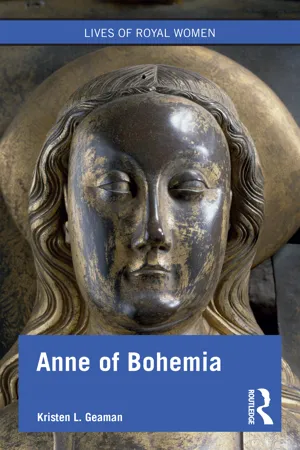
Anne of Bohemia had many distinguished forebears. She was descended from several of the premier dynasties in eastern and central Europe, including the Lithuanian Gediminids, the Polish Piasts, the Czech Přemyslids, and the Luxembourgs. Although the British monarchy is today the world’s most famous, in the fourteenth century, Anne, daughter of an emperor and descendant of the saintly Přemyslid lineage, had more cachet. This chapter gives a brief overview of the political and cultural achievements of Anne’s father, Emperor Charles IV, and her elder half brother Wenceslas IV, who ultimately negotiated Anne’s English marriage. Once the marriage treaty was signed, Anne slowly traveled across central Europe before arriving in England in mid-December 1381.
Although the terms of Anne and Richard’s marriage were somewhat unconventional – Anne brought no dowry and the political alliance did not materialize – the marriage was still a major diplomatic undertaking. The union brought together two adherents of Pope Urban VI, the Roman side in the Western Schism, while also introducing new cultural and artistic influences to the English court.
Bohemia and the Empire
Although Anne’s father, Charles IV, was the first king of Bohemia to become Holy Roman emperor, Bohemia had long been part of the empire’s orbit. The Přemyslid family had ruled the area around Prague as far back as the ninth century, and the East Frankish king recognized them as dukes in 871. The most famous Přemyslid Duke of Bohemia was Wenceslas I (r. 921–935), who was assassinated and then hailed as a saint and martyr. He was, and remains, a potent symbol for Bohemia and the Czech Republic more broadly. Charles IV honored St. Wenceslas with the beautiful St. Wenceslas Chapel in St. Vitus Cathedral.
The first Přemyslid to hold the title king of Bohemia, as granted by the Holy Roman emperor, was Vratislav I in 1085, but the title was not hereditary until the reign of Ottokar I (1198–1230), who received this honor for supporting the victorious imperial candidate in a civil war. Before the ascension of Anne’s family, the Luxembourgs, the emperor did not hold any lands in Bohemia and generally did not visit, but the kingdom’s main bishoprics were tied to the imperial archbishopric of Mainz for centuries. In addition, many German speakers migrated to Bohemia, often settling in towns where they were skilled laborers and burghers. It was Charles IV who pulled Bohemia fully into the empire, yet he also elevated the kingdom, ensuring Prague became an independent archdiocese in 1344, increasing his family’s hereditary lands at the expense of imperial lands to ensure the continued dominance of the Bohemian king and incorporating the Bohemian crown lands so they could not be divided among male heirs and reduce Bohemia’s power.
The first Luxembourg king of Bohemia was John, Anne’s paternal grandfather, who owed his position both to the extinction of the male line of the Přemyslid dynasty and to the election of his father, Henry VII, Count of Luxembourg, as king of the Romans in November 1308. The Luxembourgs’ new prominence in the empire made them an attractive alliance in the eyes of the Bohemian elite, particularly the Cistercian abbots of Sedlec and Zbraslav, who asked Henry VII to marry his son to Elisabeth Přemyslid. Henry initially resisted and suggested his younger brother, but the Bohemians insisted on John, who was now royalty. Henry agreed, and the 18-year-old Přemyslid princess married 14-year-old John of Luxembourg at Speyer on September 1, 1310. The couple subsequently returned to Bohemia, achieved victory over a competing claimant in December 1310, and were crowned king and queen of Bohemia on February 7, 1311.1
Charles IV and Elisabeth of Pomerania
The future emperor was born in Prague on May 14, 1316, and was initially named Wenceslas, no doubt after his ancestors on his mother’s side. John sent his son Wenceslas, then age seven, to the French court, where he changed his name to Charles at his 1323 confirmation, after his godfather the king. Shortly thereafter, he was betrothed to his first wife, Blanche of Valois (1316–1348), a cousin of the French king. When the male Capetian line died out, Charles’s much older brother-in-law became Philip VI (b. 1293, r. 1328–1350), the first Valois king of France.
During his time at the French court, Charles studied with the cleric Pierre de Rosiers, who later became Pope Clement VI (1342–1352). This connection was instrumental in ensuring that Prague was raised to an archbishopric, free of the control of the archbishop of Mainz, in 1344. In 1331, at the age of 15, Charles met his father in Italy; however, John soon left, and Charles was in charge in northern Italy for two years, returning to Bohemia in late 1333. With John still elsewhere, Charles now ruled in Bohemia. Under the title Margrave of Moravia, Charles worked to restore royal power and regain mortgaged castles. Although Charles essentially ruled with his father, things were not always smooth. His autobiography relates that in 1335, advisors drove a wedge between him and John by playing up how John was foreign while Charles was half Přemyslid. In 1341, though, John designated Charles as heir and had him rule Bohemia from 1342 to 1344 during the king’s absence. In mid-1346, Charles was elected king of the Romans in opposition to Lewis the Bavarian, who died of a stroke in October 1347, after which Charles secured the loyalty of the rest of the empire. After John’s death, fighting for the French, and against Richard II’s father, at the battle of Crécy in August 1346, Charles became king of Bohemia. He was crowned emperor in Rome in 1355.2
Charles IV was known for his diplomatic skill and was much less warlike than his father, which is an interesting parallel with Richard II and his warrior father and grandfather. Some of Richard’s court protocol mimicked that of Charles IV (see Chapter 4), although Charles was obviously a more successful monarch than his son-in-law. The emperor’s political acumen is on full display with his marriages and continued territorial gains. Although his first marriage, to Blanche of Valois, was arranged for him in childhood, it continued the Luxembourgs’ alliance with France. After Blanche’s death, Charles used his second and third marriages to expand Bohemian territory. John of Luxembourg had added Upper Lusatia and most of Silesia, while Charles added much of the Upper Palatinate and the last Silesian dukedom. Charles married Anne of Bavaria (1329–1353), of the Wittelsbachs, his major imperial rivals, in 1349. Anne’s father, Rudolf II, was Duke of Bavaria and Count Palatine of the Rhine, and the union gave Charles territory around Nuremberg. In May 1353, Charles married his third wife, Anna of Schweidnitz (1339–1362), obtaining the Silesian duchies of Schweidnitz and Jauer.3 Although his final marriage, to Anne of Bohemia’s mother, did not bring him territory, it did bring the possibility of the Polish crown.
Charles also purchased territory outright. In 1353, he bought Hoenstein, Hersbruch, Auerbach, Reicheneck, and Velden. He also paid £26,000 for Alun, Henbach, Luterberg, and Rosenstein in 1360. In 1370, he purchased Lower Lusatia and later Brandenburg for 400,000 florins for his younger sons Sigismund and John. Many of these places, such as Upper and Lower Lusatia, became part of the Bohemian Crown, a “superpersonal union of lands” that created a “specific, permanent territorial extent” that kept the lands together and connected to the office of the king of Bohemia rather than Charles personally.4 Charles also set about securing thrones for his sons. In 1363, Wenceslas was crowned king of Bohemia to ensure his succession, and in 1376, he was crowned king of the Romans. Charles betrothed his son Sigismund to Mary, one of the daughters of Louis the Great, king of Hungary. Sigismund and Mary were supposed to rule Poland, but Sigismund ultimately became king of Hungary and later king of Bohemia as Wenceslas’s heir. Charles worked assiduously to increase his family’s wealth and prestige, which meant Anne’s marriage connected her husband to prominent continental rulers.
Another of Charles’s notable political successes was the Golden Bull of 1356. This document established how the king of the Romans was to be elected, and its procedures were followed for over 400 years. The bull established the seven imperial electors (the archbishops of Cologne, Mainz, and Trier; the king of Bohemia; the Margrave of Brandenburg; the Count Palatinate of the Rhine; and the Duke of Saxony-Wittenberg) and stated that only four votes out of seven were needed to elect the king. In addition, the electoral territories could not be divided, ensuring that only one person would inherit and voting rights would not expand. The Golden Bull left two of Charles’s major rivals, the Habsburgs and the Bavarian Wittelsbachs, without votes, a testament to his diplomatic skills.5
Charles IV dealt with many of the same problems his forebears had, including the relationship of king and nobility. Czech nobles held their land freely and occupied the highest government posts, which provided them with substantial power. The king of Bohemia, however, had profitable silver mines, mints, customs, revenues from towns and monasteries, and the support of religious leaders and establishments as a bulwark to his power. Sometimes Charles had to retreat, as he did in 1355 when noble opposition forced him to withdraw his pro-royal law code, the “Maiestas Carolina.” Other times, such as when he defeated the 1356 rebellion led by the powerful noble Rožmberk family, Charles was in the ascendant. During his reign, Charles also did a fine job of balancing the interests of both the ethnic Czechs and Germans in his kingdom. The towns had been largely German in population (and the nobility Czech), although the Czech percentage of burghers increased after the plague.6 Skillfully balancing these various interests increased stability in the kingdom.
Not everything about Charles’s reign was an unqualified success. During the initial wave of the plague, he did nothing to protect his Jewish subjects from harm. He granted preemptive pardons to the burghers and knights of several German cities, including Nuremberg, allowed them to dispose of Jewish property, and even canceled debts owed to Jewish people after the massacres.7 Such behavior might seem at odds with Charles’s other accomplishments, but it serves as a reminder of the widespread anti-Semitism in medieval Europe. Near the end of his reign, problems in the mining industry led to a decline in silver exports and devaluing of coinage. Costs of goods rose. Charles also failed to establish Prague as a major destination for long-distance trade. Prague was not located along any of the already-established trade routes, and German trading towns resisted changes that would have negatively impacted them.8 These economic difficulties would become more evident in the reign of Wenceslas.
Charles was an active king until the end. In 1377–1378, he traveled with his son Wenceslas to Paris for a diplomatic summit with Charles V. At the end of the year, on Sunday, November 29, 1378, Charles died, probably from pneumonia brought about after a fall from a horse, at the age of 63. His funeral began on December 11 and finished with a requiem mass on December 15. He was buried in St. Vitus Cathedral.9
Anne’s mother, Elisabeth of Pomerania, was born in late 1346. After her mother’s death in 1361, Elisabeth and her younger brother lived at the Polish court. She married Charles at Krakow on May 21, 1363, in the presence of her grandfather, Casimir the Great, king of Poland, and probably her father, Bogisław V, Duke of Pomerania. She was crowned queen of Bohemia in Prague on June 18 of the same year. Like Charles’s previous marriages, this one was political. In 1362, a dispute among Charles, Louis of Hungary, and Rudolph Habsburg of Austria almost caused a war. The papacy stepped in to help, achieving a ceasefire, while the potential combatants agreed to have Casimir the Great arbitrate a final settlement. Charles married Elisabeth before the settlement was concluded, although the marriage surely supported the settlement: Elisabeth, granddaughter of Casimir, was also related to Louis of Hungary. Not only did Charles’s marriage solve this particular diplomatic problem, but it also set him up (in the long term) for a potential claim to the Polish throne. For his part, Casimir probably also hoped to enlist the emperor as an ally for Poland against the Teutonic Knights.
From her base in Prague, Elisabeth traveled a great deal, both with Charles and alone. She traveled to Italy with Charles in 1368–1369 (although the two were often separated once they arrived), and she was crowned empress on November 1, 1368, in Rome. She traveled with him to Aachen, Cologne, and Koblenz in 1372; to Lübeck in 1375; to Aachen again in 1376 for Wenceslas’s coronation as king of the Romans; and in 1374 and 1377 to Tangermünde, among other cities. The empress also traveled alone to Magdeburg in 1377 and Dortmund in 1378. After Charles’s death, Elisabeth spent most of her time at her dower castle of Hradec Králové (Königgrätz), where she lived as a Franciscan tertiary. She died on February 13, 1393, and was buried at St. Vitus Cathedral.10
Anne thus grew up in a pious and well-connected family, with a diplomatically perceptive father. She learned the politics of mediation and was later able to assist her husband, Richard II, as he pursued a less warlike course of action. Anne’s political and cultural heritage, detailed in this chapter, prepared her well for her role as England’s queen.