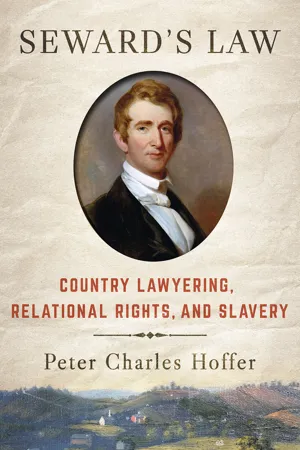
In Seward's Law, Peter Charles Hoffer argues that William H. Seward's legal practice in Auburn, New York, informed his theory of relational rights—a theory that demonstrated how the country could end slavery and establish a practical form of justice. This theory, Hoffer demonstrates, had ties to Seward's career as a country lawyer. Despite his rise to prominence, and indeed preeminence, as a US secretary of state, Seward's country-lawyer mentality endured throughout his life, as evinced in his personal attitudes and professional conduct.
Relational rights, identified and termed here for the first time by Hoffer, are communal and reciprocal, what everyone owed to every other member of their community. Such rights are at the center of a jurisprudential outlook that arises directly from living in a village. Though Seward was limited by the Victorian mores and the racialist presumptions of his day, the concept of relational rights that animated him was the natural antithesis to the theories and practices of slavery. In the legal regime underpinning the institution, masters owed nothing to their bondmen and women, while those enslaved unconditionally owed life and labor to their masters. The irrepressible conflict was, for Seward, jurisprudential as well as moral and political.
Hoffer's leading assumption in Seward's Law is that a lifetime spent as a lawyer influences how a person responds to everyday challenges. Seward remained a country lawyer at heart, and that fact defined the course of his political career.
- 228 pages
- English
- ePUB (mobile friendly)
- Available on iOS & Android
eBook - ePub
About this book
Information
Publisher
Cornell University PressYear
2023Print ISBN
9781501767333
9781501767333
eBook ISBN
9781501767357
Table of contents
- Introduction
- 1. “There Is No Law of This State Which Recognizes Slavery”
- 2. “Harboring and Concealing a Weary and Fainting Slave”
- 3. “There Is a Higher Law Than the Constitution”
- 4. “An Irrepressible Conflict between Opposing and Enduring Forces”
- 5. “I Am to Engage in Conducting a War against a Portion of the American People”
- 6. “To the Arbitrament of Courts of Law and to the Councils of Legislation”
- 7. “The Union Has Been Rescued from All Its Perils”
- Conclusion
- Acknowledgments
- Notes
- Index
Trusted by 375,005 students
Access to over 1.5 million titles for a fair monthly price.
Study more efficiently using our study tools.
Frequently asked questions
Yes, you can cancel anytime from the Subscription tab in your account settings on the Perlego website. Your subscription will stay active until the end of your current billing period. Learn how to cancel your subscription
No, books cannot be downloaded as external files, such as PDFs, for use outside of Perlego. However, you can download books within the Perlego app for offline reading on mobile or tablet. Learn how to download books offline
Perlego offers two plans: Essential and Complete
- Essential is ideal for learners and professionals who enjoy exploring a wide range of subjects. Access the Essential Library with 800,000+ trusted titles and best-sellers across business, personal growth, and the humanities. Includes unlimited reading time and Standard Read Aloud voice.
- Complete: Perfect for advanced learners and researchers needing full, unrestricted access. Unlock 1.5M+ books across hundreds of subjects, including academic and specialized titles. The Complete Plan also includes advanced features like Premium Read Aloud and Research Assistant.
We are an online textbook subscription service, where you can get access to an entire online library for less than the price of a single book per month. With over 1.5 million books across 990+ topics, we’ve got you covered! Learn about our mission
Look out for the read-aloud symbol on your next book to see if you can listen to it. The read-aloud tool reads text aloud for you, highlighting the text as it is being read. You can pause it, speed it up and slow it down. Learn more about Read Aloud
Yes! You can use the Perlego app on both iOS and Android devices to read anytime, anywhere — even offline. Perfect for commutes or when you’re on the go.
Please note we cannot support devices running on iOS 13 and Android 7 or earlier. Learn more about using the app
Please note we cannot support devices running on iOS 13 and Android 7 or earlier. Learn more about using the app
Yes, you can access Seward's Law by Peter Charles Hoffer in PDF and/or ePUB format, as well as other popular books in History & American Civil War History. We have over 1.5 million books available in our catalogue for you to explore.