eBook - ePub
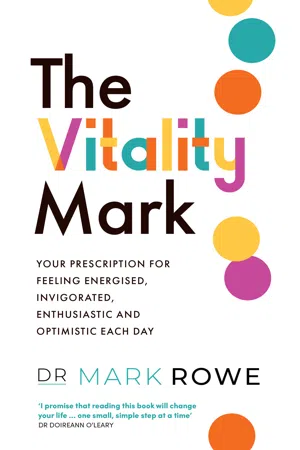
The Vitality Mark
Your prescription for feeling energised, invigorated, enthusiastic and optimistic each day
- 320 pages
- English
- ePUB (mobile friendly)
- Available on iOS & Android
eBook - ePub
The Vitality Mark
Your prescription for feeling energised, invigorated, enthusiastic and optimistic each day
About this book
How can we live with more vitality? How can we wake up each morning feeling optimistic, invigorated and enthusiastic about the day ahead?
Through his work as a lifestyle-medicine practitioner and practising GP, Dr Mark Rowe understands how our physical, mental, emotional and spiritual wellbeing all interconnect and impact on our health and ability to stay well. Balancing each of these elements forms the essence of vitality or 'the VitalityMark', as Dr Rowe has come to define it.
This book can help you identify potential gaps in your wellbeing and offers a prescription of evidence-based strategies that will guide you from intention to action. By sharing insights from more than 25 years of helping others, Dr Rowe will direct you, too, towards health-enhancing habits to boost your energy, build resilience and better recharge from stress.
Learn how the science of lifestyle medicine can transform the quality of your life and those of the people you love. Learn to live with more vitality.
Information
SECTION FOUR
The Mind of
Vitality
Vitality
The mind of vitality is resilient, focused and less prone to distraction. By taking a strength-based approach to life, you will learn to reframe your past experiences for growth and new perspectives. In this section I hope to help you see stress not as a threat to be thwarted or a symbol of superior capacity, but as something to be embraced. Recognising the importance of regular, restorative recharge from stress, you will actively engage with mindful practices to embrace present-moment awareness. And the mind of vitality never stops learning and growing. Small positive changes, consistently applied over time, can lead to big results.
Mindful presence
‘You have power over your mind,
Not outside events.
Realise this, and you will find strength.’
MARCUS AURELIUS
Mindfulness has its origins in Buddhism, where the term sati (meaning attention, awareness and being present without judgement) was considered a first step towards enlightenment. Once viewed with suspicion, as a proxy promise for peace and tranquillity delivered from the depths of Buddhist temples, the practice has gained widespread acceptance in the Western world, thanks in large part to Jon Kabat-Zinn’s mindfulness-based stress-reduction programmes at Massachusetts Medical School. In parallel, the scientific community has seen exponential growth in research studies showing quantum benefits when it comes to mindfulness and health – mental and emotional as well as physical.
THE SCIENCE OF PRESENCE
The ability to sit still and be fully present has never been more challenging, given the fast-paced nature of the modern world, with so much choice, clickbait and constant opportunity for digital distraction.
Noise pollution, particularly from urban living, increases the risk of high blood pressure, heart disease and can damage your hearing. So many people are experiencing information overload – data smog – from a mind-boggling array of sensory inputs – from the endless 24/7 news cycle to ever-present digital devices. All of this ‘noise’ leads to more toxic stress, mental fatigue, distraction, diminished focus and willpower.
I call this the SPAM mind – Syndrome of the Partially Attentive Mind – the sense that something ‘out there’ or ‘in here’ is always more interesting than what is right in front of you. Symptoms of the SPAM mind include mindless eating, forgetting someone’s name as soon as you hear it, losing your keys, phone or credit card. Being so distracted by something that you forget to do something important right now. You get up in the morning and questions flood your brain as you grapple with an array of emails and social media notifications. What will I wear? What fires do I need to put out first at work? What will I eat first? This paradox of excess choice was eloquently articulated by Confucius, who wrote that the man who chases many rabbits catches none. So many people are submerged in a world that is always on, distracted by the era of obsessive hyperconnectivity, which contributes to the epidemic of anxiety and heightens the intensity of the stress response.
The SPAM mind is heightened by distraction and overload from digital devices, with a potential detrimental impact on your mental health. I call them potential weapons of mass distraction, leading to a deficit in attention from a constant ping in your inbox. Distraction keeps you chained to the shallow surface of the mind. Research suggests that as the brain grows dependent on phone technology, the intellect can weaken. I recall a senior executive recently admitting to me a compulsion to check his Twitter notifications in the midst of team leadership meetings! He’s clearly not alone, as recent Ofcom UK research found that people on average:

The smartphone is a really powerful psychoactive substance, providing variable rewards with neurobiological reinforcement via the activation of dopamine pathways in your prefrontal cortex. This dopamine release can trigger feelings of compulsion and addiction. Time distortion, disinhibition, ease of access and perceived anonymity all combine to provide a perfect tool for digital distraction.
With many competing demands for your attention and energy, there is an inevitable tendency to multitask. Stanford University research has found that multitasking is often counterproductive, in that trying to do many things at once often means doing next to nothing at all44. Multitasking is perhaps better termed ‘switch tasking’, as your brain switches attention rapidly from one task to the next. The brain’s bandwidth of active cognitive capacity is limited to dealing with just a few chunks of data at any one time (seven chunks, in fact, plus or minus two). Rapid switching over and back, from one task to the next, burns valuable brain energy and may reduce brain efficiency by up to 40 per cent.
Research has found that you are likely to experience upwards of 6,000 (mostly negative) thoughts today, with many of these the same thoughts as those you had yesterday (and the day before)45. At any given moment, your brain can receive about 11 million pieces of information, while you are only consciously aware of about 50 of them. The electrochemical pathways in your brain deliver thoughts seconds ahead of you becoming consciously aware of them.
While you have many thoughts each day, you are not your thoughts. Thoughts come and go like leaves in the wind. Just as you can’t control what leaves blow into your garden, you can’t control your thoughts. But you can choose to rake and weed your garden, just as you can choose what thoughts to focus your attentive awareness on. The trouble with all these thoughts is you can believe they are true, leading to depressive ruminations, feelings of anxiety and toxic stress. Rather than the present, you tend to focus on the past (regret, setbacks, disappointments) and future (stress, worry and anxiety) in the endless movie that is your life.
Not being able to quieten these thoughts at night can lead to disrupted sleep, where you are tired but wired. Furthermore, you may end up spending most of your time literally living in your own head. This ‘merry-go-mind’ craves distraction. So, when smartphones arrived, digital dependency from the SPAM mind met the magnetic attraction of the digital device.
This was a lesson well learned by me in late 2013, when I was taking night-time refuge in my mobile phone. So much distraction, so many apps a mere fingertip away. Of course, the alarm clock function was just the perfect excuse to bring it to bed, where last-minute emails could be drafted or read. First thing in the morning, I was straight onto the news (almost invariably bad news) and emails, before I even got out of bed. As I began to apply the techniques of mindfulness in my own life, it was far easier to understand that phones late at night just didn’t cut the mustard. Of course, learning more about the emerging science of sleep and the deleterious impact of blue wavelength light was a great help. No more late-night technology – I began to park the phone safely in its docking station in the kitchen at an appropriate wind-down time. The results: my sleep quality improved, I felt sharper, better able to focus my attention, less anxious and less stressed. This one simple positive habit change had a cascading overall benefit.
Research from Harvard Medical School on the area of neuroplasticity has found that an eight-week mindfulness programme can begin to ‘rewire’ your brain. Specifically, the brain volume and grey matter increase in the hippocampus (an area of the brain involved in learning, memory storage, spatial orientation and encoding emotional context from the amygdalae) and the temporoparietal junction (an area involved in empathy and compassion). Furthermore, the density of the amygdala decreases, reducing the tendency to react to toxic stress (less fight or flight).
THE BENEFITS OF PRESENCE
Mindful presence allows you to break the connection between past and future while opening up the potential of the present moment. Mindful presence enables you to see things as they really are, to tune in and appreciate your senses, to be fully present, here and now in this moment as you are reading this.
Imagine a jam jar filled with water. Take a large spoon of dirt, put it into the jar, put the lid back on and give the jar a good shake. The jar of water symbolises the mind, while the cloudiness and moving pieces of dirt represent your ‘merry-go-mind’ of noise, distraction and everyday challenging life events. Now, place the jar on a table and wait for the dirt to settle at the bottom. The settled jar represents mindful presence, as you rest in awareness with a newfound freedom to experience reality as it really is. You see the whole picture with more clarity: the clear water as well as the mud at the bottom.
Mindfulness is this awareness tha...
Table of contents
- Cover
- Title Page
- Contents
- Foreword
- Introduction
- Section One: The Heart of Vitality
- Section Two: The Body of Vitality
- Section Three: The Soul of Vitality
- Section Four: The Mind of Vitality
- Conclusion: Vitality – a new vital sign
- Endnotes
- Acknowledgements
- Copyright
- About the Author
- About Gill Books
Trusted by 375,005 students
Access to over 1.5 million titles for a fair monthly price.
Study more efficiently using our study tools.
Frequently asked questions
Yes, you can cancel anytime from the Subscription tab in your account settings on the Perlego website. Your subscription will stay active until the end of your current billing period. Learn how to cancel your subscription
No, books cannot be downloaded as external files, such as PDFs, for use outside of Perlego. However, you can download books within the Perlego app for offline reading on mobile or tablet. Learn how to download books offline
Perlego offers two plans: Essential and Complete
- Essential is ideal for learners and professionals who enjoy exploring a wide range of subjects. Access the Essential Library with 800,000+ trusted titles and best-sellers across business, personal growth, and the humanities. Includes unlimited reading time and Standard Read Aloud voice.
- Complete: Perfect for advanced learners and researchers needing full, unrestricted access. Unlock 1.5M+ books across hundreds of subjects, including academic and specialized titles. The Complete Plan also includes advanced features like Premium Read Aloud and Research Assistant.
We are an online textbook subscription service, where you can get access to an entire online library for less than the price of a single book per month. With over 1.5 million books across 990+ topics, we’ve got you covered! Learn about our mission
Look out for the read-aloud symbol on your next book to see if you can listen to it. The read-aloud tool reads text aloud for you, highlighting the text as it is being read. You can pause it, speed it up and slow it down. Learn more about Read Aloud
Yes! You can use the Perlego app on both iOS and Android devices to read anytime, anywhere — even offline. Perfect for commutes or when you’re on the go.
Please note we cannot support devices running on iOS 13 and Android 7 or earlier. Learn more about using the app
Please note we cannot support devices running on iOS 13 and Android 7 or earlier. Learn more about using the app
Yes, you can access The Vitality Mark by Mark Rowe in PDF and/or ePUB format, as well as other popular books in Desarrollo personal & Medicina alternativa y complementaria. We have over 1.5 million books available in our catalogue for you to explore.