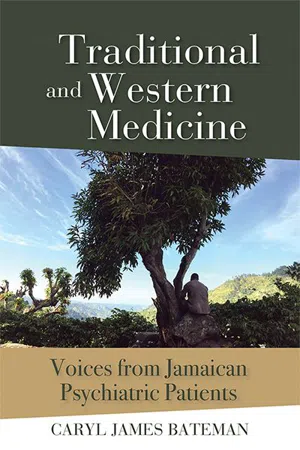
Traditional and Western Medicine: Voices from Jamaican Psychiatric Patients is for anyone interested in broadening their perspective on alternative treatment models, particularly the use of traditional methods alongside Western biomedical techniques. Caryl James Bateman critiques the tensions that exist between conventional approaches in psychiatric treatment and highlights how these may interfere with patients' views, especially those patients who have endemic beliefs in spiritual influences on health and traditional cures and rituals, often originating from African teachings. Through the stories of six former patients who, despite receiving Western biomedical treatment, conceptualize their illness using a traditional viewpoint, James Bateman empowers the patients to tell their own stories of their personal journeys and share their lived experiences of mental illness, giving the reader a rare first-hand account of what lies beyond the label of a psychiatric diagnosis.
eBook - ePub
Traditional and Western Medicine
Voices from Jamaican Psychiatric Patients
- English
- ePUB (mobile friendly)
- Available on iOS & Android
eBook - ePub
About this book
Information
Print ISBN
9789766408459
Table of contents
- Cover Page
- Title Page
- Copyright Page
- Contents
- List of Figures
- Introduction
- 1 The Context of This Study
- 2 Patients’ and Practitioners’ Worldviews
- 3 The Approach I Used to Hear My Participants
- 4 “May I Speak to You?”: Openness and Understanding
- 5 Intersubjective Truths
- 6 Meeting the Participant, Not the Diagnosis
- References
- Index
Trusted by 375,005 students
Access to over 1.5 million titles for a fair monthly price.
Study more efficiently using our study tools.