eBook - ePub
Computational Intelligence and Data Sciences
Paradigms in Biomedical Engineering
- 272 pages
- English
- ePUB (mobile friendly)
- Available on iOS & Android
eBook - ePub
Computational Intelligence and Data Sciences
Paradigms in Biomedical Engineering
About this book
This book presents futuristic trends in computational intelligence including algorithms as applicable to different application domains in health informatics covering bio-medical, bioinformatics, and biological sciences. Latest evolutionary approaches to solve optimization problems under biomedical engineering field are discussed. It provides conceptual framework with a focus on application of computational intelligence techniques in the domain of biomedical engineering and health informatics including real-time issues.
Information
1 Performance of Diverse Machine Learning Algorithms for Heart Disease Prognosis
Dhruv Kaliraman, Gauri Kamath, Suchitra Khoje, and Prajakta Pardeshi
MIT WPU
DOI: 10.1201/9781003224068-1
Contents
- 1.1 Introduction
- 1.2 Literature Review
- 1.3 Materials and Methods
- 1.3.1 Data
- 1.3.2 Outlier Detection
- 1.3.3 Data Preprocessing
- 1.3.4 Dimensionality Reduction
- 1.3.5 Ensemble Methods of Machine Learning
- 1.4 Proposed Approach for the Classification Model
- 1.4.1 Logistic Regression
- 1.4.2 Random Forest
- 1.4.3 Gradient Boosting
- 1.4.4 Extra-Trees Classifier
- 1.4.5 AdaBoost
- 1.4.6 MLP
- 1.4.7 Decision Tree Classifier
- 1.5 Results
- 1.6 Conclusions
- References
1.1 Introduction
Heart failure is the prime cause of death. It is one of the most chronic illnesses, and it can lead to disabilities and pose financial problems to patients. As per World Health Organization records, 17.5 million individuals die every year from cardiovascular disease [1]. The prognosis of heart disease is challenging for doctors as some of the symptoms experienced can be related to other illnesses or may be indicators of aging [2]. When the arteries of the heart lose the ability to transport blood that is rich in oxygen, heart disease is likely to occur. A common cause is plaque buildup in the lining of larger coronary arteries. It may partially or entirely block the blood flow in the heart’s large arteries. This condition may occur as a result of an illness or accident that changes the way the heart arteries function [3]. Electrocardiogram (ECG), Holter screening, echocardiogram, stress examination, cardiac catheterization, cardiac computerized tomography (CT) scan, and cardiac magnetic resonance imaging are some of the medical tests that doctors and experts run to detect cardiovascular disease [4].
Diagnosis is a difficult, and critical process must be completed correctly and quickly. The availability of high-quality treatments at reasonable prices is a major concern for healthcare organizations such as hospitals and emergency centers [5]. However, if the coronary disease is diagnosed early enough, it can be successfully treated by a combination of dietary modifications, medical treatments, and surgical procedures [3]. The complications of heart disease can be decreased, and the heart’s rhythm can be increased with the proper therapy [6].
Factors: After a lot of research, experts have classified the risk factors that can cause heart disease into two categories: risk factors that can be controlled and managed, and risk factors that will remain unaffected even after the treatment. Risk factors that don’t have a scope of improvement include family background, ethnicity, and age. High levels of blood pressure, cholesterol, frequent alcohol intake, and physical inactivity are all risk factors that can be controlled to a certain extent. Hypertension is a condition that can harm the blood arteries, making it a highly likely risk factor for heart disease. Blood arteries may be damaged by high blood pressure. Tobacco consumption of any type increases the risk of CVD. Chemicals used to prepare tobacco products too have detrimental effects on the blood vessels. When high levels of cholesterol are detected in the body, heart disease is most likely to occur. Obesity or being overweight raises the risk of heart failure as well [7]. The precise timing of disease diagnosis determines the extent to which the disease can be controlled. The proposed research aims to diagnose these heart conditions early to prevent catastrophic effects [8].
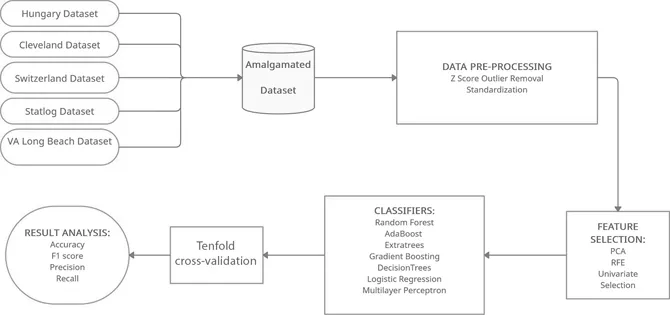
Health researchers have produced a vast collection of medical evidence that can be analyzed, and useful information can be extracted from it. Data mining techniques are methods for retrieving useful information from vast amounts of data [9]. Large networks of data in a medical database are discrete [10]. As a consequence, making decisions based on discrete data becomes a daunting challenge. Machine learning (ML), a subfield of data mining, excels at handling massive, well-formatted, normalized datasets. ML is a tool that can be used to diagnose, track, and forecast different diseases in the medical field [11]. The goal is to make the process easier and to deliver successful care to patients while avoiding serious repercussions [12]. The role of ML in detecting hidden discrete patterns and analyzing the data is critical. Following data processing and dimensionality reduction, ML methods aid in the early detection and speedy diagnosis of heart disease. This chapter aims at testing the efficacy and the potential of numerous ML and deep learning [13] techniques for predicting cardiac disease at an early level (Figure 1.1).
1.2 Literature Review
Bayu and Sun [14] suggested a new method to build a double-tier ensemble. Random forest, gradient boosting, and extreme gradient boosting were the three ensemble learners that were merged with the help of a stacked architecture. To determine which feature set was the most important for each dataset, a particle swarm optimization-based attribute selection was performed. They also carried out a double-layered statistical test to buttress their postulations and to show that they were not based on suppositions. They also implemented tenfold cross-validation to improve their results.
Emmanuel et al. [15] aimed at implementing dimensionality reduction and a feature extraction technique by searching attributes that can cause cardiovascular disease. Phenomenal results were obtained when chi-square analysis and principal component analysis (PCA) were applied together to random forest and the accuracy that was obtained was 98.7% using Cleveland, 99.0% using Hungarian, and 99.4% using Cleveland–Hungarian datasets. According to the outcomes obtained from different models, the amalgamation of chi-square and PCA produced stronger results. The models were evaluated based on the accuracy, recall, precision, f1 ranking, Matthews correlation coefficient, and finally Cohen’s kappa coefficient.
Ludi et al. [16] focused on congestive heart failure detection that suggests an ensemble methodology and employs heart rate variability data as well as deep neural networks. The databases employed in this study were the BIDMC Congestive Heart Failure Database (BIDMC-CHF), Congestive Heart Failure RR Interval Database (CHF-RR), MIT-BIH Normal Sinus Rhythm (NSR) Database, Fantasia Database (FD), and Normal Sinus Rhythm RR Interval Database (NSR-RR). After extracting the expert features of RR intervals, a deep learning feature extraction network based on a long short-term memory convolutional neural network was built. Taking the BIDMC-CHF, NSR, and FD data, the propose...
Table of contents
- Cover
- Half Title
- Title Page
- Copyright Page
- Table of Contents
- Preface
- Acknowledgments
- Editors
- Contributors
- Chapter 1 Performance of Diverse Machine Learning Algorithms for Heart Disease Prognosis
- Chapter 2 Intelligent Ovarian Detection and Classification in Ultrasound Images Using Machine Learning Techniques
- Chapter 3 On Effective Use of Feature Engineering for Improving the Predictive Capability of Machine Learning Models
- Chapter 4 Artificial Intelligence Emergence in Disruptive Technology
- Chapter 5 An Optimal Diabetic Features-Based Intelligent System to Predict Diabetic Retinal Disease
- Chapter 6 Cross-Recurrence Quantification Analysis for Distinguishing Emotions Induced by Indian Classical Music
- Chapter 7 Pattern Recognition and Classification of Remotely Sensed Satellite Imagery
- Chapter 8 Viability of Information and Correspondence Innovation for the Improvement of Communication Abilities in the Healthcare Industry
- Chapter 9 Application of 5G/6G Smart Systems to Overcome Pandemic and Disaster Situations
- Chapter 10 Risk Perception, Risk Management, and Safety Assessments: A Review of an Explosion in the Fireworks Industry
- Chapter 11 High-Utility Itemset Mining: Fundamentals, Properties, Techniques and Research Scope
- Chapter 12 A Corpus Based Quantitative Analysis of Gurmukhi Script
- Chapter 13 An Analysis of Protein Interaction and Its Methods, Metabolite Pathway and Drug Discovery
- Chapter 14 Biosensors for Disease Diagnosis
- Index
Trusted by 375,005 students
Access to over 1.5 million titles for a fair monthly price.
Study more efficiently using our study tools.
Frequently asked questions
Yes, you can cancel anytime from the Subscription tab in your account settings on the Perlego website. Your subscription will stay active until the end of your current billing period. Learn how to cancel your subscription
No, books cannot be downloaded as external files, such as PDFs, for use outside of Perlego. However, you can download books within the Perlego app for offline reading on mobile or tablet. Learn how to download books offline
Perlego offers two plans: Essential and Complete
- Essential is ideal for learners and professionals who enjoy exploring a wide range of subjects. Access the Essential Library with 800,000+ trusted titles and best-sellers across business, personal growth, and the humanities. Includes unlimited reading time and Standard Read Aloud voice.
- Complete: Perfect for advanced learners and researchers needing full, unrestricted access. Unlock 1.5M+ books across hundreds of subjects, including academic and specialized titles. The Complete Plan also includes advanced features like Premium Read Aloud and Research Assistant.
We are an online textbook subscription service, where you can get access to an entire online library for less than the price of a single book per month. With over 1.5 million books across 990+ topics, we’ve got you covered! Learn about our mission
Look out for the read-aloud symbol on your next book to see if you can listen to it. The read-aloud tool reads text aloud for you, highlighting the text as it is being read. You can pause it, speed it up and slow it down. Learn more about Read Aloud
Yes! You can use the Perlego app on both iOS and Android devices to read anytime, anywhere — even offline. Perfect for commutes or when you’re on the go.
Please note we cannot support devices running on iOS 13 and Android 7 or earlier. Learn more about using the app
Please note we cannot support devices running on iOS 13 and Android 7 or earlier. Learn more about using the app
Yes, you can access Computational Intelligence and Data Sciences by Ayodeji Olalekan Salau, Shruti Jain, Meenakshi Sood, Ayodeji Olalekan Salau,Shruti Jain,Meenakshi Sood in PDF and/or ePUB format, as well as other popular books in Technik & Maschinenbau & Data Mining. We have over 1.5 million books available in our catalogue for you to explore.