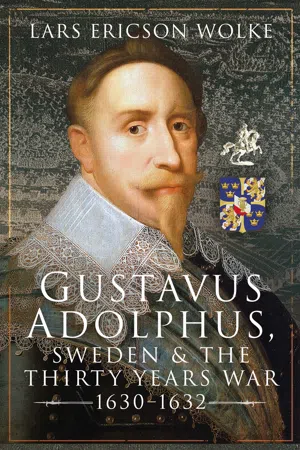
The little-known story of the Swedish king and military commander who conquered much of Germany in the early seventeenth century.
As one of the foremost military commanders of the early seventeenth century, Gustavus Adophus, king of Sweden, played a vital role in defending the Protestant cause during the Thirty Years War. In the space of two years—between 1630 and 1632—he turned the course of the war, winning a decisive victory at the Battle of Breitenfeld and conquering large parts of Germany. Yet remarkably little has been written about him in English, and no full account of his extraordinary career has been published in recent times. That is why this perceptive and scholarly study is of such value.
The book sets Gustavus in the context of Swedish and European dynastic politics and religious conflict in the early seventeenth century, and describes in detail Swedish military organization and Gustavus's reforms. His intervention in the Thirty Years War is covered in graphic detail—the decision to intervene, his alliance with France, his campaigns across the breadth of Germany, and his generalship at the two major battles he fought there.
His exceptional skill as a battlefield commander transformed the fortunes of the Protestant side in the conflict, and he had established himself as a major European figure before his death on the battlefield. Lars Ericson Wolke, one of the leading experts on the military history of the Baltic and the Thirty Years War, offers a fascinating insight into Gustavus the man and the soldier.
- 248 pages
- English
- ePUB (mobile friendly)
- Available on iOS & Android
eBook - ePub
Gustavus Adolphus, Sweden and the Thirty Years War, 1630–1632
About this book
Information
Subtopic
Military BiographiesIndex
HistoryChapter 1
Introduction
In December 1634 Charles Ogier, newly appointed as a secretary in the French embassy, arrived in Stockholm as an assistant to the new ambassador Claude de Mesmes, count d’Avaux, one of the most talented subordinates of Cardinal Richelieu. The French diplomats came as representatives of Sweden’s most important ally in the German war, but they were of course also from one of Europe’s foremost Catholic powers.
On New Year’s Eve 1634 the French delegation went to Riddarholm’s church, to pay their respects at the tomb of Gustavus Adolphus. There they were struck by the simplicity of the burial site, and by the memorial text in honour of the late king. His deeds were praised and his victories over the enemies of his kingdom – the Danes, Russians and Poles – were described. The inscription ended with the words: he ‘reigned with utmost wisdom and finally, since he had defeated the Emperor and liberated the Germans from the heresies of the Pope, suffered an heroic death as the victor at the battle of Lützen on 6 November 1632’. The French ambassador became ‘very angry’ over the words ‘liberated the Germans from the heresies of the Pope’, but when he calmed down he decided not to protest, and Ogier concluded that the text had been written not by a member of the royal family or a nobleman, but most likely by some silly schoolmaster or priest who had tried to make a name for himself by insulting the Pope.1
This small incident illustrates the complexity of Sweden’s involvement in the Thirty Years War, officially as the liberator of the German Protestants, but at the same time being allied with Catholic France. It was indeed a story of ‘my enemy’s enemy is my friend’, and it indicates the diplomatic intrigues that went on far from events on the battlefield. It also explains to some extent why Sweden became so powerful during this period and why it became involved in the Thirty Years War.
In 1561 Sweden (which then included Finland) crossed over the Gulf of Finland and took over the city of Reval (now Tallinn) and northern Estonia. For most historians this was Sweden’s first step towards an era of greatness, the creation of a Swedish Baltic Sea empire. Through the terms of a peace treaty in 1617 vast territories were absorbed from Russia and Swedish Estonia was linked to Finland via the Carelian peninsula and the province of Ingria, east of Estonia. At the same time Russia was excluded from any shore or harbour on the Baltic Sea. (This state of affairs persisted throughout the seventeenth century and the early years of the eighteenth century until the peace treaty of 1721, when the Swedish Baltic empire collapsed and the era of greatness came to an end.) Further expansion took place when in 1621 Sweden conquered Riga from Poland, as well as the land north of the Düna (Daugava) river, i.e. the southern part of today’s Estonia and the northern part of Latvia.
During this period Denmark (including Norway) remained Sweden’s arch-enemy. The two countries had fought a costly war in 1611–1613 from which Denmark emerged victorious, and it was not until the two wars of 1643–1645 and 1657–1658 that Sweden finally defeated Denmark and managed to conquer important territories from both Denmark and Norway. Until then the question of who was the ruler of the Baltic Sea remained unsettled. When seen from this perspective, Swedish involvement in the war in Germany in 1630 was not a ‘natural’ development – far from it. But both Sweden and Denmark feared the growth of the Holy Roman Emperor’s power in northern Germany; although they distrusted one another and couldn’t cooperate, both countries intervened in Germany for the same purpose, but where Denmark failed, Sweden succeeded.
This recent history had an important influence on the principal motives for Swedish involvement in the Thirty Years War. First, the prospect of a Catholic and Imperial advance towards the Baltic Sea posed a large strategic threat to Sweden. Second, the recently concluded (1629) six-year armistice with Poland had for the time being settled the situation on the Polish front, although many Swedes (not least Axel Oxenstierna, Lord High Chancellor of Sweden from 1612 until his death in 1654) feared the Poles would break off the armistice in order to support the Holy Roman Emperor. Third, the victorious peace with Russia in 1617, partly as a result of the ‘great chaos’ in Russian politics, made a Russian attack on Sweden unlikely for a number of years. Russia was the arch-enemy of Poland, and any blow against the Emperor, who was regarded in Moscow as Poland’s ally, would be supported by Russia. So the absence of a military threat from Russia (until the 1650s) was significant for Sweden. ‘All quiet on the eastern front’ was an important prerequisite for Sweden to wage war in Germany. Fourth, Denmark’s strategic interest in preventing any Imperial advance in northern Germany made Copenhagen willing to accept Swedish involvement in the German war, although the Danes never wanted Swedish power to grow from successes in Germany. There was also a fifth and highly significant factor, namely support for Sweden from Catholic France (from 1631 in terms of political and financial backing, and from 1635 with military means). This support had not been openly declared when the decision to go to war was made in Stockholm in 1629–1630, but most signals from diplomatic contacts pointed in that direction.
The Holy Roman Empire of the German Nation
Since the year 962 the Emperor ruled the Holy Roman Empire of the German Nation, one of Europe’s most populous. The Emperor was chosen by the seven Prince-Electors (Kurfürsten), but after 1438 the title was more or less de facto inherited within the Habsburg family. But in the mid-16th century the Habsburgs were split into a Spanish branch and an Austrian branch, and it was the Austrian branch that retained the dignity of Emperor. In 1806 the Empire was dissolved by order of Napoleon, and the Habsburg Emperor in Vienna continued to rule in his Austrian Empire.
In this very disintegrated German Empire there was a continual power struggle between the Emperor in Vienna and different German princes. Sometimes the political and religious contradictions were mixed. For instance, some princes in the Catholic League opposed the political influence of the Emperor, although they were religious allies.
When Emperor Matthias died in 1619 his Imperial power was weak and he lacked an army of his own. The new Emperor, Ferdinand II, thus had two goals for his reign: to strengthen the Imperial power and to support the counter-Reformation. Both goals came to a head in Bohemia and with the assistance of Maximilian of Bavaria Ferdinand crushed the uprising. Then Ferdinand began to raise an army of his own under the command of Wallenstein. Together with the army of the Catholic League under Tilly, Wallenstein advanced towards northern Germany and destroyed all resistance.
But it was not only the Protestants who feared this new development; many Catholic princes were worried by the increasing power of the Emperor. But with his military successes, Wallenstein was also regarded as a growing threat to his Imperial masters, and as the general became more and more independent he was eventually murdered on Ferdinand’s order in 1634. From then on the Imperial army was commanded by the Emperor and no one else.
When Ferdinand died in 1637 he was succeeded by his son Ferdinand III, who was also king of Bohemia and king of Hungary, as well as commander-in-chief of the Imperial army. Ferdinand III reeled between confrontation and negotiation, all in an attempt to strengthen the Imperial power in Germany. But he never achieved his goal, and finally he accepted the peace treaties in Westphalia in 1648. After thirty years of war, the only Imperial success to speak of was the Emperor’s control over Austria and the other Habsburg inheritance countries, including Bohemia. In the rest of the German Empire the Emperor’s power was weak or simply non-existent.
Had any of these main factors ceased to apply, and regardless of any ambition to gain control over trade along the estuaries of the German rivers, Swedish forces would probably not have landed on German soil in the summer of 1630. The strategic threat was the triggering factor, but the landing might still not have happened had any of the other factors not pertained. Despite the mutual strategic interest with Denmark, the Swedish participation in Germany would never have taken place without the lack of threats on the Russian and Polish fronts.
The Swedish victory at Breitenfeld in September 1631 surprised not only the Imperial and Catholic forces, but also the Swedes themselves and their potential German allies, and led to the development of more ambitious aims. It is very important to remember that later Swedish successes during the war and the nation’s territorial gains through the 1648 peace treaty were not foreseen in 1629 and 1630 and they did not influence decision-making at the time.
Chapter 2
Sweden, the Reformation and Germany1
Soon after the events in Wittenberg in 1517, when Martin Luther nailed his 95 theses to the door of All Saints’ Church, marking the beginning of the Protestant Reformation, the tide of change reached Sweden, at the time, of course, a Catholic country. By 1521 there was some sympathy for the Reformation among the German burghers in Stockholm, where a German-speaking minority is estimated to have made up some 10 per cent of the city’s 8 000–9 000 inhabitants. By the time of Gustavus Adolphus, the population of Stockholm had grown to some 20 000–25 000 people.
In 1524 the leading Swedish reformer, the priest Olaus Petri, moved from the important bishopric of Strängnäs to Stockholm. Here King Gustavus (I) Vasa granted him the right to preach in the largest city church, St Nicolai, also known as the Grand Church. At the same time the Catholic vicar of St Nicolai went abroad on an international mission, and the king replaced him with the Protestant Nicolaus Stecker from Wittenberg. It was an important development.
During a meeting of the diet in Västerås in 1527 much of the wealth of the church (especially its lands) were taken over by the crown. It was also decided that the word of God must, everywhere in the country, be preached in Swedish and not in Latin. This meeting has traditionally been regarded as ‘the Reformation diet’, but that overestimates its importance. The decisions were mainly of a financial nature rather than theological, but it was the first defeat of the Catholic church.
A long process followed that finally transformed Sweden into a Protestant country. When Gustavus Vasa was crowned in 1528 he did not, as did the medieval kings, swear to protect the might and privileges of the church, but rather to serve God’s and the people’s church. And it was Olaus Petri, not a Catholic bishop, who conducted the coronation ceremony. The new king (the grandfather of Gustavus Adolphus) was not interested in theological matters, but he was very keen to take control of the considerable wealth of the church, hence his support for the Reformation, despite harsh criticism from the leading Catholic bishops.
In 1526 the New Testament was published in Swedish, followed by a complete translation of the Bible in 1541. Gustavus Vasa also began to attack the monasteries – around 1520 there were fifty-three Catholic monasteries in Sweden (forty-two for monks and eleven for nuns). These were both important landowners and potential centres of resistance to the Reformation. Several of them were closed around 1530 and their lands were taken over by the crown. In some cases their buildings were transformed into hospitals. Others were torn down and their remains used for fortification projects. In 1549 the last monks were driven away from Sweden’s most important monastery, Saint Birgitta in Vadstena, although the nuns there were allowed to stay until the very end of the sixteenth century. In 1578 the nunnery at Nådendal in Finland (just north of Turku) was closed, leaving Saint Birgitta as the only surviving nunnery. As late as 1580 the papal nuncio Antonio Possevino visited the nuns at Vadstena and described the Birgitta monastery as ‘this flowering and isolated herb in the wilderness of heresy’.

In 1531 Olaus Petri’s brother Laurentius became the first Protestant archbishop of Sweden, despite the protests from the Catholic bishops. For obvious reasons, his appointment was not acknowledged by the Pope, and in Catholic propaganda the year 1531 was regarded as the start of ‘the Devil’s regime’ in Sweden. In 1539 Georg Norman, a German, was appointed superintendent, the highest-ranking civil servant for ecclesiastical matters apart from the king, and this decision marked the beginning in Sweden of a Protestant church ruled by a prince after the German model.
Despite widespread protests, and the large-scale armed peasant rebellion in 1542–1543, the Reformation was established and by the time Gustavus Vasa died in 1560 Sweden was regarded as a Protestant country, although large sections of the population still adhered to their ancestors’ Catholic beliefs. During the reign of King John III (1568–1592), who married a Catholic Polish princess, the process stopped and took some steps back. The king wanted to reinstate some Catholic practices, although he never intended to go back wholly to Catholicism, and even less to obey the Pope. But some new saints were reinstalled and canonised, and in 1571 a new regulation for the liturgy of the church was issued by the king. This was a compromise which half opened the door towards Catholic belief, and some observers regarded it as opening the way for a future shift back to Catholicism. One of John’s advisers was Petrus Michaelis Fecht, who had studied in Wittenberg as a pupil of Philip Melanchton, a collaborator with Martin Luther who had argued for softer, more humanistic evangelical ideals, including older (Catholic) worship manuals. In 1575 John issued the New Ordinantia, which stressed the links to the early Christian church in the first centuries AD (a central part of John’s personal theology), and reintroduced some Catholic forms of worship.
The following year John’s Liturgia Svecanae Ecclesiae was printed as the liturgical handbook of the Swedish church. This marked the culmination of John’s pro-Catholic efforts but provoked intense protests from evangelical priests who regarded the Liturgia as too Catholic. It created a deep division within the Swedish church, leading many priests to regard John III as a crypto-Catholic. A Jesuit school was opened in 1576 in the old monastery buildings in Stockholm, but in 1583/1584 the school was transferred to Protestant priests. During the 1580s many young Swedish men went abroad to study at Jesuit colleges in Rome, and also in Olmütz (Olomouc) in the Czech Republic and other places.
The theological tensions in Sweden continued to grow but in 1592 John III died. His son, the Catholic Sigismund, was already the king of Poland and now also became the king of Sweden. But a meeting in Uppsala in 1593, attended by representatives of the nobility, the priests, the burghers and the peasants, declared that Sweden was an evangelical state, and would follow the Augsburg Confession (the primary confession of faith of the Lutheran church and one of the most important documents of the Protestant Reformation). Almost 2 000 people, including priests and other important individuals, signed up to this declaration, and almost all John’s theological reforms were abolished, especially the Liturgia of 1576, which was regarded as ‘an entrance to the Pope’s gruesome aberration’. The chairman of the meeting concluded with the words: ‘Now is all Sweden becoming one man and all of us have one Lord and God.’ This point may be regarded as the culmination of the Reformation in Sweden, after some seven decades.
However, after a civil war in 1598–1599 the Catholic King Sigismund was ousted (although he remained king in Poland, his mother’s home country, until his death in 1632) and his uncle, the Calvinist Charles (IX), the father of Gustavus Adolphus, became king. Yet the danger of a Catholic backlash remained, most likely originating in the strong Catholic beliefs still common among the peasantry.
Little by little the Protestant policy hardened. In 1605 two Swedes were executed for having Catholic contacts in Prague and as late as 1624 the mayor of Södertälje (a town approximately 35km south of Stockholm) was executed for the same reason. At around the same time the city clerk of Stockholm, Eggert Matsson Aurelius, was arrested for having studied at the Catholic Jesuit College in Braunsberg (Braniewo in today’s Poland), but he was later released. In 1617 the parliament decided that the exercise of Catholic beliefs would result in the death penalty.
However, these severe punishments demonstrate that in the early seventeenth century Catholicism continued to have a strong following in Sweden, and that it was greatly feared. How widespread these beliefs were we can never tell for sure, but during the seventeenth century Sweden became one of the most orthodox Protestant countries in Europe. The rate at which Catholic beliefs decayed among ordinary Swedes is difficult to estimate, but the process began after the diet of 1527 and was still not completed in the early seventeenth cen...
Table of contents
- Cover
- Title
- Copyright
- Contents
- List of Plates
- Preface
- Timeline
- 1. Introduction
- 2. Sweden, the Reformation and Germany
- 3. The son of a usurper, Gustavus Adolphus, 1594–1611
- 4. The establishment of the new king’s rule, 1611–1621
- 5. Recruitment and tactics: the military reforms in the 1610s and 1620s
- 6. It’s all about Poland, 1621–1629
- 7. The road to the German war, 1627–1630
- 8. The bridgehead, 1630
- 9. The breakout from the bridgehead, 1630–1631
- 10. Breitenfeld, 1631: was it so decisive?
- 11. How to keep an army in Germany: diplomacy, economy and military efforts
- 12. The hakkapelites: myth and reality
- 13. Six important towns: Frankfurt, Hamburg, Mainz, Stralsund, Stettin and Wismar
- 14. The general, the soldier and the soldier’s wife: attitudes to the military
- 15. The propaganda war
- 16. The home front
- 17. The new front in southwestern Germany
- 18. Sweden and Spain meet in Germany, 1631
- 19. The consolidation of Swedish power in Mecklenburg, 1632
- 20. The operations between the Elbe and Weser, 1632
- 21. The attack on Bavaria in the spring of 1632
- 22. Sea lines of communication: naval warfare
- 23. The rush for Saxony, autumn 1632
- 24. The costs of the war
- 25. The battle at Lützen, 6 November 1632
- 26. The king’s return home and funeral
- 27. Sweden and the second half of the Thirty Years War, 1633–48
- 28. The heritage of Gustavus Adolphus: Sweden’s German provinces
- 29. From war hero to pastry: historiography and commemoration
- Appendices: Commanders, troop organisation and strengths
- Notes
- References
- Plates
Trusted by 375,005 students
Access to over 1.5 million titles for a fair monthly price.
Study more efficiently using our study tools.
Frequently asked questions
Yes, you can cancel anytime from the Subscription tab in your account settings on the Perlego website. Your subscription will stay active until the end of your current billing period. Learn how to cancel your subscription
No, books cannot be downloaded as external files, such as PDFs, for use outside of Perlego. However, you can download books within the Perlego app for offline reading on mobile or tablet. Learn how to download books offline
Perlego offers two plans: Essential and Complete
- Essential is ideal for learners and professionals who enjoy exploring a wide range of subjects. Access the Essential Library with 800,000+ trusted titles and best-sellers across business, personal growth, and the humanities. Includes unlimited reading time and Standard Read Aloud voice.
- Complete: Perfect for advanced learners and researchers needing full, unrestricted access. Unlock 1.5M+ books across hundreds of subjects, including academic and specialized titles. The Complete Plan also includes advanced features like Premium Read Aloud and Research Assistant.
We are an online textbook subscription service, where you can get access to an entire online library for less than the price of a single book per month. With over 1.5 million books across 990+ topics, we’ve got you covered! Learn about our mission
Look out for the read-aloud symbol on your next book to see if you can listen to it. The read-aloud tool reads text aloud for you, highlighting the text as it is being read. You can pause it, speed it up and slow it down. Learn more about Read Aloud
Yes! You can use the Perlego app on both iOS and Android devices to read anytime, anywhere — even offline. Perfect for commutes or when you’re on the go.
Please note we cannot support devices running on iOS 13 and Android 7 or earlier. Learn more about using the app
Please note we cannot support devices running on iOS 13 and Android 7 or earlier. Learn more about using the app
Yes, you can access Gustavus Adolphus, Sweden and the Thirty Years War, 1630–1632 by Lars Ericson Wolke in PDF and/or ePUB format, as well as other popular books in History & Military Biographies. We have over 1.5 million books available in our catalogue for you to explore.