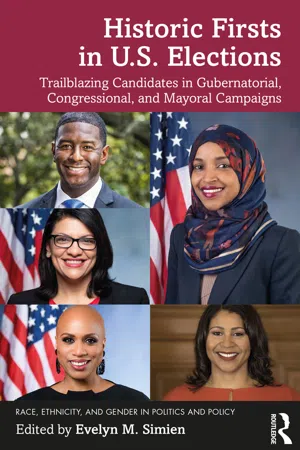
Historic Firsts in U.S. Elections:Trailblazing Candidates in Gubernatorial, Congressional, and Mayoral Campaigns examines barrier-breaking figures across various types of elective offices and constituent groups. The moment in which historic firsts enter the electoral arena, and the unique campaigns that ensue, are shown to be symbolically empowering. These change agents on the campaign trail become lighting rods for more liberal policies, and their candidacies are tied to questions of representation, electability, and performance. The distinctive combinations of race, ethnicity, and gender identities represented here translate into voter excitement to go to the polls and participate in other ways. Original chapters by respected scholars and practitioners consider how recent breakthrough elections are similar to yet different from past elections for gubernatorial, congressional, and mayoral offices. The shadow of Donald Trump's wildly unconventional U.S. presidency looms over this groundbreaking analysis, linking local to national level politics. For students of politics across the curriculum, this book expands the theoretical capacity of intersectionality research and links it to voter mobilization and electoral success.
eBook - ePub
Historic Firsts in U.S. Elections
Trailblazing Candidates in Gubernatorial, Congressional, and Mayoral Campaigns
- 128 pages
- English
- ePUB (mobile friendly)
- Available on iOS & Android
eBook - ePub
Historic Firsts in U.S. Elections
Trailblazing Candidates in Gubernatorial, Congressional, and Mayoral Campaigns
About this book
Information
1Historic Firsts in U.S. ElectionsAn Introduction
Evelyn M. Simien
DOI: 10.4324/9781003213925-1
Introduction
Do trailblazing candidates bring formerly politically inactive people into the electoral process? Historic Firsts in U.S. Elections examines barrier-breaking figures across various types of elective offices and constituent groups. At the heart of this book is a central, organizing concept—symbolic empowerment—that suggests historic firsts matter insofar as they mobilize new segments of the American electorate. The moment in which historic first candidates enter the electoral arena, and the campaigns that ensue, are described in terms of contextual effects that are symbolically empowering. The cumulative effect of their multiple identities and the historic nature of their campaigns stoke the desire to vote and participate in other ways, from attending a campaign rally and donating money to giving someone a ride to the polls, despite problems that arise in dealing with traditional opponents, from the injection of coded racial appeals or “dog whistles,” to the distortion of their legislative records and altered images in commercial ads or political cartoons (López 2015; Phoenix 2020).
The presence of a historic first candidate who mirrors a marginalized group pictorially signals greater access to electoral opportunities and motivates political behavior from the kind of voters that political analysts would describe as being on the periphery of American politics looking in, if they are following campaigns at all. These races are hard fought, and the stakes are high especially when historic first candidates unite diverse electorates and establish multiracial coalitions in opposition to conservatives who seek to suppress votes and impose ballot restrictions. Loyalty, or a sense of belonging, to the group in question facilitates the process whereby a strong affective intragroup emotion like pride results in an ego-enhancing appraisal of the event and public figure associated with a socially valued outcome—that being, in this case: the election of a historic first to public office (Lazarus 1991; Marcus, Newman, and MacKuen 2000; Parkinson, Fischer, and Manstead 2005; Finn and Glaser 2010; Sullivan 2014; Phoenix 2020; Burge 2020). They, who act as change agents on the campaign trail, emerge as lighting rods for more liberal and progressive public policies. As such, historic candidacies are inextricably tied to questions of representation, electability, and performance (Phillips 1995; Mansbridge 1999). That said, the shadow of Donald Trump’s wildly unconventional 2016 election, his first term as an American president, the 2018 congressional midterm elections, and the 2020 American presidential election loom over this groundbreaking analysis.
In the months leading up to the 2018 congressional midterm and 2020 American presidential elections, journalists wrote in anticipation of several breakthrough contests. The 2018 midterm elections were markedly different from prior ones, with the Democrats gaining a total of 41 seats in the U.S. House of Representatives and assuming control of that chamber (Brown and Cassese 2020). A record number of historic first candidates had run for and won their parties’ nomination for election to the U.S. House and Senate in 2018, and polls showed that several trailblazing candidates were running competitive gubernatorial campaigns at the same time. Many of whom aspired to become state and national leaders were diversifying American politics based on multiple axes of identity: age, race, ethnicity, sexual orientation, religion, indigeneity, etc. Twenty-four historic firsts were elected to serve as representatives in the U.S. House and Senate as well as state governors, twelve of whom were women of color (Epstein and Scott 2018; Hansen 2018; Levin and Wong 2018; Mak 2018). Still, others ran and won on the local level as city mayors. See Table 1.1 for a list of historic first candidates elected in 2018 to congressional and gubernatorial offices.
| Candidate | Political Party | History Making Firsts | Office | State | ||||
|---|---|---|---|---|---|---|---|---|
| Cindy Axne | Democratic | Female | U.S. House | IA | ||||
| Marsha Blackburn | Republican | Female | U.S. Senate | TN | ||||
| Angie Craig | Democratic | Openly lesbian | U.S. House | MN | ||||
| Sharice Davids | Democratic | Native American, openly lesbian | U.S. House | KS | ||||
| Veronica Escobar | Democratic | Latina | U.S. House | TX | ||||
| Abby Finkenauer | Democratic | Female | U.S. House | IA | ||||
| Sylvia Garcia | Democratic | Latina | U.S. House | TX | ||||
| Michele Lujan Grisham | Democratic | Latina | Governor | NM | ||||
| Lou Leon Guerrero | Democratic | Female | Governor | GU | ||||
| Deb Haaland | Democratic | Native American female | U.S. House | NM | ||||
| Jahana Hayes | Democratic | Black female | U.S. House | CT | ||||
| Cindy Hyde-Smith | Republican | Female | U.S. Senate | MS | ||||
| Janet Mills | Democratic | Female | Governor | ME | ||||
| Joseph Neguse | Democratic | Black male | U.S. House | CO | ||||
| Kristi Noem | Republican | Female | Governor | SD | ||||
| Alexandria Ocasio-Cortez | Democratic-Socialist | Youngest female | U.S. House | NY | ||||
| Ilhan Omar | Democratic-Farmer-Labor | Somali American, Muslim female | U.S. House | MN | ||||
| Chris Pappas | Democratic | Openly gay male | U.S. House | NH | ||||
| Jared Polis | Democratic | Openly gay male | Governor | CO | ||||
| Ayanna Pressley | Democratic | Black female | U.S. House | MA | ||||
| Kim Reynolds | Republican | Female | Governor | IA | ||||
| Kyrsten Sinema | Democratic | Openly bisexual female | U.S. Senate | AZ | ||||
| Rashida Tlaib | Democratic-Socialist | Palestinian-American, Muslim female | U.S. House | MI | ||||
| Lauren Underwood | Democratic | Black, female, millennial | U.S. House | IL | ||||
Note: N=24, compiled by the author based on data derived from Epstein and Scott 2018; Center for American Women and Politics (CAWP) 2018; Hansen 2018; Levin and Wong 2018; and Mak 2018. | ||||||||
Why did 2018 produce such large gains for history-making firsts? A couple of factors combined to elect more diverse candidates to public office. These factors relate to the behavior of both the candidates and the voters. Record numbers of historic first candidates ran for the U.S. House and Senate in 2018, in part because of special circumstances that motivated them to seek election from Donald Trump’s presidency and social movements #MeToo and #BlackLives Matter to the Supreme Court Justice Brett Kavanaugh’s Senate Confirmation hearings (Brown and Cassese 2020; Castle et al. 2020). Arguably, the game-changing performances of historic first candidates necessitate an ongoing, research agenda on how candidate identities [plural] mobilize new segments of the American electorate, in part due to higher voter turnout rates exhibited by women, racial and ethnic minorities, as well as younger age cohorts in recent elections.
Historic Firsts in U.S. Elections builds upon previous work by extending the symbolic empowerment framework to the Trump era, and by shifting the focus from the historic firsts of presidential campaigns—Shirley Chisholm and Jesse Jackson; Hillary Clinton and Barack Obama to recent history-making firsts of gubernatorial, congressional, and mayoral campaigns. In Historic Firsts: How Symbolic Empowerment Changes U.S. Politic...
Table of contents
- Cover
- Endorsements Page
- Half-Title Page
- Series Page
- Title Page
- Copyright Page
- Dedication
- Contents
- List of Figures and Tables
- List of Contributors
- Acknowledgments
- 1 Historic Firsts in U.S. Elections: An Introduction
- 2 Andrew Gillum’s Quest to Become Florida’s First Black Governor
- 3 Ilhan Omar: Breaking Barriers for Muslim, Somali American, and Immigrant Women
- 4 Ayanna Pressley: Change Can’t Wait
- 5 Rashida Tlaib: A Symbol and Champion for Detroit
- 6 Mayor London Breed and the Limits of Governing while Black and Female in San Francisco
- 7 Historic Firsts in U.S. Elections: A Conclusion
- Index
Trusted by 375,005 students
Access to over 1.5 million titles for a fair monthly price.
Study more efficiently using our study tools.
Frequently asked questions
Yes, you can cancel anytime from the Subscription tab in your account settings on the Perlego website. Your subscription will stay active until the end of your current billing period. Learn how to cancel your subscription
No, books cannot be downloaded as external files, such as PDFs, for use outside of Perlego. However, you can download books within the Perlego app for offline reading on mobile or tablet. Learn how to download books offline
Perlego offers two plans: Essential and Complete
- Essential is ideal for learners and professionals who enjoy exploring a wide range of subjects. Access the Essential Library with 800,000+ trusted titles and best-sellers across business, personal growth, and the humanities. Includes unlimited reading time and Standard Read Aloud voice.
- Complete: Perfect for advanced learners and researchers needing full, unrestricted access. Unlock 1.5M+ books across hundreds of subjects, including academic and specialized titles. The Complete Plan also includes advanced features like Premium Read Aloud and Research Assistant.
We are an online textbook subscription service, where you can get access to an entire online library for less than the price of a single book per month. With over 1.5 million books across 990+ topics, we’ve got you covered! Learn about our mission
Look out for the read-aloud symbol on your next book to see if you can listen to it. The read-aloud tool reads text aloud for you, highlighting the text as it is being read. You can pause it, speed it up and slow it down. Learn more about Read Aloud
Yes! You can use the Perlego app on both iOS and Android devices to read anytime, anywhere — even offline. Perfect for commutes or when you’re on the go.
Please note we cannot support devices running on iOS 13 and Android 7 or earlier. Learn more about using the app
Please note we cannot support devices running on iOS 13 and Android 7 or earlier. Learn more about using the app
Yes, you can access Historic Firsts in U.S. Elections by Evelyn M. Simien in PDF and/or ePUB format, as well as other popular books in Politics & International Relations & American Government. We have over 1.5 million books available in our catalogue for you to explore.