- 160 pages
- English
- ePUB (mobile friendly)
- Available on iOS & Android
eBook - ePub
About this book
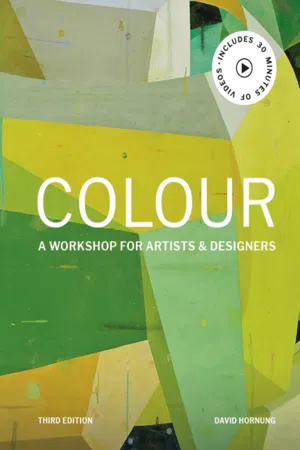
Taking a practical approach to colour, Colour: A workshop for artists and designers is an invaluable resource for art students and professionals alike. With its sequence of specially designed assignments and in-depth discussions, it effectively bridges the gap between colour theory and practice to inspire confidence and understanding in anyone working with colour. This third edition is updated with more contemporary examples drawn not just from painting, but from textiles, graphic design, illustration and animation. An expanded discussion of digital techniques, new assignments and a refreshed design have all been brought together to create a highly readable and relevant text.
Information
Topic
ArtSubtopic
Art TechniquesPART ONE SEEING COLOR

IN PART ONE YOU WILL
→ Recognize the basic mechanics of color perception.
→ Distinguish between additive and subtractive color theories.
→ Compare and contrast the RGB and CMY primary triads.
→ Discover how changing light conditions affect color.
Color is the place where our brain and the universe meet. —Paul Klee
THE VISIBLE LIGHT SPECTRUM
The perception of color is a wonder of nature that we experience involuntarily whenever we open our eyes in a lighted place. To make it happen, our retinas are lined with light-sensitive cone-shaped receptor cells that communicate with the brain via the optic nerve. Our eyes are only sensitive to a narrow range of wavelengths within the entire electromagnetic spectrum. Wavelengths are measured in nanometers (precisely one billionth of a meter), and we can only sense wavelengths between approximately 380 and 750 nanometers in width. The range of colors that we can see is known as the visible light spectrum. Just outside the VLS lie infrared and ultraviolet radiation, which are invisible to the naked eye.
The SPECTRUM is made up of color zones. Each zone is a continuum that contains all of the variations of wavelength that we associate with a particular color. Yellow, for example, extends from a warm, golden yellow to the cooler yellow of a lemon skin. But the transitions between color zones are finely graded, so the exact point at which golden yellow slips into lemon yellow is impossible to determine (fig. 1.1).
The relative wavelengths of the colors of the spectrum are indicated in the table below:
HOW WE PERCEIVE COLOR
A lemon appears lemon yellow to us because its surface molecules reflect lightwaves that pulsate at approximately 570 nm. Lightwaves that are not reflected but absorbed do not stimulate our cone cells and are not perceived as color. Figure 1.2 illustrates the concept of the full spectrum of light striking a lemon. It shows all wavelengths except those that we perceive as lemon yellow being absorbed, while the yellow wavelength is reflected to the retina and relayed to the brain.
But seeing color is actually stranger and more wonderful than that. Figure 1.3 represents the mechanics of color perception more accurately. It indicates that lightwaves do not literally contain the color yellow, or any other color. Likewise, objects, e.g., a lemon, don’t contain color, nor do inks, dyes, and other colorants. Color exists only in the brain. This illustration depicts uncolored lightwaves striking a lemon. One wavelength is selectively reflected back to the retina and passed on to the brain, which perceives the color yellow. (Yellow is perceived when the cone cells that trigger red and green are stimulated simultaneously; there are no individual yellow triggering cone cells.)


1.1 The full range of the hue yellow extends from golden yellow (leaning toward orange) to lemon yellow (leaning toward green).

1.2 Color perception of a lemon.

1.3 Another view of color perception: color exists in the brain.

1.4 The primary triad in additive color: red, green, and blue.

1.5 The primary triad in subtractive color: cyan, magenta, and yellow.
There are two distinct theories that apply to color perception: ADDITIVE, which explains color in light, and SUBTRACTIVE, which explains how color is seen when light is reflected.
Additive Color
Artists who work with lighting in interior design or in the theater rely on additive color theory. Instead of mixing pigments, they combine light. Light has three primary colors from which all other spectral colors can be achieved. They are red, green, and blue (RGB). These colors match the three kinds of cone cell that line the retina; each individual cone cell is specifically sensitive to wavelengths triggering red, green, or blue.
The combination of red and green light makes yellow, red and blue make magenta, and green and blue make cyan, so the secondary colors in additive theory are cyan, magenta, and yellow. Figure 1.4 represents the three primary and three secondary colors in light.
When you overlap two beams of colored light, the result is always brighter than both colors. Indeed, if you train red, green, and blue beams on a single spot, the result is white light. Combining colored lights creates brighter colors; therefore, light color theory is considered additive.
Subtractive Color
Subtractive color theory applies to color seen by means of reflected light. It has its own PRIMARY TRIAD: cyan, magenta, and yellow (CMY). Figure 1.5 represents the subtractive primary triad and its secondary colors: red, green, and blue.
In contrast to mixing colored light, mixing “pure” colors in pigment produces results that are darker and duller than the colors being combined. The less alike the colors being mixed, the darker the result. If you combine cyan, magenta, and yellow pigments the result will be a dark brown approaching black. (But not quite black, which is why black is added in four-color process printing.) Because mixing colored pigments subtracts luminosity, or the amount of reflected light, it is referred to as a subtractive process.
COLOR ON THE COMPUTER SCREEN
On the computer, color is lit from behind rather than reflected. Screen color appears cleaner and brighter than any printed output. Even if the hue, value, and saturation (terms examined later in this book) of a color are close, a printed version of a screen color can never truly match it. Anyone who creates images on the computer for printed output must contend with this color “translation.”
There are several ways to work with color on the screen that are presented in Adobe Photoshop as color modes. You can choose a color mode when setting up a new document or by looking under “Image” to find “Mode” on an existing image. Some available color modes are RGB, CMYK, Duotone, Lab Color, and Grayscale. Among these, RGB and CMYK are appropriate to our study of color.
The RGB color mode corresponds to the primary triad in light (red, green, and blue). It is used in imag...
Table of contents
- Cover
- Title
- Copyright
- Contents
- Foreword: Jennifer Maloney
- Introduction
- Part One: Seeing Color
- Part Two: First Principles
- Part Three: The Color Workshop
- Part Four: Beginning Color Studies
- Part Five: Color Schemes & Color Proportion
- Part Six: Color Interaction
- Part Seven: Color Harmony
- Part Eight: Applying Color Principles
- Part Nine: Color Research
- Part Ten: Color Experience & Interpretation
- Part Eleven: Free Studies
- Illustrated Glossary
- Bibliography
- Credits
- Index
Trusted by 375,005 students
Access to over 1.5 million titles for a fair monthly price.
Study more efficiently using our study tools.
Frequently asked questions
Yes, you can cancel anytime from the Subscription tab in your account settings on the Perlego website. Your subscription will stay active until the end of your current billing period. Learn how to cancel your subscription
No, books cannot be downloaded as external files, such as PDFs, for use outside of Perlego. However, you can download books within the Perlego app for offline reading on mobile or tablet. Learn how to download books offline
Perlego offers two plans: Essential and Complete
- Essential is ideal for learners and professionals who enjoy exploring a wide range of subjects. Access the Essential Library with 800,000+ trusted titles and best-sellers across business, personal growth, and the humanities. Includes unlimited reading time and Standard Read Aloud voice.
- Complete: Perfect for advanced learners and researchers needing full, unrestricted access. Unlock 1.5M+ books across hundreds of subjects, including academic and specialized titles. The Complete Plan also includes advanced features like Premium Read Aloud and Research Assistant.
We are an online textbook subscription service, where you can get access to an entire online library for less than the price of a single book per month. With over 1.5 million books across 990+ topics, we’ve got you covered! Learn about our mission
Look out for the read-aloud symbol on your next book to see if you can listen to it. The read-aloud tool reads text aloud for you, highlighting the text as it is being read. You can pause it, speed it up and slow it down. Learn more about Read Aloud
Yes! You can use the Perlego app on both iOS and Android devices to read anytime, anywhere — even offline. Perfect for commutes or when you’re on the go.
Please note we cannot support devices running on iOS 13 and Android 7 or earlier. Learn more about using the app
Please note we cannot support devices running on iOS 13 and Android 7 or earlier. Learn more about using the app
Yes, you can access Colour Third Edition by David Hornung in PDF and/or ePUB format, as well as other popular books in Art & Art Techniques. We have over 1.5 million books available in our catalogue for you to explore.