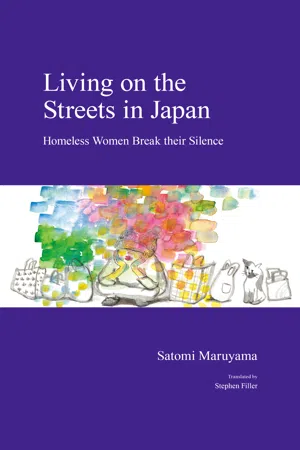
eBook - ePub
Living on the Streets in Japan
Homeless Women Break their Silence
- 278 pages
- English
- ePUB (mobile friendly)
- Available on iOS & Android
eBook - ePub
About this book
Homelessness has been recognized as a serious problem in Japan since the 1990s, but the dominant model of a "homeless person" has been that of an unemployed male laborer—a model that has largely excluded women, who experience homelessness in different forms. This study gives the homeless women of Japan a voice at last. Based on extensive fieldwork, the author paints a vivid picture of the unique experiences of homeless women living in a diverse range of environments. By introducing a gender perspective to the analytic framework and challenging the conception of the homeless individual as a rational, autonomous subject, the author invites a critical reconsideration of homeless studies and of public policy.
Trusted by 375,005 students
Access to over 1.5 million titles for a fair monthly price.
Study more efficiently using our study tools.
Information
1 Toward an ethnography of homeless women
Theories of Homelessness Today
These days, rough sleepers – people who live and sleep on the streets – have become a ubiquitous presence in major cities. The sight of people sleeping in cardboard boxes by the roadside or in train stations, and of blue tarp tents in parks and riverbeds, is common throughout Japan, including in smaller, regional cities. Much of the initial attention paid to rough sleepers, who first appeared in large numbers with the 1991 collapse of the bubble economy, was no doubt due to their significance as a symbol of poverty in an affluent society. Despite the attention they attracted, the number of rough sleepers grew steadily throughout the recession of the 1990s, eventually swelling to over 30,000 people.
In response to this situation, the Japanese government made a serious commitment to effectively address the needs of rough sleepers. Activities by service providers grew substantially, and support organizations cranked up their activities. As a result, the number of rough sleepers began to drop. However, the global economic downturn precipitated by the Lehman Brothers bankruptcy of 2008 caused these numbers to rise once again. More recently, the media have begun to report on people who are just a step away from rough sleeping, such as non-regular workers evicted from their dormitory after losing their jobs, and young people who spend the night in Internet cafés. Such reports make the poverty accompanied by the loss of a place to live feel more familiar and ordinary.
The subject of this book is homelessness – the condition of poverty accompanied by the loss of a home. In Japan, the word “homeless” is usually used to refer to persons sleeping rough on the streets. The 2002 Self-Help Act for Homeless People (hereafter referred to as the Self-Help Act) defines homeless persons as rough sleepers, namely, “persons living permanently and without good reason in locations or facilities such as city parks, riverbeds, roadsides, and stations.” However, the condition of homelessness – of not having a home – can be manifested in many ways other than rough sleeping. “Internet refugees” staying in Internet cafés, non-regular workers evicted from dormitories, and women taking refuge in domestic-violence shelters are all homeless in the sense of lacking a fixed place to live. This book will consider not only the condition of rough sleeping, but a wide variety of forms of poverty accompanied by the loss of a place to live, such as those just described. I will distinguish the two by using “homelessness” to describe the general condition of poverty accompanied by the loss of a home, and “rough sleeping” when referring specifically to persons living on the streets.
Research on homelessness has been carried out in a wide variety of fields, ranging from sociology, to social welfare studies, law, architecture, and medicine. However, as suggested by the common tendency to limit the definition of homelessness to the condition of rough sleeping, little research has yet been done that covers the entire spectrum of poverty accompanied by the lack of a residence, or “homelessness” as it is considered in this book. Iwata Masami (1995) conducted groundbreaking research with her historical analysis of government policies to combat poverty accompanied by the lack of a residence. Iwata’s historical examination of social welfare policy demonstrated how the homeless, including rough sleepers, were left out of general anti-poverty measures – which should have addressed the needs of all citizens equally – adopted after World War II. As a result, homeless people came to constitute a special class of the poor. Recently, as awareness has grown that homelessness can take forms other than rough sleeping, investigative research using a broad definition of homelessness has gradually emerged, such as the 2004 White Paper of the Japan Housing Council, and large-scale studies that extend to the lives of former street dwellers who successfully transitioned to living in permanent housing (Rainbow Coalition 2007; National Homeless Support Network 2011). Other studies dealing with one form of homelessness in the wider sense – namely, young people spending the night in Internet cafés – can be considered as efforts to reveal the hidden extent of homelessness (Ministry of Health, Labour and Welfare, Employment Security Bureau, 2007; Osaka City, Graduate School for Creative Cities, Kamagasaki Homeless Support Organization 2008).
Far more work has been conducted focusing solely on rough sleepers, partly because people living on the streets are more highly visible. In particular, sociological studies on yoseba, districts inhabited by large numbers of day laborers, have long included discussions of rough sleepers. Yoseba are sites where day laborers gather to seek jobs. Well-known yoseba include Kamagasaki in Osaka, San’ya in Tokyo, Kotobuki in Yokohama, and Sasajima in Nagoya. Around the larger yoseba are numerous doya, simple workers’ hostels. Day laborers will often stay in these facilities after the day’s work is done. However, during periods when there is less work available, many day laborers are unable to pay the bed fee, and are forced into rough sleeping. It is said that for this reason rough sleepers could be found at the yoseba even during the 1980s when the bubble economy was at its peak.
Aoki Hideo’s The Lives and Deaths of Yoseba Workers (1989), which focused on yoseba of that period, was a groundbreaking study that helped pave the way for later research. Aoki criticizes previous studies of yoseba in fields like social pathology and labor economics. In their zeal to comprehend the problem of yoseba with the aim of solving it, Aoki argues, such studies treat workers as persons in need of “improvement,” and emphasize the inferiority of their status (Aoki 1989). Aoki argues that in addition to comprehending and analyzing the problems of the yoseba, it is also necessary to recognize the agency of the workers themselves, and their personal efforts to change their situation. Aoki’s approach is a radical departure from previous research that had attempted to objectively assess social problems and prescribe solutions. He opposes the view that yoseba are a form of social pathology, on the grounds that this assumption is itself an implicit endorsement, and reproduction, of discriminatory attitudes. He argues instead for paying attention to the intentions of those living in the margins of society, and engaging with the ways in which the marginalized resist society at large. Although Aoki’s major research interest at the time was day laborers in yoseba, his research also covered rough sleeping as a condition suffered by day laborers who had grown old or become sick.
With the 1991 collapse of the bubble economy, however, the number of day-laborer jobs plummeted. Rough sleeping ceased to be a temporary condition or a final stage for yoseba laborers. Rather, it increasingly became the regular condition even for workers still in prime working condition. Subsequently, as economic conditions grew increasingly dire, even former regular workers began to be seen sleeping rough, and rough sleepers became more visible across the urban landscape, no longer limited to yoseba areas. Under these conditions, local governing bodies with large numbers of rough sleepers, such as Osaka and Tokyo prefectures, began around the mid-1990s to create their own policies and conduct studies on rough sleepers (Urban Life Institute 2000; Osaka City University Institute on Urban Environmental Problems 2001 and others).
In 2002, the Self-Help Act was passed as the first nation-wide measure to address the problem of rough sleeping. The Self-Help Act, a temporary law with a term of ten years, mandated, among other things, the creation of employment opportunities, job training, and lodging.1 At around this time, the construction commenced on residential facilities for rough sleepers in larger cities, including “Self-Help Centers” where rough sleepers capable of working could stay for several months while looking for work. However, with fewer jobs available, many who received assistance with their job search were unable to find work within the allotted time-frame, while others found only unstable jobs; thus, some ended up going back to rough sleeping. Support measures continue to be limited by, for example, restrictions on the repeated use of support centers. Additionally, the Self-Help Act states explicitly that when the presence of rough sleepers impedes the intended use of facilities such as parks, “necessary measures” are to be taken. There have been fears that this may be used as grounds...
Table of contents
- Cover
- Title Page
- Copyright
- Contents
- Figures
- Tables
- Photos
- Foreword to the English-Language Edition
- Foreword to the Original Edition
- 1 Toward an ethnography of homeless women
- 2 Who are the homeless women?
- 3 Establishing welfare for homeless women
- 4 Gender norms and the use of welfare facilities
- 5 The world of women who sleep rough
- 6 Continuing and ending rough sleeping
- 7 The process of change
- 8 Resisting the spell of the autonomous subject
- Epilogue
- Afterword
- Notes
- References
- Name Index
- Subject Index
Frequently asked questions
Yes, you can cancel anytime from the Subscription tab in your account settings on the Perlego website. Your subscription will stay active until the end of your current billing period. Learn how to cancel your subscription
No, books cannot be downloaded as external files, such as PDFs, for use outside of Perlego. However, you can download books within the Perlego app for offline reading on mobile or tablet. Learn how to download books offline
Perlego offers two plans: Essential and Complete
- Essential is ideal for learners and professionals who enjoy exploring a wide range of subjects. Access the Essential Library with 800,000+ trusted titles and best-sellers across business, personal growth, and the humanities. Includes unlimited reading time and Standard Read Aloud voice.
- Complete: Perfect for advanced learners and researchers needing full, unrestricted access. Unlock 1.5M+ books across hundreds of subjects, including academic and specialized titles. The Complete Plan also includes advanced features like Premium Read Aloud and Research Assistant.
We are an online textbook subscription service, where you can get access to an entire online library for less than the price of a single book per month. With over 1.5 million books across 990+ topics, we’ve got you covered! Learn about our mission
Look out for the read-aloud symbol on your next book to see if you can listen to it. The read-aloud tool reads text aloud for you, highlighting the text as it is being read. You can pause it, speed it up and slow it down. Learn more about Read Aloud
Yes! You can use the Perlego app on both iOS and Android devices to read anytime, anywhere — even offline. Perfect for commutes or when you’re on the go.
Please note we cannot support devices running on iOS 13 and Android 7 or earlier. Learn more about using the app
Please note we cannot support devices running on iOS 13 and Android 7 or earlier. Learn more about using the app
Yes, you can access Living on the Streets in Japan by Satomi Maruyama, Stephen Filler in PDF and/or ePUB format, as well as other popular books in Social Sciences & Gender Studies. We have over 1.5 million books available in our catalogue for you to explore.