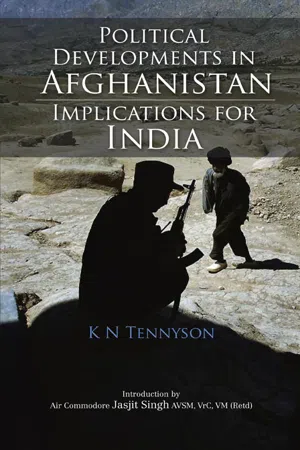
Political Developments in Afghanistan: Implications for India is an account on the longstanding relationship between the two Southern Asian countries. At the outset, the author briefly takes the readers to the colonial period political development in the region in an attempt to analyse the factors which laid the foundation of their historical engagement. The book focuses on the relations between the two Southern Asian countries after partition of the Indian subcontinent. The post-partition political developments in the Indian subcontinent (India-Pakistan and Afghanistan-Pakistan antagonism) and the emergence of the Cold War politics in the region that impelled their relations to a new level find adequate space. The author argue that though Afghanistan is India's indispensable neighbour, its political ties and strategic interests were weakly rooted during the Cold War period. The author has also discussed in detail the debate of India's foreign policy towards the Soviet Union during the Soviet invasion of Afghanistan.The change of political conditions in Afghanistan after the dethronement of the Taliban regime once again provided an opportunity for India to come into contact with the Afghans. Yet, India seems not to have made full use of the potential in its relations with Afghanistan because of Pakistan antagonistic policy. Pakistani leaders have never reconciled to the grievances of the post-partition political problems and crisis with India, and consider India as the "biggest threat" to their existence. Pakistan not only adopts a hostile policy towards India, but, its policy towards Afghanistan too has been shaped on the basis of its relations with India. Thus, Pakistan's leaders maliciously observe Afghanistan policy towards India and actively campaign with the international community to "stonewall" India's involvement in the politics of Afghanistan for fear of India's influence. It is because of such an aggressive and offensive policy adopted by Pakistan that every peace effort in the region has been thwarted even before it could be tested.This book explores India's past diplomatic relations with Afghanistan, and examines the problems and prospects in India-Afghanistan relations in a changing geostrategic environment.
- English
- ePUB (mobile friendly)
- Available on iOS & Android
eBook - ePub
About this book
Information
1
Historical and Political Developments in Afghanistan: Impact on the Indian Subcontinent
The areas which now comprise Afghanistan were always at the crossroads… it was both a gateway to foreign armies as well as a source of invasions.— Rasul Bakhsh Rais1
Afghanistan, which literally means “Land of the Afghans,”2 originally denoted the areas where the Pashtuns3 had settled, and the terms “Afghan” was initially used for the Pashtun tribes.4 For many centuries, Afghans were referred to “as Avagana and A-po-Kien from which the term ‘Afghanistan’ seems to have been derived,” wrote Mohammad Amin Wakman, Honorary Chairman and Director of International Affairs of the Afghan Mellat Party.5 He added that with the subsequent spread of Pashtuns in other regions, “the term ‘Afghanistan’ gradually signified a larger territory that eventually included Khurasan of the Islamic era and Ariana [also known as Bactria] of ancient times.”6 Since, the term “Afghan” originally referred only to a particular ethnic group, the Pashtuns, the Afghans were called by different names by different people. H.W. Bellew, a British political officer at Kabul, wrote that the Mohammadans of Asia Minor and the Western countries called the Afghans “Sulemani,” whereas the people of India and the East generally knew the Afghans by the name “Pashtun.” He further added that the Afghan “is also called Rohilla,” but, pointed out that “this name is properly applicable only to the true [Pashtun], the native of Roh (the Highlands), the true Highlander.”7
Emergence of the Afghan State
The historical record indicates that Afghanistan until the 18th century was “not a homogenous national state, [but] a conglomeration of tribes and ethnic groups” ruled by various foreign empires, local Emirs, and Kings.8 For instance, the Greeks ruled “Bactria” (ancient name of Afghanistan) around 200 BC, which was followed by the Shakas also known as the Scythians, the Parthians and the Kushans.9 In 652 AD,, the Arabs invaded Afghanistan and introduced Islam. Subsequent other invaders included Genghis Khan (1219), Sabuk-tagin (10th century), Timurlang (14th century), and Babur (1504).10 Describing the pitiable political condition of Afghanistan, Col Algernon Durand, who was the British Agent in Gilgit from 1889-94, wrote, “The armies of Alexander, the hordes of Gengis Khan and Timur go glittering by; dynasties and civilizations rise and fall like the waves of the sea; peace and prosperity again and again go down under the iron hoof of the conqueror; for centuries past, death and decay have ruled in the silent heart of Asia.”11 Sadhan Mukherjee too opined, “Invader after invader ravaged Afghanistan, drowning it in blood and gore. Some invaders left only a bloody imprint; some integrated themselves totally with the indigenous population, while still others came as birds of passage.”12
For centuries, the Afghans were suppressed and subjugated by external powers as the latter fought for supremacy and influence in the region. In the course of their struggle for influence and power domination, the external powers “encompassed the whole or great part of modern Afghanistan in conjunction with the whole or part of one or more of her present neighbours in Central and South Asia” into their kingdom.13 For example, in the 16th century, Afghanistan’s territory was not under a single administration, but was divided among three powerful empires. “The Indian-based Moghal Empire ruled over Kabul and eastern Afghanistan. Northern Afghanistan (Maimana, Mazar-e-Sharif, and Kunduz) was part of a Central Asian polity ruled by Uzbek Emirs. Western Afghanistan was an integral part of Iran [Khurasan] that put Herat under the control of the Safavid Empire. Southern Afghanistan was first a Moghal territory that later came under the control of Iran after the Safavids conquered Kandahar.”14
However, the political conditions of Afghanistan underwent tremendous change after the death of the Persian King Nadir Shah (1747). Following the death of Nadir Shah, Ahmad Shah of the Abdali clan (tribe) was chosen as his successor in a Loya Jirga (Grand Assembly) of tribal chiefs in Kandahar in 1747. Ahmad Shah, on becoming the chief of the Afghans, “styled himself Durr-i-Durran, ‘the Pearl of the Age,’ and his clan was henceforth known as the Durrani.”15 This event could be considered as a turning point in the history of Afghanistan, because Ahmad Shah Durrani then enlisted the support of the local tribes and founded the “Kingdom of Afghanistan.”16 Subsequently, he embarked on a series of military campaigns and expanded his empire by conquering the neighbouring regions like Punjab, Kashmir, Sind, Sirhind, Baluchistan, Khurasan, Balkh, and several other regions bordering the southern bank of the Amu Darya (Oxus) river, and ruled Afghanistan until his death (1773).17 Timur Shah, son of Ahmad Shah Durrani, succeeded to the throne and ruled the country from 1773 to 1793. Unlike his father Ahmad Shah Durrani, Timur Shah was a “weak and indolent” ruler, therefore, he “could not pursue the vigorous policy of his predecessor.”18 He subsequently shifted his capital from Kandahar to Kabul. According to Ralph H. Magnus and Eden Naby, Timur Shah “moved his capital from Kandahar to Kabul in order to weaken the power of other Durrani sardars (princes) [and] also to be closer to the Punjab, his richest province.”19 Ahmad Shayeq Qassem wrote that during the reign of Timur Shah, “despite an increased tendency by the centrifugal forces of tribal leaders and some provincial governors to break away from the central government, the Durrani Empire remained intact.”20 However, the Durrani Empire began to crumble during the reign of Zaman Shah, Timur’s (fifth) son and successor, who ruled Afghanistan from 1793 to 1800.
Having ascended the throne of Kabul, an ambitious Zaman Shah advanced to Lahore in 1798 with the cherished “dream of invading the interior of Hindustan” like his predecessors. But he was compelled to return to Peshawar from Lahore without fulfilling his ultimate dreams of reaching Hindustan, because of the dispute with Persia (present Iran) over the province of Khurasan.21According to Historians R. C. Majumdar and others, the British India Empire was “kept in a chronic state of unrest” at the prospects of Zaman Shah invading India, so, to thwart the growing power of Zaman Shah, the British sent “two missions in 1799 to Persia, whose relations with Afghanistan were then strained.” The British design proved successful. Zaman Shah was eventually “overthrown and blinded” and was forced to flee to Bukhara, then to Herat and finally to India (Ludhiana), because of “the interplay of dynastic rivalries over a royal successor.” The mighty Durrani Empire disintegrated with the ouster of Zaman Shah from power, as his brother and successor Mahmud Shah was weak and could not keep the kingdom intact. 22
Colonisation of Afghanistan
Since the middle of the 18th century, the confrontation between the European powers for territory expansion in Central and Southern Asia began to take place. In the light of this development, by the early 19th century, Russia began to manoeuvre its foreign policy towards the Central and Southern Asian regions. In 1809, Napoleon and Russian Czar Alexander 1 signed the Treaty of Tilsit with the aim to plan for a combined invasion of India.23 Four years later, in 1813, Russia and Persia concluded the Treaty of Gullistan, as Russia was eager to expand its territory in the East.24 A recent publication of the Russian General Staff has indicated that Russia diverted its interest towards the Central and Southern Asia regions due to the “desire to abolish the slave trade and to establish [law and] order and control along the southern border.”25 Whatever the reason, the British viewed Russian expansion in the region as a threat to India which held an important place in the “Crown of the British Empire.” Therefore, the British took various measures, politically and commercially, to expand their sphere of influence into the Central Asian region primarily “to find a sound ‘scientific’ defensive frontier for India,” not forgetting the commercial interest. One such approach was that, in 1809, the first British mission under Mountstuart Elphinstone came to Afghanistan and signed a Friendship Treaty with the Afghan Amir, Shah Shuja, at Peshawar.26 Two and half decades later, in 1836, the British alarmed by the Amir of Afghanistan leaning towards Russia, sent (another mission) Alexander Burnes, a distinguished British officer, to Kabul “under the pretext of a commercial mission.” But, according to Majumdar and others, Burne’s secret mission to Kabul was to study the working of the political affairs of Afghanistan and “judge what was to be done hereafter.”27 Having met the Amir of Afghanistan Dost Muhammad, Burnes was convinced that the latter was willing “to accept British overtures, provided the British government agreed to put pressure on Ranjit Singh to restore Peshawar to him.”28 Burnes, therefore, recommended that the British ally with the Amir of Afghanistan. However, Lord Auckland and his two Secretaries rejected Burnes’ suggestion of the need to develop an alliance with the Amir of Afghanistan, because doing so would mean “opposing their Sikhs allies.”29 The indifferent attitude of the British government toward the Amir of Afghanistan consequently led the Amir to strengthen his country’s relations with Russia...
Table of contents
- Cover
- Half Title
- Title
- Copyright
- Contents
- Acronyms
- Acknowledgements
- Introduction
- 1. Historical and Political Developments in Afghanistan: Impact on the Indian Subcontinent
- 2. India-Afghanistan Relations: Post-Independence to Pre-Soviet Invasion
- 3. Soviet Invasion of Afghanistan: Effect on India’s Foreign Policy
- 4. India-Afghanistan Relations in the 1990s
- 5. War on Terror: Impact on India-Afghanistan Relations
- 6. Towards a Politically Stable Afghanistan: Problems and Prospects
- 7. Opportunities and Challenges
- Appendices
Trusted by 375,005 students
Access to over 1.5 million titles for a fair monthly price.
Study more efficiently using our study tools.
Frequently asked questions
Yes, you can cancel anytime from the Subscription tab in your account settings on the Perlego website. Your subscription will stay active until the end of your current billing period. Learn how to cancel your subscription
No, books cannot be downloaded as external files, such as PDFs, for use outside of Perlego. However, you can download books within the Perlego app for offline reading on mobile or tablet. Learn how to download books offline
Perlego offers two plans: Essential and Complete
- Essential is ideal for learners and professionals who enjoy exploring a wide range of subjects. Access the Essential Library with 800,000+ trusted titles and best-sellers across business, personal growth, and the humanities. Includes unlimited reading time and Standard Read Aloud voice.
- Complete: Perfect for advanced learners and researchers needing full, unrestricted access. Unlock 1.5M+ books across hundreds of subjects, including academic and specialized titles. The Complete Plan also includes advanced features like Premium Read Aloud and Research Assistant.
We are an online textbook subscription service, where you can get access to an entire online library for less than the price of a single book per month. With over 1.5 million books across 990+ topics, we’ve got you covered! Learn about our mission
Look out for the read-aloud symbol on your next book to see if you can listen to it. The read-aloud tool reads text aloud for you, highlighting the text as it is being read. You can pause it, speed it up and slow it down. Learn more about Read Aloud
Yes! You can use the Perlego app on both iOS and Android devices to read anytime, anywhere — even offline. Perfect for commutes or when you’re on the go.
Please note we cannot support devices running on iOS 13 and Android 7 or earlier. Learn more about using the app
Please note we cannot support devices running on iOS 13 and Android 7 or earlier. Learn more about using the app
Yes, you can access Political Developments in Afghanistan by K N Tennyson in PDF and/or ePUB format, as well as other popular books in Politics & International Relations & International Relations. We have over 1.5 million books available in our catalogue for you to explore.