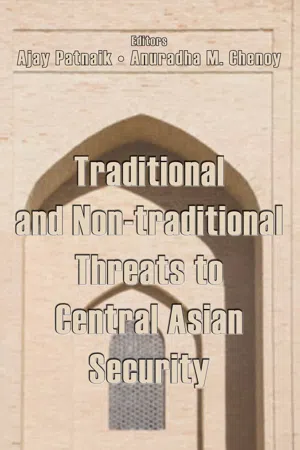
Traditional conception of security emphasises territorial integrity and national sovereignty as primary values to be protected. In this notion, traditional threats are essentially related to external military threats that seek to undermine the security of the sovereign state and its territorial integrity. As the present book shows, the threats to Central Asian security are both external and internal. Today challenges from non-traditional threats are greater than traditional ones. Ethnic, religious and linguistic issues can create instability. Similarly, poverty, hunger, unemployment and unequal distribution of wealth as well as environmental issues are going to pose the biggest challenge to the regional states in the near future. The drying up of the Aral Sea is affecting the health and lives of hundreds of thousands of people cutting across republics. Water-related confrontations are not unlikely given the problems related to water-sharing in the region. This book focuses mainly on many of the non-traditional security threats to Central Asian states which can even affect relations between states and transform into traditional security challenges.
eBook - ePub
Traditional and Non-Traditional Security Threats to Central Asian Security
- English
- ePUB (mobile friendly)
- Available on iOS & Android
eBook - ePub
Traditional and Non-Traditional Security Threats to Central Asian Security
About this book
Information
Section II
Non-Traditional Security Issues
7 | Non-Traditional Security: A Conceptual Analysis |
A.P.S. Chouhan & Jyoti M. Pathania |
‘----- national security includes traditional defence policy and also the non-military actions of a state to ensure its total capacity to survive as a political entity in order to exert influence and to carry out its internal and international objectives.’Michael H. H. Louw
Introduction
At the commencement of the 21st century we stand on the threshold of what futurologists termed the ‘Power-Shift Era’, where change is swift and complex, knowledge replaces ‘the mindless fist’, communication technology has catapulted us into a 24-hour society that never sleeps, and a globalised planet with transnational boundaries makes us at once interdependent and wary of each other. Threat perceptions also change, transcending mere defence of territory to identifying other areas of conflict within nations that could explode into threats to human security. The idea of non-traditional or comprehensive security has begun to be widely accepted and the importance of deterring existing threats and preventing new threats has been well recognised.1
Since the end of the Cold War, the ‘non-traditional threats’ have become the source of growing concern around the world. Many scholars feel that war has ceased to be a means of resolving disputes and is no more synonymous solely with physical forms of combat. On the horizon are a host of potential wars—diplomatic, political, economic, trade, information, cultural, and environmental, to name a few. We need to realise these contemporary threats and the profound effect they can have on a nation’s growth and progress. Thus the Clauswitzean thesis, of war being an instrument of state policy, still holds good. However, the form seems to have changed.
The Commission on Global Governance clearly identifies this change in the following statement issued by it in Nov 1995, ‘The security of people recognises that global security extends beyond the protection of borders, ruling elites and exclusive state interests to include the protection of people. It does not exclude military threats from the security agenda; instead it proposes a broader definition of threats in light of the pressing post-Cold War humanitarian concerns.’2
These non-military threats to security pose a potent danger to a nation’s progress, development, and unity. There is a need to identify the macro non- traditional threats and prepare to combat the dominant security challenge of the new millennium. Whether these threats emanate from within or outside the boundaries of the state is immaterial to their consideration as security threats. Similarly, whether they are a product of deliberate or inadvertent acts is irrelevant. The harmful impact they will have on the individual or the surrounding eco-system is what actually matters. Hence, there has been a paradigm shift in the security concerns of all nations from a narrow, unilateralist, traditional military threat to a broader, multilateral, non-military threat to security.
The aim of this paper is to trace the etymology of non-traditional thinking including the historical perspective, decipher the various theories, paradigms, and metaphors in this field, the shift in the security paradigm from traditional to non-military threat and try to find if any interface exists between traditional and non-traditional security issues. In this paper I would be using the term Non-traditional security and Non-Military Threats interchangeably without any alteration in their meanings.
From time immemorial, all across the globe, security has been synonymous with military and national security with external military threat. All nations till recently had looked upon the external threats to its security only. A number of wars in the past have cemented our beliefs. However, as we now know, security of a nation is far more complex and overarching. The present turbulent times and imponderables of the international and regional strategic order have diffused the forms the new warfare may take. External enemies and military threats are visible and easy to identify, and somewhat tangible, the non-military threats are more difficult to discern. There is a need to understand security in all its dimensions and focus on issues that ensure not only physical security but also the continued development of a nation and its people. Non-traditional security/non-military threats have emerged as the dominant security challenge of the new millennium and the time has come to address these vital security concerns. Future security is more dependent on the success of the nation to overcome its non-military threats to ensure the unhindered growth of the country and its people and culture. Hence, in the contemporary world, a nation must look beyond the conventional military threats and address the non-traditional threats in order to have a stable, comprehensive, effective, and holistic security.
Etymology of Non-traditional Thinking
The Concept
During the Cold War period, the notion of security was generally understood in relation to the security of the state, in terms of preserving its territorial integrity and political sovereignty (Military Threats). In the 1980s, the notion of security was broadened to include not only the military and territorial security of a state, but also economic and environmental issues (Comprehensive Security). However, the central objective of security remained the state. Even as this concept was broadened, the taboo to ‘deepen’ it i.e., to enlarge the notion of security in order to reach the human being still existed. It was only during the 1990s that the security paradigm was ‘truly deepened’ and the security of the individual was put at the centre of security strategies (Human Security). It is this human security in its various forms and its associated values that forms the basic framework for non-traditional security.
Thus human security has permitted two major changes; first, reorientation of the discourse on security from purely state centric to the individual as well and second, broadening of the analysis of security, beyond military dimension, in order to address non-military threats to the individual.3
Genesis of Non-Traditional Thinking
Re-conceptualisation of security became necessary because of gradual but fundamental and long-term changes in the international system. Some of the prime factors which necessitated a new thinking on the concept and scope of security studies were the demise of Cold War which led to a globally interdependent world, change in nature of warfare to include a struggle for techno–economic superiority, political and cultural space rather than purely conventional military might. States, today, are more than ever dependent on international society and institutions.4
Against the backdrop of all these factors, the late 20th century saw a rise or prominence of non-traditional security issues, in particular human security. The genealogy of the idea can be related to, if not traced back to, the growing dissatisfaction with prevailing notions of development and security in the 1960s, 1970s, and 1980s. Economics undoubtedly led the way with its critiques of the dominant models of economic development beginning in the 1960s. In the middle 1970s, the home of security studies in international relations, the multinational World Order Models Project (WOMP), launched an ambitious effort to envision and construct a more stable and just world order, and as a part of this endeavour drew attention to the problem of individual well being and safety.5
As per Kanti Bajpai, the most important forerunners of the idea of human security or non-traditional security were the reports of a series of multinational independent commissions composed of prominent leaders, intellectuals and academicians. Beginning in the 1970s the Club of Rome group produced a series of volumes on the sWorld ProblematiqueW which were premised on the idea that there were a host of complex problems troubling people of all nations: poverty, degradation of the environment, alienation of youth, rejection of traditional values, inflation and other monetary and economic disparities. The report noted that, “every person in the world faces a series of pressures and problems that require his attention and action. These problems affect him at many different levels. He may spend much of his time trying to find tomorrow’s food. He may be concerned about personal power or the power of the nation in which he lives. He may worry about a world war or a war next week with a rival clan in his neighbourhood”.
In the 1980s two other independent commissions contributed to the change in thinking on development and security. The first was the Independent Commission on International Development Issues, chaired by Willy Brandt, which, in 1980, issued the so called ‘North–South Report’. This report not only raised traditional security issues like peace and war, but also issues like how to overcome world hunger, mass misery and alarming disparities between the living conditions of rich and poor”.6 The second commission of the 1980s, the Independent Commission on Disarmament and Security Issues, chaired by Olof Palme, authored the famous ‘Common Security Report’, which also drew attention to alternative ways of thinking about peace and security. It acknowledged that common security requires that people live in dignity and peace, that they have enough to eat and are able to find work and live in a world without poverty and destitution.7
In 1991 the Stockholm initiative on Global Security and Governance issued a call for ‘common responsibility in the 1990s’ which referred to ‘challenges to security other than political rivalry and armaments’ and to a wider concept of security, which deals also with threats that stem from failures in development, environmental degradation, excessive population growth and movement, and lack of progress towards democracy.
In 1995, the Commission on Global Governance’s report, ‘Our Global Neighbourhood’ stated that “the concept of global security must be broadened from the traditional focus on the security of states to include the security of people and the security of the planet”.8
The first explicit document wherein mention of the name THuman SecurityH and other important elements of ‘Non-Traditional Security’ were found, was in the UNDP report of 1994. Mahbub ul Haq was the man behind this report. In this new concept of security he said, “security would be equated with the security of individuals, not just security of territory”. He further said that “we need to fashion a new concept of security that is reflected in the lives of our people, not in the weapons of our country. Fundamentally human security will be achieved through development, not through arms”.9
The UNDP’s Human Development Report of 1994 called ‘Redefining Security: The Human Dimension’ purports to offer an alternative to traditional security professing a necessary supplement to human development, and states that it is time to redress the balance and include protection of people as security. The report lists seven components or seven specific values of human security viz., economic security, food security, health security, environmental security, personal security, community security, and political security.10
The Canadians also gave a people centric view of security in 1996 when their foreign minister Lloyd Anworthy, in an address to the 51st UN General Assembly, first broached the idea of human security on behalf of his government. By focusing on people and highlighting non-traditional security, the UNDP certainly made an important contribution to post-Cold War thinking.
Thus came about the non-military threats and a new dimension to security—the non-traditional security, keeping the people at the centre stage and the individual, as a part of the state, as the main focus. After going through the genesis of non-traditional security, it is pertinent to study the various theories on this subject and view it from the prism of scholars and academicians so as to fathom the various interpretations and definitions of this new concept.
Paradigms, Theories & Metaphors of Non-Military Threats
Understanding Non-Traditional Security
The first task in defining ‘non-traditional security’ is to identify issues that rise to the level of security concern, that is, to define ‘security’. The second task is to differentiate between ‘traditional’ and ‘non-traditional’ security issues.
In defining what constitutes ‘security’, five sets of questions need to be asked. First, what values are being threatened? Second, what is threatening those values? Third, what means are available to counter the threat? Fourth, who is expected to provide the protection or security against the threat? Fifth, and finally, who will pay the cost of the protection/security? Issues become ‘securitised’ when a threat exists or is believed to exist against some fundamental values that are held by some actor, be it an individual, a group, a community, a nation, a group of nation, or an international community. Those fundamental values vary depending on whose values they are.
The first aspect regarding non-military threats to security is the object of the threat, whether they represent dange...
Table of contents
- Cover
- Half Title
- Title
- Copyright
- Contents
- Authors Bio
- Introduction
- Section I Traditional Security Issues in Central Asia
- Section II Non-Traditional Security Issues
- Section III Water, Energy and Environmental Issues
- Section IV Socio-Economic and Identity Issues
Trusted by 375,005 students
Access to over 1.5 million titles for a fair monthly price.
Study more efficiently using our study tools.
Frequently asked questions
Yes, you can cancel anytime from the Subscription tab in your account settings on the Perlego website. Your subscription will stay active until the end of your current billing period. Learn how to cancel your subscription
No, books cannot be downloaded as external files, such as PDFs, for use outside of Perlego. However, you can download books within the Perlego app for offline reading on mobile or tablet. Learn how to download books offline
Perlego offers two plans: Essential and Complete
- Essential is ideal for learners and professionals who enjoy exploring a wide range of subjects. Access the Essential Library with 800,000+ trusted titles and best-sellers across business, personal growth, and the humanities. Includes unlimited reading time and Standard Read Aloud voice.
- Complete: Perfect for advanced learners and researchers needing full, unrestricted access. Unlock 1.5M+ books across hundreds of subjects, including academic and specialized titles. The Complete Plan also includes advanced features like Premium Read Aloud and Research Assistant.
We are an online textbook subscription service, where you can get access to an entire online library for less than the price of a single book per month. With over 1.5 million books across 990+ topics, we’ve got you covered! Learn about our mission
Look out for the read-aloud symbol on your next book to see if you can listen to it. The read-aloud tool reads text aloud for you, highlighting the text as it is being read. You can pause it, speed it up and slow it down. Learn more about Read Aloud
Yes! You can use the Perlego app on both iOS and Android devices to read anytime, anywhere — even offline. Perfect for commutes or when you’re on the go.
Please note we cannot support devices running on iOS 13 and Android 7 or earlier. Learn more about using the app
Please note we cannot support devices running on iOS 13 and Android 7 or earlier. Learn more about using the app
Yes, you can access Traditional and Non-Traditional Security Threats to Central Asian Security by Ajay Patnaik Anuradha M Chenoy, Ajay Patnaik & Anuradha M Chenoy in PDF and/or ePUB format, as well as other popular books in Politics & International Relations & International Relations. We have over 1.5 million books available in our catalogue for you to explore.