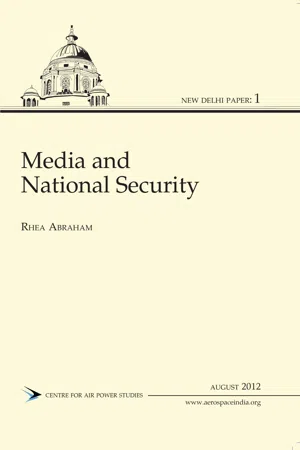
The concept of National Security in the 21st century has expanded beyond our traditional dimensions of security as purely national defence by a state and its military, to policies that accommodate security from the perspective of state and its people. In this context, the powerful tool of media, colossal and integrated, has become an inseparable tool for information dissemination and a continuum in policy intervention for states to secure their integrity and sovereignty. Also, for a democracy like India with a diverse society, its multilingual media becomes an available and active platform for deliberation of actions and rationale to develop opinions and decisions that serves the purpose of independent and palpable citizens involved in the broader decision making. Thus, moving beyond the textbook definition of media to educate and inform, the book focuses on the Indian media in particular as influential and imperative in the current scenario and its role in fighting the psychological war alongside the state and its forces, and against contemporary national security threats such as terrorism. It tries to understand the Indian media in its varied theoretical forms and the projection of its power to the people who employ it and those who synchronize its events. The book also tries to understand the intermingling of conflict and the Indian media, while indulging in newer concepts such as peace journalism and strategic education. However; the role of the Indian media continues to be under question due to its nascent pragmatic endeavours, and thereby needs to be defined categorically and holistically in the Indian domain. This exercise aims to centre the Indian media on its role as an eminent player and collaborator of policies on security and at the same time futuristically assess the extension of its perceived role in the larger dimensions of India's national security.
- English
- ePUB (mobile friendly)
- Available on iOS & Android
eBook - ePub
Media and National Security
About this book
Information
Subtopic
National Security1. | NATIONAL SECURITY AND THE INDIAN MEDIA: A CONTEXTUAL INTERPRETATION |
The media is the most powerful entity on earth. They have the power to make the innocent guilty and to make the guilty innocent, and that’s power, because they control the minds of the masses.— Malcolm X1, an African AmericanHuman Rights Activist (1925‐65)
National Security, as a concept in the contemporary structure of a Nation State, is highly entwined with the facilitation of governance, which is the effective management of national affairs of a country at all levels of its functioning and execution, aimed at maintaining the integrity of the nation and the security of its people. To achieve good governance, it becomes essential for the authorities to exercise political, economic and judicial procedures in a manner, which ensures that the people are given their freedom to fulfil their duties, and resolve their disputes as is allowed in the written constitution.2 Similarly for India, the preamble to the Indian Constitution provides the key to its national security policy, where it enshrines the sovereignty of the people in a socialist, secular, democratic republic based on the pillars of Justice, Liberty, Equality and Fraternity. The safeguarding of national security, thus, encompasses dedication and timely awareness to counter any threat or external force that hampers the well being of the Indian State in a successful manner as is advised by the Rule of Law.3
For a country like India, the backbone of its democracy and the propagator of its national interests remains the access to information and expression, which helps its citizens to make responsible and objective choices, to promote accountability by its officials, to provide solutions to conflict resolution, and also to encourage diverse views of its diverse people.4 This access of information has, in turn, allowed the Indian media to play the role of the fourth estate and watchdog that holds the Government accountable in all its activities, and also functions as the only mode of expression for its people. Our Constitution emphasises an active and independent media which is highly maintained on the ideals of freedom of speech and expression as contained in Article 19 of the Indian framework, and which allows the Indian journalists to be spontaneous activists in the overall governance of the country. Abiding by the fundamentals enshrined by the architects of sovereign India through the years, the Indian media has been allowed to grow and transcend from an active disseminator of information to an omnipresent unit of the society. It has not only helped in building, shaping or transforming an individual’s perceptions, but has also been given the power to challenge the Government, the Judiciary, and other institutions of the country that form part of the larger policymaking system.5 The increasing reach of regional and global communication systems and sophisticated technology has made media in India, an autonomous tool of statecraft.6 The Indian media also continues to provide channels of communication, helping to educate, inform and exchange information between the public and its Government. Thus, the ability to influence the attitudes and behaviour of countries and their policies has helped the Government to initiate its national strategic goals through an integrated, coordinated and combined media that acts as a tool and channel for information dissemination and enlightenment.7
However, to the extent that the Indian media continues to play the role of an information activist for an informed public and responsible Government, it deserves much deeper and sustained study by promoters, actors and facilitators of democracy and good governance. In consonance with this requirement, the subsequent chapters of the occasional paper aim to highlight the expansion of the new generation media as an entity into the security domain of every country. The first chapter introduces a contextual framework to help understand the complexity of the relationship between the media and the realm of national security. The study consequently tries to analyse the importance of the understanding of India’s national security needs by its media, and the role it can play in maintaining a steady and efficient Government. Focusing on the functioning of the Indian print and broadcast media only, the paper tries to dissect media behaviour with case studies that help to put forward need for an effective cooperation between the State and the media in India to counter national security threats in a phased manner. While dealing with national security, it has become inevitable to dismiss the relationship that any media has with the facilitation of terrorism. Thus, the paper also broadly underlines the tryst of Indian media with its contemporary security challenge and the role it plays in counter‐terrorism strategies, making the task of incorporating media in the national security strategy even more unavoidable. The study not only aims to theoretically analyse the role of the Indian media in conflict resolution through the theoretical basis of journalism but proposes to lay a practical and implementable outline for the State and policy guides to actively involve the media in maintaining security, peace and stability in the region.
Understanding National Security
Theories and Strategies
In 1948, academician Hans Morgenthau in his book ‘Politics among Nations’ defined national security as ‘the integrity of national territory and its institutions’8 while providing impetus to the concept of national security in the Cold War era as restricted to the security of the State and its boundaries and focusing on the role of the Defence and the security forces. In the contemporary age, however, national security has branched from national defence, and has broadened to incorporate different aspects of a globalised world, in terms of human, economic, energy, cultural and political security. Though still heavily influenced and defined by the Government, the concept of national security has now entered the public domain, and is being framed by most scholars as ‘the creation of conditions that contribute to the nation’s political, social and economic consolidation and ensure territorial integrity of the country, acquisition of capabilities to sustain these conditions, safeguard freedom of options and capabilities to survive in a volatile security environment’.9
Defining the concept of national security continues to be an extremely challenging task as various factors identify its capacity at all levels of perception, and thus, cannot be restricted to a single definition due to its changing nature from State to State.10 Some definitions equate the concept of national security to the State and centre all related policies revolving around the Nation State, while others factor the State and individuals as the constituents of national security. There has been a change in the school of thought of strategists, where the concept of security has changed merely from the security of the State to the security of the citizens11. The need to safeguard ideology, the political system, society and its people has also become important to the overall national security architecture.12 The sacred concept of national security is now being theorised into two broad classifications: (1) the recognition and preservation of State security based on territory, and (2) societal security based on identity. Both these remain symbiotic in nature, and are mainly required to protect the boundaries of the State, foreign policy, rights of citizens and the Diaspora from threats posed by another State, radical elements and non‐state actors.13
National security also encompasses the expected behaviour of a democratic nation – as in the case of India – by focusing on providing the right to life and liberty to its citizens; equality in all spheres of activity; cooperation between the public and private sector operating in the State; preservation of territorial sovereignty and integrity; maintaining a flexible civil and military relation; robust economic development and a proactive and independent media.14 National security remains dynamic, fluid and multi‐directional, and is considered the survival of the Nation‐State. It embodies external security (safeguarding the nation from foreign threats), and internal security (within the State). It also highlights the maintenance of economic, military, political and diplomatic power over its peers and neighbouring countries.15 We can thereby summarise that in the current security environment, national security cannot be interlinked with national defence only; as it covers a wide range of aspects that require the cooperation and understanding of the State, its forces, institutions and the public.
Challenges to National Security
In the age of globalisation and inter‐dependence, security threats to national interests, not only involve conventional threats such as other Nation States but also non‐state actors such as terrorist organisations, drug and arms dealers and multinational corporations.16 Traditional threats to national security have been bypassed into an era where the security challenges cannot be eliminated by the military forces alone; they require the cooperation and collaboration of security forces with organisations that are State or Non‐State, for support and expertise to diminish and eradicate the threat either completely or to a minimum level. The measures adopted to maintain national security in the face of these threats have also led to an ongoing debate among countries of the world, on the use and role of governance,17 which can be enhanced through science and technology and also through private organisations. The contemporary concern regarding national security and governance also centres on the exercise of national security laws and strategy which, if not subjected to good governance, may simply serve as a reason for18 tensions between the preservation and sovereignty of the State and the rights and freedoms of its citizens in order to maintain peace and stability.
Though common domestic failures such as corruption, poverty, crime, insurgency and home‐grown terrorism continue to initiate concerns for the national security of any country including India, external threats such as global terrorism, use of nuclear weapons by State or Non‐State actors, border disputes, and environmental calamities have emerged as severing the nation’s security and strength. One common challenge to the national security of any State, regardless of the geographic location, remains the threat of terrorism which has crossed national borders into international territories, and has become part of a global threat to the security of the world system. Mainly for a country like India, situated in the heart of the Southern Asian subcontinent, the factor of terrorism continues to plague the nation’s security perceptions. Thus, keeping the relevance of the threat intact, the paper tries to streamline India’s immediate national security threat as terrorism, and debate counter‐strategies that require attention from the State and its organisations, in order to curb the spreading violence ti...
Table of contents
- Cover
- Title
- Copyright
- Contents
- Introduction
- 1. National Security and the Indian Media: A Contextual Interpretation
- 2. Understanding the Media, its Theory and Practices
- 3. Indian Media and Terrorism
- 4. The Media of the 21st Century: Recommendations and Conclusion
- CAPS ‘Non‐Resident Fellowship’ Programme on National Security
Trusted by 375,005 students
Access to over 1.5 million titles for a fair monthly price.
Study more efficiently using our study tools.
Frequently asked questions
Yes, you can cancel anytime from the Subscription tab in your account settings on the Perlego website. Your subscription will stay active until the end of your current billing period. Learn how to cancel your subscription
No, books cannot be downloaded as external files, such as PDFs, for use outside of Perlego. However, you can download books within the Perlego app for offline reading on mobile or tablet. Learn how to download books offline
Perlego offers two plans: Essential and Complete
- Essential is ideal for learners and professionals who enjoy exploring a wide range of subjects. Access the Essential Library with 800,000+ trusted titles and best-sellers across business, personal growth, and the humanities. Includes unlimited reading time and Standard Read Aloud voice.
- Complete: Perfect for advanced learners and researchers needing full, unrestricted access. Unlock 1.5M+ books across hundreds of subjects, including academic and specialized titles. The Complete Plan also includes advanced features like Premium Read Aloud and Research Assistant.
We are an online textbook subscription service, where you can get access to an entire online library for less than the price of a single book per month. With over 1.5 million books across 990+ topics, we’ve got you covered! Learn about our mission
Look out for the read-aloud symbol on your next book to see if you can listen to it. The read-aloud tool reads text aloud for you, highlighting the text as it is being read. You can pause it, speed it up and slow it down. Learn more about Read Aloud
Yes! You can use the Perlego app on both iOS and Android devices to read anytime, anywhere — even offline. Perfect for commutes or when you’re on the go.
Please note we cannot support devices running on iOS 13 and Android 7 or earlier. Learn more about using the app
Please note we cannot support devices running on iOS 13 and Android 7 or earlier. Learn more about using the app
Yes, you can access Media and National Security by Rhea Abraham in PDF and/or ePUB format, as well as other popular books in Politics & International Relations & National Security. We have over 1.5 million books available in our catalogue for you to explore.