- 288 pages
- English
- ePUB (mobile friendly)
- Available on iOS & Android
eBook - ePub
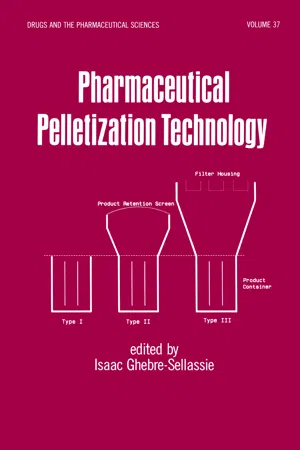
Pharmaceutical Pelletization Technology
About this book
This book serves as a formulation and processing guide during the development of pelletized dosage forms. It provides the pharmaceutical technologist with basic information about the design aspects of the relevant processing equipment.
Information
1 Pellets: A General Overview
DOI: 10.1201/9781003066231-1
I. DEFINITION
Traditionally, the word “pellet” has been used to describe a variety of systematically produced, geometrically defined agglomerates obtained from diverse starting materials utilizing different processing conditions. These products may be fertilizers, animal feeds, iron ores, or pharmaceutical dosage forms, to mention but a few. It is appropriate, therefore, at the outset to define the words “pellet” and “pelletization” in the context in which they are used in the book in order to avoid confusion. Pelletization is an agglomeration process that converts fine powders or granules of bulk drugs and excipients into small, free-flowing, spherical or semi-spherical units, referred to as pellets. Pellets range in size, typically, between 0.5–1.5 mm, though other sizes could be prepared, depending on the processing technologies employed. The most widely used pelletization processes in the pharmaceutical industry are extrusion/spheronization, solution/suspension layering, and powder layering. Each of these processes is discussed in detail later in the book and need not be defined here. Other processes with limited application in the development of pharmaceutical pelletized products include globulation, balling, and compression (Figure 1) and are briefly described below.

Globulation or droplet formation describes the two related processes of spray drying and spray congealing [1]. During spray drying, drug entities in solution or in suspension form are sprayed, with or without excipients, into a hot-air stream to generate dry and highly spherical particles. Though the technique is suitable for the development of controlled-release pellets, it is generally employed to improve the dissolution rates and, hence, bioavailability of poorly soluble drugs. Spray drying has been used for years for a variety of reasons. Consequently, the literature is replete with descriptions of both process and equipment.
Spray congealing is a process in which a drug is allowed to melt, disperse, or dissolve in hot melts of gums, waxes, fatty acids, etc., and is sprayed into an air chamber where the temperature is below the melting points of the formulation components, to provide, under appropriate processing conditions, spherical congealed pellets. Depending on the physicochemical properties of the ingredients and other formulation variables, pellets with immediate- or controlled-release behavior can be produced.
Compression is a pelletization process in which mixtures or blends of active ingredients and excipients are compacted under pressure to generate pellets of defined shape and size. The pellets are small enough to be filled into capsules. The formulation and processing variables that govern the production of pellets during compression are similar to those that are routinely employed in tablet manufacturing. In fact, pellets produced by compression are nothing but small tablets that are approximately spheroidal in shape.
Balling describes a pelletization process in which finely divided particles are converted, upon the addition of appropriate quantities of liquid, to spherical particles by a continuous rolling or tumbling motion. The liquid may be added prior to or during the agitation stage. Pans, discs, drums, or mixers may be used to produce pellets by the balling process.
II. HISTORICAL DEVELOPMENT
Although various industries have routinely utilized pelletization processes since the turn of the century to manufacture particles with defined sizes and shapes, it was only in the early 1950s, in response to a desire to sustain the release of drugs over extended periods of time, that the pharmaceutical industry developed a keen interest in the technology. Pellet-based extended-release products initially employed conventional pills [2]. Pills of different release profiles were combined in predetermined proportions and encapsulated in hard gelatin capsules to produce sustained-release oral dosage forms. However, the number of pills that could be filled into a single capsule was limited, and the duration of release could not be extended beyond a few hours [2], In addition, the manufacturing process of the pills was cumbersome and labor-intensive. It also required experienced artisans to do the job, thereby making the process an art rather than a science. As the processing equipment got more sophisticated, tablet machines that were capable of producing thousands of tablets in a matter of minutes became available. However, in spite of the tremendous strides made in reducing processing times and perfecting the technology that led to the production of minitablets suitable for encapsulation, the approach did not alleviate the size limitation that was encountered during the development of pills-based sustained-release products. That is, the volume that could be made and the number of pellets that could be filled into a capsule were prohibitively small. Consequently, extensive research was conducted to develop alternative techniques to provide pelletized dosage forms that exhibit extended-release properties.
A major breakthrough occurred in 1949 when a pharmaceutical scientist at Smith Kline & French (SKF) realized the potential application of candy seeds in sustained-release preparations and embarked on the development of tiny drug pellets that could be loaded into capsules [2]. The candy seeds were nothing but small sugar particles that were used for topping decorations on pastries and related foodstuffs, and were prepared by a process, at the time, unknown to the pharmaceutical industry. However, in 1951 a landmark paper, which described in detail the manufacturing process of the seeds, appeared in the Confectioners Journal and revolutionized the production of pelletized products [3]. The process utilized standard coating pans and involved successive layering of powder and binder on sugar granules until spherical seeds of the desired size were obtained. The process was lengthy and required days to be completed. It, nevertheless, spearheaded a new era and provided the basis for the development of future pelletization processes. Not only was the process directly applicable to drug candidates, but also the candy seeds or nonpareils, which are inert and innocuous, functioned as starter seeds upon which drugs were layered, with or without sustaining materials. During the early days, the technology was refined and perfected by SKF and was applied to a number of its prescription drugs, for which the company received a series of patents [4–6]. It was, however, the major success of the long-acting cold remedy, Contac, that partially fueled a renewed interest in the development of extended-release pelletized products [2]. While substantial effort was made to further improve and refine the existing pelletization techniques, major resources were also allocated toward exploring alternative methods that were faster, cheaper, and more efficeint, both in terms of formulations and processing equipment.
In 1964, a new pelletization technique that provided sustained-release pellets ranging in size between 0.25–2.0 mm was patented by SKF [7]. It comprised a spray congealing process in which the drugs were dissolved or dispersed in a lipid material in the molten state to form a slurry, followed by atomization of the slurry into a low-temperature gas chamber until spherical congealed pellets were produced. The sizes of the pellets obtained from a given formulation and a set of processing conditions were determined by the nozzle orifice. The pellets were manufactured in a spray dryer, a piece of equipment that already had a wide application in the industry.
At about the same time, the Marumerizer was commercially introduced. This new machine was developed in Japan and could produce large quantities of spherical pellets in a relatively short time. The Marumerizer and variations of it were subsequently patented in the United States [8–10]. Basically, the process involves extrusion of a wetted mass of a mixture of active ingredients and excipients to provide cylindrical segments or extrudates followed by spheronization of the extrudates in the Marumerizer or Spheronizer. Extruders and spheronizers, which are the main pieces of equipment employed for this process, are described at length in Chapter 4. Suffice it to say that the emergence of the process as a practical pelletization technique enhanced the status of pellets in pharmaceutical drug dosage form development. The process is capable of producing pellets containing more than 90% active, provided that the physicochemical properties of the drug and other formulation constituents are optimum. Direct pharmaceutical applications of the process for the development of pellets were first published in the literature in the early 1970s [11–14] and the process has been the subject of intensive research ever since.
As drug delivery systems became more sophisticated, the role of pellets in drug dosage form design and development increased substantially, and both manufacturers of processing equipment and private investigators have intensified their search for highly efficient processing equipment in order to accommodate the increased demand. Not only are already existing pieces of equipment being continuously improved upon, but also new designs are reaching the market at an increasing rate. The trend is expected to continue in the foreseeable future.
III. RATIONALE FOR PELLETIZATION
Pellets are of great interest to the pharmaceutical industry for a variety of reasons. Pelletized products not only offer flexibility in dosage form design and development, but are also utilized to improve the safety and efficacy of bioactive agents. However, the single most important factor responsible for the proliferation of pelletized products is the popularity of controlled-release technology in the delivery of drugs.
When pellets containing the active ingredient are administered in vivo in the form of suspensions, capsules, or disintegrating tablets, they offer significant therapeutic advantages over single-unit dosage forms [15]. Because pellets disperse freely in the gastrointestinal tract, they invariably maximize drug absorption, reduce peak plasma fluctuations, and minimize potential side effects without appreciably lowering drug bioavailability. Pellets also reduce variations in gastric emptying rates and overall trans...
Table of contents
- Cover
- Half Title
- Series
- Title
- Copyright
- Preface
- Contents
- Contributors
- 1. Pellets: A General Overview
- 2. Conventional and Specialized Coating Pans
- 3. Fluid Bed Equipment
- 4. Extrusion and Spheronizing Equipment
- 5. Centrifugal Equipment
- 6. Mechanism of Pellet Formation and Growth
- 7. Solution and Suspension Layering
- 8. Dry Powder Layering
- 9. Extrusion and Spheronization Technology
- 10. Formulation Variables
- 11. Evaluation and Characterization of Pellets
- Index
Trusted by 375,005 students
Access to over 1.5 million titles for a fair monthly price.
Study more efficiently using our study tools.
Frequently asked questions
Yes, you can cancel anytime from the Subscription tab in your account settings on the Perlego website. Your subscription will stay active until the end of your current billing period. Learn how to cancel your subscription
No, books cannot be downloaded as external files, such as PDFs, for use outside of Perlego. However, you can download books within the Perlego app for offline reading on mobile or tablet. Learn how to download books offline
Perlego offers two plans: Essential and Complete
- Essential is ideal for learners and professionals who enjoy exploring a wide range of subjects. Access the Essential Library with 800,000+ trusted titles and best-sellers across business, personal growth, and the humanities. Includes unlimited reading time and Standard Read Aloud voice.
- Complete: Perfect for advanced learners and researchers needing full, unrestricted access. Unlock 1.5M+ books across hundreds of subjects, including academic and specialized titles. The Complete Plan also includes advanced features like Premium Read Aloud and Research Assistant.
We are an online textbook subscription service, where you can get access to an entire online library for less than the price of a single book per month. With over 1.5 million books across 990+ topics, we’ve got you covered! Learn about our mission
Look out for the read-aloud symbol on your next book to see if you can listen to it. The read-aloud tool reads text aloud for you, highlighting the text as it is being read. You can pause it, speed it up and slow it down. Learn more about Read Aloud
Yes! You can use the Perlego app on both iOS and Android devices to read anytime, anywhere — even offline. Perfect for commutes or when you’re on the go.
Please note we cannot support devices running on iOS 13 and Android 7 or earlier. Learn more about using the app
Please note we cannot support devices running on iOS 13 and Android 7 or earlier. Learn more about using the app
Yes, you can access Pharmaceutical Pelletization Technology by Isaac Ghebre-Selassie in PDF and/or ePUB format, as well as other popular books in Technology & Engineering & Pharmacology. We have over 1.5 million books available in our catalogue for you to explore.