Originally published in 1976, the authors present a theory of cognitive development based upon an information-processing approach. This approach leads to the presentation of precise models of performance on a number of tasks derived from a set of critical quantitative concepts: elementary quantification, number concepts, conservation and transitivity. These models encompass both early and late developmental stages, and a process model of the developmental mechanism itself is outlined. Here is one of the first attempts to apply the information-processing view of cognitive psychology to developmental issues raised by empirical work in the Piagetian tradition. It includes an extensive analysis of the processing demands of several of the classic tasks and describes the development of a system capable of performing a wide range of other tasks, including the ability to be self-modifying. It provides an introduction to general concepts and detailed properties of cognitive models stated as production systems. It will be most valuable for students in cognitive development and related courses in developmental, cognitive, and educational psychology, as well as computer science.
- 260 pages
- English
- ePUB (mobile friendly)
- Available on iOS & Android
eBook - ePub
About this book
Information
1 Toward an Information-Processing Solution to Some Problems in the Study of Cognitive Development
This chapter starts with a brief statement of two central problems in the study of cognitive development: the issues of stage and transition. Specific aspects of these problems will be presented in subsequent chapters, and an extensive discussion of research relating to these issues can be found in Wallace (1972a). In its most concise form, the stage issue can be stated as: “What does a child have when he ‘has’ conservation (or class inclusion or transitivity)?” The transition question is: “From where did ‘it’ (what he ‘has’) come, and how did it get there?”
The second part of the chapter describes the nature of the models we will use in formulating answers to these questions. The models are based upon a specific kind of information-processing system–a production system–and an associated language for constructing computer-simulation models of the child at different levels of development. We assume that most readers will be unfamiliar with production systems, and we have attempted to provide a sufficiently detailed and comprehensive description to enable the reader to understand all the models in this book.
Production systems provide a descriptive format for stating information-processing models, as well as an actual language for writing simulation programs that allow the models to be “run” on a computer. In addition, they encompass a collection of psychological assumptions about the nature of the human information-processing system. In this chapter we will describe many of these assumptions, and then modify and elaborate them in subsequent chapters.
Problems in Research on Cognitive Development
The Problem of Stage
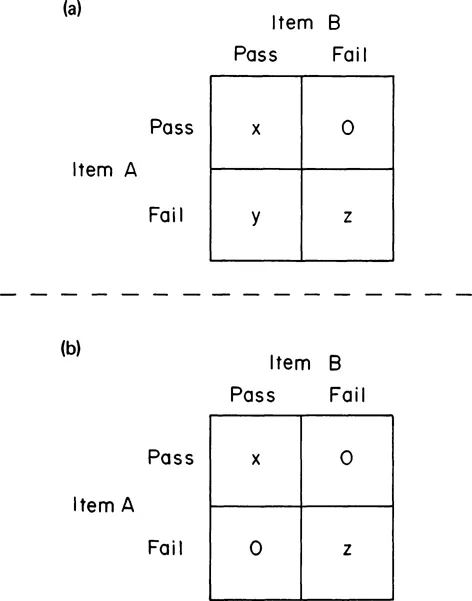
One fundamental problem in the study of cognitive development is the determination of the developmental relationship between particular cognitive skills. In the customary experimental paradigm, children are presented with a set of test items intended to tap the cognitive skills under investigation. The developmental sequence for any pair of items, A and B, can be determined by examining the fourfold table of passes and failures for the two items. For instance, if there are no occurrences in the pass A-fail B cell (Fig. 1.1a), then there exists strong evidence that the cognitive processes sufficient to pass item B are necessary to pass item 4; or, if the empty cells are pass A-fail B and fail A-pass B (Fig. 1.1b), then there is evidence that both skills appear simultaneously. The complexity of the questions raised by this problem is clearly illustrated by the research literature centered on the concept of “stage” in Piaget’s theory of intellectual development. A comprehensive review of this work has been recently provided by Pinard and Laurendeau (1969). One of the most controversial issues which they discuss stems from Piaget’s contention that all of the groupings underlying the stage of concrete operations “appear at the same time without our being able to seriate (them) into stages [Piaget, 1941, p. 246].” Their review of the studies aimed at evaluating this assertion provides an inconsistent picture: some of the results support synchronism while others reveal asynchronism.
In a careful analysis of the conceptual ambiguities inherent in the traditional view of stages, Flavell (1971) argues that much of this inconsistency can be attributed to an oversimplified view of what synchronism might mean. To say that two items (skills, rules, strategies, etc.) develop in synchrony could mean “that they begin their development at the same time, or conclude it (achieve functional maturity) synchronously, or both, or even neither (that is, have developmental courses which show some chronological overlap, but only in the middle regions) [Flavell, 1971, p. 450].”
It is extremely difficult to design experiments to resolve this issue, as the following consideration of methodological difficulties encountered by Smedslund (1964) will indicate. Smedslund attempted to determine the nature of the interrelations within a set of test items regarded as tapping specific aspects of Piaget’s level of concrete reasoning. Concrete reasoning is assumed to be reflected in certain types of inference patterns and, in Smedslund’s view, the unitary nature of the construct requires that these patterns should be exactly related. The results, however, revealed that not one of the fourfold tables covering the pass-fail relations between pairs of items contained an empty cell and, thus, none of the pairs of items exhibited an exact relationship. In addition none of the items were free from inconsistent subitem responses.
In searching for an explanation of the wide variations in children’s performance on the tasks, Smedslund hypothesized that the inconsistency and absence of exact relations might be due to the fact that the items could not be meaningfully compared, since they differed not only in the inference pattern involved, but also in the nature of the stimulus situations presented to the subjects and in the goal objects which they were instructed to attain. Exact relations between inference patterns might be discovered if goal objects and stimulus situations were held rigidly constant. Smedslund (1966a, b, c) attempted to do this in a further series of experiments. Due to the difficulty of retaining identical stimulus situations while varying the inference pattern under consideration, the focus of the work was a comparatively narrow task area. It involved comparisons of children’s ability to determine the effect of various combinations of addition and subtraction of one unit on the relative amount in two unseen collections which the subjects were informed were equal at the outset. Contrary to Smedslund’s expectations, even with these narrow tasks exact relations between items proved to be nonexistent. The results demonstrated that the same logical task structure, with identical perceptual and conceptual contents, may yield radically different solution frequencies depending, for example, merely on position in the series of tasks.
The lesson to be learned from these findings, Smedslund believes, is that tasks must be analyzed in much more detail than is provided by a description of their conventional logical structure. The general problem is to determine exactly how the input is encoded by the subject and what transformations occur between encoding and decoding. The objective task structure alone does not yield a valid description of the solution performance, and it is necessary to diagnose the actual psychological processes in great detail to obtain minute descriptions or well-supported inferences about the actual sequence and content of the thinking processes.
The Problem of Transition
A second basic issue posing intractable methodological problems is the question of the nature of the transition rule in cognitive development, that is, the mechanisms or processes which govern the child’s movement from state to state through the developmental sequence. The difficulties which characterize research on this theme are exemplified in the experimental studies aimed at determining the relative importance of the factors invoked by learning theories and Piaget’s concept of “equilibration” in accounting for the process of transition. As Laurendeau and Pinard (1962) have pointed out, an overview of the results of these studies leads to pessimism about the outcome of an experimental approach to the transition problem. The existing experimental results appear to be compatible both with Piaget’s position and with that of the protagonists of learning theory, and a solution is still awaited to the methodological problem of devising a series of critical experiments.
An important underlying cause of this situation appears to be the level of generality at which the theoretical accounts of transition are presented. The focus on change is, in general, imperfectly developed in Piaget’s formulation of intellectual development. As Wohlwill (1966) has indicated, for all its formal elaboration and complexity, Piaget’s system remains at base a structural analysis of children’s performance on cognitive tasks at different levels of their development. His treatment of the functional side of the problem, the nature of the processes by which these changes take place, is much less complete. With the solitary exception of an account of the appearance of conservation of continuous quantity couched in terms of the typical test situation, Piaget’s (1957, 1960) descriptions of the functioning of equilibration are highly general statements which do not deal with the particular mechanisms governing developmental changes or specify the conditions under which they take place.
The practical effects of this lack of an account of equilibration in specific process terms can be seen in the confusion surrounding the numerous experimental attempts to accelerate the appearance of the various conservations. Sigel and Hooper (1968) report a variety of competing acceleration treatments, all of which are regarded by their authors as being based on Piaget’s description of the underlying processes concerned. The absence of a precise process-performance link contributes to the extreme difficulty of putting Piaget’s account of transition to an experimental test, since the lack of specificity makes it all too easy to argue that a wide range of experimental results are compatible with his position.
These fundamental problems-stage and transition-are interrelated. The cognitive skills whose mastery defines a stage are operationally defined in terms of a set of tasks that have become classics in Piagetian literature (for example, class inclusion, transitivity, conservation). However, a careful analysis of the information-processing demands of the task variants indicates that we are dealing with a far from homogeneous entity, even when tasks are supposed to be identical. The difficulty compounds itself when procedural variations are introduced; for although we can record the gross effects of systematic procedural variations, we have no theoretical basis upon which to explain the effects of those variations or from which to derive new procedural variations. With respect to transition, in the absence of precise models of what it is that is going through transition, theories must remain vague and nonoperational.
The Information-Processing Paradigm
Faced with a segment of behavior of a child performing a task, we pose the question: “What would an information-processing system require in order to exhibit the same behavior as the child?” The answer takes the form of a set of rules for processing information: a computer program. The program constitutes a model of the child performing the task. It contains explicit statements about the capacity of the system, the complexity of the processes, and the representation of informationthe data structure-with which the child must deal.
Since the child’s behavior can be represented as a finite time sequence of symbols, there are, in principle, an infinite number of different models one could construct to account for the child’s performance. However, to gain even initial plausibility as psychological theories, such models might satisfy some general metatheoretical constraints. Simon (1972) lists four such criteria: (a) consistency with what we know of the physiology of the nervous system; (b) consistency with what we know of behavior in tasks other than the one under consideration; (c) sufficiency to produce the behavior under consideration; and (d) definiteness and concreteness.
With respect to the last criterion, one can view three levels of explanation in information-processing terms. At level I, the task-specific level, we have models that are designed to explain cognitive behavior for specific, narrowly defined, tasks, for example, playing games such as chess and checkers and solving problems such as series completion. Such models are usually stated as running programs that are sufficient to meet minimal performance criteria. At level II, the information-processing models are aimed at a general reformulation of a wider range of problems in terms of the requirements they impose on the organism. Th...
Table of contents
- Cover
- Half Title Page
- Title Page
- Copyright Page
- Original Title Page
- Original Copyright Page
- Dedication
- Table of Contents
- Preface
- 1. Toward an Information-Processing Solution to Some Problems in the Study of Cognitive Development
- 2. Quantitative Comparison: A Production System Model
- 3. Processes for Quantification
- 4. Class Inclusion
- 5. Conservation of Quantity
- 6. Transitivity of Quantity
- 7. The Organization of the Information-Processing System
- 8. The Development of the Information-Processing System
- References
- Author Index
- Subject Index
Trusted by 375,005 students
Access to over 1.5 million titles for a fair monthly price.
Study more efficiently using our study tools.
Frequently asked questions
Yes, you can cancel anytime from the Subscription tab in your account settings on the Perlego website. Your subscription will stay active until the end of your current billing period. Learn how to cancel your subscription
No, books cannot be downloaded as external files, such as PDFs, for use outside of Perlego. However, you can download books within the Perlego app for offline reading on mobile or tablet. Learn how to download books offline
We are an online textbook subscription service, where you can get access to an entire online library for less than the price of a single book per month. With over 1.5 million books across 990+ topics, we’ve got you covered! Learn about our mission
Look out for the read-aloud symbol on your next book to see if you can listen to it. The read-aloud tool reads text aloud for you, highlighting the text as it is being read. You can pause it, speed it up and slow it down. Learn more about Read Aloud
Yes! You can use the Perlego app on both iOS and Android devices to read anytime, anywhere — even offline. Perfect for commutes or when you’re on the go.
Please note we cannot support devices running on iOS 13 and Android 7 or earlier. Learn more about using the app
Please note we cannot support devices running on iOS 13 and Android 7 or earlier. Learn more about using the app
Yes, you can access Cognitive Development by David Klahr,J. G. Wallace in PDF and/or ePUB format, as well as other popular books in Psychology & History & Theory in Psychology. We have over 1.5 million books available in our catalogue for you to explore.