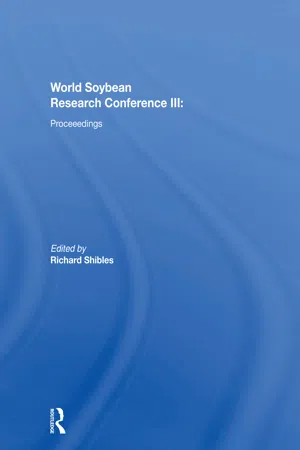
This volume consists of full length manuscripts of 159 of the 165 invited papers presented at World Soybean Research Conference III that was held in the Scheman Continuing Education Building at Iowa State University August 12-17, 1984. The authors, widely recognized as world authorities in their fields, represent all aspects of soybean research activity: breeding and genetics, crop and soil management, economics, entomology, food science, international programs, nematology, pathology, physiology, plant nutrition, rhizobiology, utilization, and weed science. This proceedings, which contains more than 1200 pages of information including many tables and figures, represents the most extensive compilation of soybean research results since the previous proceedings were published in 1980. It should be of value to research scientists, students and administrators alike.
- 1,282 pages
- English
- ePUB (mobile friendly)
- Available on iOS & Android
eBook - ePub
About this book
Information
BREEDING AND GENETICS
Plenary Paper BIOTECHNOLOGY AND ITS IMPACT ON FUTURE DEVELOPMENTS IN SOYBEAN PRODUCTION AND USE
DOI: 10.1201/9780429267932-46
Modern biotechnology is based on scientific advances that make it possible to isolate and clone specific pieces of DNA containing genes, and to sequence the nucleotides in a DNA molecule (i.e., read the genetic code), so that the precise location and structure of genes can be studied at the molecular level. These advances were fueled by major improvements in technique, by the discovery and exploitation of specialized enzymes (restriction endonucleases, DNA polymerases, reverse transcriptases, and ligases) with which DNA is manipulated, and the exploitation of plasmids (originally identified as sex factors in bacteria) with which DNA from any source can be amplified (cloned). Related advances make it possible to transfer genes from organism to organism by means that by-pass the normal sexual processes governing intraspecific inheritance (National Research Council, 1984). The purpose of this contribution is to survey the ways in which modern biotechnology has already had, and may in the future have, an impact on our understanding of the soybean. We shall review the prerequisites for genetic engineering of a crop plant with some examples of recent accomplishments with other species, and summarize soybean breeding objectives that might be amenable in the future to genetic engineering. Finally, we will summarize the current state of the art as regards soybeans.
As with any new field, terminology tends to grow quickly. The careful definition of the terms lags behind. New terms are invented and used in different ways by different people, or old terms accumulate new meanings, again often not very precisely. Here, then, are some definitions of terms as we shall use them.
Biotechnology: The application of recombinant DNA, cell and tissue culture, classical plant breeding and other methods used to develop new and improved plants and plant products. Because they are useful in crop production, genetically-engineered plant disease diagnostic tools and agricultural microbes can also be considered products of plant biotechnology.
Genetic Engineering: Genetic manipulations that use recombinant DNA methods (gene-splicing) to change the genetic make-up of an organism.
Gene Expression: Control of when the newly introduced genes are turned on and off during the life cycle of the recipient plant, and the levels at which the genes are working when turned on.
Gene Isolation: The identification of specific genes (each encoding a specific protein) responsible for a given genetic trait, and the isolation of those genes, usually via a bacterial plasmid or phage vector cloning system.
Gene Transfer (Transformation): The coding regions of isolated genes, along with appropriate regulatory signals, are moved into a recipient organism (in this case a crop plant) on a vector in such a way that the genes are integrated into the chromosome and expressed.
Plasmid: A relatively small, autonomous circular piece of DNA, not part of the chromosome, most common in bacteria. Their convenient size and ability to be moved from organism to organism make plasmids very useful in cloning genes and as vectors for inserting genes into cells.
Regeneration: The creation of a complete plant from a single plant cell or small piece of plant tissue. A regenerated plant thus is a clone of another plant. Regeneration can be a complex process involving multiple hormone, nutrient and growing condition treatments.
Vectors: Pieces of DNA that can move or be moved from one organism to another and survive in both. Genes can be spliced into a vector to be carried into another organism. Certain plasmids and viruses are useful vectors. Alternatively, vector systems can be based on other means of moving genes, such as microinjection, liposomes, or direct uptake of DNA from the medium.
BIOTECHNOLOGY AND SOYBEANS
Recent Applications of Biotechnology Methods to Soybean Research
Modern biology, including recombinant DNA and other related methods, has begun to have a major impact on our understanding of soybeans. This section is intended to present three brief examples.
The Stress Response. When organisms are placed in stressful situations, the machinery of gene expression and protein synthesis responds rapidly and often dramatically. Overall protein synthesis is reduced, and new proteins, not present in the absence of the stress, are produced. One of the best characterized plant species in this regard is the soybean, due to the work of Joe Key and his colleagues over the past several years. Briefly, soybean seedlings, or excised hypocotyls (cv. Wayne), when transferred from 28 C to 40 C produce a new set of proteins, called heat-shock or hs proteins, and cease to produce proteins that are normally produced in unstressed tissue (Key et al., 1981). These proteins are of low molecular weight (15–18,000 kD) and present a much more complex picture than that found in the well-studied heat-shock response of Drosophila (Schoffl and Key, 1983).
From the start, the study of this response, including its kinetics, its complexity, and its possible role in conferring thermal tolerance in soybeans (Lin et al., 1984) relied heavily upon molecular biology methods. Several genes encoding heat-shock proteins in soybeans have now been cloned and their structures are being studied. It is known that heat-shock genes occur in multigene families and that the genes of one class of such proteins may be clustered on the chromosome (Schoffl and Key, 1983).
Gene Structure. Soybean genes encoding glycinin, β-conglycinin, and lectin (the seed storage proteins), leghemaglobin, RuBP carboxylase, and actin have been cloned and at least partly characterized (Kitamura et al., 1984; Goldberg, 1983). The Lel gene for seed lectin in soybean (Vodkin et al., 1983) encodes a mature protein of 253 amino acids, plus a 32-amino acid signal sequence at the N-terminus; it is one of two known genes for lectin in the soybean genome (the other, Le2, apparently is not expressed in seeds). The mature protein is processed in-vivo after translation from the messenger RNA to remove the signal sequence. The signal sequence is presumed to be involved in the transport and/or compartmentalization of the mature protein into protein bodies in developing seeds. The Lel gene contains no introns (i.e., the mRNA is an unprocessed exact copy of the DNA in the coding region of the gene). Thus, it shares several properties with other more abundant seed proteins (no or few introns, signal sequences), but differs in being encoded by a single gene rather than by a multi-gene family (Goldberg, 1983).
Several soybean and Glycine soja genotypes phenotypically lack lectin (Le−). Such plants contain the coding region for Lel but it is interrupted (in the Le− genotype Sooty) approximately in the middle of the gene by a 3.4 kilobase sequence that has structural features of a transposable element (Vodkin et al., 1983). Thus, the absence of lectin in Le− plants is due not to the absence of the gene, but to its failure to function because of a large insertion in the coding sequence.
Nitrogen Fixation and the Rhizobium Symbiosis. Because molecular biology and recombinant DNA technology originated in the study of microorganisms and viruses, it is perhaps not surprising that the most rapid progress to date in agricultural biotechnology has been made in manipulation of plant-associated microorganisms. Of the 24 million hectares of soybeans grown annually in the U.S., some 12 million are inoculated with the nitrogen-fixing symbiont, Rhizobium japonicum. Strain selection and improvement has been an agricultural research goal for many years. Significant progress, due to biotechnology, may result from processes now under active investigation.
Strains presently in use often lack significant traits. For ...
Table of contents
- Cover
- Half Title
- Title
- Copyright
- Contents
- Foreword
- Preface
- Economics
- Utilization
- Breeding and Genetics
- Pathology
- Entomology
- Physiology
- Rhizobium
- Soil and Crop Management
- Weed Science
- Dimensions of World Production, Utilization, and Research
- Continuing Committee for World Soybean Research Conference-IV
- Constitution for World Soybean Research Conferences
- Author Index
Trusted by 375,005 students
Access to over 1.5 million titles for a fair monthly price.
Study more efficiently using our study tools.
Frequently asked questions
Yes, you can cancel anytime from the Subscription tab in your account settings on the Perlego website. Your subscription will stay active until the end of your current billing period. Learn how to cancel your subscription
No, books cannot be downloaded as external files, such as PDFs, for use outside of Perlego. However, you can download books within the Perlego app for offline reading on mobile or tablet. Learn how to download books offline
Perlego offers two plans: Essential and Complete
- Essential is ideal for learners and professionals who enjoy exploring a wide range of subjects. Access the Essential Library with 800,000+ trusted titles and best-sellers across business, personal growth, and the humanities. Includes unlimited reading time and Standard Read Aloud voice.
- Complete: Perfect for advanced learners and researchers needing full, unrestricted access. Unlock 1.5M+ books across hundreds of subjects, including academic and specialized titles. The Complete Plan also includes advanced features like Premium Read Aloud and Research Assistant.
We are an online textbook subscription service, where you can get access to an entire online library for less than the price of a single book per month. With over 1.5 million books across 990+ topics, we’ve got you covered! Learn about our mission
Look out for the read-aloud symbol on your next book to see if you can listen to it. The read-aloud tool reads text aloud for you, highlighting the text as it is being read. You can pause it, speed it up and slow it down. Learn more about Read Aloud
Yes! You can use the Perlego app on both iOS and Android devices to read anytime, anywhere — even offline. Perfect for commutes or when you’re on the go.
Please note we cannot support devices running on iOS 13 and Android 7 or earlier. Learn more about using the app
Please note we cannot support devices running on iOS 13 and Android 7 or earlier. Learn more about using the app
Yes, you can access World Soybean Research Conference III by Richard Shibles in PDF and/or ePUB format, as well as other popular books in Biological Sciences & Biology. We have over 1.5 million books available in our catalogue for you to explore.