In Creating a Reggio-Inspired STEM Environment for Young Children, the newest addition in the Redleaf Press Quick Guide series, award-winning educator Vicki Carper Bartolini offers practical suggestions and resources for rethinking your early learning environment with a focus on STEM, using the Reggio Emilia approach lens honoring a student-centered, self-guided curriculum based on principles of respect, responsibility, and community through exploration and play.
Creating a Reggio-Inspired STEM Environment for Young Children will inspire teachers and give them steps that they can take tomorrow after reading the book. ?Includes snapshot case studies of three programs that have brought their STEM environments to life.
- English
- ePUB (mobile friendly)
- Available on iOS & Android
eBook - ePub
Creating a Reggio-Inspired STEM Environment for Young Children
About this book
Information
Topic
EducationSubtopic
Classroom Management
CHAPTER 1: LESSONS LEARNED FROM REGGIO EMILIA

And our expectations of the child must be very flexible and varied. We must be able to be amazed and to enjoy, like the children often do. We must be able to catch the ball that the children throw us, and toss it back to them in a way that makes the children want to continue the game with us, developing, perhaps, other games as we go along.
—Tiziana Filippini, pedagogista and former director of the Documentation and Research Centre, Reggio Emilia, quoted in The Hundred Languages of Children, 3rd ed.
As with thousands of others who have been inspired by the Reggio philosophy, my thinking about the environment, particularly as it relates to STEM learning, transformed all of my professional work. I was surprised to notice how many of the Reggio investigations I observed or read about involve inquiry-based STEM learning. Whether children are studying the architecture of the buildings in their city or the mechanics of the curtains in a theater, they are consistently engaged in the 6Cs while conducting observations, collecting data, making predictions, and analyzing and evaluating data. Capturing children’s questions, assumptions, collaborations, misunderstandings, communications, revisions, findings, joy, and wonder as they experimented with the properties of water, gears and mechanical devices, and the chemical processes of cooking reinforced my thinking about children’s competencies and the importance of access to high-quality, playful learning experiences.
All children deserve wondrous, stimulating, and creative STEM learning environments where their amazements, curiosities, questions, and observations are valued. At the same time, all teachers deserve the opportunity and support to create such learning environments, ones that are inspiring and inviting to them as well. What I call “the Reggio way” provides a road map as to how this might be done, with emphasis on finding one thing to try tomorrow using everyday, low-cost (or no-cost), thoughtfully chosen materials. Throughout this book, I focus on the following elements that are central to my understanding of the Reggio philosophy:
1. Teachers in Reggio Emilia describe the classroom environment as the “third teacher.”
Typically preschool classrooms are staffed by two adults who scaffold and facilitate learning. In these early childhood Reggio centers, the environment is considered the third teacher, the laboratory where learning is supported and constructed. The intentional design of this environment fosters encounters, relationships, communication, and collaboration among children and adults. Provocations such as puzzling objects or items from nature spur surprise, wonder, curiosity, discussion, and further study. Children’s questions and interests evolve into investigations alongside their teachers. In this instructional and flexible space, studies unfold over time. Natural light, the color palette, and the careful selection and placement of materials create an inspiring instructional environment. Panels of children’s work reflect respect and trust in children’s competencies. The reader will find further discussion of the messages and values embedded in the environment (chapter 2), the use of time (chapter 3), the use of space (chapter 4), aesthetics (chapter 5), and the choice of materials (chapter 6).
2. Teachers in Reggio often describe their work with children as inquiry or research.
Practicing a “pedagogy of listening” prompted by children’s questions and interests, teachers collaboratively engage in investigations using scientific processes, or the inquiry method—what some in the United States call project-based learning. Together they make observations, gather information, analyze the data, propose solutions, and reflect on their new learning. Viewing the children as competent and capable, full of intelligence, the teachers trust that children can sustain their engagement with complex, child-generated topics over a period of time. Children collaborate to research a topic or problem of interest, coming up with their own ideas. Along the way, while listening to children, teachers provoke further curiosity and critical thinking by asking open-ended questions. Together teachers and children document the learning process and outcomes of their investigations, capturing aha moments for reflection and celebration (chapter 7). Some examples of inquiry-based or project-based learning include planting and tending a garden, cooking with vegetables and fruits, composting with worms, and observing and recording life cycles of plants and animals.
3. In creating a Reggio-inspired learning environment, teachers promote the 6Cs.
As described in Becoming Brilliant by Roberta Golinkoff and Kathy Hirsh-Pasek (2016), the 6Cs are collaboration, communication, content, critical thinking, creativity, and confidence. As the authors note, “In many ways, the Reggio approach to learning is a perfect example of the 6Cs at work in a school environment. Like the 6Cs, it was born from the science that views children not just as heads but as whole, active engaged people with social sides too” (264). In the Reggio-inspired environment, children collaborate and communicate as they plan a project that provides for the study of rich content. Using their creative and critical-thinking skills—observing, comparing and contrasting, predicting, analyzing, reflecting—they investigate their topic. Despite probable bumps and disagreements along the way, they build self-confidence, trust, and respect for one another as they satisfactorily document, complete, and share their investigation or project.
4. Teachers lead by example.
Throughout this book, I have sprinkled my beliefs about how important it is that we inspire children to marvel at, value, and care for the sacred web of life. Reggio educators strive to bring the outdoors in and the indoors out, understanding the learning opportunities found in nature. This commitment continues with their responsible and innovative use of the Remida, the Creative Recycling Centre. Here industries donate unused or scrap materials that teachers recycle and repurpose.
Self-Assessment Checklist
• What is the philosophy of your setting? Classroom? Preschool? Do you have a philosophy? How might the Reggio elements discussed in this book and the 6Cs connect with you or help you develop and make visible a living, breathing philosophy?
• What resources do you already have that you can build upon? What interesting materials might be available? Perhaps you have access to a safe neighborhood for outdoor adventures. Are you within walking distance of a park, library, museum, factory, pond, shady trees, or open field? Do you have parents, colleagues, or friends who might be willing to share their hobbies or expertise in STEM areas?
• Using guidelines from Susan Stacey’s book Inquiry-Based Early Learning Environments, “examine old scripts of ‘what should be’ in an early childhood environment” (2019, 14). She defines scripts as “long-held ways of doing things” that may have lost meaning or value in your setting. As you read, consider new scripts that can support your evolving philosophy as it pertains to the STEM early learning environment.

Snapshot: Elisabeth Amen Nursery School
The historic Elisabeth Amen Nursery School, situated on the campus of Wheaton College in Norton, Massachusetts, provides a private full and part-day preschool program. It serves as a lab for the psychology department and field placement site for the education department. Following a study trip with me to Reggio Emilia, the former director of the nursery school returned to this campus lab school questioning the “old scripts” and the messages and values promoted in the environment of their early childhood program. Her questioning was the start to many changes in the nursery school, continuing today with a passionate new director (a teacher who worked with the former director). For example, the entrance hallway (or what in Reggio would be considered a kind of piazza) is now valued as a place of intersection and social exchange for passing teachers, staff, children, parents, and college students who work at the nursery school. Documentation of the children’s investigations is showcased, promoting public discussion as passersby notice, question, interpret, and admire children’s work.
As the new director proudly notes, their entrance to the school conveys “respect for the child” and “the wonder of it all,” very much in keeping with the Reggio philosophy as well as with the 6Cs. However, as she notes, “Change is a process that takes time. It involves staff buy-in, figuring out things together, being afraid yet still taking risks, testing and revisiting, and of course finding resources.” They have found that establishing some long-term goals while working on one shortterm objective at a time helps them to maintain balance and perspective. Since 2014, their overarching long-term goal has been to transform their traditional playground into a playful outdoor, inquiry-based classroom, while also working to integrate the arts with inquiry-based learning (what some might call STEAM—science, technology, engineering, arts, and mathematics). Short-term objectives allow the parent advisory committee, in place for a two-year commitment, to focus their energies on a specific project while working toward the overarching long-term goal. Objectives have included purchasing a four-sided outdoor easel and providing a cover for the outside stage for children’s presentations. Working together on the outdoor classroom has forged a great partnership among families, local volunteers, and the staff. Snapshots of the Amen Nursery School throughout this book primarily focus on the ongoing development of their outdoor STEM learning environment.
Snapshot: Local Head Start Program
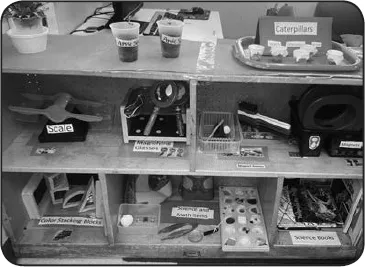
At the local Head Start, the director noted that STEM is now everywhere in the environment. Opportunities for hands-on exploration can be found all around the setting, including bookcases, shelves, the dramatic play area, in displays of children’s books, and outdoors. Teachers have made STEM tools such as scales, magnifying glasses, large magnets, blocks, and tweezers readily accessible for hands-on explorations. Children’s observations of life cycles are at eye level, encouraging questions, discussion, data analysis, and conclusions.
Comprehensive in its offerings, this part-day federally funded preschool program includes education, nutrition, medical, family support, transportation, and home visiting components. Children come from many backgrounds, often from families whose first language is not English. Entry into the program is based on income criteria. As a federal program, they must follow extensive regulations, including use of the required Creative Curriculum. A few years ago, Head Start programs began to emphasize the integration of STEM studies and experiences for children. Although the local Head Start program did not intentionally design their current program based on knowledge of the Reggio Emilia philosophy, they have found that, over time, they are uncovering and embracing many Reggio elements as they work to implement their curricular guidelines.
A few years ago, working with Wheaton College students, the director began a weekly STEM Day. College students planned and implemented the weekly activities. The director now describes STEM as having become more integrated, in “little ways” throughout each day, with the teachers and children no longer seeing “today” as STEM Day. She describes the teachers as beco...
Table of contents
- Cover
- Title Page
- Copyright
- Dedication
- Contents
- Acknowledgments
- Introduction: Lessons Learned from a Preschool Teacher
- Chapter 1: Lessons Learned from Reggio Emilia
- Chapter 2: Messages and Values in the STEM Environment
- Chapter 3: The Use of Time
- Chapter 4: The Use of Space
- Chapter 5: Aesthetics
- Chapter 6: Materials and Themes
- Chapter 7: The Teacher’s Role in the STEM-Centered Learning Environment
- Chapter 8: Resources for Setting Up a Reggio-Inspired STEM Environment
- References
Trusted by 375,005 students
Access to over 1.5 million titles for a fair monthly price.
Study more efficiently using our study tools.
Frequently asked questions
Yes, you can cancel anytime from the Subscription tab in your account settings on the Perlego website. Your subscription will stay active until the end of your current billing period. Learn how to cancel your subscription
No, books cannot be downloaded as external files, such as PDFs, for use outside of Perlego. However, you can download books within the Perlego app for offline reading on mobile or tablet. Learn how to download books offline
Perlego offers two plans: Essential and Complete
- Essential is ideal for learners and professionals who enjoy exploring a wide range of subjects. Access the Essential Library with 800,000+ trusted titles and best-sellers across business, personal growth, and the humanities. Includes unlimited reading time and Standard Read Aloud voice.
- Complete: Perfect for advanced learners and researchers needing full, unrestricted access. Unlock 1.5M+ books across hundreds of subjects, including academic and specialized titles. The Complete Plan also includes advanced features like Premium Read Aloud and Research Assistant.
We are an online textbook subscription service, where you can get access to an entire online library for less than the price of a single book per month. With over 1.5 million books across 990+ topics, we’ve got you covered! Learn about our mission
Look out for the read-aloud symbol on your next book to see if you can listen to it. The read-aloud tool reads text aloud for you, highlighting the text as it is being read. You can pause it, speed it up and slow it down. Learn more about Read Aloud
Yes! You can use the Perlego app on both iOS and Android devices to read anytime, anywhere — even offline. Perfect for commutes or when you’re on the go.
Please note we cannot support devices running on iOS 13 and Android 7 or earlier. Learn more about using the app
Please note we cannot support devices running on iOS 13 and Android 7 or earlier. Learn more about using the app
Yes, you can access Creating a Reggio-Inspired STEM Environment for Young Children by Vicki Carper Bartolini in PDF and/or ePUB format, as well as other popular books in Education & Classroom Management. We have over 1.5 million books available in our catalogue for you to explore.