When James Monroe became president in 1817, the United States urgently needed a national transportation system to connect new states and territories in the west with older states facing the Atlantic Ocean. In 1824, the Supreme Court declared that Congress had the power to regulate traffic on all navigable rivers and lakes in the United States. Congress began clearing obstructions from rivers, and these projects enabled steamboats to transform cross-country travel in the United States. This book explains how building a nationwide economic market was essential to secure the loyalty of geographically remote regions to the new republic. Aschenbrenner defends the activist role of President James Monroe (1817-1825) and Chief Justice John Marshall (1801-1835). Under their leadership, the federal government made national prosperity its 'Job One'. The market revolution transformed the daily lives of households and businesses in the United States and proved to Americans that they shared a common social and economic destiny. As Monroe declared at the conclusion of his Presidency: 'We find abundant cause to felicitate ourselves in the excellence of our institutions'.
eBook - ePub
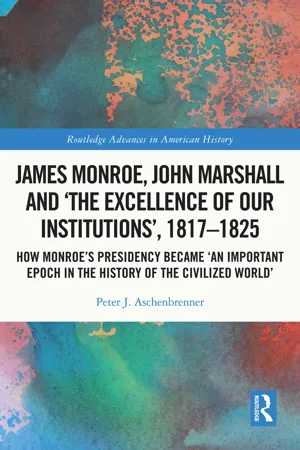
James Monroe, John Marshall and ‘The Excellence of Our Institutions’, 1817–1825
How Monroe’s Presidency Became 'An Important Epoch in the History of the Civilized World'
- 202 pages
- English
- ePUB (mobile friendly)
- Available on iOS & Android
eBook - ePub
James Monroe, John Marshall and ‘The Excellence of Our Institutions’, 1817–1825
How Monroe’s Presidency Became 'An Important Epoch in the History of the Civilized World'
1‘Westward the Course of Empire Takes Its Way’
DOI: 10.4324/9781003019381-2
‘A hut in the midst of the forest was a post-office’
Edmund Burke (1729–1797) was long dead by the time that Alexis de Tocqueville (1805–1859) and Gustave de Beaumont (1802–1866) toured the United States. The French government dispatched de Tocqueville and Beaumont across the North Atlantic to investigate prison conditions. Arriving in 1831, these two social scientists spent nine months touring the country. The American fascination for speed and novelty distracted de Tocqueville and Beaumont from their original purpose. De Tocqueville’s resulting travelogue and commentary De La Démocratie en Amérique/Democracy in America appeared in Paris in two volumes (1835, 1840). English translations followed in London and New York.1 De Tocqueville recorded the following anecdote. Traveling the back country of North Carolina, he reported that ‘from time to time we came to a hut in the midst of the forest; this was a post-office. The mail dropped an enormous bundle of letters at the door of this isolated dwelling, and we pursued our way at full gallop, leaving the inhabitants of the neighboring log houses to send for their share of the treasure’.2 De Tocqueville equated the incoming letters and newspapers that residents might collect as their ‘treasure’.
In December 1830, Postmaster General W.T. Barry reported to Congress on the operations of the Post Office Department. Barry assured Senators and Representatives that the financial condition of the Post Office was sound. The Department’s books reflected a surplus of $148,724.22. The Department had, as Barry declared, ‘fulfilled all anticipations of its efficiency’.3 Moreover, the Post Office stood ready to take on more projects. ‘In the several States, improvements in mail facilities have been loudly called for’.4 On Barry’s account Americans needed more than the 8,401 post offices that his department was operating throughout the United States. One of these was De Tocqueville’s ‘hut in the midst of the forest’. Such a ‘hut’ satisfied a remote community’s need for basic services. The ‘growing population and extending settlements of the country’, Barry informed Congress, ‘have absolutely required them’. Americans were ‘loudly’ demanding postal services, Barry reported. This clamor, he judged, proved that Americans were underserved.5 Barry was adept at dabbing the canvas with a nationwide brush. Beginning in 1831, the Postmaster General promised Congress, ‘the mail will run from this city [Washington, D.C.] to New Orleans in thirteen days’.6 The ‘whole yearly transportation in coaches, steamboats, sulkeys, and on horseback, amounted to about 14,500,000 miles’.7 Edmund Burke, however, warned governments with republican tendencies that unleashing consumer demand for their services would be the first step on the road to anarchy (1790). ‘By having a right to every thing they want every thing’.8 If your neighbors were enjoying postal services, why should you sacrifice your appetite for government offerings on the altar of Burkean thunderings? Barry took full credit for his department’s accomplishments, while also disclosing operational details that readers could employ to assess his department’s administrative competence. There are ‘rules that have been adopted in relation to the conduct of postmasters’. These norms guided and governed the behavior of official in the Post Office Department; their purpose was to root out ‘official delinquencies’ and correct ‘losses’ caused by such misbehavior. What was required was the ‘unremitted and undivided attention of a competent officer’.9
‘Bureaucratic agenda’ is my term for the official face that a department exhibits to Congress. In this regard the institution’s purpose is to secure ‘a degree of confidence in the fidelity of its officers’, as Barry put the matter. Barry’s ‘officers’ are the federal officials that a department (agency) tasks to fulfill the will of Congress.
‘Bureaucratic autonomy’ is my term for the human face that an institution agent exhibits to consumers of its goods and services. Barry assured his readers that his department achieved ‘increased expedition of the mails on many routes of great interest’. Barry referred to the introduction in North Carolina of ‘a line of stages from Edenton to Washington’ and a ‘steamboat line from Wilmington to Smithville … to run twice a week each way’. Touching a note of interest to modern and post-modern readers, Barry assured Congress that the price of postage would remain the same. ‘The current revenue of the Department for the succeeding year will be sufficient for its disbursements’.10
‘The sea-coast exclusively enjoyed the benefit of speedy conveyance’
As the 1st Congress, 3rd Session reached the midpoint of its legislative life, John Steele – a Federalist Congressman from North Carolina – rose to speak in the House of Representatives. As of 31 January 1791, the House was – for the third and final time – postponing action on postal route designations. Congress bobbled its obligation to legislate programmatic action and Steele was not happy about it. The Congressman argued that Congress should settle the matter by naming towns and villages to serve as beginning, middle and end points in a national postal network. On three occasions, however, the 1st Congress surrendered to President Washington the power to designate postal routes.11 Rep. Steele also observed that, ‘upon the president’s establishment of the principal post-road, a considerable and populous part of North Carolina derived no advantage from the establishment, and the sea-coast exclusively enjoyed the benefit of regular and speedy conveyance for their correspondences, and thus the agricultural interest was sacrificed to the commercial’.12 I will return to this intrastate dispute over postal routes shortly.
It was not until February 1792 – during the 2nd Congress, 1st Session – that the House of Representatives resolved the delegation issue. I refer to the Act of February 20, 1792.13 That statute chartered the modern Post Office Department, the predecessor to the United States Postal Service. In so doing, Congress anticipated Postmaster Gen. Barry’s declaration that the ‘growing population and extending settlements of the country have absolutely required’ delivery of postal services on a nationwide scale (1830).14 Lessons learned in 1792: if the country ‘absolutely required’ programmatic action, Congress would get its hands dirty with the necessary details.
Congress crafted the Act of February 20, 1792 as an exercise in batch-processing. Accordingly, the members of the House of Representatives named 206 places in Section 1 of the Act of February 20, 1792. Congress designated the postal route from Wilmington DE to Dover DE, for example, to run from ‘Newcastle [to] Cantwell’s Bridge and Duck Creek’. This route offered scenic views of the Delaware River. Steele drew attention to another facet of batch-processing. It is one thing for a parliamentary assembly to resolve competition for post office facilities between Rhode Island and Georgia. Intrastate allocation was also an issue. Steele noted that North Carolina’s ‘sea-coast exclusively enjoyed the benefit [of postal services] and thus the agricultural interest was sacrificed to the commercial’.15 Constitution II assigned North Carolina five Representatives.16 Presumably the five North Carolina Congressmen serving in the 2nd Congress, 1st Session were unable to settle conflicting intrastate demands for postal services. If North Carolina’s Congressmen could not settle these disputes, their colleagues in the House would be obliged to do it for them.
Congress pointedly refused to fund the post office with funds appropriated from Treasury revenues. Section 28 of the Act of February 20, 1792 made this clear by dedicating a ‘surplus’ from any calendar year to the purpose of ‘defraying any deficiency’ carried over from the prior year.17 Delivery of postal services expanded from 200 locations (1792) to over 8,400 (1830), a 42-fold increase. Consumers of postal services funded this expansion. Efficiency in delivering services was therefore a paramount goal. Only by encouraging consumers to accept their collective role as a funding vehicle for future expansion could unserved communities get their mail at de Tocqueville’s hut in the back country.18 Congress was well aware that achieving efficiencies called for energy-saving measures. In one case Congress assigned a fixed value to time wasted. ‘And if any ferryman shall, by willful negligence, or by refusal to transport the mail across any ferry, delay the same, he shall forfeit and pay for each half hour that the same shall be so delayed, a sum not exceeding ten dollars’.19
There were alternatives to batch-processing. Congress designated a single postal route to run ‘from Albany [NY] to Bennington [VT]’,20 on 3 March 1791, the day before Vermont joined the Union.21 In the interval 1792 to 1837, however, Congress rarely employed a one-off approach.22 The term ‘brokerage’ requires further attention. ‘It required an extraordinary degree of resolution in a public man’, Van Buren declares, ‘to attempt to resist a passion that had become so rampant’. It became the task of Congressional legislators to transform Van Buren’s lust for a ‘thousand local improvements’ into batches of semi-regimented sentences.23 This is the chokepoint through which policy must be filtered to achieve its formal (and final) expression. Statutory text – on this or the other side of the pond – need not be composed by lawyers. If read aloud, however, statutes must sound like lawyers wrote them.
‘The Yeas and Nays shall be entered on the Journal’
The House Journal for the 2nd Congress, 1st Session discloses that members did not take a roll call vote on the bill that became the Act of February 20, 17...
Table of contents
- Cover Page
- Half-Title Page
- Series Page
- Title Page
- Copyright Page
- Dedication Page
- Contents
- Foreword
- Acknowledgments
- Introduction: ‘Destinies Beyond the Reach of Mortal Eye’
- 1 ‘Westward the Course of Empire Takes Its Way’
- 2 ‘To Adopt a System of Internal Improvement’
- 3 ‘Powers to Create and to Preserve’
- 4 ‘Captivating Improvements to Seduce Their Constituents’
- 5 ‘There Is More Than One Mode of Accomplishing the End’
- 6 ‘To Protect the Public Industry from Parasite Institutions’
- 7 ‘An Important Epoch in the History of the Civilized World’
- Appendix A: Survey of 1,147 Improvement Projects
- Appendix B: Railroads Subsidized via Federal Land Grants
- Appendix C: The Political Governance and Resource Exploitation Clauses
- Appendix D: The Cumberland Road
- Appendix E: The ‘Two Governments’ Formula
- Appendix F: Technical Appendix and Editorial Practices
- Appendix G: Public History, Practice and Purpose
- Appendix H: James W. McCulloch, John Marshall and the US Sinking Fund
- Appendix I: Comparing and Contrasting Nations and Cultures in The Federalist
- Appendix J: Marshall and Monroe Discuss the ‘Views’
- Appendix K: The Bonus Bill (1817) and the 1818 House Resolution.
- Appendix L: Unravelling the Northwest Ordinance
- Index
Trusted by 375,005 students
Access to over 1.5 million titles for a fair monthly price.
Study more efficiently using our study tools.
Frequently asked questions
Yes, you can cancel anytime from the Subscription tab in your account settings on the Perlego website. Your subscription will stay active until the end of your current billing period. Learn how to cancel your subscription
No, books cannot be downloaded as external files, such as PDFs, for use outside of Perlego. However, you can download books within the Perlego app for offline reading on mobile or tablet. Learn how to download books offline
Perlego offers two plans: Essential and Complete
- Essential is ideal for learners and professionals who enjoy exploring a wide range of subjects. Access the Essential Library with 800,000+ trusted titles and best-sellers across business, personal growth, and the humanities. Includes unlimited reading time and Standard Read Aloud voice.
- Complete: Perfect for advanced learners and researchers needing full, unrestricted access. Unlock 1.5M+ books across hundreds of subjects, including academic and specialized titles. The Complete Plan also includes advanced features like Premium Read Aloud and Research Assistant.
We are an online textbook subscription service, where you can get access to an entire online library for less than the price of a single book per month. With over 1.5 million books across 990+ topics, we’ve got you covered! Learn about our mission
Look out for the read-aloud symbol on your next book to see if you can listen to it. The read-aloud tool reads text aloud for you, highlighting the text as it is being read. You can pause it, speed it up and slow it down. Learn more about Read Aloud
Yes! You can use the Perlego app on both iOS and Android devices to read anytime, anywhere — even offline. Perfect for commutes or when you’re on the go.
Please note we cannot support devices running on iOS 13 and Android 7 or earlier. Learn more about using the app
Please note we cannot support devices running on iOS 13 and Android 7 or earlier. Learn more about using the app
Yes, you can access James Monroe, John Marshall and ‘The Excellence of Our Institutions’, 1817–1825 by Peter J. Aschenbrenner in PDF and/or ePUB format, as well as other popular books in History & Early Modern History. We have over 1.5 million books available in our catalogue for you to explore.