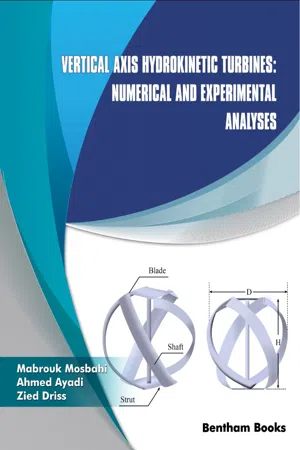
This handbook is a guide to numerical and experimental processes that are used to analyze and improve the efficiency of vertical axis rotors. Chapters present information that is required to optimize the geometrical parameters of rotors or understand how to augment upstream water velocity. The authors of this volume present a numerical model to characterize the water flow around the vertical axis rotors using commercial CFD code in Ansys Fluent®. The software has been used to select adequate parameters and perform computational simulations of spiral Darrieus turbines. The contents of the volume explain the experimental procedure carried out to evaluate the performance of the spiral Darrieus turbine, how to characterize the water flow in the vicinity of the tested turbine and the method to assess the spiral angle influence on the turbine performance parameters. Results for different spiral angles (ranging from 10° to 40°) are presented. This volume is a useful handbook for engineers involved in power plant design and renewable energy sectors who are studying the computational fluid dynamics of vertical axis turbines (such as Darrieus turbines) that are used in hydropower projects. Key features: - 4 chapters that cover the numerical and experimental analysis of vertical axis rotors and hydrokinetic turbines - Simple structured layout for easy reading (methodology, models and results) - Bibliographic study to introduce the reader to the subject - A wide range of parameters included in experiments - A comprehensive appendix of tables for mechanical parameters, statistical models, rotor parameters and geometric details.
eBook - ePub
Vertical Axis Hydrokinetic Turbines: Numerical and Experimental Analyses: Volume 5
- English
- ePUB (mobile friendly)
- Available on iOS & Android
eBook - ePub
Vertical Axis Hydrokinetic Turbines: Numerical and Experimental Analyses: Volume 5
About this book
Information
Topic
Physical SciencesSubtopic
EnergyBibliographic Study
Mabrouk Mosbahi, Ahmed Ayadi, Driss Zied
1. Introduction
Recently, electricity is known to be an essential requirement indicating the modernity of a society. It is considered a needed component in the development of a country. In fact, basic human needs, such as health, transport, food, and education, are based on electrical energy (Jorgenson et al., 2014). There are several technologies accessible that could be used to provide electricity to the whole world. Fossil fuels are among the most important sources of energy. People use coal, petroleum, oils, and natural gas to fulfill their needs in terms of powering vehicles and electricity production.
As a consequence of the extreme utilization of non-renewable energy sources, the exhaustion of these sources has become threatening to humanity. The continued demand has grown beyond its peak in recent years. Owing to the extravagant utilization of non-renewable energy sources, the world also has been facing environmental problems related to the emission of a huge amount of pollutants (Apergis et al., 2014). The utilization of sustainable energy sources is necessary to lower greenhouse gas emissions in the atmosphere (Chang et al., 2003). The solar, geothermal, biomass, water, and wind sources are considered important sources in many areas of applications. Among these sources of green energy, hydropower is a renewable energy source that will possibly be developed in the future (Paish, 2002). Although hydropower can not completely replace the traditional sources of energy, it can be an interesting and green substitute.
2. Hydropower
The hydrological cycle, which is also known as the water cycle, fuels hydropower. In fact, the heat produced by the solar radiation evaporates the water contained on the earth’s surface, which turns into clouds and rain (Yüksel, 2010). Water runoff is produced by the rain which falls on the land surfaces. Waterpower is a sustainable and renewed source of energy as long as the sun shines since solar energy powers the hydrological cycle. Since antiquity, it has been used by humans to survive. In fact, there are different types of applications (Peng and Guo, 2019).
Fig. (1) presents the share of renewable energy sources in the global electricity system in 2016. From this Figure, it has been noted that waterpower is the most widely used for electricity generation (16.6%) compared to wind, solar, and other renewables. Hydropower plants can be classified into four major kinds, such as run (Killingtveit, 2019).

Share of renewables in the global electricity system 2016 (Killingtveit, 2019).
2.1. Run-of-river Hydropower Plants
A run-of-river hydropower plant is a hydroelectric system that generates electrical power from the available flow of the river. In fact, the water current is diverted from the river and guided in a penstock, as shown in Fig. (2). The run-of-river hydropower plant differs from other hydropower plants types in the absence of a reservoir and large dam. However, a small dam can sometimes be used to ensure enough water goes in the penstock. In addition, some storage capacity can be used for a few hours.
2.2. Storage Hydropower Plants
This water power plant is characterized by the presence of a water tank, as presented in Fig. (3). The confined water is released for eventual consumption. The stored water in the reservoir furnishes flexibility to produce electrical power on need and lowers dependency on the water current change. A huge reservoir could stow water for a long time. However, the used reservoir for a storage hydropower plant is designed for seasonal storage. Compared to the run of river water power plant, the storage water power plant presents various advantages such as:

Run-of-river hydropower plant (Breeze, 2018).

Storage hydropower plant (Breeze, 2018).
- Provides the possibility to stow big volumes of energy.
- Provides the possibility to control water flows.
- The storage reservoir is a multipurpose system.
2...
Table of contents
- Welcome
- Table of Content
- Title
- BENTHAM SCIENCE PUBLISHERS LTD.
- PREFACE
- Bibliographic Study
- Numerical Parameters Effect
- Investigation of Spiral Darrieusturbine
- Performance Investigation of Spiral and Spherical Turbines
- Glossary
- References
Trusted by 375,005 students
Access to over 1.5 million titles for a fair monthly price.
Study more efficiently using our study tools.
Frequently asked questions
Yes, you can cancel anytime from the Subscription tab in your account settings on the Perlego website. Your subscription will stay active until the end of your current billing period. Learn how to cancel your subscription
No, books cannot be downloaded as external files, such as PDFs, for use outside of Perlego. However, you can download books within the Perlego app for offline reading on mobile or tablet. Learn how to download books offline
Perlego offers two plans: Essential and Complete
- Essential is ideal for learners and professionals who enjoy exploring a wide range of subjects. Access the Essential Library with 800,000+ trusted titles and best-sellers across business, personal growth, and the humanities. Includes unlimited reading time and Standard Read Aloud voice.
- Complete: Perfect for advanced learners and researchers needing full, unrestricted access. Unlock 1.5M+ books across hundreds of subjects, including academic and specialized titles. The Complete Plan also includes advanced features like Premium Read Aloud and Research Assistant.
We are an online textbook subscription service, where you can get access to an entire online library for less than the price of a single book per month. With over 1.5 million books across 990+ topics, we’ve got you covered! Learn about our mission
Look out for the read-aloud symbol on your next book to see if you can listen to it. The read-aloud tool reads text aloud for you, highlighting the text as it is being read. You can pause it, speed it up and slow it down. Learn more about Read Aloud
Yes! You can use the Perlego app on both iOS and Android devices to read anytime, anywhere — even offline. Perfect for commutes or when you’re on the go.
Please note we cannot support devices running on iOS 13 and Android 7 or earlier. Learn more about using the app
Please note we cannot support devices running on iOS 13 and Android 7 or earlier. Learn more about using the app
Yes, you can access Vertical Axis Hydrokinetic Turbines: Numerical and Experimental Analyses: Volume 5 by Mabrouk Mosbahi,Ahmed Ayadi,Zied Driss in PDF and/or ePUB format, as well as other popular books in Physical Sciences & Energy. We have over 1.5 million books available in our catalogue for you to explore.