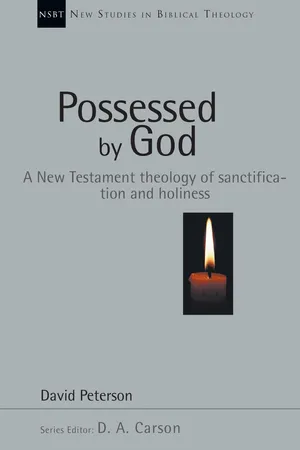
In this New Studies in Biblical Theology volume, David Peterson challenges the common assumption that the New Testament views sanctification as primarily a process. He argues that its emphasis falls upon sanctification as a definitive event, "God's way of taking possession of us in Christ, setting us apart to belong to him and to fulfill his purpose for us." Simply to identify sanctification with growth and holiness, he contends, obscures the emphasis and balance of New Testament teaching and creates unrealistic expectations. Throughout this study Peterson builds his case on the careful exegesis of relevant passages, with a keen eye for the pastoral implications of his findings.Addressing key issues in biblical theology, the works comprising New Studies in Biblical Theology are creative attempts to help Christians better understand their Bibles. The NSBT series is edited by D. A. Carson, aiming to simultaneously instruct and to edify, to interact with current scholarship and to point the way ahead.
eBook - ePub
Possessed by God
A New Testament theology of sanctification and holiness
- 191 pages
- English
- ePUB (mobile friendly)
- Available on iOS & Android
eBook - ePub
Possessed by God
A New Testament theology of sanctification and holiness
About this book
Information
Topic
Theology & ReligionSubtopic
Biblical StudiesChapter One
The biblical starting-point
Christians at the end of the twentieth century may be surprised to discover how controversial the doctrine of sanctification has been throughout history. Vigorous debates have taken place about the nature of holiness and how it is acquired.1 In some quarters, sanctification has been almost exclusively understood in ritual terms. In others, it has been associated with asceticism and various forms of self-discipline. More commonly, however, it has been explained as a process of moral and spiritual transformation, flowing from justification by faith.
From the moment of initiation into Christ, growth in holiness has been expected in the context of everyday life and experience. Change has been viewed as the work of the Holy Spirit, but with varying degrees of emphasis on human effort and the need to follow humanly-devised programmes for transformation. Progress has sometimes been sought by withdrawal from the world, to encounter God through individual spiritual exercises.
Some Christian traditions have highlighted the need for a crisis experience for sanctification. This has been sought as the gift of God in answer to faith, as a ‘second blessing’ beyond conversion. Various ‘higher-life’ movements have combined such teaching with different degrees of perfectionism. Adherents have been encouraged to expect miraculous character transformation or a new level of spirituality, making possible significant progress in holiness.
Theology and biblical interpretation
Why do Christians differ so much on a topic like this? Fundamentally because of the way we interpret Scripture. A primary task for theologians is to survey the Bible’s teaching on a given subject and to show how the evidence can be meaningfully arranged and expressed. An associated task is to show how the doctrine that is formulated relates to other biblical themes. Much confusion about sanctification has arisen because these theological activities have been pursued in ways that are methodologically unsound.
In the first place, inadequate attention has been paid to the use of holiness terminology in the New Testament and to passages which deal specifically with the subject of sanctification. Presuppositions about its nature and purpose seem to have determined the selection and interpretation of key texts. Writers have often been preoccupied with establishing the place of sanctification within the framework of a given theological system rather than letting the biblical evidence speak for itself. For many, sanctification has become such a broad concept that its particular New Testament meaning has been obscured. Most importantly, the background of Old Testament theology, which regularly shapes the writings of the New Testament, has not been sufficiently taken into account.
With such problems in mind, my plan is firstly to explore the theological roots of New Testament thinking in a broad survey of Old Testament principles and practices. I will then examine the way New Testament writers adapt the concepts of sanctification and holiness that were part of their biblical inheritance. From time to time, critical passages will be approached in the light of later doctrinal questions and debates. Related passages and themes will then be discussed in connection with the teaching of those key passages. The overall aim will be to hear afresh God’s challenge to holiness, encouraged by the promises on which it is grounded and guided by the teaching with which it is associated.
The holiness of God
First and foremost, holiness in Scripture is a description of God and his character. God is regularly identified as ‘the Holy One’ (e.g. Jb. 6:10; Is. 40:25; 43:15; Ezk. 39:7; Ho. 11:9; Hab. 1:12; 3:3) or ‘the Holy One of Israel’ (e.g. 2 Ki. 19:22; Is. 1:4; 43:3; Je. 50:29; 51:5). Isaiah describes him more completely as ‘the high and lofty one who inhabits eternity, whose name is Holy’ (Is. 57:15). Yet the same prophet goes on to indicate that the Lord who dwells in ‘the high and holy place’ dwells also with ‘those who are contrite and humble in spirit’.
A synonym for deity
So essential is holiness to God’s character that when Amos speaks of him swearing ‘by his holiness’ (Am. 4:2), it is the same as saying ‘the Lord God has sworn by himself (Am. 6:8). God’s ‘arm’, God’s word and God’s spirit are all holy because they belong to him (e.g. Is. 52:10; Ps. 105:42; Is. 63:10). Since God’s name is so closely associated with his character and person, there is much in the Old Testament about not profaning his holy name (e.g. Ex. 20:7; Lv. 20:3; Ezk. 20:39; 36:20; Am. 2:7). Rather, Israel is to trust in his name, to glory in it and to bless it (e.g. Ps. 33:21; 1 Ch. 16:10; Ps. 103:1).
The root meaning of the Hebrew noun ‘holiness’ (qōḏeš) and the adjective ‘holy’ (qāḏôš) is separation.2 The Greek Bible uses hagios and some of its derivatives as the equivalent of the Hebrew. This terminology refers to the distinctness or otherness of God’s character, activities and words. God’s holiness is particularly associated with his majesty, sovereignty and awesome power (e.g. Ex. 15:11–12; 19:10–25; Is. 6:1–4). As the one who is supreme over all, he is transcendent, exalted and different from everything he has made. He cannot be compared with the gods of human imagination or be judged by human standards.
God is separate and distinct because he is God. He is not separated from this, that, or the other because of any of his attributes or qualities or the like (Snaith 1944: 30).3
God alone is holy in himself.
An important dimension to God’s separateness and distinctness is his moral purity and perfection. He is presented in the Old Testament as ethically unique, ‘too pure to behold evil’ and unable to tolerate wrong (Hab. 1:12–13; cf. Is. 1:4–20; 35:8). He must act with holy justice when his people rebel against him, yet his love will not allow him to wipe them out. Speaking through Hosea, he explains his restoration of them in these terms, ‘for I am God and no mortal, the Holy One in your midst, and I will not come in wrath’ (Ho. 11:9). This means that his love is also ‘holy’. God loves with an incomparable and distinctive love.
The holiness of God revealed
From the time of the exodus from Egypt, the Lord was recognized by Israel as being ‘majestic in holiness, awesome in splendour, doing wonders’ (Ex. 15:11).4 The defeat of Pharaoh and his gods and the passage of Israel through the sea revealed the uniqueness of the God who had always been there, sustaining his creation, making promises to the patriarchs and fulfilling his plans. ‘The Song of Moses’ declares that the Lord, though different from the gods of human imagination, and finally beyond description, had been met in history – in his saving acts and in the revelation of his glory associated with those wonderful deeds.
There were two sides to God’s holiness which Israel witnessed in the exodus and subsequently. He brought judgment upon those who flouted his purposes and salvation to those who trusted in him. At Mount Sinai, the revelation of his holiness made him seem threatening and unapproachable (Ex. 19:10-25; cf. Jos. 24:19; 1 Sa. 6:20). But the giving of the law was an expression of his mercy and grace and a sign of his intention to dwell among his people as ‘the Holy One’ (cf. Ex. 29:42–46; Ho. 11:9; Is. 57:15). The tabernacle in the wilderness and the temple in Jerusalem were to be the physical means of identifying and responding to his kingly presence in their midst.
At a later stage in Israel’s history, the prophet Isaiah had a vision of the holiness of God encapsulating much of what had been revealed before. The Lord appeared to him in the Jerusalem temple as king of the universe, enthroned in a heavenly palace (Is. 6:1–4), with his supernatural attendants proclaiming: ‘Holy, holy, holy is the LORD of hosts; the whole earth is full of his glory’.5 Even though the holiness of God cannot be adequately conveyed in vision or word, angelic beings declared that it could be encountered in our universe, which is like a vast temple dedicated to his use and the display of his glory. God’s glory is his holiness revealed.
Overcome and exposed by what he experienced, the prophet confessed that there was no hope for him or for rebellious Israel in the presence of such a God. ‘Woe is me! I am lost,’ he said, ‘for I am a man of unclean lips, and I live among a people of unclean lips; yet my eyes have seen the King, the LORD of hosts!’ (Is. 6:5). As the representative of God’s people, Isaiah acknowledged their rejection of God’s rule and their failure to worship him appropriately. Judgment on their sin would inevitably follow. With a burning coal from the altar of incense, however, a seraph expressed God’s extraordinary mercy: ‘Now that this has touched your lips, you...
Table of contents
- Cover
- Titles in this series
- Title Page
- Dedication Page
- Contents
- Series preface
- Preface
- Abbreviations
- Introduction
- Chapter One: The biblical starting-point
- Chapter Two: Sanctified in Christ
- Chapter Three: Sanctified by word and Spirit
- Chapter Four: Pursuing holiness
- Chapter Five: Living between the cross and the resurrection
- Chapter Six: Transformation, renewal and growth
- Appendix A: The meaning of hagiasmos in the New Testament
- Appendix B: Sanctification and God’s law
- Notes
- Index of Scripture references
- Index of modern authors
- Bibliography
- Praise for Possessed by God
- About the Author
- More Titles from InterVarsity Press
- Copyright
Trusted by 375,005 students
Access to over 1.5 million titles for a fair monthly price.
Study more efficiently using our study tools.
Frequently asked questions
Yes, you can cancel anytime from the Subscription tab in your account settings on the Perlego website. Your subscription will stay active until the end of your current billing period. Learn how to cancel your subscription
No, books cannot be downloaded as external files, such as PDFs, for use outside of Perlego. However, you can download books within the Perlego app for offline reading on mobile or tablet. Learn how to download books offline
Perlego offers two plans: Essential and Complete
- Essential is ideal for learners and professionals who enjoy exploring a wide range of subjects. Access the Essential Library with 800,000+ trusted titles and best-sellers across business, personal growth, and the humanities. Includes unlimited reading time and Standard Read Aloud voice.
- Complete: Perfect for advanced learners and researchers needing full, unrestricted access. Unlock 1.5M+ books across hundreds of subjects, including academic and specialized titles. The Complete Plan also includes advanced features like Premium Read Aloud and Research Assistant.
We are an online textbook subscription service, where you can get access to an entire online library for less than the price of a single book per month. With over 1.5 million books across 990+ topics, we’ve got you covered! Learn about our mission
Look out for the read-aloud symbol on your next book to see if you can listen to it. The read-aloud tool reads text aloud for you, highlighting the text as it is being read. You can pause it, speed it up and slow it down. Learn more about Read Aloud
Yes! You can use the Perlego app on both iOS and Android devices to read anytime, anywhere — even offline. Perfect for commutes or when you’re on the go.
Please note we cannot support devices running on iOS 13 and Android 7 or earlier. Learn more about using the app
Please note we cannot support devices running on iOS 13 and Android 7 or earlier. Learn more about using the app
Yes, you can access Possessed by God by David G. Peterson, D. A. Carson in PDF and/or ePUB format, as well as other popular books in Theology & Religion & Biblical Studies. We have over 1.5 million books available in our catalogue for you to explore.