eBook - ePub
Rewriting Indian History
Colonial Encounter in Basavaraj Naikar’s The Queen of Kittur
- English
- ePUB (mobile friendly)
- Available on iOS & Android
eBook - ePub
Rewriting Indian History
Colonial Encounter in Basavaraj Naikar’s The Queen of Kittur
About this book
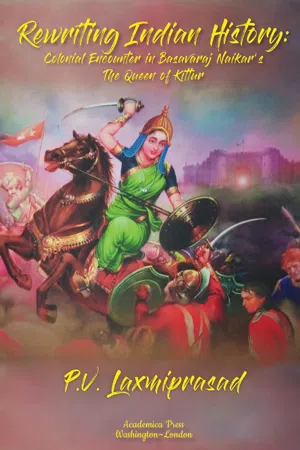
Basavaraj Naikar's The Queen of Kittur delineates the history of Pre-Independent India during the East India Company. The colonial encounter that it significantly deals with was fought between the Queen of Kittur – (Rani Chennamma) and the authorities of the East India Company around 1824 for land and political power. Although the Queen put up a heroic fight with the East India Company and succeeded in killing Thackeray, the political agent of South India and Collector of Dharwad, she was eventually betrayed by her courtiers later, and as a result, her kingdom was annexed to the British Raj, and she was imprisoned in her own fort at Balihongala, where she breathed her last in 1829 after suffering from nostalgia for the past glory of her kingdom. The Queen represents a typical example of Female heroism, sheer bravery and valiant fighting tactics – all depicting the icon of Women Empowerment in current times. History is absorbing and refreshing in the novel. Naikar investigates the history of the particular period in India and justifies substantially the patriotism of the Queen of Kittur in a gripping narration. The theme of honour and glory; patriotism and freedom; betrayal and defeat of the royal family of Kittur kingdom are succinctly highlighted. The spirit of freedom serves as a model to the entire womankind. The novelist has immortalized the Queen of Kittur through the historical novel. It is in other words re-writing history to the millions of readers across the globe. A spirited recollection of history to the core of her patriotism and national duty and honour---- P.V.Laxmiprasad—Indian Scholar
Information
The Queeen of Kittur –Appreciation
Basavaraj Naikar’s The Queen of Kittur, hailed as a novel of historical monument, is significant in many aspects. It was history, valour, revolt and finally female heroism that the novel primarily deals with. The novel delineates the heroic life of Rani Chennamma of Kittur kingdom in South India and her encounters with the East India Company rulers in 1824. She is credited with the first queen who rebelled against the British rulers thirty- three years before Rani Laxmibai of Jhansi came on the scene. She had a direct encounter with J.M. Thackeray, the Collector of Dharwad, and killed him in the first battle. To quote R.C. Chulki who reviewed the novel: “The Queen of Kittur is a highly absorbing historical novel in which the author has neither distorted the facts nor exaggerated them. Neither has he suppressed the truth, nor has he sacrificed it for the sake of convenience” (IBC, 13).
The novel truly reflects the colonial conflict between Rani Chennamma and the cruel tactics of the East India Company. Further, the novel is a portrayal of internal and external conflicts. It is also a depiction of historical war in which heroes and traitors equally played their part. Interestingly, the novel is deeply rooted in the change of allegiance from the Peshwas to the Company Sarkar. The people of Kittur never accepted the authority of the British. They fully supported the Queen when she was widowed. Later, she adopted a child since they had no issue. As Basavaraj Naikar begins the novel by describing the royal personality of Raja Mallasarja:
Raja Mallasarja, who, true to his name, was like a fighting tiger, sat on his throne in a dignified style, resting his chin lightly on his left palm. His turban glittered in the yellowish light of torches lit in the court hall. His Diwan, Sardar Gurusiddhappa sat on the royal seat to the right side of and a little below the Raja’s throne. The various scholars and poets of the court like Vengi Chennabasappa, Magundi Basava, Rudragowda and Amriteswara sat on their seats (1).
The court completed its rendition of a melodious song that really put the King in eternal joy and contentment. He is one who was seen as, “Raja Mallasarja beamed with a smile of satisfaction. He said, “Bravo! Gentlemen, you are no ordinary singers but high priests of (2) folk music. My kingdom is indeed lucky to have such great artists in it. I am very proud of you all” (3).
His stint as King was very much liked by all alike. He is how the novelist describes:
Raja Mallasarja was a very devout person and patronized all the religious institutions like temples, monasteries and mosques. Kallumath Monastery was known as Savira Samsthan Math as it had under its control a thousand monasteries scattered all over the kingdom.One day His Holiness Sri Prabhuswami sat discussing the spiritual matters with the junior Madivalaswami in the Kallumath monastery. At that time Raja Mallasarja entered the monastery and bowed down to His Holiness reverentially and stood there.His Holiness Prabhuswami said to the junior swami, “My dear boy, Madivala, this is the Raja of our kingdom, who is like a father and protector to all the citizens. It is our duty to treat him respectfully. Please get a wooden seat for him from inside” (3).
A feeling of satisfaction and a token of appreciation poured in for the King. His loyalty, and royal appreciation could be seen in the way:
He exclaimed, “Your Holiness, what a beautiful idea! As you said, only he, who thinks of God, will be eternal. The rest of us are merely ephemeral beings. My being a Raja is the result of my punya of the previous birth as well as of the penance of holy gurus like you. Though you are still a boy, your philosophical thought is very high. You are indeed a great guru. I am really very happy about it. I shall give you whatever you desire. I shall execute whatever you order me to.”Then the junior Madivalaswami asked him, “Your Majesty, can you give me whatever I ask for?”“Your Holiness, please order me. I shall give it definitely.”“Your Majesty, when the entire world is the gift of God, why are you so proud of giving it?”Raja Mallasarja was deeply touched by the junior swami’s words. He soon recovered his composure and said,“Your Holiness, your elevated philosophy of life is indeed the result of your penance in the previous birth. Kindly forgive me for my ignorance. I shall give you whatever is gifted by God to me. I am only a medium. Kindly ask for it”(4).
Usually, Kings and Queens had great love for gardens and religious duties. Even festivals used to be celebrated with great harmony and pomp. The king’s love for beautiful garden and devotion to Puja gets a literary description. He would host a few religious discourses by scholars. His kingly personality was well appreciated:
Raja Mallasarja was a great connoisseur of the things of beauty in life. He used to wear fine clothes and therefore his wardrobe included elegant robes made in different parts of the country. He was also fond of beautiful plants, trees and flowers. That is why he had developed a botanical garden in Devarasigihalli. That garden contained a large variety of medicinal plants, umbrageous trees, and colourful and fragrant flowers. Raja Mallasarja used to celebrate the Ganapati puja, Dasara and Dipavali festivals and the worship of Goddess Kariyamma regularly with great pomp. He would arrange religious discourses on Basava Purana and Durdundeswara Purana by Virasaiva scholars, in the month of Sravana every year. Similarly he would invite the subjects of 360 villages of fourteen Karyats of the kingdom to attend the religious discourses. After the discourses were completed on the last day of Sravana, Raja Mallasarja would arrange the programme of Purana” (5).
In the run up to the British secret acts, Raja Mallasraj shared certain confidential news with his Diwan. It is how the novelist presents them to the readers. The expansion of English rule troubled the king in his words. Battles are fought. Winning a battle is his first priority.
One day Raja Mallasarja Desai sent for Diwan Gurusiddhappa Diwan Gurusiddayya Charantimath hailed from Shapur village in Belgaum area and had been a loyal officer in the court of Kittur. He was popularly known as Gurusiddhappa. The Diwan bowed himself into the court-hall and stood askance before the Raja. Raja Mallasarja asked him, “Be seated, Diwan sir. I am worried about the incessant battles between Tippu Sultan and the Peshwas. Practically there has been no peace in the Deccan region. On the other hand, the Company Sarkar has been growing more and more powerful. We’ll have no future unless we do something for survival. We’ll be swallowed by the demon called Ingrezi government. We cannot be easy victims to the British demon. That’s why I have been planning of organizing the Desais, chieftains and kings of the Deccan including the Raja of Kolhapur. We have to do this secretly, without giving any clue to the British fellows. Once we are united, we can fight the foreign enemies successfully. What’s your opinion about this?” (6).
One finds that there are internal quarrels as well within the royal families when there were kingdoms. Kings and Queens used to have clashes and quarrels over these unexpected developments. The Killings of Rani’s relatives at Belavadi reflect the times and moods of the day.
In the early days Raja Mallasarja had ordered his soldiers to kill Bommappa Desai and eleven other members of the royal family of Belavadi kingdom. Hence the soldiers had made all the twelve people of Belavadi stand in a row and severed their heads one by one. This event had saddened Rani Rudramma because those people of Belavadi happened to her distant relatives. She had, therefore, quarreled with Raja Mallasarja and gone away to be her parental home at Tallur and stayed there for a short while. But she had returned to Kittur to stay with her husband only after she gradually forgot the sad event and grew reconciled to the harsh reality of life.
Early in the morning Raja Mallasarja was awakened by Rani Rudramma, who had already had her bath and performed the istalinga worship. The smoke of incense burning before the family idols was spiraling up slowly and radiating a sweet fragrance everywhere. Raja Mallasarja busied himself with morning ablutions. Raja Mallasarja mounted the white stallion and settled himself properly on the saddle. Diwan Gurusiddhappa and other Sardars of his retinue also jumped on to their horses and waited for their Raja to lead them. As Mallasarja spurred his horse, it began to move slowly, clip, clop, clip, clop. The other horses followed it, raising clouds of dust behind them. As they rode on, the trees and hills faded behind them. They climbed the hills and descended into the valleys and crossed the rivers. When the sun reached the zenith of the sky, they felt a bit tired and hungry. They, therefore, rested under the shade of trees near a (8)
Basavaraj Naikar describes the mighty extension of Kakati state:
Kakati was a small princely state near Belgaum. The progenitor of her (Chennamma’s) family was Marimama Gowda, who migrated from Bijapur to Kakati (or Kagati), which was given to him as an inam by the Adil Shahis in recognition of his loyalty and heroism in capturing a cruel bandit who was a menace to the public as well as to the ruling Patwardhans. Kannagowda, the uncle of Chennamma was the 12% man in succession and came to limelight by around 1775. The jagir comprised of twenty-nine fertile villages in and around Belgaum. Dhulappagowda Desai and Padmavati lived there in peace and prosperity. When a baby girl was born to the couple theywere overjoyed by the event and named her as Chennamma.. The astrologers of the court studied the time of the birth of the baby; cast her horoscope and forecast that she would grow into a dynamic and celebrated lady. As the couple had no male progeny, they wanted to bring up their daughter as if she were a son (10).
The Kingly affection and treatment of erstwhile kings and queens was presented to the readers. The”Sarkar, our land is indeed blessed by your presence. We are really very lucky. But we have a difficulty, which we cannot overcome by ourselves. We request you to help us out of it.” (12) Raja Mallasarja looked at the villagers affectionately and said, “Gentlemen, let me know what your difficulty is. I shall definitely help you out of it, if I can.” Now the villagers were encouraged by the affectionate talk of the Raja. “Sarkar, we have been terrified by a tiger which moves about here in the wood. It has killed two human beings. Only last week it swallowed a child playing outside the hut. So far nobody has been able to kill it. We live in constant dread of it. We do not know when we would enter into its jaws. Sarkar, you have come here as a god. We implore you to save us from its claws.” Raja Mallasarja understood the import of their words and felt deep pity for them. He said to them, “Gentlemen, I understand your problem. Don’t you worry about it henceforth. I shall not leave this camp until I kill that tiger, however deadly it might be” (12).
Gurusiddhappa said, “All right, Sarkar. Let it be as you wish.” Raja Mallasarja and his soldiers mounted their horses and rode towards that part of the hill where the terrific tiger was said to be moving about. They dismounted from their horses and tethered them to the trees. The wood was crowded with tall trees and wild undergrowth. Occasionally sparrows spattered and other birds twittered. The sun was slowly rising to the zenith of the sky. The soldiers scattered themselves and sat on the branches of different trees at strategic spots with their guns ready to shoot the ferocious animal. Raja Mallasarja had selected an important spot near which there was a stream in which the water was flowing with a gentle murmur. Raja Mallasarja intuitively knew that the tiger would definitely come there to quench its thirst, about midday. He had instructed his soldiers to affect the bleating of sheep in order to arouse the curiosity of the tiger.(13)
Mallasaraja was hunting for the tiger and he soon found a spot where it was hidden behind the bushes. This indicates that he was good at hunting, archery, and fighting the enemies.
After a little while there seemed to be a little stir in the bushes at a short distance. Raja Mallasarja cocked his ears and turned in the direction from where the sound came. He concentrated his attention on that direction and heard the sound of dry leaves being crunched at a slow rhythm. Raja Mallasarja was sure that the tiger had started moving about. He charged his bow and sat in a ready position. As he heard the crunch of dry leaves and saw the stripes of yellow and black between the bushes, he instantly shot off the arrow, which bolted speedily with a whir in the air. As the arrow pierced the flank of the tiger, the Raja heard a piteous and thunderous roar. He waited for a little more time to see if it stirred any longer. But no sound was heard. He guessed that the tiger must have died. He climbed down from the tree and walked towards the spot, where the ferocious animal must have lain. He waited behind a bush and peeped beside it and lo! He saw the tiger lying stretched out. (14)
From here, Mallasarja begins to see the young and beautiful lady who was none other than his dream girl. “Raja Mallasarja was further surprised by the confident tone with which some young lady was talking to him for the first time in his life. As he turned in that direction, he saw an extraordinarily pretty young lady coming towards him. He sized her from top to bottom. His eyes were riveted on the wealth of her beauty. Her complexion, moonlike face, buxom breasts, handsome hips, tapering thighs beneath the silk (14). Sari trussed behind her, and creeping arms arrested his attention. His heart began to throb wildly and his entire being began to vibrate like a needle in the presence of a magnet. He remembered who he was and how he should behave himself.” (15) He sighted Chennamma and that finds the way of how King mallasarja fell in love with Chennamma. Intensity of love and emotion became the first seeds of her appreciation.
Equally with adroit skill and keen observation, Chennamma was observing his royal dignity and grace very carefully. She fell in love with his handsome personality. Her heart began to throb wildly as she grew aware of her own inner emotions. Then she asked him gently, “Dear sir, may I know who you are so that I can tell my father about you.” (15) The Hunt was for the girl of whom he wanted to have her as his wife. The dialogue as one sees is pointed and straightforward between them. “Sarkar, kindly excuse me for behaving so rudely. I did not know who you were. Kindly forgive me.” Raja Mallasarj...
Table of contents
- Cover
- Title Page
- Copyright
- Contents
- Biography of Basavaraj Naikar
- Preface
- Introduction to History
- The Queeen of Kittur –Appreciation
- Conclusion
- Works Cited
Trusted by 375,005 students
Access to over 1.5 million titles for a fair monthly price.
Study more efficiently using our study tools.
Frequently asked questions
Yes, you can cancel anytime from the Subscription tab in your account settings on the Perlego website. Your subscription will stay active until the end of your current billing period. Learn how to cancel your subscription
No, books cannot be downloaded as external files, such as PDFs, for use outside of Perlego. However, you can download books within the Perlego app for offline reading on mobile or tablet. Learn how to download books offline
Perlego offers two plans: Essential and Complete
- Essential is ideal for learners and professionals who enjoy exploring a wide range of subjects. Access the Essential Library with 800,000+ trusted titles and best-sellers across business, personal growth, and the humanities. Includes unlimited reading time and Standard Read Aloud voice.
- Complete: Perfect for advanced learners and researchers needing full, unrestricted access. Unlock 1.5M+ books across hundreds of subjects, including academic and specialized titles. The Complete Plan also includes advanced features like Premium Read Aloud and Research Assistant.
We are an online textbook subscription service, where you can get access to an entire online library for less than the price of a single book per month. With over 1.5 million books across 990+ topics, we’ve got you covered! Learn about our mission
Look out for the read-aloud symbol on your next book to see if you can listen to it. The read-aloud tool reads text aloud for you, highlighting the text as it is being read. You can pause it, speed it up and slow it down. Learn more about Read Aloud
Yes! You can use the Perlego app on both iOS and Android devices to read anytime, anywhere — even offline. Perfect for commutes or when you’re on the go.
Please note we cannot support devices running on iOS 13 and Android 7 or earlier. Learn more about using the app
Please note we cannot support devices running on iOS 13 and Android 7 or earlier. Learn more about using the app
Yes, you can access Rewriting Indian History by P. V. Laxmiprasad in PDF and/or ePUB format, as well as other popular books in Literature & Literary Criticism. We have over 1.5 million books available in our catalogue for you to explore.