- 462 pages
- English
- ePUB (mobile friendly)
- Available on iOS & Android
eBook - ePub
About this book
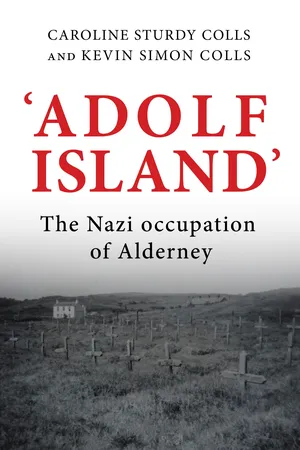
'Adolf Island' offers new forensic, archaeological and spatial perspectives on the Nazi forced and slave labour programme that was initiated on the Channel Island of Alderney during its occupation in the Second World War. Drawing on extensive archival research and the results of the first in-field investigations of the 'crime scenes' since 1945, the book identifies and characterises the network of concentration and labour camps, fortifications, burial sites and other material traces connected to the occupation, providing new insights into the identities and experiences of the men and women who lived, worked and died within this landscape. Moving beyond previous studies focused on military aspects of occupation, the book argues that Alderney was intrinsically linked to wider systems of Nazi forced and slave labour.
Trusted by 375,005 students
Access to over 1.5 million titles for a fair monthly price.
Study more efficiently using our study tools.
Information
Topic
Scienze socialiSubtopic
Storia britannica modernaPart I
Work
1
The labourers
The German invasion, and Hitler’s decision to transform Alderney into an ‘impregnable fortress’, irrevocably altered its landscape.1 The construction of thousands of individual fortifications and earthworks left behind material traces that embodied Hitler’s desire to occupy British territory and ultimately to invade mainland Britain (Figure 1.1). Many publications have been written about these structures – most notably by Colin Partridge, Michael Ginns and Trevor Davenport.2 These works provide important detailed information regarding the types of fortifications constructed, their military significance and the ingenuity of their engineering. The reader is therefore referred to these works if these aspects are of interest, as well as to Chapter 2 of this volume.
However, the labourers who built these megastructures have received considerably less attention. Just as Peter Hayes argued that he did not know of a single military history book that referred the reader to who built the bunkers in Normandy, scant are the stories of the labourers sent to Alderney in books that have focused on the fortifications.3 Yet, it was the exploitation of these men and (to a lesser extent) women that ensured that Alderney, and the Channel Islands more widely, ‘were fortified much stronger and much earlier than the Atlantic Wall’.4 Without these people, the military personnel stationed on the island could not have realised Hitler’s vision to retain his little piece of England until the final months of World War 2 (WW2).5 The human cost involved in such an undertaking has rarely been considered; the result being that the vast majority of forced, slave and less-than-slave labourers sent to Alderney have remained anonymous.6 Just as the Nazis themselves described the labourers as ‘tools’ operating within a vast machine, they are often presented as a homogenous mass in post-war documents and literature.7
As the first step in attempting to reverse this trend, this chapter focuses on the identities of these labourers: Who were they? Where did they come from, and why and how were they sent to Alderney? Drawing upon extensive archival research, this chapter discusses the individual stories of the labourers and details concerning the various demographics from which they came. In taking this approach, it also aims to establish how the nature of the work being undertaken, and the attitudes towards individual and groups, affected the daily lives of the labourers and how their treatment was influenced by the wider Nazi forced and slave labour programme implemented across Europe. The latter is especially important as whether the construction works on Alderney were undertaken for military/economic gain or as part of a wider strategy of persecution levied at minority groups remains one of the most contentious issues surrounding Alderney’s occupation.

Figure 1.1 Some of the immense fortifications constructed (mostly by forced, slave and less-than-slave labourers) on Alderney during the German occupation. The anti-tank wall at Longy Bay (top left), gun emplacement at Battery ‘Annes’ – Westbatterie (top right), defensive positions at Bibette Head (bottom left), and a bunker/casemate at Longy Bay
The first labourers
Almost immediately after the first German planes landed on Alderney on 2 July 1940, the Nazi administration began to ship workers to the island. At this stage, most were volunteers who were tasked with killing any remaining livestock, reviving Alderney’s economy and transporting goods to the neighbouring island of Guernsey (which was also occupied).8 Steps were taken to grow food, repair damaged property and make habitable living quarters for the military personnel. Many of these workers were under the control of Field Command 515 (Feldkommandantur 515/FK515), Alderney’s newly installed military government.9 From early 1941 onwards, several calls for volunteers capable of undertaking repair work and agricultural activities were posted in local newspapers in Guernsey and Jersey.10 Four working parties existed by September 1941; two were responsible for agriculture, the third for the maintenance of property and the fourth for breakwater improvement works. Additional groups arrived from the neighbouring islands throughout the occupation, all of which were under tight surveillance to ensure no inappropriate behaviour occurred and no escape attempts were made.11 In July 1941, Sector Group I/14 of the Fortress Engineers (Abschnittgruppen I/14, Festungspionierstab) came to Alderney to undertake construction works.12 Accompanied by a contingent of Belgian forced labourers, they were tasked with the construction of camps (described in Chapters 3–6) to house the large number of workers set to arrive on the island. A group of Moroccan and Algerian labourers given over to the Germans by the French Vichy government also arrived in a poor state of dress and health.13 Other workers sent to Alderney during this first phase included French women employed as cooks in the newly functioning Norderney camp (Chapter 5).
Organisation Todt (OT)
After Hitler’s directive in October 1941 to make the Channel Islands into an ‘impregnable fortress’, it soon became evident that the Fortress Engineers and volunteer workers from the neighbouring islands would not be able to complete the fortification of Alderney on the scale required.14 Consequently, the Todt Organisation (Organisation Todt, henceforth the OT) was tasked with sourcing and transporting thousands of workers and construction materials to the island. The OT was an administrative entity set up in 1933 by Dr Fritz Todt to assist the Fortress Engineers with the Westwall construction programme. From 1938 onwards, it became responsible for the provision of labour to firms involved in construction projects ordered by the Nazi Party.15 Hitler described it as ‘an organisation entrusted with the execution of construction tasks playing a decisive role in the war effort’ after 1939.16 Although it was not a Nazi Party organisation, members still swore an oath of loyalty to Hitler and staff wore uniforms bearing swastikas after the war broke out. To create a more centralised system of control from Berlin and after Todt’s death in February 1942, the OT was governed by Hitler’s architect and Minister for Armament and War Production, Dr Albert Speer, and Ministerial Director, Franz Xaver Dorsch.17 However, in reality, organisation was governed more closely at local level, firstly by nine geographically designated task forces (Einsatzgruppen) and then by the individual personnel in charge of workers at construction sites.
In the case of Alderney and OT group ‘Adolf’, work was supervised by the Fortress Engineers who reported to the Chief Construction Offi...
Table of contents
- Cover
- Half Title
- Title Page
- Copyright
- Contents
- List of figures
- List of tables
- Acknowledgements
- Archival abbreviations
- Map
- Introduction
- Part I: Work
- Part II: Life
- Part III: Death
- Part IV: Aftermath
- Concluding remarks
- Appendix
- Index
Frequently asked questions
Yes, you can cancel anytime from the Subscription tab in your account settings on the Perlego website. Your subscription will stay active until the end of your current billing period. Learn how to cancel your subscription
No, books cannot be downloaded as external files, such as PDFs, for use outside of Perlego. However, you can download books within the Perlego app for offline reading on mobile or tablet. Learn how to download books offline
Perlego offers two plans: Essential and Complete
- Essential is ideal for learners and professionals who enjoy exploring a wide range of subjects. Access the Essential Library with 800,000+ trusted titles and best-sellers across business, personal growth, and the humanities. Includes unlimited reading time and Standard Read Aloud voice.
- Complete: Perfect for advanced learners and researchers needing full, unrestricted access. Unlock 1.5M+ books across hundreds of subjects, including academic and specialized titles. The Complete Plan also includes advanced features like Premium Read Aloud and Research Assistant.
We are an online textbook subscription service, where you can get access to an entire online library for less than the price of a single book per month. With over 1.5 million books across 990+ topics, we’ve got you covered! Learn about our mission
Look out for the read-aloud symbol on your next book to see if you can listen to it. The read-aloud tool reads text aloud for you, highlighting the text as it is being read. You can pause it, speed it up and slow it down. Learn more about Read Aloud
Yes! You can use the Perlego app on both iOS and Android devices to read anytime, anywhere — even offline. Perfect for commutes or when you’re on the go.
Please note we cannot support devices running on iOS 13 and Android 7 or earlier. Learn more about using the app
Please note we cannot support devices running on iOS 13 and Android 7 or earlier. Learn more about using the app
Yes, you can access 'Adolf Island' by Caroline Sturdy Colls,Kevin Colls in PDF and/or ePUB format, as well as other popular books in Scienze sociali & Storia britannica moderna. We have over 1.5 million books available in our catalogue for you to explore.