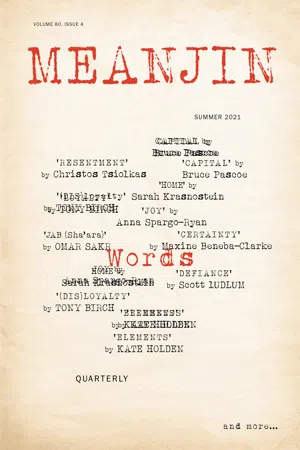
The December issue of Meanjin is titled: Words.It features a special series of non-fiction pieces in which Australian writers respond to one-word titles, including: Sarah Krasnostein on Home Tony Birch on (Dis)loyalty Bruce Pascoe on Capital Kate Holden on Elements Christos Tsiolkas on Resentment Maxine Beneba-Clarke on Certainty Scott Ludlum on Defiance Bernard Keane on Betrayal Anna Spargo-Ryan on Joy Mandy Ord on Lost Dan Dixon on Hunger Omar Sakr on Jab (Sha'ara) Karen Wyld on SoarPlus: Henry Reynolds on the Dark Emu culture wars, Fatima Measham on what it means to love animals, Daniel Nour on the white gaze in literary criticism, and more essays from Claire G. Coleman, Ben Walter, Soon-Tzu Speechley and Peter Craven. There's new fiction from Arnold Zable, Anneliz Erese, Carol Lefevre and Ashley Goldberg, a lively review section and a dozen new poems.
eBook - ePub
About this book
Trusted by 375,005 students
Access to over 1 million titles for a fair monthly price.
Study more efficiently using our study tools.
Information
Subtopic
Literary EssaysIndex
LiteratureESSAY
A SQUANDERED INHERITANCE
Soon-Tzu Speechley
IWALK BY A house on The Grove in Coburg sometimes. It’s the sort of house that characterises many of our older suburbs, of a style we might broadly call ‘post-Federation’. Its pitched roof sweeps generously over the wide front verandah, its simple profile interrupted only by a shallow gable ornamented with wooden shingles. The design, influenced by the Arts and Crafts movement of the nineteenth century, also hints at the California Bungalow shape of things to come. Set among The Grove’s nineteenth-century mansions, the house captures a moment of transition in the history of the suburb, and our changing architectural tastes in the early twentieth century. Homes like these, protected by a heritage overlay from the local council, tell the story of a city’s ups and downs.
Over the years, I have watched the shape of its roof change. The ridge sags in the middle, creating a gentle arc that curves upwards towards each end of the building, reminding me of the swallowtail roofs of Hokkien temples in Malaysia where I grew up. Unlike those temples, this roof is open, its terracotta tiles long gone, its beams exposed to the elements. The house is a century old, but this curve is relatively recent. While the open roof is no feature of its Edwardian architecture, its appearance by design: the removal of internal walls and columns has sped up the process of collapse in what one Moreland councillor has described as a case of ‘demolition by neglect’.1 The owners had put in an application to demolish the historic home, part of a local heritage precinct, to construct two new townhouses.
Without a roof to seal the house from the elements, nature does the work of the wrecking ball. No longer habitable but without a demolition permit, the house exists in limbo. This is another chapter in its hundred-year story. It’s a familiar tale, one repeated in different iterations across the city, which highlights the growing pressures on our historic built environment. Melbourne has experienced dizzying growth in recent decades. The city’s population hit 5.16 million before the COVID-19 pandemic, the closest it’s come to overtaking Sydney in almost a century.2 Despite the impact of the pandemic, Melbourne’s population grew by 80,088 people between 2019 and 2020.3 By the middle of this century, Melbourne is expected to have a population of more than 10 million.4

Hoffman Brickworks, Brunsick. Date unknown
This growth has created a panoply of new pressures, pressures that can be read in the spiralling cost of home ownership and diminishing affordability of rentals across the city. These are the growing pains of the city. Against this backdrop of rising rents and real estate, heritage buildings are often seen as an obstacle to meeting our growing spatial needs, ungainly old things that get in the way. These pressures are reflected in the heritage buildings left to rot so that they can make way for something new.
In Brunswick, the former Hoffman Brickworks has been the focus of a protracted heritage battle. The site is on the Victorian Heritage Register as an important reminder of Brunswick’s industrial past. In these brickworks, much of the surrounding suburb was formed from clay dug up in pits where Gilpin and Clifton parks now provide inner-city green lungs. Established in 1879, the Hoffman Brickworks introduced the mass production of bricks in the state.5 At its peak, the brickworks sprawled over five hectares from Dawson Street to Albert Street, churning out countless bricks for more than a century. If you live in an older brick building in Brunswick and the surrounding suburbs, there’s a good chance the walls around you were minted at the Hoffman Brickworks.
The story of the brickworks is the story of Victorian Brunswick, but also of its postindustrial afterlife. Its tall brick chimneys, caked with grime, are still a prominent feature of the suburb’s skyline. While a number of buildings in the old brickworks were converted into apartments and townhouses in the 1990s, the old brick-pressing shed has continued to deteriorate over the years, plagued by fire and weather damage. In the original plans for the brickworks, the shed was slated to become a museum.
Local residents and the National Trust have pushed back against the developer’s plans to demolish the pressing shed for more apartments.6 They argue the museum that will occupy its lobby is a token gesture. The developers argue their ‘passion for preserving history is evident in [their] plans’.7 The loss of the brick-pressing shed would be a real loss to Brunswick, part of the story of how this suburb came to be. While the byzantine processes of planning disputes operate away from view, the grey skies of a Brunswick winter peek out from the shed’s tattered roof. The uncertain fate of the brickworks demonstrates that heritage is a process of constant negotiation, that we are constantly re-evaluating the place of our past in our present. The things we choose to keep, demolish and build tell us about who we are. Our buildings tell a communal story, one built in dialogue with our neighbours and with generations past.
Heritage buildings capture more than a moment in time. They tell layered stories of how we got here. Across Brunswick, Victorian shops and workers’ cottages bear traces of post-war migration, evidenced in concrete caryatids and front yards planted with olive and lemon trees. Mirrors for feng shui hang over old wooden doors. Ostentatious terraces built during the gold rush now serve as sharehouses for uni students and young professionals. Cast-iron verandahs with spandrels depicting cockatoos are draped with fairy lights and Tibetan prayer flags. Shop signs in Greek, Italian, Arabic, and Chinese nestle under frothy baroque plasterwork from the turn of the last century. Rusting corrugated roofs carry gleaming solar panels. Old timber pickets support corflutes emblazoned with slogans about the environment. Each successive inhabitant remakes these old buildings in their own image. Together, these details paint a picture of who we are. We lose more than just some century-old bricks when these places are reduced to dust.
Farther south, in Carlton near the university, a more dramatic heritage battle has been waged over the Corkman Hotel. Originally called the Carlton Inn, the historic pub was one of the oldest in the suburb. Its location, just off University Square, has long made it a haunt for students at Melbourne University. The building was stealthily demolished on a Saturday night, despite stop work orders from the City of Melbourne, to make way for a planned 12-storey apartment building.8 Since the pub’s illegal demolition in 2016, there have been calls to rebuild the historic watering hole, much loved by students from the neighbouring Melbourne Law School.9
For some, a pub in England serves as a rallying cry. The victim of an illegal demolition too, the Carlton Tavern in Maida Vale was reconstructed after Westminster City Council compelled the developers to rebuild it, brick by brick.10 Our planning system makes it unlikely that the Corkman will be resurrected,11 and a rebuilt Victorian pub will only ever be a facsimile of the real thing. This pub, where students and locals gathered for more than a century, is gone. The Corkman’s demolition does, however, highlight that heritage protections are only a small impediment when profit margins on development are staggeringly high. There is no question that there is a desperate need for new homes. Already beyond the reach of many, the median price of houses in this city rose 16.2 per cent in the last year.12
There is something fundamentally wrong with a housing market that seems destined to exclude most of my generation from home ownership, no matter how much we try to avoid smashed avo on toast.13 As Melbourne races towards becoming Australia’s most populous city, it is inevitable that some old buildings will have to make way for new homes. But it is also clear that there is something deeply wrong with the way we build things too. As housing has become increasingly commodified, construction has come to resemble the old colonial model of resource extraction. Through glossy architectural renders, land is transformed, as if by magic, into investment properties for the negatively geared.
As the capitalist logic of disposability grows ever more expansive, buildings are coming to resemble fast fashion or takeaway containers. Despite advances in construction technology, the average lifespan of Australian buildings is falling.14 The average age of Australian buildings at demolition has been estimated to be around 62 years,15 with some new homes being built to last as few as 30 years.16
While many of us have stopped using single-use coffee cups, the buildings in which our lives play out are becoming increasingly disposable. Buildings that were built to stand for centuries are making way for homes that may not last a lifetime. Our cities are being reshaped not by the pressing need for homes, but in the interests of capital.17 We build quickly and cheaply to maximise profits, but these are false economies once the real environmental costs are factored in. This approach is unsustainable. Construction accounts for about one-quarter of Australia’s emissions.18 Cement alone accounts for 8 per cent of the world’s carbon emissions.19
New buildings often produce a ton of CO2 per square metre of construction.20 It is now a truism that this is the urban century, with the majority of humans worldwide now living in cities. This year’s COP26 climate conference will have a day dedicated to the built environment, reflecting its heavy ecological toll.21 The rapid pace of construction has been accompanied by a ballooning of carbon emissions. Even when old buildings are replaced with more energy-efficient structures, the total emissions resulting from demolition and construction are often considerably higher than those resulting from a careful environmental retrofit.22 As the Guardian...
Table of contents
- Cover
- Title Page
- Copyright Page
- Contents
- Editorial
- National Accounts
- Moonah Mind
- Certainty
- Cynicism in the Information Age
- Into Green
- Desire: The Hook Upon Which Everyone Hangs
- Australia in Three Books
- Resentment
- Elements
- Tracking Dark Emu
- Betrayal
- (Dis)loyalty
- Capital
- Whispering Road
- Defiance
- Soar
- Hunger
- Homework
- The Tale Of Lake Pedder
- Watching
- What we Mean When we Say we Love Animals
- A Squandered Inheritance
- The White Gaze and Brown Rage In Australian Literature
- Jab (Sha’ara)
- Lost
- Home
- The Things you See When you Haven’t Got a Gun
- Joy
- Eye Contact
- The Butterthigh Effect
- The Red Soil Road
- The Man who Loved the Persimmon Tree
- A Quiet World
- Interested in Custard
- The White Waratah
- Zucchini
- Not Waiting but Wanting
- Resisting the Colonising Gaze
- Fragile Networks
- It’s Not a Bad Book, Necessarily
- Controlled Visibility
- Slide into The Glory Hole Of Your Life
- Blockhead
- Things
- Reverse in French
- Fighting Terms
- last swim before space flight
- By the Esk
- Water
- On Air
- Undone by a Petrol Clamour
- A Fire Pit in Suburbia
- Working the Tides
- Still Life circa 1945–1950
- from Ideas of Travel
- Fossilised Crab on a Rock
- Poetry contributors
Frequently asked questions
Yes, you can cancel anytime from the Subscription tab in your account settings on the Perlego website. Your subscription will stay active until the end of your current billing period. Learn how to cancel your subscription
No, books cannot be downloaded as external files, such as PDFs, for use outside of Perlego. However, you can download books within the Perlego app for offline reading on mobile or tablet. Learn how to download books offline
Perlego offers two plans: Essential and Complete
- Essential is ideal for learners and professionals who enjoy exploring a wide range of subjects. Access the Essential Library with 800,000+ trusted titles and best-sellers across business, personal growth, and the humanities. Includes unlimited reading time and Standard Read Aloud voice.
- Complete: Perfect for advanced learners and researchers needing full, unrestricted access. Unlock 1.4M+ books across hundreds of subjects, including academic and specialized titles. The Complete Plan also includes advanced features like Premium Read Aloud and Research Assistant.
We are an online textbook subscription service, where you can get access to an entire online library for less than the price of a single book per month. With over 1 million books across 990+ topics, we’ve got you covered! Learn about our mission
Look out for the read-aloud symbol on your next book to see if you can listen to it. The read-aloud tool reads text aloud for you, highlighting the text as it is being read. You can pause it, speed it up and slow it down. Learn more about Read Aloud
Yes! You can use the Perlego app on both iOS and Android devices to read anytime, anywhere — even offline. Perfect for commutes or when you’re on the go.
Please note we cannot support devices running on iOS 13 and Android 7 or earlier. Learn more about using the app
Please note we cannot support devices running on iOS 13 and Android 7 or earlier. Learn more about using the app
Yes, you can access Meanjin Vol 80, No 4 by in PDF and/or ePUB format, as well as other popular books in Literature & Literary Essays. We have over one million books available in our catalogue for you to explore.