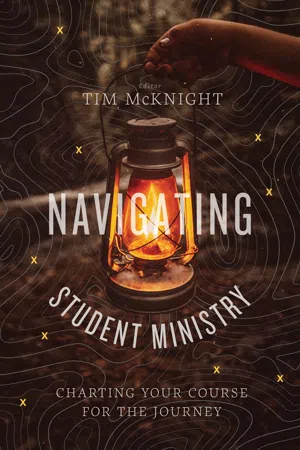
Teenagers are not a lost cause; they need wise leaders to help them along in their faith journeys. In Navigating Student Ministry, veteran student ministers with more than one hundred years of combined experience guide others through the often-challenging aspects of ministering to young people. This multi-contributor introductory textbook helps both those discerning a call to student ministry and those already invested in students. Editor Tim McKnight has crafted a book that can serve as both a topical resource and a comprehensive manual for those in the fun, exhausting, and eternally rewarding realm of student ministry.
Biblical and Theological Foundations for Student Ministry • TIM McKNIGHT •
I looked down at the luminescent dashes and digits of my army-issued lensatic compass. Rain clouds obscured the moonlight, and it started to drizzle on our heads. My group consisted of students at the Army Chaplain’s School and Center conducting a night land-navigation course they needed to pass in order to graduate. We had completed the day land-navigation course earlier that afternoon. Now our task consisted of using a map, compass, and a list of bearings to find five license plates nailed to five trees somewhere in the vast forest at Fort Dix, New Jersey.
In the daytime, we had found that even if we strayed somewhat from the compass bearing, we might arrive closely enough to the tree to still see the license plate nailed to it. Night navigation was not so forgiving. We did not have the benefit of seeing the plate from a distance if we strayed off course. To avoid missing the license plate, we had to frequently check our compasses. The term we used for checking the compass frequently was “checking your azimuth.” It was imperative that we check our azimuth frequently to stay on course during the night land-navigation exercise.
Biblical Foundations for Student Ministry
Checking our azimuth reminds me of the role that God’s Word plays in student ministry. Before I would rely on my azimuth to point me to the desired destination, I had to be confident in my compass. Was it accurate and reliable? Was it calibrated to true north? Could I consider my compass trustworthy?
Before we turn to Scripture as our authority and foundation for student ministry, we must first believe that the Bible is reliable, trustworthy, and authoritative. Why should we consider the Bible our authority in the Christian life and student ministry? How do we know that Scripture is trustworthy? We must first answer such questions before we will consider Scripture our authority for student ministry and a foundation upon which we can build such ministry. These questions relate to the realm that theologians call “the revelation and authority of Scripture.”
Biblical Revelation and Authority
The Bible is authoritative because it is the Word of God. In Paul’s letter to Timothy, he wrote, “All Scripture is inspired by God and is profitable for teaching, for rebuking, for correcting, for training in righteousness, so that the man of God may be complete, equipped for every good work” (2 Tim 3:16–17). The Greek word for “inspired” in this passage is theopneustos. It means “God-breathed.” Paul claimed that the Holy Spirit breathed out the words of Scripture through the biblical authors. Church historian Geoffrey Bromiley wrote the following in regard to how the early church fathers saw the relationship between the inspiration and authority of Scripture:
As the Word of God given by the Spirit of God, Scripture had for the Fathers the status of a primary authority in the life, teaching, and mission of the church. Deriving from God and enshrining the truth of God, it had indeed the authority of God himself. This applied to the Old Testament in virtue of its prophetic testimony to the Christ who was still to come. It applied to the New Testament in virtue of its apostolic witness to the Christ who had already come in fulfillment of the promises.1
Through Scripture, God reveals who he is, through the Old Testament, culminating in the miraculous incarnation of Jesus in the New Testament. He unfolds his plan to redeem humankind from the beginning of creation in Genesis to the return of Christ in Revelation. The written Word introduces the incarnate Word through the witnesses of the Gospels. We see the good news of the gospel regarding the life, death, resurrection, ascension, and second coming of Jesus Christ in the words of the New Testament. Only through the Bible can we begin to learn who God is and how we might be reconciled to him through the gospel of Jesus Christ.
Because Scripture is God’s Word, it bears his authority. If we follow Jesus Christ as Lord, we will seek to apply his Word to our lives. Christ-followers should submit to Scripture in all matters of faith and life. The Bible is the source of authority for believers. As such, all ministries of the church, including student ministry, are founded on the authority of Scripture.2
Although the Word of God is more than a compass, the Bible does provide direction for believers and churches. If we are going to navigate student ministry well, we must look to our compass to guide us in the right direction. With that in mind, what is the biblical foundation for student ministry?
Foundations in Deuteronomy
Listen, Israel: The Lord our God, the Lord is one. Love the Lord your God with all your heart, with all your soul, and with all your strength. These words that I am giving you today are to be in your heart. Repeat them to your children. Talk about them when you sit in your house and when you walk along the road, when you lie down and when you get up. Bind them as a sign on your hand and let them be a symbol on your forehead. Write them on the doorposts of your house and on your city gates. Deut 6:4–9
This passage of Scripture begins with the Shema, Israel’s declaration of faith, which identified Israelites as God’s chosen people and differentiated them from their surrounding polytheistic neighbors. In reciting the Shema, the people of Israel acknowledged the sovereignty of Yahweh over their lives. Through this confession, they remembered who God is and the ways he sovereignly worked on their behalf. In turn, through the inspiration of the Holy Spirit, Moses charged them to love God for who he is and for what he has done.
Regarding this passage, Michael McGarry, in his book A Biblical Theology of Youth Ministry, writes, “God’s people ought to be marked by love: love of God that is so life-transforming others are loved more than oneself. In the same way that Israel embraced the Shema as their identity marker, Christians live according to the gospel of grace.”3 There is a biblical foundation for student ministry in the call of this passage for parents and the faith community to help students love God with their hearts and souls.
Moses admonished the assembly of Israelites to teach the accounts he shared with them regarding God’s faithful provision on behalf of the people of Israel to the next generation. Notably, he called for Hebrew parents to teach their children who God is and what he has done with the goal of their loving God and placing their faith in him.4 The responsibilities and goals of teaching given to parents in this passage make clear that a biblical student ministry must involve parents as the primary disciplers of their students. Deuteronomy 6:4–9 clearly teaches that parents are primarily responsible to lead the next generation to love God, remember him, and keep his commandments. Biblical student ministry must, therefore, involve parents.
Biblical student ministry also involves the church, student pastors, and adult student leaders. Moses spoke those words of admonishment to the entire faith assembly of Israel, not just to parents. The entire faith body of Israel carried the responsibility of passing on a love for God and his commandments to the next generation. The Levites, leaders in the faith community, helped parents to teach their children the commands of Yahweh. The people of faith shared in their responsibility to raise children of faith.
Such an admonishment to the community of faith in Moses’s time provides a biblical foundation for the conviction that the church is responsible for helping parents teach their students to love God and keep his commandments. Pastors, student pastors, and adult student leaders should come alongside parents and help them to disciple their students. Some students in our churches do not have parents who believe in God and follow Christ. Adults in the church are responsible to teach those students to love God and follow his Word.5 Like the Levites, church leaders, including student ministers, should shepherd their students through teaching the Word of God and nurturing them in the faith.
These words from Moses to parents and the faith community of Israel regarding passing on a love for God and faith in Yahweh to Israel’s covenant children help lay a biblical foundation for student ministry. They call families and the family of God to raise children who love the Lord and keep his commandments. As Christ-followers, however, we know that this covenant will foreshadow a new covenant that Jesus Christ will establish.
Foundations in Matthew
The eleven disciples traveled to Galilee, to the mountain where Jesus had directed them. When they saw him, they worshiped, but some doubted. Jesus came near and said to them, “All authority has been given to me in heaven and on earth. Go, therefore, and make disciples of all nations, baptizing them in the name of the Father and of the Son and of the Holy Spirit, teaching them to observe everything I have commanded you. And remember, I am with you always, to the end of the age.” Matt 28:16–20
People place great weight upon their last words spoken at the end of their time on this earth. Jesus is no different. In this passage of Scripture, he met the disciples back where his ministry began in Galilee. During this last meeting with them, Jesus fulfilled the promise he made to them when they started following Him, “‘Follow me,’ he told them, ‘and I will make you fish for people’” (Matt 4:19). His final words to them showed them what he meant by this promise.
First, in this passage, we see that the Great Commission is based on the authority of Jesus Christ (28:18). Jesus is the sovereign Lord through whom all things were created (John 1:1–4; Col 1:16–17). As Lord of all heaven and earth, Jesus’s authority extends over the object of this command—his disciples, which include students, parents, and church leaders. The Great Commission given to the disciples on that day still applies to every Christ-follower today.
The scope of the Great Commission also relates to student ministry. It calls Christ-followers to make disciples of panta ta ethne—“all nations” (Matt 28:19). Jesus wants his followers to reach people from every ethnic group and every generation with the gospel. Students across the world fit easily within this scope. According to the United Nations Population Fund, there are 1.8 billion people who are between ten and twenty-four years old.6 This comprises 23 percent of the world’s population. These students need to hear the life-changing gospel and become followers of Jesus Christ.
There is only one imperative in this command from Jesus: “make disciples.” The words we translate as “go,” “baptizing,” and “teaching” are all participles in the original language. A rough translation of the imperative and participles in the passage would read “as you are going,” “make disciples,” “baptizing,” and “teaching.”7 The point is this: Christ-followers are to make disciples as they are going about their daily life. While they are at work, school, or home, or are performing tasks in their communities, Jesus calls them to make disciples. Disciple-making should be a part of their everyday lives. For the purpose of our focus, parents should disciple their students as they are going about their daily and weekly routines. Student pastors and church leaders should come alongside families and help them disciple their teenagers. If there are any teens who do not have believing parents, then the student ministers and leaders in the church must evangelize and disciple them.
This focus on the church relates to Jesus’s mention of baptism in his description of the disciple-making process in this passage. Baptism implies that the individual has already become a disciple through repentance and faith. A peer, parent, or student ministry leader shared the gospel with the student, and he or she began, through repentance and faith, the life of a disciple. The next step for this new believer is to make his or her faith in Christ public by following Christ’s example and being baptized. As one who maintains believer’s baptism, I hold that baptism unites the new disciple into the local church. In their public profession of faith through baptism, Christ-followers are identifying with a local congregation. The congregation, in turn, is affirming this believer’s confession of faith as legitimate and commits to helping the new believer grow in Christ as the scriptural phrase in the first sentence of the next paragraph shows.
This emphasis on spiritual growth relates to Jesus’s admonition for disciple-makers, “teaching them to observe everything I have com...
Table of contents
Foreword: Clayton King
Acknowledgments
Introduction: Preparing for Your Journey: Tim McKnight
1 Biblical and Theological Foundations for Student Ministry: Tim McKnight
2 The Call to Student Ministry: Sam Totman
3 The Life of the Student Minister: Tim McKnight
4 Student Ministry and Leadership Development: Chandler Vannoy
5 The Student Ministry Team: Tim McKnight
6 Adolescent Development: Paul Kelly
7 Student Ministry and Youth Culture: Karen Jones
8 Student Ministry and the Family: Timothy Paul Jones
9 Student Ministry and Evangelism: Justin Buchanan
10 Student Ministry and Discipleship: R. Scott Pace
11 Student Ministry and Technology: Sam Totman
12 Welcome to the Future: Student Ministry Next: Troy Temple
13 Conclusion: Student Ministry Philosophy and Strategy Development: Tim McKnight
Appendix 1: Catechism Classes and Other Surprising Precedents for Age-Organized Ministries: Timothy Paul Jones
Appendix 2: Student Ministry and Parachurch Organizations: Jay Strack
Name & Subject Index
Scripture Index
Trusted by 375,005 students
Access to over 1.5 million titles for a fair monthly price.
Study more efficiently using our study tools.
Frequently asked questions
Yes, you can cancel anytime from the Subscription tab in your account settings on the Perlego website. Your subscription will stay active until the end of your current billing period. Learn how to cancel your subscription
No, books cannot be downloaded as external files, such as PDFs, for use outside of Perlego. However, you can download books within the Perlego app for offline reading on mobile or tablet. Learn how to download books offline
Perlego offers two plans: Essential and Complete
Essential is ideal for learners and professionals who enjoy exploring a wide range of subjects. Access the Essential Library with 800,000+ trusted titles and best-sellers across business, personal growth, and the humanities. Includes unlimited reading time and Standard Read Aloud voice.
Complete: Perfect for advanced learners and researchers needing full, unrestricted access. Unlock 1.5M+ books across hundreds of subjects, including academic and specialized titles. The Complete Plan also includes advanced features like Premium Read Aloud and Research Assistant.
Both plans are available with monthly, semester, or annual billing cycles.
We are an online textbook subscription service, where you can get access to an entire online library for less than the price of a single book per month. With over 1.5 million books across 990+ topics, we’ve got you covered! Learn about our mission
Look out for the read-aloud symbol on your next book to see if you can listen to it. The read-aloud tool reads text aloud for you, highlighting the text as it is being read. You can pause it, speed it up and slow it down. Learn more about Read Aloud
Yes! You can use the Perlego app on both iOS and Android devices to read anytime, anywhere — even offline. Perfect for commutes or when you’re on the go. Please note we cannot support devices running on iOS 13 and Android 7 or earlier. Learn more about using the app
Yes, you can access Navigating Student Ministry by Tim McKnight in PDF and/or ePUB format, as well as other popular books in Theologie & Religion & Christlicher Dienst. We have over 1.5 million books available in our catalogue for you to explore.