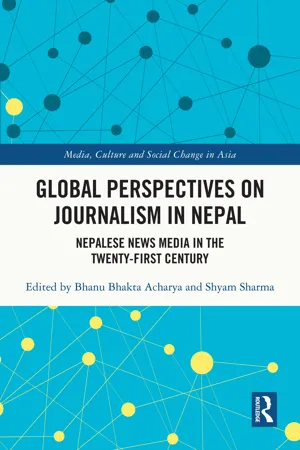
With more than 1000 newspapers, 1100 local radios, 200 television channels, 3000 online news portals, and over 80 colleges providing media education and training, news media, and media education are vibrant fields in Nepal. This book provides a comprehensive overview of Nepal's news media, including empirical studies, critical reviews, and theoretical and philosophical analyses focusing on journalism and contemporary media practices in the country, using local standpoints and global perspectives. Laying foundations of academic research and discourse, it explores key issues about the state of media and journalism practices of Nepal and situates them against the professional standards of global journalism and journalism education. The book covers all news media, including traditional (newspaper, radio, and television) and digital platforms.
eBook - ePub
Global Perspectives on Journalism in Nepal
Nepalese News Media in the Twenty–First Century
- 320 pages
- English
- ePUB (mobile friendly)
- Available on iOS & Android
eBook - ePub
Global Perspectives on Journalism in Nepal
Nepalese News Media in the Twenty–First Century
About this book
Information
1 Setting the ScenePerspectives on Nepali News Media in the 21st Century
DOI: 10.4324/9781003139430-1
For media scholars interested in the history and evolution of journalism in different countries, Nepal makes an interesting case. One of the most fascinating documents in the 120 years of this history is the Sanad, a set of ethical guidelines for the publication of the Gorkhapatra weekly issued by Prime Minister Dev Samser on 23 April 1901. This was Nepal's first weekly, and the longest-running newspaper. The document, published about two weeks before the newspaper's first issue, was written when American media were enduring what came to be known as yellow journalism, unethical practices to attract readers and increase newspaper circulation. The guidelines in Nepal were created to prevent wrongdoings like exaggerated content, misleading newspaper headlines, deceptive news stories, sensational cartoons, fake interviews, and other malpractices. At the time, American journalists were still debating whether journalists should follow any legal or ethical guidelines to uphold their quality and professionalism. It was also when European journalists and media stakeholders were following the footprints of John Milton, who in the 17th century advocated a free, unregulated press. In contrast to the West, Nepal's rulers were creating guardrails against the potential misuse of newspapers. While part of the motivation was to prevent the defamation of the autocratic Rana oligarchy, and while no journalist contributed to the guide, this Nepali document represents one of the first formal codes of ethics to provide a framework for journalists on what to do and what not when publishing a newspaper.
One century later, political and social upheavals have sparked new expansion and innovation in journalism, communication, and mass media. The technology now was not one but many, the frontiers global and local, and the social impacts stunning. With the emergence in merely three decades of over one thousand regularly published newspapers, eleven hundred registered local radios, two hundred registered television channels, and two thousand registered online portals, this tiny Asian country offers much to study, theorize, and share with the broader world about the evolution of media. In this introductory chapter, we seek to set the historical, sociopolitical, professional, educational, and technological contexts against which the contributions by our colleagues are situated.
While providing scholarly contexts for the book, this introductory chapter assesses the overall situation and prospects of the 21st century's Nepali media environment. Situating Nepal's experience in the global media profession's radical transformations, we generate a few perspectives that bring Nepal's experiences into focus. Over the last 30 years, Nepali journalism experienced explosive growth in the number and variety of media outlets across the country, a media environment with diverse content production, scope of coverage, technology use, and professional development, including ethical and legal measures. Connecting global perspectives with various media issues of Nepal, this chapter presents an overview of Nepal's media development from professional, sociopolitical, academic, and technological perspectives. As we develop perspectives on these global-local intersections, we show that despite the remarkable changes of the last three decades, Nepal's news media environment is experiencing a chaos that throws professional standards of excellence into doubt, as many media genres are being introduced, developed, and practiced at the same time. These perspectives will hopefully provide both context and lenses with which to read the rest of the book.
Scarcity in Abundance
Since the politically liberal Constitution of the Kingdom of Nepal was promulgated in 1990, guarantees of press freedom have brought about an explosion in Nepal's media landscape. Through these three democratic decades, print media dominated the 1990s, broadcast media pervaded the 2000s, and those traditional media gradually ceded audience share to online news portals in the 2010s. The media-friendly environment of a democratic society saw several broadsheet Nepali and English daily newspapers establish themselves: Kantipur and The Kathmandu Post (18 February 1993), Nepal Samachar Patra (11 January 1996), Rajdhani Daily (4 June 2001), The Himalayan Times (23 November 2001), Annapurna Post (12 December 2002), Naya Patrika (14 April 2007), and Nagarik and Republica (24 April 2009). These major newspapers started with large capital investments and an established national network of news reporters. Some of them had regional or provincial editions and international correspondents in India, Malaysia, and Arab countries, among others.
In addition, politically polarized weekly newspapers such as the right-wing Saptahik Bimarsh, Deshantar, Punarjagaran, and Ghatana ra Bichar, and the progressive Chhalphal, Dristi, Budhabar, Jana Aastha, and Janadesh were started by politically loyal journalists, whose major focus was political gains through news reporting that purposely supported or fought particular ideologies, parties, and leaders (Acharya, 2019, 2021). The past two decades have also seen a surge of opinion-based news magazines, such as the weeklies Himal Khabar Patrika, (first published 14 April 1999), Nepal Magazine (30 July 2000), Samay (18 April 2004), and the Nepali Times (13 April 2000). They have published critical news reports, fostered investigative journalism on social, political, and economic issues, provided platforms to multiple opinions, and also covered issues facing marginalized communities in the country. Media historian Onta (2001, p. 334) observed that:
The growth in print media [in the 1990s] has contributed to opening up Nepali society to new ideas and newer ways of looking at “old” issues. It has enlarged the space of what can be called civil society in Nepal and facilitated the search for democratic foundations for the state and the entire society at large.
Nepal's print media significantly enriched the country's journalistic landscape in the 1990s by widening their scope of news coverage with emphasis on social, political, and economic issues.
However, the excessive partisanship of Nepali print media partially undermined the rule of law, people's rights to information, and political stability in the country. Even though broadcast media grew rapidly after the digital turn at the dawn of the current century, the growth and institutionalization of media institutions had relatively stagnated since then (Onta, 2008). While the National Communication Policy 1991 opened the door to private sector FM radio, the National Broadcasting Act 1993 allowed them to deliver programs on education, entertainment, and the news. As a result, Radio Sagarmatha was established in 1997, as the first community-based radio in South Asia and ending the erstwhile monopoly of the state-run Radio Nepal. Dozens of radios now started broadcasting across the country in cooperative, community, and commercial models. That trend continued with the launch of many private television channels during 2000s, in which Channel Nepal (2001) was the pioneer, followed by Kantipur Television (2003), Image Channel (2003), Avenues Television (2007), Sagarmatha Television (2007), and ABC Television (2008), among others. Dozens of radio and television stations were licensed following the people's movement in 2006, liberalizing the landscape further. Unfortunately, the capital Kathmandu continued to dominate radio and television broadcasting and stations beyond the valley, marginalizing local issues and voices. The great variety of specialty radio stations, including educational, agricultural, entertainment, and news, could not foster the spirit of the new constitution and the federalized structures it created.
Despite the explosion in the number of outlets and the liberalization of the landscape, the content, scope, and general approach of most programming rarely covered marginal voices but instead fell into repetitive patterns (Onta, 2008). For instance, private televisions have been following the same structure as state-owned stations: start the morning with cultural and religious programs, then do multiple news bulletins, move to talk shows, and punctuate this with entertainment programs and sponsored content prepared by external agencies.
One benefit of private sector growth amid democratic liberalization is the greater criticism and watchful eye on governments that have remained mired in political logjams and turmoil. Private radio and television stations deserve significant credit for the success of Nepal's democratic movement, as well as fostering other public goods. For example, FM community radios in Nepal have become role models in South Asia and beyond in facilitating community empowerment by “giving voices to the marginalized sections of population” (Banjade, 2007, p. 291). Community broadcasting is most typically FM band, since this band lacks the transmission ranges of medium or long wave radio spectrums, and therefore, focuses on local community issues (Banjade, 2007; Dahal, 2013; Onta, 2008; UNESCO, 2013; Wabwire, 2013). However, some FM stations such as Radio Kantipur and Image FM successfully experimented with cross-country broadcasting by buying up other local radio stations to develop programming networks. While interest groups such as political parties and NGOs also exploit community radios in Nepal as advocacy tools to manipulate public perceptions, private and community broadcasting services have played important roles, as discussed in some of the chapters of this book.
At the turn of the century, the dramatic advent of digitization and the internet further magnified the challenges against professionalization of media, both globally and in Nepal. Online news portals, the newest mass media platform, began to appear in the late 1990s, were publicly recognized as news media in the 2000s, and their number exploded in the 2010s until they numbered over two thousand. Even as they established themselves as mainstream news media, the style of online news portals has always been tabloid and partisan. While only about a dozen such portals are reliable outlets for news, starting with the launch of kantipuronline.com (later ekantipur.com) in 2000 (Acharya, 2005; Sedhai, 2012); the rest regularly skirt or break national and international ethical norms of professional journalism, so it has become difficult to take them seriously. Online media portals are generally distrusted for promoting yellow journalism: sensationalism, exaggerated and misleading claims, and presenting sponsored content as news. Their professional culture is so awful that many so-called “online journalists” have faced criminal charges of breaching individual privacy, plagiarism, and copyright infringements. As this book's authors highlight, online news portals have struggled financially since the COVID-19 pandemic, and overcrowded media markets have made branding and audience building impossible.
A number of scholars (e.g., Acharya, 2019;...
Table of contents
- Cover Page
- Half-Title Page
- Series Page
- Title Page
- Copyright Page
- Dedication Page
- Contents
- List of figures
- List of tables
- Preface
- Acknowledgments
- List of contributors
- 1 Setting the Scene: Perspectives on Nepali News Media in the 21st Century
- Part I Professional Perspectives
- Part II Academic Perspectives
- Part III Sociopolitical Perspectives
- Part IV Technological Perspectives
- Index
Trusted by 375,005 students
Access to over 1.5 million titles for a fair monthly price.
Study more efficiently using our study tools.
Frequently asked questions
Yes, you can cancel anytime from the Subscription tab in your account settings on the Perlego website. Your subscription will stay active until the end of your current billing period. Learn how to cancel your subscription
No, books cannot be downloaded as external files, such as PDFs, for use outside of Perlego. However, you can download books within the Perlego app for offline reading on mobile or tablet. Learn how to download books offline
We are an online textbook subscription service, where you can get access to an entire online library for less than the price of a single book per month. With over 1.5 million books across 990+ topics, we’ve got you covered! Learn about our mission
Look out for the read-aloud symbol on your next book to see if you can listen to it. The read-aloud tool reads text aloud for you, highlighting the text as it is being read. You can pause it, speed it up and slow it down. Learn more about Read Aloud
Yes! You can use the Perlego app on both iOS and Android devices to read anytime, anywhere — even offline. Perfect for commutes or when you’re on the go.
Please note we cannot support devices running on iOS 13 and Android 7 or earlier. Learn more about using the app
Please note we cannot support devices running on iOS 13 and Android 7 or earlier. Learn more about using the app
Yes, you can access Global Perspectives on Journalism in Nepal by Bhanu Bhakta Acharya, Shyam Sharma, Bhanu Bhakta Acharya,Shyam Sharma in PDF and/or ePUB format, as well as other popular books in Social Sciences & Ethnic Studies. We have over 1.5 million books available in our catalogue for you to explore.