Acquisitions and Corporate Strategy
eBook - ePub

Acquisitions and Corporate Strategy

Alliances, Performance, and Divestment

  1. 272 pages
  2. English
  3. ePUB (mobile friendly)
  4. Available on iOS & Android
eBook - ePub

Acquisitions and Corporate Strategy

Alliances, Performance, and Divestment

About this book

Corporate restructuring (acquisitions, alliances and divestment) is a visible form of corporate strategy. For example, firm investments in buying and selling assets exceed the gross domestic product of the majority of nations. Most research in this area examines acquisitions, but informing practice is limited by examining acquisitions in isolation or using a narrow focus. For example, a lingering problem is that average acquisition performance is consistently around zero, suggesting a need to identify practically relevant relationships.

In addressing this need, research on three fundamental questions is covered: 1) How do acquisitions relate to other corporate strategy options?; 2) What helps to predict acquisition performance?; and 3) What are persistent acquisition research issues? The first question is intended to overcome a research limitation that acquisitions are often examined independent of other corporate strategies, including internal development, alliances, and divestment. The second question addresses novel relationships associated with the primary focus of acquisition research in examining what drives acquisition performance. The third question reflects on the underlying complexity of the phenomenon that makes it a challenge to identify what drives acquisition performance. Overall, the intent of presenting ideas on these fundamental questions is to illustrate promising areas for future research.

This book presents the latest state of knowledge on the topic and will be of interest to researchers, academics, and advanced students in the fields of strategic management, international business, and organizational studies.

Frequently asked questions

Yes, you can cancel anytime from the Subscription tab in your account settings on the Perlego website. Your subscription will stay active until the end of your current billing period. Learn how to cancel your subscription.
No, books cannot be downloaded as external files, such as PDFs, for use outside of Perlego. However, you can download books within the Perlego app for offline reading on mobile or tablet. Learn more here.
Perlego offers two plans: Essential and Complete
  • Essential is ideal for learners and professionals who enjoy exploring a wide range of subjects. Access the Essential Library with 800,000+ trusted titles and best-sellers across business, personal growth, and the humanities. Includes unlimited reading time and Standard Read Aloud voice.
  • Complete: Perfect for advanced learners and researchers needing full, unrestricted access. Unlock 1.4M+ books across hundreds of subjects, including academic and specialized titles. The Complete Plan also includes advanced features like Premium Read Aloud and Research Assistant.
Both plans are available with monthly, semester, or annual billing cycles.
We are an online textbook subscription service, where you can get access to an entire online library for less than the price of a single book per month. With over 1 million books across 1000+ topics, we’ve got you covered! Learn more here.
Look out for the read-aloud symbol on your next book to see if you can listen to it. The read-aloud tool reads text aloud for you, highlighting the text as it is being read. You can pause it, speed it up and slow it down. Learn more here.
Yes! You can use the Perlego app on both iOS or Android devices to read anytime, anywhere — even offline. Perfect for commutes or when you’re on the go.
Please note we cannot support devices running on iOS 13 and Android 7 or earlier. Learn more about using the app.
Yes, you can access Acquisitions and Corporate Strategy by David R. King in PDF and/or ePUB format, as well as other popular books in Business & Business General. We have over one million books available in our catalogue for you to explore.

Information

Publisher
Routledge
Year
2022
Print ISBN
9781032036373
eBook ISBN
9781000573800

Section I How do acquisitions relate to other corporate strategy options?

David R. King
DOI: 10.4324/9781003188308-2
Many divestments are acquired (Laamanen, Brauer, & Junna, 2014; Weston, 1989) and a substantial percentage of acquisitions experience some form of divestment (Ravenscraft & Scherer, 1987; Weston, 1989), making the strategic options inexorably linked. However, divestment and acquisitions are rarely studied together. Divestment generally occurs during integration or the later stages of an acquisition. Meanwhile, target selection, the start of the acquisition process, is influenced by alliances (Porrini, 2004). Again, there is limited research with a combined focus on alliances and acquisitions (Shi, Sun, & Prescott, 2012). Further, international strategy and foreign market entry is often presented as a choice between cross-border acquisitions (CBA) and foreign direct investment (FDI), and what drives choices between these alternatives remains unclear (Tsang & Yamanoi, 2016). The problem of understanding corporate strategy from focusing only on the role acquisitions play is akin to only studying one side of a six-sided dice to describe the whole. The result is an incomplete picture of important relationships. This section raises awareness of this issue, and it also takes initial steps to address it by presenting research that compares acquisitions with alliances, divestment, and FDI.
In Chapter 1, Elio Shijaku, David King, and Ainhoa Urtasun examine how characteristics associated with transaction costs in the exchange of strategic resources with alliances contribute to acquisition activity. Increased awareness of different firm capabilities from a focal firm’s portfolio of alliances can inform acquisition decisions, leading to observations that alliances often precede acquisitions. In examining internalization of prior alliances with an acquisition, they argue it is more likely when there are market failures associated with uncertainty and opportunism. Empirical analysis finds that more than one source of market failure is often needed before a firm completes an acquisition of an alliance partner.
In a review of divestment research, Sina Amiri, David King, and Samuel DeMarie in Chapter 2 find (similar to the study of acquisitions) there is a need to integrate theoretical perspectives and look at divestment more holistically. For example, context associated with a firm’s environment, ownership (e.g., family firm), or experience appears to be important antecedents to restructuring. Additionally, how investors react to divestment is influenced by whether divestments are made as part of a firm’s larger acquisition strategy (Bingham, Heimeriks, Schijven, & Gates, 2015), suggesting the need to consider portfolio theory in acquisition research. Further, shared processes across acquisition and divestment activity may facilitate development of firm restructuring capabilities (Doan, Sahib, & van Witteloostuijn, 2018).
In Chapter 3, Oleksandra Kochura, Nicola Mirc, and Denis Lacoste provide a closer look at how strategy scholars approach and study divestitures and acquisitions, including the different ways they can be combined to restructure a firm’s portfolio of businesses. By arguing that acquisitions and divestitures are sequential on their own, the authors demonstrate that in business configurations, any one of these can precede another. Through the consolidation of the temporal interrelationships between acquisition and divestiture, this chapter aims to advance our understanding of various possible corporate restructuring patterns.
In Chapter 4, Nan Zhang and Joseph Clougherty examine the relationship between CBA and greenfield investments (GI). The establishment-mode choice literature considers these to be substitutes for conducting business in a host nation. Recent scholarship, however, posits a more complex relationship where distinctness, partial substitution, and even complementarity might better characterize the relationship between investment modes. This lack of consensus is partly driven by the presence of empirical challenges and potential endogeneity. To surmount these challenges, the authors invoke an estimation approach based on cross-price elasticities. US merger-policy enforcement constitutes a “price” directly affecting CBA that only indirectly affects GI via a substitutive or complementary relationship. Employing firm-level data covering 1,763 firms situated in 58 industries from 2003 to 2017, their panel-data empirical testing indicates that merger-policy investigations deter cross-border horizontal acquisitions and attract greenfield investments. In other words, empirical results support GI substituting for CBA.

References

  • Bingham, C., Heimeriks, K., Schijven, M., &am...
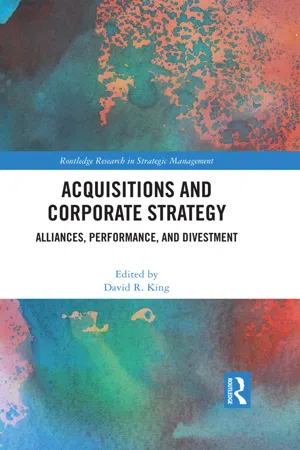
Table of contents

  1. Cover
  2. Half-Title Page
  3. Series Page
  4. Title Page
  5. Copyright Page
  6. Table of Contents
  7. Acknowledgments
  8. List of illustrations
  9. About the contributors
  10. Reflection on corporate restructuring research
  11. Section I How do acquisitions relate to other corporate strategy options?
  12. Section II What helps to predict acquisition performance?
  13. Section III What are persistent acquisition research issues?
  14. Index