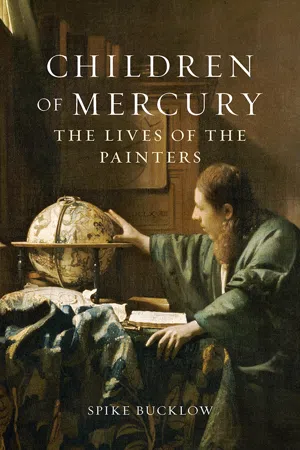
- English
- ePUB (mobile friendly)
- Available on iOS & Android
eBook - ePub
About this book
Children of Mercury is a bold new account of the lives of pre-modern painters, viewed through the lens of the Seven Ages of Man, a widespread belief made famous in the 'All the world's a stage' speech in Shakespeare's As You Like It. Spike Bucklow follows artists' lives from infancy through childhood, adolescence and adulthood to maturity, old age and death. He tracks how lives unfolded for both male and female painters, from the famous, like Michelangelo, through Artemisia Gentileschi and Mary Beale, to those who are now forgotten, like Jehan Gillemer. The book draws on historic biographies, artists' own writings and, uniquely, the physical evidence offered by their paintings.
Information
Topic
ArtSubtopic
Art General1
‘Mewling and Puking’ Babies
When I started researching a book on the whole lives of painters between the twelfth and seventeenth centuries, my first discovery was that very little is known about their early years. This chapter therefore contains few personal details about painters as infants, but it also covers issues that would have affected the young would-be painters, including the types of family into which they were born, infant mortality rates, nature, nurture and the role of planets in making sense of life and inevitable loss.
For Ptolemy, infancy started some time before birth and ended around the age of three. These first few years in the life of a future painter were practically indistinguishable from those of any other member of society, not because all infancies were the same but because they were all so different. When they were infants, those eventually destined for fame in any arena might have been cared for or neglected and been well fed or gone hungry. Variable harvests and low food security meant that poor newborns may not have survived famine, but even the offspring of the rich could be vulnerable in times of apparent plenty. For example, the Infanta Margaret Theresa – who stands centre stage in Velázquez’s Las Meninas – had tantrums about having to eat rotting food that ‘stank like dead dogs’ and was ‘covered in flies’.1
Of course, we only know about the Infanta’s foul temper and her miserable diet because she was the daughter of Philip IV, king of Spain, one of the most powerful men in the Western world, even if he couldn’t keep his kitchen stocked. (Nor, indeed, could he regularly pay his painter, although, diplomatically, Velázquez gave no hint of hardship when depicting himself alongside the sweet-looking Infanta.2) Details about the infancies of most ordinary people simply did not enter the historical record, so it is lucky for us that demographic studies suggest historical child-rearing practices were similar across all sections of society.3 Research also suggests much continuity between historic and current child-rearing practices.4
Those who would one day become painters had diverse backgrounds: for example, Titian’s father was a mine superintendent, Ghirlandaio’s was a garland maker and Tintoretto’s was a dye worker. Two had sons who became painters and the third had a daughter who became a painter. In the thirteenth century, Giotto’s father was a ‘tiller of the soil and a simple fellow’, according to Vasari, although this may not actually be true.5 In the fifteenth century, Leonardo da Vinci’s father was a notary, his mother was a peasant and he was illegitimate. In the sixteenth century, Rubens’s father was a legal adviser to, and clandestine lover of, Anna of Saxony, second wife of William of Orange. (Upon discovery of their relationship, Rubens’s father was imprisoned before being exiled, and Peter Paul Rubens was born in Siegen, but his mother effectively erased this episode so Rubens thought he had been born in Cologne.6) In the seventeenth century, Juan de Pareja’s father was Spanish, his mother African, and he was a slave.
Such early details can be formative. For example, Leonardo knew that he was a ‘natural’ child, or a bastard, later claiming that this helped make him ‘of great intellect, spirited and lively and loveable’, drawing on the popular idea that those born from acts of love were superior to those born from acts of duty.7 Yet at the same time illegitimacy could also cause problems, such as disputes with his much younger, legitimate brothers. Leonardo was possibly spoilt by his paternal grandmother, his natural mother and then his stepmother, and such childhood factors may have contributed to adult idiosyncrasies that included secretive mirror-writing, failure to finish projects and rejection of long-established technical traditions: in Vasari’s words, his ‘strangest methods’ and ‘capricious mixtures’.8 Sigmund Freud – who identified with Leonardo – attempted a psychoanalysis of the painter based on childhood records but rightly predicted that it would be dismissed as a mere ‘psychoanalytical novel’.9 Vasari, who had first-hand access to people who knew Leonardo, just called him ‘variable and unstable’.10
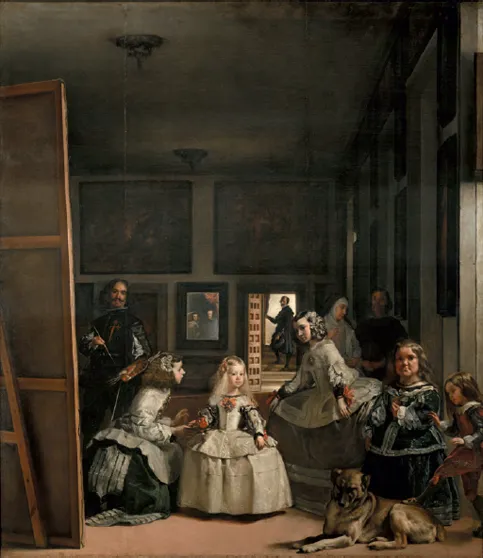
Diego de Velázquez, Las Meninas, 1656, oil on canvas. This artist’s self-portrait is set in the court of Philip IV of Spain in the presence of the Infanta Margaret Theresa. As well as being a painter, Velázquez was also responsible for assembling Philip IV’s collection of paintings, including works by Raphael, Titian and Rubens. This has long been considered the painters’ painting and is a profoundly subtle allegorical statement about the art of painting. Luca Giordano called it a ‘theology of painting’. The stretcher and bare canvas may refer to the Allegory of Paintingby Artemisia Gentileschi (see Chapter Four), which Velázquez could have seen in her studio.
A study of artists in Delft shows that, after 1600, the proportion of painters born into painting families had begun to decrease, possibly because the craft-based aspects of painting were on the wane. (Crafts traditionally enjoyed hereditary transmission, hence the existence of trade names, such as Smith, as family names.) Those Delft painters who were not born into families of painters included the children of engravers, art dealers and glassmakers, all of whom shared the same guild as painters. They also included brewers and merchants, attorneys and notaries, schoolmasters, city or state officials, clerks and ministers of religion. Other painters’ parents were goldsmiths, silversmiths, jewellers, spectacle makers, candle makers, masons, bakers, nail makers, sail makers, carpenters and innkeepers. At the peak of its creativity Delft was probably similar to other northern cities, at least as far as the social origins of its painters is concerned – they were as varied as any other group.11
Whatever their family backgrounds, infants had a limited chance of survival, and while it is difficult to get accurate figures about historic infant death, parish records and archaeological data gives us some idea.12 The statistics are not strictly comparable but it is safe to say that, historically, infant death was much more common than it is in Europe today. The infant future painter was therefore very likely to have been touched by death. For example, Hans Holbein’s mother probably died shortly after giving birth and his father never remarried. Hans was brought up by his widowed paternal grandmother until she died when he was six or seven. And when Raphael was two years old his brother died; a little later, in the space of three weeks, both his mother and his baby sister died.13
Historically, about a quarter of newborns died in their first year and only about half survived beyond puberty.14 In the early sixteenth-century Low Countries, about half of those painting at the age of twenty could expect to live to the age of 65 and about one in ten could expect to reach eighty.15 Statistically, female painters lived slightly longer. All painters had better life expectancies than both peasants and the nobility, bucking a trend since urban life expectancy was generally lower than rural life expectancy and the artists usually lived in towns.16 Painters – or at least, those in the early sixteenth-century Low Countries – seem, for some reason, to have been one of the healthier sections of society. Across the whole of Europe, the average age of death for painters was 63.17
Relative longevity in adults shows that painters could easily be born into families of several living generations. So, with early marriage and early child-rearing, someone in their seventies could well have witnessed the births of not only their own children, but their grandchildren and great-grandchildren. Tragically, they could also have seen a significant number of them die. Any infant’s death would, of course, have had an enormous emotional impact on their family, so the terrible toll of infant mortality encouraged numerous ways of trying to come to terms with inexplicable and devastating loss.
Parents expressed their fear of infant death by baptizing babies as soon as possible, making them ready for their possibly imminent afterlife. In the fourteenth-century dream-vision poem Pearl the now unknown poet found consolation in the biblical Parable of the Vineyard (Matthew 20:1–16) after the death of his two-year-old daughter. In this parable the first are last and the last first. In other words, his daughter had her reward in heaven without having to labour long on Earth. A graphic expression of the same idea is found in Holbein’s Dance of Death series, which starts with images of the Creation, Temptation and Expulsion from Eden before introducing Death, shown tilling the soil alongside Adam. Death then proceeds to pick off 34 victims one by one, the first being the pope and the last an infant. The image of Death Taking an Infant is immediately followed by the ultimate image in the series, All Souls at the Final Judgment. Holbein implies the same in his Alphabet of Death, where Death Taking an Infant adorns the letter Y and the Final Judgment adorns Z. And as if to reinforce the Pearl’s connection between infant death and the Parable of the Vineyard, Death’s penultimate victim in the Dance is a ploughman, taken in the field.18 This is not to suggest that Holbein knew the poem but, rather, that both poet and artist played with a commonplace theme. We might also wonder whether the early loss of his mother and grandmother might help account for Holbein’s adult focus on death.
One way to come to terms with life’s sometimes cruel vagaries was to compare family events to events in the wider world. Everyone in the medieval and early modern worlds was close to the cycles of food production, so birth, growth and death were constant companions. But crop failures and lame oxen were just as unpredictable as childhood disease, so events on Earth were also related to events in the heavens, where things seemed more reassuringly predictable. Every day and night the Sun, Moon, planets and the stars all rose in the east, followed their allotted paths through the sky unperturbed by events below, and then set in the west.19 The Sun very obviously influenced the course of the seasons, and it was thought that, more subtly, all the heavenly bodies, acting in concert, influenced all life on Earth.
The search for signs in the heavens eventually found the Seven Ages, which are in the Hippocratic medical tradition and are also mentioned by St Ambrose, who connected them with spiritual development.20 However, the connection between the stages of life and planets was probably most clearly expressed in second-century Alexandria in a work by Ptolemy, whose astrological text the Tetrabiblos was translated from Greek into Arabic in the ninth century and into Latin in the twelfth century.21 Ptolemy rationalized the planets’ effects on our lives in terms of Aristotle’s four qualities - hot, cold, wet and dry – mixtures of which expressed themselves in our physical health and psychological disposition.22 For example, an imbalance of hot and dry made people ‘choleric’ or short-tempered. A dominance of hot and wet made people ‘sanguine’ or easy-going. Cold and wet made them ‘phlegmatic’ or cool and calm, while too much cold and dry made them ‘melancholic’ or heavy and slow.23 In his chapter ‘The Periodical Divisions of Time’, Ptolemy said that infancy lasted for four years and was connected to the Moon, a feminine planet, represented by Diana, goddess of the hunt. Infancy was ‘moist’, like the Moon, Diana or Luna, and also ‘variable’, like her.24
The Moon’s ‘moist’ character would once have been obvious – people awoke to wet underfoot and it was thought that dew appeared in response to the Moon. In the late sixteenth century Shakespeare called the Moon the ‘governess of floods’, meaning she ruled the tides.25 And in cultures where the microcosm (the inner world) was linked to the macrocosm (the outer world), it would have been no surprise that a woman’s menstrual cycle could also follow the Moon. It is therefore entirely appropriate that the first momentous event in a person’s life, their birth, should fall in the stage traditionally governed by the Moon. Birth is a tidal event – first the infant is peacefully swimming in amniotic fluid, then, shortly after its mother’s waters break, it finds itself gasping for breath on dry land.
The Moon’s ‘variable’ ch...
Table of contents
- Front Cover
- Half Title
- Title Page
- Copyright
- Contents
- Prologue
- 1 ‘Mewling and Puking’ Babies
- 2 Learning the Ropes
- 3 Feeling the Pull
- 4 Influencing
- 5 The Big Push
- 6 Arrival
- 7 Leaving the Stage
- Epilogue
- REFERENCES
- ACKNOWLEDGEMENTS
- PHOTO ACKNOWLEDGEMENTS
- CAST OF CHARACTERS
Trusted by 375,005 students
Access to over 1.5 million titles for a fair monthly price.
Study more efficiently using our study tools.
Frequently asked questions
Yes, you can cancel anytime from the Subscription tab in your account settings on the Perlego website. Your subscription will stay active until the end of your current billing period. Learn how to cancel your subscription
No, books cannot be downloaded as external files, such as PDFs, for use outside of Perlego. However, you can download books within the Perlego app for offline reading on mobile or tablet. Learn how to download books offline
We are an online textbook subscription service, where you can get access to an entire online library for less than the price of a single book per month. With over 1.5 million books across 990+ topics, we’ve got you covered! Learn about our mission
Look out for the read-aloud symbol on your next book to see if you can listen to it. The read-aloud tool reads text aloud for you, highlighting the text as it is being read. You can pause it, speed it up and slow it down. Learn more about Read Aloud
Yes! You can use the Perlego app on both iOS and Android devices to read anytime, anywhere — even offline. Perfect for commutes or when you’re on the go.
Please note we cannot support devices running on iOS 13 and Android 7 or earlier. Learn more about using the app
Please note we cannot support devices running on iOS 13 and Android 7 or earlier. Learn more about using the app
Yes, you can access Children of Mercury by Spike Bucklow,Bucklow, Spike in PDF and/or ePUB format, as well as other popular books in Art & Art General. We have over 1.5 million books available in our catalogue for you to explore.