From the
New York Times–bestselling historian and two-time Pulitzer Prize finalist, "[a] compact summation of our nation's monetary history" (
Shepherd Express).
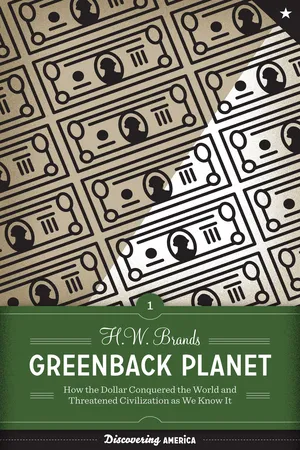
The world runs on the US dollar. From Washington to Beijing, governments, businesses, and individuals rely on the dollar to conduct commerce and invest profitably and safely. But how did the greenback achieve this planetary dominance a mere century and a half after President Lincoln issued the first currency backed only by the credit—and credibility—of the federal government?
In
Greenback Planet, acclaimed historian H. W. Brands charts the dollar's astonishing rise to become the world's principal currency. Telling the story with the verve of a novelist, he recounts key episodes in U.S. monetary history, from the Civil War debate over fiat money (greenbacks) to the recent worldwide financial crisis. Brands explores the dollar's changing relations to gold and silver and to other currencies and cogently explains how America's economic might made the dollar the fundamental standard of value in world finance. He vividly describes the 1869 Black Friday attempt to corner the gold market, banker J. P. Morgan's bailout of the U.S. treasury, the creation of the Federal Reserve, and President Franklin Roosevelt's handling of the bank panic of 1933. Brands shows how lessons learned (and not learned) in the Great Depression have influenced subsequent U.S. monetary policy, and how the dollar's dominance helped transform economies in countries ranging from Germany and Japan after World War II to Russia and China today. He concludes with a sobering dissection of the 2008 world financial debacle, which exposed the power—and the enormous risks—of the dollar's worldwide reign.
The dollar became America’s currency by historical happenstance. The silver mines of Mexico and Peru made Spain the envy of its imperial competitors during the sixteenth, seventeenth and eighteenth centuries, and Spanish silver dollars anchored the economies of the Americas and much of the rest of the world. Spanish dollars—the word dolar derived from the German thaler, an abbreviated reference to silver coins minted from metal dug from the ground at Joachimsthal in Bohemia—circulated in England’s North American colonies at the time of the American Revolution, and when the Continental Congress chose a currency for the nascent republic it adopted the one Americans knew best. The independence of the Spanish dollar from the British government rendered it the more attractive to a people who had taken up arms against King George.
The federal constitution of 1787 granted the new Congress the power “to coin money” and “regulate the value thereof.” The legislature exercised this power in the Coinage Act of 1792, which described the series of coins to be struck by the United States mint, based on “dollars or units: each to be of the value of a Spanish milled dollar as the same is now current, and to contain three hundred and seventy-one grains and four-sixteenths parts of a grain of pure, or four hundred and sixteen grains of standard silver.” There were problems with the Coinage Act, starting with its implicit evaluation of “standard silver” versus pure silver and extending to a similar weighing of silver against gold. “Eagles,” for instance, were defined as equaling ten dollars, or 247 4/8 grains of pure gold. This equation effectively specified a particular exchange rate between gold and silver. Whether the United States government would, or could, defend the stipulated rate in the face of the discovery of new gold and silver mines, the advancement of refining technology and the ebb and flow of international trade were questions the legislators left for a later day.
More immediately pressing was the fact that the gold and silver coins couldn’t cover the currency needs of the new nation. Specie had always been scarce in America, causing the colonists to turn to substitutes. Indian wampum—strings of beads or shells—served in some places; deeds to land or claims on tobacco or cotton elsewhere. Merchants employed bills of credit; individuals drafted checks against their personal good names. Colonial legislatures issued paper notes. This last method enjoyed the authority of government, which could tax to pay its obligations, but it suffered from the ease with which paper money—in contrast to gold or silver, or, for that matter, land—could be multiplied. Governments under stress were tempted to print more notes, trading the long-term cost of devaluation for the short-term benefit of liquidity. As governments succumbed to the temptation, the long term grew shorter; during the Revolutionary War the phrase “not worth a Continental” summarized the devaluation that gutted the paper currency issued by the Continental Congress.
Alexander Hamilton addressed the problem as the first treasury secretary under the 1787 constitution. Hamilton proposed the establishment of a nationally chartered but privately owned bank, the Bank of the United States, which would issue bank notes that would circulate as currency. Hamilton’s plan pleased creditors, who benefited from a strong dollar—one that purchased at least as much on repayment as when it was lent. His plan upset debtors, who benefited from a weak dollar. Hamilton’s critics, including Thomas Jefferson, the champion of debt-strapped farmers, additionally objected that the Bank of the United States would mortgage the public interest to the personal interests of the bank’s wealthy shareholders. Hamilton didn’t deny the allegation; on the contrary, he contended that the public interest required an alignment of government with the interests of the wealthy. Hamilton defeated Jefferson, with the help of dozens of members of Congress who became charter shareholders of the bank. The bank began operations in 1791 with a scheduled lifespan of twenty years.
By the time the bank’s charter ran out in 1811, the Jeffersonians controlled the government, and they let the bank lapse. They soon wished they hadn’t. The War of 1812 demonstrated the value of a stable currency and the convenience of a national bank, and in 1816 Jefferson’s heirs rechartered the Bank of the United States for another twenty years. John Marshall and the Supreme Court eliminated lingering questions about the bank’s constitutionality in the 1819 case of McCulloch v. Maryland.
Or so they thought. Andrew Jackson disagreed. Jackson held a belief common among his fellow Tennesseans and other westerners that the strong-dollar policies of the bank unfairly inhibited western growth. He held another belief, common throughout the country at the time, that although the Supreme Court spoke for the judicial branch of the government, it didn’t speak for the executive or the legislature. Jackson had no compunctions about brushing aside Marshall’s assertion of the bank’s constitutionality; he contended that neither the expressed nor implied powers of the constitution authorized the charter of such a corporate monopoly.
Yet Jackson would have allowed the bank to expire peacefully when its charter ran out had the bank’s backers not forced his hand. Henry Clay, with his eye on the 1832 election, got bank president Nicholas Biddle to request early recharter and Congress to deliver it. Jackson riposted with a veto of the recharter bill. Jackson declared the bank not merely unconstitutional but dangerous to democracy. “When the laws undertake to . . . make the rich richer and the potent more powerful, the humble members of society—the farmers, mechanics, and laborers—who have neither the time nor the means of securing like favors to themselves, have a right to complain,” Jackson said. “There are no necessary evils in government. Its evils exist only in its abuses. If it would confine itself to equal protection, and, as Heaven does its rains, shower its favors alike on the high and the low, the rich and the poor, it would be an unqualified blessing.” The Bank of the United States was no blessing, but a curse.
Having eliminated the bank’s future, Jackson proceeded to dismantle its present. The bank’s principal customer was the federal government, whose huge deposits provided the reserves against which the bank issued loans. Jackson ordered the deposits removed from the bank and placed in various state banks. Nicholas Biddle fought the removal, recalling loans and otherwise tightening credit in ways intended to arouse public opinion against the president. Jackson understood Biddle’s strategy and swore to defeat it. “The Bank, Mr. Van Buren, is trying to kill me,” he told his vice president. “But I will kill it!”
Jackson did kill the bank, defeating Biddle and vindicating the principle that the representatives of the people, rather than a small class of wealthy financiers, should direct the financial fortunes of America. It was a great victory for democracy—and a disaster for the economy. The bank’s demise inaugurated an orgy of speculation in land, funded by the flimsy credit of hundreds of poorly managed state banks; after Jackson curtailed the gambling by requiring, in the Specie Circular of 1836, that purchasers of federal lands pay with gold and silver, the economy froze up in the panic of 1837.
Not till the 1840s did the country recover, amid the enthusiasms of Manifest Destiny. Americans of the mid-nineteenth century convinced themselves that Providence smiled on them and their efforts to expand democracy west to the Pacific and south into Mexico. The annexation of Texas reflected this vision; it also triggered a war with Mexico, which continued to claim Texas. The war lasted two years and ended with American forces occupying Mexico City and its environs, including the village of Guadalupe Hidalgo, where a treaty transferring the northern half of Mexico to the United States, in exchange for a fig leaf payment of $15 million, was concluded.
At the time of the signing none of the negotiators realized that the most important financial discovery of the nineteenth century had just been made in part of the territory about to be transferred. In the foothills of the Sierra Nevada of California, above the trading post of John Sutter at the confluence of the American and Sacramento Rivers, an American expatriate named James Marshall discovered a gold nugget, followed by many others just like it. Marshall and Sutter tried to suppress the news, which nonetheless leaked out, inspiring a rush of global dimensions to California. Hundreds of thousands of miners scoured the streambeds and hillsides of the Sierra before plunging into the earth in pursuit of the ore-bearing veins. American gold production soared from less than $1 million annually to more than $50 million. The gold geology of California taught prospectors to find deposits elsewhere in the American West and around the world; the world’s gold supply doubled during the next generation.
The glut of gold allowed other countries to follow the lead of Britain, which had tied its currency to gold some decades before. Britain’s gold standard supported the expansion of British trade in such formal possessions as India, Australia and Canada, but also in the informal empire the British were creating in Central and South America. The United States didn’t join the gold group formally, instead retaining the trappings of bimetallism. Yet the excess of gold compared to silver drove the latter out of circulation as debtors paid their bills in the relatively less valuable yellow metal. In 1853 Congress acknowledged the existing state of affairs and limited silver as legal tender—money that creditors were required to accept—to debts of five dollars or less. The result was a de facto gold standard.
The country experienced another panic, in 1857, after speculation in railroads and mining stocks turned sour and the Central America, a ship carrying $2 million in California gold to New York, went down in a hurricane off the Carolina coast. The financial panic intensified the fear many felt for the American republic, which was careening toward secession and civil war. The election of Abraham Lincoln furnished South Carolina the occasion for finally doing what inhabitants of the Palmetto State had been threatening to do for decades: bolt the Union. South Carolina’s secession prompted similar actions by several other states, and when Lincoln forcibly resisted at Fort Sumter, the war began.
Wars are always expensive and typically test a belligerent’s financial prudence and stamina. The infant American republic had failed the test during the Revolutionary War, staggering to victory only with infusions of French cash. The War of 1812 made the Jeffersonians believers in the concept of a national bank. But the Civil War was a sterner test than anyone had dreamed before the conflict started. The Confederacy failed even more dismally than the early American republic had; lacking both restraint and a foreign underwriter, the Confederate government printed reams of money that rapidly grew worthless.
The Union fared much better. The northern economy was stronger than that of the South; the population was larger and more productive. The North could stand tax increases to pay for war materiel, and Northerners bought government bonds in quantities that made Jefferson Davis drool.
Even so, the cost of the war outran the Union government’s ability to tax and borrow. By early 1862 Salmon P. Chase, Lincoln’s treasury secretary, concluded that continuing the war required taking the Union partway down the path the Confederacy was following. Chase proposed an issue of treasury notes unredeemable in gold or silver yet legal tender nonetheless.
Creditors were the first to complain, on the obvious ground that they had lent hard money but would receive flimsy in return. Their spokesmen in Congress decried the unfairness of this as well as its dubious constitutionality. Article 1 of the constitution authorized Congress to coin money, but nothing was said about printing money. This wasn’t an oversight: the framers all bore painful memories of the devastating inflation spawned by the printed Continental dollars. Quite apparently they hadn’t intended for Congress to crank up the printing presses again.
The advocates of the administration’s bill promised that this time the printers—that is, the administration itself—would be circumspect. Paper money became a problem only when it proliferated; kept within bounds, it would lubricate commerce without depriving anyone of honest recompense.
The opponents weren’t buying. In a rowdy debate they pounded the administration for lax morality and shady politics. “To make these notes legal tender for debts, private and public, contracted before the passage of the bill, seems to me a clear breach of good faith,” Benjamin Franklin Thomas of Massachusetts told the House of Representatives. “Debts are obligations or promises to pay money. . . . Paper is not money.” Thomas didn’t question the need to support the troops, but he wanted the administration to do so more forthrightly. “Take from us, Mr. Chairman, our property, houses, and lands; they cannot be devoted to a nobler cause. But in God’s name leave us the consciousness of integrity; leave us our self-respect.”
Owen Lovejoy of Illinois wanted the administration to acknowledge that it was playing loose with the constitution. “I would admit the plea of necessity, if I believed it,” Lovejoy said. “And I think it is more manly to confess, as Jefferson did [in the Louisiana Purchase], that the thing was necessary but unconstitutional, than it is to attempt to torture the constitution into the support of a measure which everybody must see to be unconstitutional.” Lovejoy likened the question of paper money to the theological doctrine of transubstantiation, by which bread and wine were transformed into the body and blood of Christ. “Believe that this piece of paper is a five-dollar gold piece, and it is a five-dollar gold piece,” he mocked. “Believe it is worth five dollars, and it is worth five dollars.” He didn’t accept transubstantiation, and he wouldn’t accept paper money. “It is not in the power of this Congress, nor in the power of any legislative body, to accomplish an impossibility in making something out of nothing.” Lovejoy couldn’t believe the government would be as self-denying as the administration promised. “When we have issued $100 million we must issue another $100 million, and then another $100 million. And thus we plunge from lower depth to still lower, till we are buried in an ocean of inconvertible paper.” Shifting metaphors slightly, Lovejoy forecast imminent doom: “Sir, there is no precipice, there is no chasm, there is no possible yawning gulf before this nation so terrible, so appalling, so ruinous as this bill that is before us.”
The supporters of the legal tender bill rallied to its defense. Thaddeus Stevens of Pennsylvania, the chairman of the House ways and means committee, asked Salmon Chase to write a letter explaining the treasury’s thinking. Chase responded by confessing his own reservations about the bill. “I have felt, nor do I wish to conceal that I now feel, a great aversion to making anything but coin a legal tender in payment of debts,” the secretary wrote. He said he had hoped to persuade people to accept government notes voluntarily. Many did so. “But, unfortunately, there are some persons and some institutions which refuse to receive and pay them, and whose action tends not merely to the unnecessary depreciation of the notes but to establish discriminations in business against those who, in this matter, give a cordial support to the government, and in favor of those who do not.” For this reason the issue of the notes as legal tender had become “indispensably necessary.”
Chase’s explanation inspired other Republicans. “The bill before us is a war measure—a measure of necessity, and not of choice,” Elbridge Spaulding of New York said. “These are extraordinary times, and extraordinary measures must be resorted to in order to save our government and preserve our nationality.”
Charles Sumner of Massachusetts articulated the view that ultimately carried the day. “Surely we must all be against paper money,” Sumner told the Senate. “We must all insist upon maintaining the integrity of the government, and we must all set our faces against any proposition like the present, except as a temporary expedient, rendered imperative by the exigency of the hour. . . . Your soldiers in the field must be paid and fed. Here there can be no failure or postponement. A remedy which at another moment you would reject is now proposed. Whatever may be the national resources, they are not now within reach except by summary process. Reluctantly, painfully, I consent that the process should issue.”
The Legal Tender Act of 1862 authorized the treasury to issue $150 million in notes—which would be printed in green ink: hence the name “greenbacks”—that would be “lawful money and a legal tender in payment of all debts public and private,” except for import duties and interest on federal bonds. A link to the past and to gold still existed: the treasury notes could be converted to federal bonds, which were backed by gold. But this link was severed at the next session of Congress, when the legislature specified nonconvertible notes and ordered holders of the old notes to redeem them by July 1, 1863. “Thereafter the right so to exchange the same shall cease,” the new law said.
With this the greenback became pure fiat money: currency backed not by anything material but only by the promise of government not to abuse the printing privilege—and by the willingness of dollar-holders to suspend their disbelief in such promises. Considering the duress of the war, the two parties to the deal—the government and the dollar-holders—held up their ends of the bargain reasonably well. The value of the greenback declined against gold but did nothing like the vanishing act of the Continental dollar. During 1862 the greenback slid against gold until 129 greenback dollars were required to purchase 100 gold dollars. The greenback continued to drop during the spring of 1863, to 152 against 100 in gold, but after the Union victory at Gettysburg in July, the greenback recovered to 131. It slumped again during 1864, as Ulysses Grant made little progress against Robert E. Lee near Richmond; the low point came in July, when gold traded at 258. By the time of Lee’s surrender to Grant in April 1865 the greenback had climbed to 150.
The rise and fall of the greenback against gold was part of an institutionalizing pattern of speculation. “Along with ordinary happenings, we fellows in Wall Street had the fortunes of war to speculate about,” Daniel Drew, one of the most active speculators, recalled. “That always makes great doings on a stock exchange. It’s good fishing in troubled waters.” The fish pond for gold took shape informally, with traders initially conducting business at the edge of the stock exchange, then moving to a coal cellar on William Street, before winding up in a special venue, the Gold Room, on New Street beside the stock exchange. As the trading of gold for greenbacks became more intense, the atmosphere in the Gold Room grew less savory. “Imagine a rat-pit in full blast, with twenty or thirty men arranged around the rat tragedy, each with a canine under his arm, yelling and howling at once...
Table of contents
Cover
Title Page
Copyright
Contents
Introduction
1 Fiat Lucre: 1863–1907
2 Strong and Stronger: 1907–1928
3 Skulls and Bones: 1929–1944
4 The View from Mount Washington: 1944–1963
5 Floating, Floating . . . : 1963–1973
6 Petrodollars, Eurodollars and the Invincible Yen: 1973–1989
7 Bubble and Boil: 1990–2002
8 Be Nice to Your Creditors: 2003–
Notes
Acknowledgments
Index
Trusted by 375,005 students
Access to over 1.5 million titles for a fair monthly price.
Study more efficiently using our study tools.
Frequently asked questions
Yes, you can cancel anytime from the Subscription tab in your account settings on the Perlego website. Your subscription will stay active until the end of your current billing period. Learn how to cancel your subscription
No, books cannot be downloaded as external files, such as PDFs, for use outside of Perlego. However, you can download books within the Perlego app for offline reading on mobile or tablet. Learn how to download books offline
We are an online textbook subscription service, where you can get access to an entire online library for less than the price of a single book per month. With over 1.5 million books across 990+ topics, we’ve got you covered! Learn about our mission
Look out for the read-aloud symbol on your next book to see if you can listen to it. The read-aloud tool reads text aloud for you, highlighting the text as it is being read. You can pause it, speed it up and slow it down. Learn more about Read Aloud
Yes! You can use the Perlego app on both iOS and Android devices to read anytime, anywhere — even offline. Perfect for commutes or when you’re on the go. Please note we cannot support devices running on iOS 13 and Android 7 or earlier. Learn more about using the app
Yes, you can access Greenback Planet by H. W. Brands in PDF and/or ePUB format, as well as other popular books in Economics & Economic History. We have over 1.5 million books available in our catalogue for you to explore.