- 339 pages
- English
- ePUB (mobile friendly)
- Available on iOS & Android
eBook - ePub
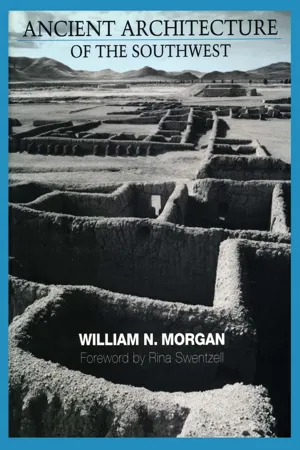
Ancient Architecture of the Southwest
About this book
During more than a thousand years before Europeans arrived in 1540, the native peoples of what is now the southwestern United States and northern Mexico developed an architecture of rich diversity and beauty. Vestiges of thousands of these dwellings and villages still remain, in locations ranging from Colorado in the north to Chihuahua in the south and from Nevada in the west to eastern New Mexico—a geographical area of some 300,000 square miles. This study presents a comprehensive architectural survey of the region. Professionally rendered drawings comparatively analyze 132 sites by means of standardized 100-foot grids with uniform orientations. Reconstructed plans with shadows representing vertical heights suggest the original appearances of many structures that are now in ruins or no longer exist, while concise texts place them in context. Organized in five chronological sections that include 132 professionally rendered site drawings, the book examines architectural evolution from humble pit houses to sophisticated, multistory pueblos. The sections explore concurrent Mogollon, Hohokam, and Anasazi developments, as well as those in the Salado, Sinagua, Virgin River, Kayenta, and other areas, and compare their architecture to contemporary developments in parts of eastern North America and Mesoamerica. The book concludes with a discussion of changes in Native American architecture in response to European influences. Written for a general audience, the book holds appeal for all students of native Southwestern cultures, as well as for everyone interested in origins in architecture. In particular, it should encourage younger Native American architects to value their rich cultural heritage and to respond as creatively to the challenges of the future as their ancestors did to those of the past.
Information
Topic
ArchitectureSubtopic
History of ArchitectureINDEX
A
Abó, Estancia Valley, New Mexico, 231
acequia madre (matriarch canal), 170
Acoma Pueblo, New Mexico, 236, 237
—ancestors of, 128, 140, 142
—relative to Oraibi, 195; to Gran Quivira, 230, 232; to Zuni, 238; to Shongopavi, 250; to Santo Domingo, 260; to Taos, 263
—site description of, 254–257
Adena culture
—architectural achievements of, 5
—See also Hopewell culture
adobe
—walls of, 10, 26, 36, 92, 100, 114, 116, 119, 170, 207
—surfaces of, 16
—mortar of, 30, 68, 191, 207
—hearth linings of, 34
—thermal properties of, 38
—solid fill of, 57
—roofs and floors of, 94
—pueblos of, 102, 150, 158, 159, 213, 215, 219, 220, 221, 223, 226, 229, 237
—structures of, 107, 156, 170, 172, 177, 179, 187, 230, 254
—houses of, 114
—altar of, 162, 250
—granary of, 173
—church of, 195
—straw-reinforced, 200
—windbreaks of, 228
—molded bricks of, 228, 235, 262
Aguatubi, San Bernardo de
—church of Awatovi, 200, 235
Alaska
—land bridge to Asia, xiii
—Athapascan area of, xvii
—pit house sites in, 3
Alkali Ridge, Utah, xvi, 5
—relative to Grass Mesa Village, 18; to Montezuma Valley, 79; to Main Ridge, 92; to Coombs, 94, 96
—site description of, 19–20
altar. See shrine
Alvarado, Hernando de (explorer)
—visits Acoma, 255
—observations on Taos, 262
Amerind Foundation, 170, 172
Anasazi (ancient enemies), xv, xvi, xvii, xviii, xix, 267
—early pithouses and kivas of, 3–20
—in Chaco Canyon, 4, 23, 24, 39–59
—in the Northern San Juan area, 4, 19, 25, 26, 81, 85, 87, 90
—Mogollon influences on, 11
—influences of, 23, 36, 99, 105, 114, 118, 120, 121, 165
—in the San Juan Basin, 24, 59–76
—in Canyon de Chelly, 76, 136
—in Mesa Verde, 78, 139, 140
—in the M...
Table of contents
- Cover
- Frontispiece
- Title Page
- Copyright
- Contents
- Foreword
- Acknowledgments
- Introduction
- Early Settlements to A.D. 900
- Regional Developments, 900 to 1140
- Unrest and Adjustment, 1140 to 1300
- Migration and Consolidation, 1300 to 1540
- Historic Pueblos, 1540 to Present
- Overview
- Glossary
- Pronunciation Guide
- Bibliography
- Index
Trusted by 375,005 students
Access to over 1.5 million titles for a fair monthly price.
Study more efficiently using our study tools.
Frequently asked questions
Yes, you can cancel anytime from the Subscription tab in your account settings on the Perlego website. Your subscription will stay active until the end of your current billing period. Learn how to cancel your subscription
No, books cannot be downloaded as external files, such as PDFs, for use outside of Perlego. However, you can download books within the Perlego app for offline reading on mobile or tablet. Learn how to download books offline
Perlego offers two plans: Essential and Complete
- Essential is ideal for learners and professionals who enjoy exploring a wide range of subjects. Access the Essential Library with 800,000+ trusted titles and best-sellers across business, personal growth, and the humanities. Includes unlimited reading time and Standard Read Aloud voice.
- Complete: Perfect for advanced learners and researchers needing full, unrestricted access. Unlock 1.5M+ books across hundreds of subjects, including academic and specialized titles. The Complete Plan also includes advanced features like Premium Read Aloud and Research Assistant.
We are an online textbook subscription service, where you can get access to an entire online library for less than the price of a single book per month. With over 1.5 million books across 990+ topics, we’ve got you covered! Learn about our mission
Look out for the read-aloud symbol on your next book to see if you can listen to it. The read-aloud tool reads text aloud for you, highlighting the text as it is being read. You can pause it, speed it up and slow it down. Learn more about Read Aloud
Yes! You can use the Perlego app on both iOS and Android devices to read anytime, anywhere — even offline. Perfect for commutes or when you’re on the go.
Please note we cannot support devices running on iOS 13 and Android 7 or earlier. Learn more about using the app
Please note we cannot support devices running on iOS 13 and Android 7 or earlier. Learn more about using the app
Yes, you can access Ancient Architecture of the Southwest by William N. Morgan in PDF and/or ePUB format, as well as other popular books in Architecture & History of Architecture. We have over 1.5 million books available in our catalogue for you to explore.