This collection of private writings by General Custer's wife offers an intimate look at their lives before and during the Civil War.
In her first year of marriage (1864–1865) to General George Armstrong Custer, Libbie Custer witnessed the Civil War firsthand. Her experiences of danger, hardship, and excitement made ideal material for a book, one that she worked on later in life yet never published. In this volume, Arlene Reynolds presents a readable narrative of Libbie Custer's life during the war years by painstakingly reconstructing Libbie's original, unpublished notes and diaries found in the archives of the Little Big Horn Battlefield National Monument.
In these reminiscences, Libbie Custer vividly describes her life both in camp and in Washington. She tells of incidents such as fording a swollen river sidesaddle on horseback, dancing at the Inaugural Ball near President Lincoln, and watching the massive review of the Army of the Potomac after the surrender. The resulting narrative tells the fascinating story of a sheltered girl's maturation into a courageous woman in the crucible of war. It also offers an intimate glimpse into the youth, West Point years, and early military service of General Custer.
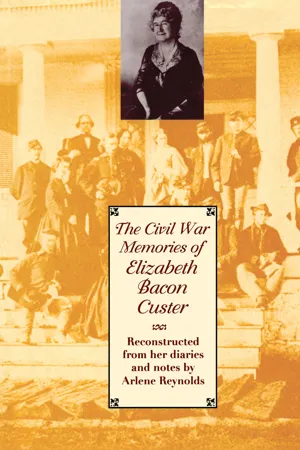
eBook - ePub
The Civil War Memories of Elizabeth Bacon Custer
Reconstructed From Her Diaries and Notes by Arlene Reynolds
- 205 pages
- English
- ePUB (mobile friendly)
- Available on iOS & Android
eBook - ePub
The Civil War Memories of Elizabeth Bacon Custer
Reconstructed From Her Diaries and Notes by Arlene Reynolds
About this book
Information
Chapter One
May I Begin
May I begin about a very merry, happy girl, in an old Michigan town near Detroit, not much impressed by the officers who came and went from the Civil War in the ’60s, but who after had her breath taken away by a proposal of marriage, much like a cavalry charge, from the young General whom I had just met. I think that when I caught my breath I mentioned the much-used word* and was told not on his part for he had carried this determination in his mind when as a little girl I had swung on the gate and called out as he passed to and from school, “Hello you Custer boy!”
Since these are very personal reminiscences of the war I venture to outline a little of the life at that time in Michigan and to bear testimony to the loyalty of my hometown, Monroe, so far removed from the conflict and with the very inadequate communications of those days; for though there were railroads and telegraphs, of course, they were slow and uncertain.
When war was declared between the North and the South I believe that the patriotism of those cultivated Eastern people, many of whom had emigrated to the territory early in eighteen hundred, was greatly due to the fact that they had helped in the final making of the state. Some had come before the railroad, by canal, lake, stage, and private conveyances and on horseback. Village government was established in a clearing in the forest and, characteristic of those people, the church and schoolhouse were built at the same time with their homes.
Proof of the refinement and taste of these people was evinced [in] the primitive dwellings of logs and rough timber, by the mahogany, inherited books, family portraits, silver, linen, and even china. I remember as a tiny child pirouetting before a mirror set low in a dressing table that would be the envy of the collector of today.
Monroe sent comparatively few to the war, for many of our ambitious young men had gone from college and school to the neighboring cities of Detroit and Toledo where opportunities were greater. But the company that was recruited had every proof of the devotion of the town. There were faithful workers among the women and girls from the Societies for Knitting, and innumerable socks and hand-made underclothing went much to the front, and many useful, and alas absurd articles, went into the haversacks of the departing company. For instance, the youngest girls were set to making linen have-locks as protection from the sun, and great was our indignation when we learned, by chance, that they were used to clean guns.
In retrospection I think that I was too immature to realize, the first three years, the awfulness of the fratricidal conflict. In my joyous life it was only when sorrow came to the town that I realized something of what war really was. The tenderness and sympathy of the village, the silence as one passed the houses of suffering, and the constant gifts of flowers stripped from the lovely gardens and left at the house of sorrow or covering the graves all summer. The tears of the people, the tolling of the courthouse bells, [and] the long line of vehicles and flower-laden pedestrians following a hero to his last resting place sobered me. The funeral dirges of those who were brought home for burial haunt me now.
I could hardly take in my Father’s personal grief over his country. He had married late in life (I was nearly a half a century younger) and the war aged him greatly and his love of country was so deep he never recovered from his grief. Day by day, in sunshine or storm, he walked to the distant railway station for the Detroit papers, unable in his anxiety to wait for their delivery in the town. As he returned through the village square the people watching him said with depression, “It’s bad news, no use to wait for the papers to tell us. Look at the old judge, speaking to no one, walking with bowed head.”
As a girl I began to feel the love of country, the sorrow of what war was, the partings with brothers and lovers that meant, possibly, final farewell. Under the tutelage of older women I scraped lint, knitted shapeless socks for the troops, rode and danced with the officers who were on temporary duty before going to the front.
Among those who came to our town was one who had been in Monroe before, working his way in order to attend our excellent academy. He had applied for West Point, passed his examinations, and graduated just in time, as he expressed it, “To run with the rest at the first battle of Bull Run.” There was a great flutter of excitement among the many pretty girls over the “Youngster,” as General McClellan called him.
With the critical and exacting eye of a girl I decided I would never like him no matter how attentive he was because his hair was light, and because I despised his military overcoat as it was lined with yellow, for I thought it his taste and did not know that it was regulation color for the cavalry. But he determined to tone down his hair, and his overcoat lining, and finally I consented to know him. I must confess to you that the little God of Love, which blinds our eyes once in life, worked such charms in my heart that I forgot the gold in his hair and yellow became my favorite color from that time til now.
And when separation came I found myself suddenly matured from girlhood to womanhood, anxiously reading the paper, and no longer laughing and teasing those girls among us who had been watching the mail so intently for letters. Finally news came in the papers that President Lincoln had insisted upon having some young cavalry commanders who would have more daring and ambition than older ones, and the yellow-haired captain was one of three who were made Generals. The papers rang with the news that at twenty-three Captain Custer had been made a “Boy General,” but his first fight with his Brigade assured President Lincoln that he had been right and he was not too young.
I’d never known, nor particularly cared for officers or army life. If I thought at all of marriage it was with a shudder over what it involved in practical details: the number and variety of fruits that must be put up, the spring housekeeping, cleaning, the planning of food three times a day for the head of the house.
I had seriously contemplated the then-despised life of an old maid and was hoping that I would have “talent” if not been taught well enough to enter the New York School of Design. Possibly I might have mentioned that matrimony, as I saw it in Monroe so constantly about me, meant domestic thralldom, for the question of efficient servants was even then a problem. However it was, I found my lover had his mind made up to a wife who would be his helpmate in entertaining for him, in homemaking for his young officers.
We had from the first an efficient woman who catered, cooked, and directed any who assisted her. I don’t remember ever being in the kitchen but three days when Eliza was ill, and then my husband’s younger brother, Lieutenant Tom, and a striker, who did know how to cook, never left my side. Of course my stepmother, who believed so in matrimony that she could hardly wait til I left school to plan, may have talked me over with a perfectly dear third or fourth cousin who was pioneering in Northern Michigan and often stayed with us. I can only recall his laughingly declining me, since a girl who could only make pepper tea for a cold, and was determined that should be the limit of her domestic education, would hardly fill the bill and would justify him in turning me down with thanks.
After I knew my husband a little better, and was less critical, he brought his West Point cadet jacket and tried it on, perhaps hoping to make it a slight argument in inducing a favorable answer to an important question he had asked the second time after I came to know him. A question he seemed to think the all important of his life.
The General’s proposal was as much a cavalry charge as any he ever took in the field. First on the astonished me who knew that in books lovers led up to proposals by slow careful approaches and chosen language, and so had some of the General’s predecessors, quite living up to the poetical or romantic. But this vehement, stammery disclosure of years of purpose I had no breath to protest. (Sometimes when greatly excited he had a slight hesitation in speech, then out poured a torrent of words.) Proposing the second time I saw him as a violent contrast to the ambling ponies of my tranquil girlhood.
The General’s staff had, some little time after the General returned, noticed that his sash had initials, [a] very significant circumstance, and when off duty they admired the embroidery and intimated that they would be interested in knowing what “LCB”* stood for. Whether the General was prepared, or whether it was inspiration, one of the staff told me that they had to be content with the enigmatical “Light Cavalry Brigade,” and, til he announced that the old judge had been won over, they could not design what really the mysterious letters meant.
The next cavalry charge of this newly made General was on my father. Objections were made to giving his only child to a life so full of hardships and danger, but by this time the daughter was arguing, and consent at last was given.
In discussing marriages, a subject of unending interest before or after, my husband believed that no marriages were happier than those of the army. There were so often, in those days of oft-occurring separations, repeated honeymoons. I felt that no little cloudlet should dim our roseate sky and he believed that no heated discussions, no fretfulness ever should be, for we both realized that every meeting in those perilous days might be our last. It was eternal vigilance, for even with the rapture of fulfilled love came the adjusting of differences of opinion, sometimes surprises, as with us, at each other’s point of view. And there came to us such marveling that anyone ever dared to marry when perhaps a few months, as with us, of only occasional, hurried, and tremulous meetings on my part constituted our knowledge of each other. For Father’s opposition had compelled me to consider his wishes and refuse clandestine intercourse. That there are many happy marriages with the limited chances to know each other can, of course, only be explained by the absorbing power of affection that teaches tolerance and liberality. With military people, with parting ever before them in that period of uncertainty, even the mildest tiff was avoided with the husband rushing constantly into action.
Our government, so austere in most respects, was sentimentally lenient when an officer put in application for leave of absence and stated, in the usual formal terms, “for the purpose of marriage.” Whatever opposition to leave of absence might be made, there seemed to be no obstacles put forward if in the application it was stated that a man wanted to go home to be married, that is if it was in the winter when hostilities were suspended. It must have been because all the world loves a lover. And if citizens realized what a number of people had to give consent for a departure from an army it would look as if all in authority, from Captain to Major, Major to Lieutenant Colonel, Lieutenant Colonel to Colonel, Colonel to General in command of Brigade or Division, were in sympathy with a man’s eagerness to be made twain. But the War Department might at the very last veto this missive of the lover with some cold formal words like these, “The Secretary of War finds on investigation that it is not consistent with the necessities of service at the present time that Captain so and so should be spared from his regiment.” Then the dear “best girl” at home had a cry or two, but dried her eyes and began to feel pride creeping into her heart in place of disappointment because the country, she saw so plainly, could not dispense with the services of a lover like hers, and the government must go to pieces if her Captain left his regiment to come home to her.
But in January of 1864 an application for leave of absence came back approved from the War Department and it looked as if we would be permitted a long honeymoon from our marriage day, February ninth, as the troops were in winter quarters.
January 1864I think I told you General Custer had gone home to be married. We all called on him last Sunday evening and in response to a congratulatory remark by Colonel Preston he said, ‘Thank you gentlemen. I’m going out to the Department of the West to get a command, or a new commander and I don’t know which.” Good wasn’t it? And well turned, he is quite sociable.[LETTER FROM AN OFFICER OF CUSTER’S BRIGADE]
*The word is “haste.”
*Libbie Clift Bacon
Chapter Two
An Embryo Soldier
General Custer was the oldest of a third set of children that swarmed in the home of Emmanuel and Maria Custer; Father and Mother Custer were widower and widow with children when they married. This son was named for a missionary. The little boy seems to have been an idol with his parents. He was consecrated to the service of the Lord and constant prayers were offered by his devout parents that he might be a minister of the gospel, go forth, and preach him that was crucified.
Father Custer was a man of fire and intense feeling and though he exhorted in the prayer meetings Sunday, politics and patriotism were equally as much a religion to him weekdays.
New Rumley [Ohio] had a company of “cornstalk militia” and what was then called training day was marching and drilling to the delight of the quiet little town, and everyone dropped work and made a holiday with the soldiers. Father Custer took his little boy, left him with friends during his military duties, then kept him with him the rest of the day while he and his friends talked of the War of 1812, the Mexican War, or even sixty-five years ago, as with the partisans of the present day, tried to convince anyone who opposed them that the only safety for the country lay in the fact that the Democratic Party be always in power. One day the proud Father took his little son home to his Mother dressed in a miniature reproduction of his own uniform that he had secretly ordered the village tailor to make, and the militia had a young recruit of four.
Whether the vehement and contentious talk of war, the brightness of the uniforms, the fife and drums [or] the fact that these days of joy with his Father were his only holidays, they must have made a deep impression on the growing mind at the time. And possibly the glamour, and eventually the glory of war, became a fixed impression. One of his older brothers was declaring, from time to time about the house, one of the famous speeches that the old school readers contained and which he was obliged to learn as the task set him by his master. The family were greatly amused and surprised one day to hear the little Armstrong call out in a very good imitation of his brother’s voice and gestures, “My voice is for war!” Of course the Father did not let this little accomplishment go unnoticed. [Autie] was set up on the counter of the village store next training day, and tightly encased in his uniform and waving his little arm this embryo soldier spouted his military lines to the amusement of the little group that had gathered around him.
As childhood ripened into boyhood and all the little brood were taught to work on the farm between the short sessions of the district school, one among them read everything that came [his] way. The devoted Father, out of his small substance, bought a book for the reader whenever he could spare the money. Over these stories of travel, adventure, and war the boy poured, taking his nooning when his brothers and Father rested or slept in the house; he lay in the quiet furrows of the field that he plowed and read of war and its heroes. Napoleon became his hero and continued so through life. Thus ended his parents’ hopes. Instead of becoming a peaceful shepherd of men, he was dominated by desire to serve his country. But this he kept from his sensitive parents, dreading to hurt their feelings and disappoint them. He continued to plow, sow, and reap summers, taking his tuition at the country schools winters, and finally attained to a little school of his own where he boarded round as was the custom in isolated districts.
Politics and religion dominated the Custer household and the lad learned early that a voter had influence if his Father’s party was in power. But the Republicans were the leaders in 1856 and he realized that it was of little avail to ask his Father and his friends to try and obtain for him an appointment to West Point. At that time there was no civil examination as now; their Congressmen were allowed to appoint a certain number to the Military Academy. There were then, as at the present time, many applicants. Fathers who had served their Congressman earnestly when he ran for office did not hesitate to exact tribute when their turn came to want anything.
What then had the lad to hope for, as the age limit hung over him. After twenty he could never be trained a finished soldier. At sixteen he dared all and wrote to the Honorable John A. Bingham representing New Rumley and the district in Congress.
Dear Mr. Bingham,I am told that you can send a boy to West Point. I want to go there and I hear that you don’t care whether a boy is a Democrat or Republican. I am a Democrat and I hope that you can send me to West Point for I want to be a soldier.Yours respectfully,
George A. Custer
Mr. Bingham replied June fourth giving the necessary qualifications for a cadetship but added that he had already offered the appointment elsewhere; should it be accepted of course he would have none to confer. June eleventh the lad replied from the Normal School at Hopedale, giving physical requisties [sic] for admittance to West Point and ending his letter, “If that young man from Jefferson County does not push the matter, or if you hear of another vacancy, I should be glad to hear from you. Yours with great respect.” Both letters are formal, and somewhat stilted, but vigorous in penmanship. But it seems that Mr. Bingham was much impressed with the manliness of the application and out of eleven others he chose the son of a Democrat.
When he was eighty [Mr. Bingham] recalled, as he often had during his eventful life, for he was always in public life, our minister to China and a leader in his state all his days. In reminiscing he called the General “My boy George,” and said he loved him as he loved his own son and confessed, “I had been in Congress but a short time when I received a letter from a boy that captivated me wonderfully. Forty years have gone by but I remember it now. It was a boy’s letter, in a boyish hand, but the writing despite the painstaking effort showed a firmness of purpose, a determination to succeed seldom apparent in one so young. And I was struck with the originality and blunt honesty of his expressions.”
In January Mr. Bingham wrote from the House of Representatives sending the conditional appointment to West Point to be signed by the recipient and approved by his Father. He directs him to sign the printed instructions and return [them to] the Secretary of War and report at the Academy between June 11 and 20. Then this busy man, writing his own letters, did not sign without a word of tenderness that marked his whole acquaintance afterward but wished him health, happiness, and success throug...
Table of contents
- Cover
- Title
- Copyright
- Dedication
- Contents
- Editor’s Note
- Introduction
- Preface
- 1. May I Begin
- 2. An Embryo Soldier
- 3. “I’m the Nest Egg”
- 4. Our First Eventful Journey
- 5. My Baptism of Fire
- 6. “And Do They All Do That to You?”
- 7. I Seem to Have Been Mostly Blushing
- 8. “Let’s Take Our Hour”
- 9. “The Old Lady Kicks agin It”
- 10. In My Usual Courageous Position
- 11. After Wearing Anxiety
- 12. “Another Glorious Day for Our Arms’
- 13. Joy That the War Was Over
- 14. Knighthood in Flower
- Epilogue
- The Red Neck Tie
- Young Custer’s Bride
- Bibliography
- Index
- Photo Inserts
Trusted by 375,005 students
Access to over 1.5 million titles for a fair monthly price.
Study more efficiently using our study tools.
Frequently asked questions
Yes, you can cancel anytime from the Subscription tab in your account settings on the Perlego website. Your subscription will stay active until the end of your current billing period. Learn how to cancel your subscription
No, books cannot be downloaded as external files, such as PDFs, for use outside of Perlego. However, you can download books within the Perlego app for offline reading on mobile or tablet. Learn how to download books offline
Perlego offers two plans: Essential and Complete
- Essential is ideal for learners and professionals who enjoy exploring a wide range of subjects. Access the Essential Library with 800,000+ trusted titles and best-sellers across business, personal growth, and the humanities. Includes unlimited reading time and Standard Read Aloud voice.
- Complete: Perfect for advanced learners and researchers needing full, unrestricted access. Unlock 1.5M+ books across hundreds of subjects, including academic and specialized titles. The Complete Plan also includes advanced features like Premium Read Aloud and Research Assistant.
We are an online textbook subscription service, where you can get access to an entire online library for less than the price of a single book per month. With over 1.5 million books across 990+ topics, we’ve got you covered! Learn about our mission
Look out for the read-aloud symbol on your next book to see if you can listen to it. The read-aloud tool reads text aloud for you, highlighting the text as it is being read. You can pause it, speed it up and slow it down. Learn more about Read Aloud
Yes! You can use the Perlego app on both iOS and Android devices to read anytime, anywhere — even offline. Perfect for commutes or when you’re on the go.
Please note we cannot support devices running on iOS 13 and Android 7 or earlier. Learn more about using the app
Please note we cannot support devices running on iOS 13 and Android 7 or earlier. Learn more about using the app
Yes, you can access The Civil War Memories of Elizabeth Bacon Custer by Elizabeth Bacon Custer in PDF and/or ePUB format, as well as other popular books in History & Historical Biographies. We have over 1.5 million books available in our catalogue for you to explore.