The first complete history of the nineteenth-century revolt, drawing on original Texan and Mexican sources and on-site inspections of almost every battlefield. Hardly were the last shots fired at the Alamo before the Texas Revolution entered the realm of myth and controversy. French visitor Frederic Gaillardet called it a "Texian Iliad" in 1839, while American Theodore Sedgwick pronounced the war and its resulting legends "almost burlesque." In this highly readable history, Stephen L. Hardin discovers more than a little truth in both of those views. Drawing on many original Texan and Mexican sources and on-site inspections of almost every battlefield, he offers the first complete military history of the Revolution. From the war's opening in the "Come and Take It" incident at Gonzales to the capture of General Santa Anna at San Jacinto, Hardin clearly describes the strategy and tactics of each side. His research yields new knowledge of the actions of famous Texan and Mexican leaders, as well as fascinating descriptions of battle and camp life from the ordinary soldier's point of view. This award-winning book belongs on the bookshelf of everyone interested in Texas or military history. Winner, T. R. Fehrenbach Book Award, Texas Historical Commission Summerfield G. Roberts Award, Sons of the Republic of Texas Honorable Mention, Certificate of Commendation, American Association for State and Local History "In Texian Iliad you smell the smoke of battle." — Texas Monthly "Hardin has succeeded admirably in writing a balanced military history of the revolution, making an important contribution to the extensive body of work on the struggle that eventually led to Texas' becoming part of the United States." — Austin American-Statesman "I look forward to consulting this book for the rest of my career!" —David J. Weber, Robert and Nancy Dedman Professor of History, Southern Methodist University
- 337 pages
- English
- ePUB (mobile friendly)
- Available on iOS & Android
eBook - ePub
About this book
Information
CHAPTER 1
“We Are All Captains and Have Our Views”
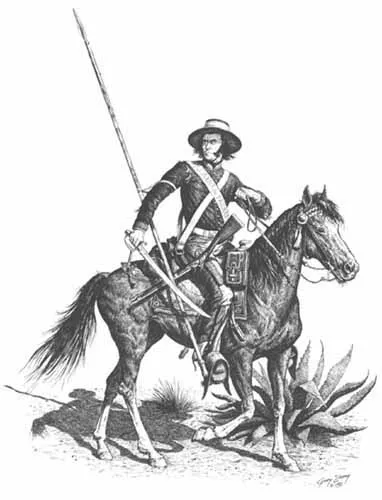
1. TROOPER, FLYING COMPANY OF ALAMO DE PARRAS
Retreat from Gonzales October 2, 1835
Following the skirmish at Gonzales, this seasoned trooper glances over his shoulder to see whether the deadly Texian riflemen are in pursuit. He is happy to see they are not but realizes that service in Texas has suddenly become far more dangerous. Yet stationed in San Antonio de Béxar, the men of the Flying Company of Alamo de Parras are accustomed to the rigors of frontier garrison life. The fledgling Republic of Mexico, beset by civil strife and economic uncertainty, was hard pressed to pay, feed, uniform, and equip its soldiers adequately even in the interior. Those serving on the far-flung frontera could expect even less, normally the dregs and hand-me-downs from an inefficient and corrupt supply system. Writing from Nacogdoches in 1828, General Manuel Mier y Terán complained: “The garrison of this fort has received nothing for seven months, and is therefore reduced to the most deplorable state.” For Mexican soldiers in Texas, this “deplorable state” became a way of life, and conditions had not greatly improved by 1835.
This cynical trooper reflects prolonged neglect. His uniform is patched and threadbare; his mount is far from a thoroughbred; and his deportment is that of one who has been dispatched to the edge of nowhere and forgotten. He has no motive to fight gringo rebels and resents being ordered to risk his life for a cause he does not fully understand.
His hat is of the type illustrated by the European lithographer Claudio Linati in 1828; note the wide band that obscures the crown except for about an inch at the top. The dark blue coatee had red collars and cuffs. While on campaign, troopers favored the loose-fitting blue or gray overalls reinforced with leather. A red stripe ran the full length of the outside seam of the pant leg. Boots and spurs are of a civilian pattern and are like those worn by local vaqueros.
Indeed, much of his kit reveals heavy borrowing from the Texas ranching culture. The saddle and bridle are probably the handiwork of local craftsmen. On the frontera, one made do with whatever was available—regulation or not.
For purposes of illustration, this trooper is well armed, but not all those who served in his unit would have been issued such a wide array of weaponry. The lance is drawn after those illustrated by Linati, and a specimen is currently on display in the Long Barracks Museum at the Alamo. The tercerola (carbine) is a holdover from the Spanish period. Manufactured in 1815, it is actually no older than the Brown Bess muskets used by most Mexican infantrymen. Like Spanish Cuera (leather jacket) Dragoons from which the flying companies evolved, this trooper prefers the espada ancha to the longer regulation sword. The sword depicted here is drawn after one that Texas Ranger Robert Hall captured in Mexico in 1847, but a blade of this type would have been common in Texas a decade earlier. This distinctive weapon is currently housed at the Los Nogales Museum in Seguin, Texas.
1
“We Are All Captains and Have Our Views”
“We Are All Captains and Have Our Views”
THE AMERICAN COLONISTS OF MEXICAN TEXAS were no strangers to war: they were born to it. Most descended from America’s first revolutionaries, and many had fought with Andrew Jackson in 1815 at New Orleans, where they defeated British regulars fresh from victories against Napoleon’s best. But other enemies lingered closer to home. Indians harassed the frontier. And while suffering numerous losses to raiding parties, the settlers never doubted their eventual triumph.1
Mexico had need of such men in Texas, where the fierce and mobile Comanches, Kiowas, and Apaches discouraged settlement and made life itself a gamble. Sweeping down from their camps west of the Balcones Escarpment, Indians struck in the night, stealing horses, burning ranches, killing men, and carrying off terrified women and children. Spanish, and then Mexican, officials knew that if the region were to serve as an effective barrier against foreign intrusions, it must be populated by loyal settlers who knew how to fight. Yet despite generous offers of land, few Mexican families could be lured to Texas.2
Moses Austin, a former Spanish subject in upper Louisiana, proposed what appeared to be a workable solution, colonizing the area with former U.S. citizens who would become Spanish citizens and Roman Catholics. In 1821, after slight hesitation, government officials approved a grant permitting him to distribute twenty thousand acres among three hundred families. Austin’s death coincided with the end of Spanish rule, but Stephen Fuller Austin set out to complete his father’s work. The new Mexican rulers understood the wisdom of colonizing Texas and therefore acknowledged him as his father’s heir. Soon other Anglo-Celtic empresarios established additional colonies along the fertile banks of the Brazos River, in the piney woods of East Texas, and on the grassy plains above the Nueces River.3
At first the union was a happy one. The Mexican settlers, or tejanos, were happy to gain allies in their war against marauding Indians as well as opportunities for trade with the United States that had been denied them earlier. American immigrants were grateful for free land, no taxes, a liberal constitution modeled after their own, and a dispensation to retain their slaves even though Mexico had earlier abolished slavery. In 1825 empresario Green C. DeWitt reflected the spirit of cooperation by naming the capital of his colony after Rafael Gonzales, governor of Coahuila y Tejas. Mexicans reciprocated in 1831, when they provided a six-pound cannon to defend settlers against roving tribes.4
But by then the mood was already changing, for many U.S. citizens came to Texas uninvited. Mexican officials began to perceive these illegal immigrants to be a greater threat than the Indians. Pushed by the Panic of 1819 and pulled by the lure of free land, U.S. citizens had flocked to Texas with or without permission. Unlike those who received land grants, they felt little loyalty to Mexico. In April 1830, the Mexican congress passed a law forbidding further immigration from the United States; desirable settlers were excluded, but the flood of illegal squatters continued, thereby aggravating the situation. Colonists were alarmed when President-General Antonio López de Santa Anna overthrew the constitutional government and jettisoned the Federal Constitution of 1824. He ordered all illegal settlers expelled, and all Texians (as they now preferred to call themselves) disarmed. Austin rode to Mexico City to seek separate statehood for Texas. Discouraged at the lack of progress, he wrote an intemperate letter to the cabildo of San Antonio de Béxar urging it to act without government permission. Government officials intercepted the missive, and angered by what appeared to be sedition, President Valentín Gómez Farías had Austin arrested. Upon his release two years later, Austin returned to Texas convinced that resistance to centralist tyranny was the colonists’ only recourse. By that time, Santa Anna had annulled all constitutional restraints and assumed dictatorial powers. In May 1835, when Mexican federalists in Zacatecas rose in revolt, the self-appointed “Napoleon of the West” crushed them with a ruthlessness that was to become his trademark. Upon defeating the rebels, Santa Anna rewarded his centralist soldiers by allowing them two days of rape and pillage in Zacatecas; more than two thousand defenseless noncombatants were killed in that orgy of destruction. Texians received reports of the rape of Zacatecas with dismay and foreboding.5
Nevertheless, prior to September 1835, the citizens of DeWitt’s Colony had been staunch supporters of the Mexican government. On the tenth day of that month, however, a Mexican soldier entered Adam Zumwalt’s storeroom and with little or no justification bludgeoned Jesse McCoy with the butt of his Brown Bess musket. This act of military brutality appeared to have altered the sentiments of the DeWitt colonists. Tales of centralist maliciousness, formerly dismissed as war party propaganda, seemed to have been authenticated. Suspicions were further confirmed when Colonel Domingo Ugartechea, military commander at San Antonio de Béxar, recalled the Gonzales cannon. Ugartechea could not have foreseen the consequences of that fatal command.6
The cannon became a point of honor and an unlikely rallying symbol. Gonzales citizens had no intention of handing over the weapon at a time of growing tension between Texians and the Mexican government, especially since McCoy’s beating, and they escorted out of town the squad sent to pick it up.7
Angered by the Texian action, Colonel Ugartechea sent Lieutenant Francisco Castañeda and a hundred dragoons to redeem the cannon. Once Ugartechea had ordered its return, it became a matter of principle; his demands must be enforced. Ugartechea nevertheless ordered Castañeda to demand the cannon but if possible to avoid confrontation. Late in September 1835, presidial troopers left Béxar, as most settlers now called San Antonio, on what seemed a routine mission, making their way toward the tiny settlement on the banks of the Guadalupe.8
When Castañeda’s troops arrived on September 29, only eighteen Texians stood ready to oppose them. The settlers had removed the ferry and all the boats to the east bank of the rain-swollen stream. Gonzales pickets and the swift current prevented the dragoons from fording. Shouting across the torrent, Castañeda informed the armed citizens that he carried a dispatch for the alcalde. The defenders replied that they would allow one courier to swim across.9
For once the rigid Mexican bureaucracy aided the settlers. Upon reading the message, Captain Albert Martin, leader of the Gonzales eighteen, replied that Alcalde Andrew Ponton was out of town; until he returned Castañeda must wait on his side of the river. Martin did not say so, but the Texians were determined not to surrender the cannon. In fact, as soon as he learned of the Mexican demand, Martin sent three men to bury the gun. The Texians needed time to assemble more men, and they gained it by stalling. Blocked by the river, the colonists, and the Mexican penchant for well-ordered procedure, Castañeda pitched camp about three hundred yards from the contested crossing, atop DeWitt’s Mound, the highest ground in the area.10
Back in Béxar, a Gonzales doctor with the unlikely name of Launcelot Smither attempted to intercede as a self-appointed peacemaker. While in San Antonio on private business, he had heard of his neighbors’ refusal to hand over the cannon and “immediately remonstrated” to Ugartechea. The colonel listened to his pleas, then told Smither that, if he would ride to Gonzales and persuade the settlers to comply, he would order his soldiers not to take hostile action. Accompanied by a Mexican sergeant and two troopers, Smither rode out toward Castañeda’s camp on the Guadalupe.11
While Dr. Smither and his escort were riding to prevent bloodshed, messengers from Gonzales galloped to surrounding settlements calling volunteers to battle. A Fayette militia company under Colonel John Henry Moore responded. Other detachments came from Columbus, but they had been unable to choose a captain and were commanded in committee fashion by Edward Burleson, Robert M. Coleman, and Joseph Washington Elliot Wallace. Writing to San Felipe resident James B. Miller, Coleman reported, “We have as yet no head [but] there will be one chose to day.” Even so, Coleman, who would later be an insubordinate thorn in the side of General Sam Houston, did not appear overly concerned. “We are all captains and have our views,” he affirmed. Among egalitarian volunteers, an officer was merely first among equals, a man who displayed “natural” leadership.12
In keeping with U.S. militia tradition, the assembled volunteers elected their officers. Captain Martin held titular command of the Gonzales contingent, but the reinforcements, unwilling to serve an officer they had not chosen, “required a reorganization.” When the results of the election were tallied, Moore emerged as colonel, Wallace as lieutenant colonel, and Burleson as major.13
In the meantime, Dr. Smither and his escort had traveled from Béxar to the Mexican camp in the “shortest time that distance could be rode.” Once there he found a frustrated Castañeda; what had begun as a routine mission had developed into the makings of a conflict, and one for which the junior officer did not wish to assume responsibility. Three mounted Texians were currently scouting his position, and he asked Smither to take these men a message: he had no wish to fight settlers; he wanted only to talk with their commander, but his requests for communications had been repeatedly denied.14
As Smither approached the Texian outriders, he recognized one of them as Captain Matthew (“Old Paint”) Caldwell, a noted ranger captain and Indian fighter. The doctor explained Castañeda’s position, giving Caldwell “all the particulars.” Caldwell told Smither to return to the Mexican camp and remain there until dawn. He further directed Smither to assure Castañeda that he would not be molested that night and that, if that officer would come to Gonzales with Smither the next morning, “he should have any communication he wished” and would be “treated with all the respect of a gentleman.” Smither returned to Castañeda with Caldwell’s expressions of goodwill.15
Despite those assurances, the settlers prepared for action. Moore had called a council of war, although there had been no declaration of hostilities, and Castañeda seemed content to remain on his side of the river. True, he had demanded the cannon, but thus far he had not attempted to take it by force. Moore and his council ultimately reached a decision, not for political or military reasons, but according to the dictates of homespun practicality. They determined that it would not do “to bear their own expenses and to ride the distance they had merely to meet the enemy and return home without a fight.” Good men had been summoned to meet the foe, and if the Mexicans would not attack, the Texians would carry the fight to them. It remains uncertain whether they were aware of Caldwell’s promise to Castañeda when they made the decision to attack, but at that juncture any promise to a centralista would have meant little.16
Once the Texian officers determined their course of action, the men prepared for battle. A squad dug up the cannon and mounted it atop a pair of cart wheels. Lacking cannon balls, the townsmen gathered metal scraps to substitute for canister. The volunteers also readied their long rifles, shotguns, and even fowling pieces.17
Nor were spiritual considerations overlooked. The Reverend W. P. Smith, a Methodist preacher, delivered a sermon replete with references to the American Revolution. He reminded the congregation that “the same blood that animated the hearts of our ancestors in ’76 still flows in our veins.” Smith assured the men that, as one of Jackson’s New Orleans veterans, he had examined the battle plan and judged it sound.
On the frontier, any combat experience apparently made a man an authority on tactics, but veterans of New...
Table of contents
- Cover Page
- Title Page
- Copyright Page
- Contents
- List of Illustrations
- Preface
- Acknowledgments
- 1. “We Are All Captains and Have Our Views”
- 2. “Not Withstanding Peculiar Circumstances”
- 3. “We Flogged Them Like Hell”
- 4. “The Spectacle Becomes Appalling”
- 5. “Crude Bumpkins, Proud and Overbearing”
- 6. “Scoundrels Abroad and Scoundrels at Home”
- 7. “Determined Valor and Desperate Courage”
- 8. “We Are in a Critical Situation”
- 9. “The Enemy Are Laughing You to Scorn”
- 10. “Nock There Brains Out”
- Photographs and Portraits
- Epilogue
- Notes
- Selected Bibliography
- Index
Trusted by 375,005 students
Access to over 1.5 million titles for a fair monthly price.
Study more efficiently using our study tools.
Frequently asked questions
Yes, you can cancel anytime from the Subscription tab in your account settings on the Perlego website. Your subscription will stay active until the end of your current billing period. Learn how to cancel your subscription
No, books cannot be downloaded as external files, such as PDFs, for use outside of Perlego. However, you can download books within the Perlego app for offline reading on mobile or tablet. Learn how to download books offline
Perlego offers two plans: Essential and Complete
- Essential is ideal for learners and professionals who enjoy exploring a wide range of subjects. Access the Essential Library with 800,000+ trusted titles and best-sellers across business, personal growth, and the humanities. Includes unlimited reading time and Standard Read Aloud voice.
- Complete: Perfect for advanced learners and researchers needing full, unrestricted access. Unlock 1.5M+ books across hundreds of subjects, including academic and specialized titles. The Complete Plan also includes advanced features like Premium Read Aloud and Research Assistant.
We are an online textbook subscription service, where you can get access to an entire online library for less than the price of a single book per month. With over 1.5 million books across 990+ topics, we’ve got you covered! Learn about our mission
Look out for the read-aloud symbol on your next book to see if you can listen to it. The read-aloud tool reads text aloud for you, highlighting the text as it is being read. You can pause it, speed it up and slow it down. Learn more about Read Aloud
Yes! You can use the Perlego app on both iOS and Android devices to read anytime, anywhere — even offline. Perfect for commutes or when you’re on the go.
Please note we cannot support devices running on iOS 13 and Android 7 or earlier. Learn more about using the app
Please note we cannot support devices running on iOS 13 and Android 7 or earlier. Learn more about using the app
Yes, you can access Texian Iliad by Stephen L. Hardin,Gary S. Zaboly in PDF and/or ePUB format, as well as other popular books in History & Military & Maritime History. We have over 1.5 million books available in our catalogue for you to explore.