"This excellent and charming story describes a tree that endured numerous hardships to become not only a staple of Southern cuisine but an American treasure." —
Library Journal
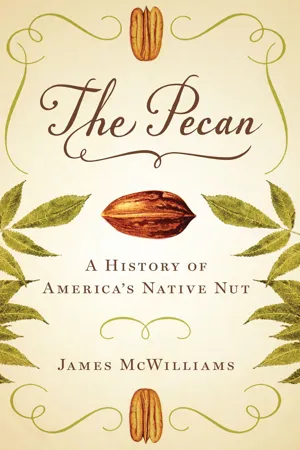
What would Thanksgiving be without pecan pie? New Orleans without pecan pralines? But as familiar as the pecan is, most people don't know the fascinating story of how native pecan trees fed Americans for thousands of years until the nut was "improved" a little more than a century ago—and why that rapid domestication actually threatens the pecan's long-term future.
In
The Pecan, the acclaimed author of
Just Food and
A Revolution in Eating explores the history of America's most important commercial nut. He describes how essential the pecan was for Native Americans—by some calculations, an average pecan harvest had the food value of nearly 150,000 bison. McWilliams explains that, because of its natural edibility, abundance, and ease of harvesting, the pecan was left in its natural state longer than any other commercial fruit or nut crop in America. Yet once the process of "improvement" began, it took less than a century for the pecan to be almost totally domesticated. Today, more than 300 million pounds of pecans are produced every year in the United States—and as much as half of that total might be exported to China, which has fallen in love with America's native nut. McWilliams also warns that, as ubiquitous as the pecan has become, it is vulnerable to a "perfect storm" of economic threats and ecological disasters that could wipe it out within a generation. This lively history suggests why the pecan deserves to be recognized as a true American heirloom.
- 193 pages
- English
- ePUB (mobile friendly)
- Available on iOS & Android
eBook - ePub
About this book
Information
Publisher
University of Texas PressYear
2013Print ISBN
9780292762183
9780292749160
eBook ISBN
9780292753914
Table of contents
- Cover
- Frontispiece
- Title Page
- Copyright
- Dedication
- Epigraphs
- Contents
- Preface
- Acknowledgments
- Introduction. Cracking the Nut
- 1. The Native Americans’ Nut
- 2. “Pekan Nuttrees”: Europeans Encounter the Pecan
- 3. “. . . the Forest into an Orchard”: Passive Cultivation on the Texas Frontier
- 4. Antoine’s Graft: The Birth of the Improved Pecan, 1822–1900
- 5. “To Make These Little Trees”: The Culture of Pecan Improvement, 1900–1925
- 6. “Pecans for the World”: The Pecan Goes Industrial, 1920–1945
- 7. “In Almost Any Recipe . . . Pecans May Be Used”: American Consumers Embrace the Pecan, 1940–1960
- 8. “China Wants Our Nuts”: The Pecan Goes Global
- Epilogue. The Future of Pecans
- Notes
- Bibliographic Essay
- Index
Trusted by 375,005 students
Access to over 1.5 million titles for a fair monthly price.
Study more efficiently using our study tools.
Frequently asked questions
Yes, you can cancel anytime from the Subscription tab in your account settings on the Perlego website. Your subscription will stay active until the end of your current billing period. Learn how to cancel your subscription
No, books cannot be downloaded as external files, such as PDFs, for use outside of Perlego. However, you can download books within the Perlego app for offline reading on mobile or tablet. Learn how to download books offline
We are an online textbook subscription service, where you can get access to an entire online library for less than the price of a single book per month. With over 1.5 million books across 990+ topics, we’ve got you covered! Learn about our mission
Look out for the read-aloud symbol on your next book to see if you can listen to it. The read-aloud tool reads text aloud for you, highlighting the text as it is being read. You can pause it, speed it up and slow it down. Learn more about Read Aloud
Yes! You can use the Perlego app on both iOS and Android devices to read anytime, anywhere — even offline. Perfect for commutes or when you’re on the go.
Please note we cannot support devices running on iOS 13 and Android 7 or earlier. Learn more about using the app
Please note we cannot support devices running on iOS 13 and Android 7 or earlier. Learn more about using the app
Yes, you can access The Pecan by James McWilliams in PDF and/or ePUB format, as well as other popular books in Biological Sciences & North American History. We have over 1.5 million books available in our catalogue for you to explore.