This study of school integration struggles in 1950s Texas demonstrates how power politics denied black students their constitutional rights.
In the famous Brown v. the Board of Education decisions of 1954 and 1955, the United States Supreme Court ruled that "separate but equal" schools for black and white students were unconstitutional. Yet it took more than a decade of struggle before black students gained full access to previously white schools. Mansfield, Texas, a small community southeast of Fort Worth, was the scene of an early school integration attempt. In this book, Robyn Duff Ladino draws on interviews with surviving participants, media reports, and archival research to provide the first full account of the Mansfield school integration crisis of 1956.
Ladino explores how politics at the local, state, and federal levels ultimately prevented the integration of Mansfield High School in 1956. Her research sheds new light on the actions of Governor Allan Shivers—who, in the eyes of the segregationists, validated their cause through his actions—and it underscores President Eisenhower's public passivity toward civil rights during his first term of office.
Despite the short-term failure, however, the Mansfield school integration crisis helped pave the way for the successful integration of Central High School in Little Rock, Arkansas, in 1957. Thus, it deserves a permanent place in the history of the civil rights movement.
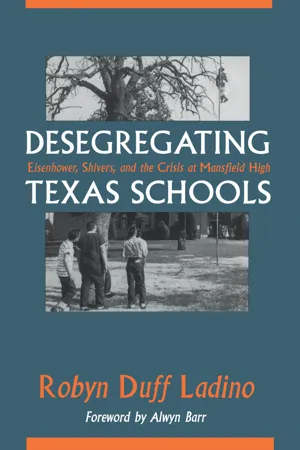
eBook - ePub
Desegregating Texas Schools
Eisenhower, Shivers, and the Crisis at Mansfield High
- 224 pages
- English
- ePUB (mobile friendly)
- Available on iOS & Android
eBook - ePub
About this book
Information
1. Pathway to Equality: The Determination to Change
In the late 1940s, African Americans in the South witnessed and experienced changes within their segregated communities that inspired a struggle to dissolve the color line on all fronts, especially education. Since 1896, when the United States Supreme Court upheld “separate but equal” in Plessy v. Ferguson, the civil rights of African Americans were tightly confined behind racial barriers. Education, employment, transportation, accommodations, and all social aspects of living in the southern United States were tied to a strict code of segregation. During the next fifty years, the practice of segregation became an undeniably ingrained institution in the South.1
The changing attitudes within black sections of southern towns evolved from an expanding awareness of economic, technological, and social advances within U.S. society that were bypassing blacks because of their oppressed conditions within the traditional southern caste system. The goal of this system was to keep blacks at the lowest point on the scale of humankind.2 An African American scholar interviewed by Robert Penn Warren explained, “It’s not so much what the Negro wants as what he doesn’t want. The main point is not that he has poor facilities. It is that he must endure a constant assault on his ego. He is denied human dignity.”3 As second-class citizens, blacks struggled daily under a system-imposed inferiority complex.
Throughout the United States, African Americans began to realize that education was the key to equality. Nowhere was this understood more than in the seventeen border and southern states and the District of Columbia, where inequitable dual systems of public education stood firmly fixed as a constant reminder to all of the inadequacies and injustices of “separate but equal.” Many southern black community leaders readily agreed that fully integrated school systems would allow their children a better chance at breaking out of the oppressive caste system to attain equal rights and status as citizens of the United States.4 During this time, Harry Golden, the editor of the Carolina Israelite, wrote:
We must remember that economic equality for the Negro race of the South is still a very long way off; so let us bear in mind that self-esteem … comes also with education. … at this moment in the history of the American Negro there remains only one course of action—the true wisdom—there must be nothing short of a stampede of the Negroes of the South into the classrooms of America. There is no other way.5
The caste system began to erode in the same way it was instituted, through legal litigation.
The subdued apathy of a large number of whites throughout the country toward the southern blacks’ predicament began a revision after World War II. In areas throughout the United States, including the South, many whites began to acknowledge the degrading living conditions of their fellow black citizens. It became unfashionable, outdated, and immoral to be openly prejudiced.6 Many Americans heard of, read, and discussed Gunnar Myrdal’s An American Dilemma. Published in 1944, it defined the blatant inequalities forced upon African Americans and examined racism as a social disease. Myrdal wrote of an anticipated transformation within U.S. society:
If this book gives a more complete record than is up to now available of American shortcomings in [race relations], I hope … that it also accounts more completely for the mutability in relations, the hope for great improvements in the near future and particularly, the dominant role of ideals in the social dynamics of America. … not since Reconstruction has there been more reason to anticipate fundamental changes in American race relations, changes which will involve a development toward the American ideals.7
A Swedish economist, Myrdal worked with a team of social scientists supported by the Carnegie Corporation to dissect the problem of racism in the United States. Examining the “moral dilemma” as both a black and a white enigma, Myrdal referred to “the Negro problem” as “the ever-raging conflict.” Studies such as Myrdal’s reinforced the growing notion among many white and most black citizens that the time for direct action against the caste system must begin with an attack on “separate but equal.”8
In the South, this notion slowly began to take the shape of a civil rights movement in the homes and churches of the black communities. Black Texans felt this drive as strongly as blacks in Alabama and Mississippi. Texas, because of its size and geographical diversity, was sectioned racially and economically. The majority of black Texans lived in the northeastern and central eastern counties. These counties, because of migration patterns and topography, had developed a southern agrarian economic system based primarily on the cotton crop. Historically, slavery had supported this crop, and by the twentieth century, sharecropping held many blacks to the land.9
By the early 1950s, the small town of Mansfield, in Tarrant County, Texas, included an estimated 1,450 citizens of which 350 were black. Situated approximately fifteen miles southeast of Fort Worth, this hamlet was on the fringe of what was known as the Deep South. Mansfield was a picturesque, well-kept, quiet town. Running north and south, U.S. Highway 287 was Main Street through the town, and it was intersected by Broad Street. Most stores and businesses were found on Main Street, with several branching off east and west on Broad Street. White residential areas developed around this central intersection and to the east of Main Street.10
Migrating from the southeastern United States, Scotch-Irish settlers came to this area a century before, establishing a gristmill on Walnut Creek. Many of the settlers brought African slaves with them to work the land. By 1856 Julian Feild and his partner, Ralph S. Man, bought 540 acres of land including the gristmill. In 1860 they founded their own steam-powered gristmill that eventually became the center of the town named Mansfeild. The name was later changed to Mansfield. In 1861 Texas seceded from the United States, becoming a part of the Confederacy. The cornmeal and flour from the Mansfield mill became important contributions of the Texas commodities sent east for the Confederate cause.11
After the Civil War, the town grew steadily and was a well-known trade center in Texas. Most of the former slaves remaining in the area became sharecroppers or farm laborers. The educational opportunities in Mansfield also brought the town notoriety. In 1867 the Mansfield Male and Female College was founded on East Broad Street. In 1901 the Mansfield Academy was established followed by the creation of the Mansfield Independent School District in 1909.12
In the early twentieth century, Mansfield continued to prosper economically. Several businesses built stores and offices on Main Street. This growth continued until the 1930s, when the Depression devastated the agricultural centers of the United States. Another contribution to the slowdown in prosperity was the growing urbanization of the South. For several years after World War II, Mansfield’s growth stagnated because of the draw of opportunities to the bigger neighboring cities of Dallas and Fort Worth. At this time, both the white and black residents of the town had to accept the changing status of their community.13
The black section of town was situated off Main Street to the west on West Broad Street. A hill and an open field created a definite break in the town’s development before entering the rows of smaller, simpler homes occupied by black families. Many blacks lived further out in the country as sharecroppers on larger farms owned by whites. The black church, Bethlehem Baptist Church, and the elementary school, Mansfield Colored School, stood within the small, closely knit community approximately two and one-half miles from Main Street.14
In the late 1940s, Mansfield’s African American residents lived under a tightly structured caste system. The races were segregated in the churches, school system, and all social activities within the town. Only white citizens held municipal offices. All white-collar jobs in Mansfield were limited to whites. Blacks employed in the town worked for low wages as laborers or in service-oriented jobs such as maids, cooks, janitors, and groundskeepers. Many blacks worked as sharecroppers and farmhands in the outlying large farms owned by white families. Those seeking better employment opportunities, especially in factories and industries, commuted to Fort Worth and Dallas.15
Black families were permitted to shop on Main Street, but rarely were they seen east of this street. Many young black men congregated in the alley on the west side of Main Street behind the local cafe, but were never allowed in the front door. To be served in the restaurants in town, blacks had to enter through the back doors off the alleys and often ate in the kitchens. Certain eating establishments banned blacks completely. The segregated system was so entrenched in the community that a barbecue drive-in owned by a black resident on the edge of Mansfield divided eating areas by race. The two grocery stores on Main Street allowed black clientele, and one accepted credit until the crops were harvested.16
Black and white children were allowed to play together around the outskirts of the town. As a young black child living near Mansfield, Floyd Moody recalled playing in the open fields around the town with two white boys during his childhood:
On Saturday mornings we used to get together, run, play stick horse together. … It’s ironic because at that point there was no color. … I didn’t see Charles and Wesley [Seeton] as white. … We wasn’t taught that way as black children. … It was only when we tried to do what they done that I noticed a difference. If we were together he’d walk in the cafe to get a hamburger, I couldn’t. … We had to sit in the back, in the kitchen.17
The racial code that existed in Mansfield allowed black and white children to play together under certain restrictions. When the children grew into young adults, the color line became much more noticeable. The associations of mixed race dating were strictly forbidden. As adults, the races were acceptably civil to each other, but there remained an obvious separation ethic. The African Americans held their own gatherings in their section of town, while the white residents congregated at events in the main area of Mansfield. Race relations in Mansfield were defined as “good” by the white citizens, but the black community felt oppressed because these “good” relations were based on doing “what the white man said.”18 In an editorial from the Mansfield News, the segregationist attitude of the era was clearly expressed: “We are not against the Negro, but we are against social equality. We think the Negroes are making great strides in improving their race and commend them for it, as long as they stick to their race.”19 By the late 1940s, African Americans throughout the South began questioning this type of proclamation. As constitutionally equal citizens, they believed they were entitled to better treatment than that defined by the established racial stigmas.20
During this time, members of Mansfield’s black community began to question their conditions within the town. Sermons, services, and meetings held in Bethlehem Baptist Church, under the guidance of the Reverend L. E. Billingslea, initiated the exchange of newly forming ideas to change the status quo for their children’s future. Some adults found these discussions upsetting, remembering from their childhood the activities of the Ku Klux Klan in Tarrant County. Others believed that the time to join the budding national civil rights movement had arrived in Mansfield. Although the black community remained closely knit, this controversy continued for many years.21
African American leaders within the Mansfield neighborhood proved to be both progressive and determined. A branch of the National Association for the Advancement of Colored People (NAACP) was founded in Mansfield in 1950. Most of the black residents became members during the early part of the decade. Those that chose not to join remained sympathetic and interested in the NAACP objectives. As a leader in the community, T. M. Moody was outspoken and knowledgeable. Employed by the federal government as a civilian, Moody worked in a large warehouse outside of Mansfield for a quartermaster. In the early 1950s, as the military integrated, Moody experienced a different social standard at his job than in Mansfield. Because of his experiences, Moody brought new ideas back to his community.22 Floyd Moody described his uncle: “T. M. was somewhat the leader of the community. … He always brought [ideas] back to us that ...
Table of contents
- Cover
- Title
- Copyright
- Dedication
- Contents
- Foreword
- Acknowledgments
- Introduction
- 1. Pathway to Equality: The Determination to Change
- 2. The Dismantlement of “Separate but Equal”
- 3. The Creed of Segregation and States’ Rights in the South with an Emphasis on Texas
- 4. Taking a Stand on School Integration: The Dilemma of President Dwight David Eisenhower during His First Term
- 5. The Mansfield School Integration Case: Jackson v. Rawdon
- 6. A Collision Course: The Crisis at Mansfield High School
- 7. A Significant Aftermath: The Mansfield School Integration Case and Crisis
- Notes
- Bibliography
- Index
Trusted by 375,005 students
Access to over 1.5 million titles for a fair monthly price.
Study more efficiently using our study tools.
Frequently asked questions
Yes, you can cancel anytime from the Subscription tab in your account settings on the Perlego website. Your subscription will stay active until the end of your current billing period. Learn how to cancel your subscription
No, books cannot be downloaded as external files, such as PDFs, for use outside of Perlego. However, you can download books within the Perlego app for offline reading on mobile or tablet. Learn how to download books offline
Perlego offers two plans: Essential and Complete
- Essential is ideal for learners and professionals who enjoy exploring a wide range of subjects. Access the Essential Library with 800,000+ trusted titles and best-sellers across business, personal growth, and the humanities. Includes unlimited reading time and Standard Read Aloud voice.
- Complete: Perfect for advanced learners and researchers needing full, unrestricted access. Unlock 1.5M+ books across hundreds of subjects, including academic and specialized titles. The Complete Plan also includes advanced features like Premium Read Aloud and Research Assistant.
We are an online textbook subscription service, where you can get access to an entire online library for less than the price of a single book per month. With over 1.5 million books across 990+ topics, we’ve got you covered! Learn about our mission
Look out for the read-aloud symbol on your next book to see if you can listen to it. The read-aloud tool reads text aloud for you, highlighting the text as it is being read. You can pause it, speed it up and slow it down. Learn more about Read Aloud
Yes! You can use the Perlego app on both iOS and Android devices to read anytime, anywhere — even offline. Perfect for commutes or when you’re on the go.
Please note we cannot support devices running on iOS 13 and Android 7 or earlier. Learn more about using the app
Please note we cannot support devices running on iOS 13 and Android 7 or earlier. Learn more about using the app
Yes, you can access Desegregating Texas Schools by Robyn Duff Ladino in PDF and/or ePUB format, as well as other popular books in Politics & International Relations & Civil Rights in Politics. We have over 1.5 million books available in our catalogue for you to explore.