"Parker has used recently declassified American materials and interviews . . . to reconstruct the steps that led to the creation of Operation Brother Sam." —
The American Historical Review
When the Brazilian military overthrew President João Goulart in 1964, American diplomats characterized the coup as a "100 percent Brazilian movement." It has since become apparent, largely through government documents declassified during the course of research for this book, that the United States had an invisible but pervasive part in the coup.
Relying principally on documents from the Johnson and Kennedy presidential libraries, Phyllis Parker unravels the events of the coup in fascinating detail. The evidence she presents is corroborated by interviews with key participants.
US interference in the Goulart regime began when normal diplomatic pressure failed to produce the desired enthusiasm from him for the Alliance of Progress. Political and economic manipulations also proving ineffective, the United States stood ready to back a military takeover of Brazil's constitutional democracy.
US operation "Brother Sam" involved shipments of petroleum, a naval task force, and tons of arms and ammunition in preparation for intervention during the 1964 coup. When the Brazilian military gained control without calling on the ready assistance, U.S. policy makers immediately accorded recognition to the new government and set in motion plans for economic support.
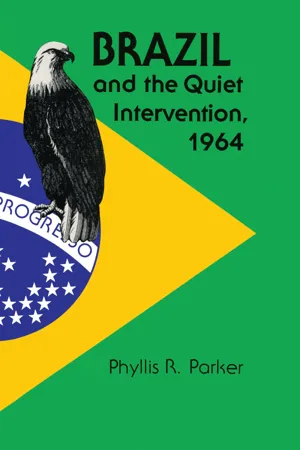
- 162 pages
- English
- ePUB (mobile friendly)
- Available on iOS & Android
eBook - ePub
Brazil and the Quiet Intervention, 1964
About this book
Information
INTRODUCTION
In 1958 Brazil’s president, Juscelino Kubitschek, proposed “Operation Pan-America.” He envisioned a dramatic economic development program to attack the critical problems of human misery that fomented political unrest in Latin America. The Eisenhower administration showed only slight interest.
In January 1959, Fidel Castro overthrew the Fulgencio Batista regime, and over the next two years the Cuban revolutionary government established strong ties with the Soviet Union. Alarmed at the potential spread of communism in the Americas, the United States became more responsive to an assistance program of positive action in Latin America.
On March 13, 1961, President John F. Kennedy proposed a new approach for U.S. assistance to Latin America: the Alliance for Progress. This program was to be a multilateral mobilization of the American nations’ efforts and resources against the vast social and economic inequities that beset them. For the United States it meant the re-orientation of its fragmented Latin American aid programs into a program of regional scope generously funded for democratic development.
The charter for the Alliance for Progress was signed at Punta del Este, Uruguay, in August 1961 by all the members of the Organization of American States (OAS) except Cuba. The charter established grand goals for the next decade: economic growth and diversification, a more equitable distribution of income, elimination of adult illiteracy by 1970, access to six years of primary education for all children, improved public health conditions, increased low-cost housing, and a strengthening of regional economic integration with the vision of a Latin American common market.4
As part of the plan, the signatories agreed to adhere to democratic principles and to establish national social and economic development programs based on the concept of self-help. They also agreed that the developing countries would be assisted with outside capital of at least $20 billion of mostly public money over a ten-year period and that the least-developed countries would be given priority in this assistance. The charter established guidelines for long-term economic development, for immediate and short-term action measures, and for external assistance from the United States in support of national development programs. Finally, it set up an organizational structure, including an expert review procedure for the national plans that all participating countries were to prepare.5
Success in Brazil, the largest and most populous nation in Latin America, was important to the success of the new program. Brazil was a constitutional democracy and a nation of spectacular potential, with abundant resources, developing industrial centers, and a growing middle class; but Brazil was also plagued by social and economic problems—staggering poverty, a largely disenfranchised agricultural sector, a chronic balance of payments problem, and a high rate of inflation. Brazil was fertile ground for the message of hope, whether from the left or from such programs as the Alliance for Progress. In Brazil, however, U.S. policy makers would be increasingly frustrated by fiscal inconsistencies in that government’s policies and by a president who seemed to encourage a redistribution of power and structural changes within that system that, it was believed, might result in a communist or socialist-oriented country less tied to the United States.
This book proposes to trace U.S. policy toward Brazil through the turbulent Goulart administration. I treat the role of the United States in Goulart’s overthrow in some detail, in order to provide a context for the considerations by U.S. policy makers that led the United States to support a coup in 1964 and to back generously the succeeding military dictatorships.
A Gaucho Becomes President
On August 25, 1961, Jânio Quadros unexpectedly resigned as president of Brazil after less than seven months in office. His vice-president, João Goulart, was out of the country at the time on a good will tour of eastern nations, including Communist China, Poland, and the U.S.S.R.
Vice-President João Belchior Marques Goulart, a wealthy land owner, cattle breeder, and lawyer from the state of Rio Grande do Sul, was 43 when Quadros resigned. “Jango,” as he was popularly known, had built a political base in labor as a protégé and controversial labor minister of Getulio Vargas (president of Brazil from 1934 to 1945 and 1950 to 1954). As minister, Goulart was active in reforming labor legislation, but he was accused of collaborating with communists, radical militants, and labor leaders.6 The military caused his ouster from the cabinet after Goulart attempted to alter the relation between the minimum wages of civilian laborers and army enlisted men in favor of the former.7
Although a member of the upper class, Goulart was a populist, in that he sought his support from the people rather than through the more traditional party structures. His lack of personal exposure to the problems of the working class, however, caused some to believe that Goulart simply exploited the growing labor sector for personal political gain.8 He remained in national politics after leaving Vargas’ administration and was elected vice-president under Juscelino Kubitschek in 1955 and again under Quadros in 1960. Former U.S. Ambassador Lincoln Gordon has suggested that Jango’s gaucho background may explain a certain pride he took in physical strength and in displays of power and thus in his political style.9 He lacked talent, and some say interest, in managing the daily activities of government.10
The resignation of Jânio Quadros brought on a crisis over legal succession to the presidency. The three military ministers in the cabinet, General Odílio Denys, Brigadier Gabriel Grün Moss, and Admiral Silvio Heck vigorously moved to block Goulart’s return to Brazil as president. The Congress proposed an alternative to the exclusion of Goulart: the creation of a parliamentary system. Determined to prevent Goulart’s assumption of the presidency, the military ministers began organizing the armed forces and put controls on the media.11 They issued a manifesto accusing Goulart of having dealt with “agents of international communism,” and charging that he might promote infiltration of the Brazilian armed forces, turning them into “simple Communist militias.”12 The effectiveness of the military was weakened by a split between those who favored Goulart’s leftist leanings and those who desired to see the constitution legally upheld. To block Goulart’s assumption of power was clearly illegal and, as it turned out, impossible without the full support of the armed forces.13
A compromise was finally reached, and on September 2 the Congress passed an amendment called the Additional Act that established a modified parliamentary system. On September 7, 1961, João Goulart was sworn in as president of the United States of Brazil under this parliamentary system.
Two New Ambassadors
During this two-week presidential succession crisis in Brazil, Lincoln Gordon appeared before the U.S. Senate Foreign Relations Committee for confirmation as ambassador to Brazil. Gordon, a summa cum laude graduate of Harvard, had been a Rhodes Scholar at Oxford, where he had earned a Ph.D. in economics. He had an impressive background both in and out of government. He had been a professor of government and administration at the Harvard School of Business and, as consultant to the State Department, had been a member of a task force that had helped create the Alliance for Progress.14
Gordon postponed assuming his new post until after the Brazilians had settled the presidential issue. On September 14, one week after Goulart became president, the State Department sent a briefing memorandum to President Kennedy describing what the U.S. position toward the new government in Brazil would be: “Pending the clarification of U.S. orientation, we propose to deal with the new government on the assumption that there has been no break in the continuity of the traditionally close and cordial relations between the United States and Brazil. As for President Goulart, we are prepared to give him the reasonable benefit of the doubt, while trying to encourage him to believe cooperation with the United States is to his and Brazil’s advantage.”15 The concern of the Brazilian military ministers over Goulart’s past political associations was shared by U.S. policy makers. That they specified a willingness to grant him a “reasonable benefit of the doubt” seems to suggest that from the beginning, Goulart’s motives were regarded with some suspicion. The briefing memorandum went on to say that the United States would honor previous commitments, but that any new assistance would be “based on an understanding that the government of Brazil would pursue its economic program under conditions of financial stabilization and would support and carry out the objectives of the Alliance for Progress.”16
Ambassador Gordon arrived in Brazil on October 3, 1961. His first request of Niles Bond, who had been chargé d’affaires in the interim, was that he explain the division of power between the president and the prime minister. Bond replied that no one really knew, but that it was reported that Jango had recently said that he “had no intention of being reduced to a ‘Queen Elizabeth,’” meaning he did not accept the notion of his presidential powers having been removed or limited by the Additional Act.17
Ambassador Gordon soon presented his credentials to Goulart and became personally acquainted with the president. His principal contacts in the government, however, were San Tiago Dantas, foreign minister, and Walter Moreira Salles, finance minister, and, to a much lesser extent, the prime minister, Tancredo Neves. Gordon’s first months were busy as he set about establishing the Alliance for Progress in Brazil. He and his staff worked with Goulart and his cabinet on matters of shared interest—debt rescheduling, aid programs, and Goulart’s proposed visit to the United States.18
Just before he resigned the presidency, Quadros had appointed Roberto de Oliveira Campos, a career diplomat and one of Brazil’s leading economists, as ambassador to the United States. With Quadros’ resignation, Campos had given up the idea of going to Washington, but his friends Dantas and Neves encouraged Goulart to retain him. Goulart did call Campos, and he told him that even though he differed with Campos politically and he considered Campos too conservative he wanted Campos’ services in Washington. Campos asked the president for instructions, but Goulart replied that he had not had time to think closely about foreign policy and referred Campos to Dantas for instructions.19
Campos arrived in Washington and presented his credentials to President John F. Kennedy in October of 1961. Kennedy questioned the new ambassador about the parliamentary system, wondering if it were viable and whether or not it would open the way for leftist infiltration and radical movements in the country. Campos related his beliefs that parliamentary systems work best when few parties are in the system (Brazil had twelve parties at the time) and that much depended on the vigor and effectiveness of the new cabinet.20
Two Omens for the Future
A Profits-Remittance Law—Differences between Friends
On November 29, 1961, the Chamber of Deputies passed a remittance of profits bill that raised the question among the U.S. business community in Brazil of whether Brazil, which had traditionally welcomed foreign private investors, was becoming a hostile business environment. The U.S. business sector in Brazil argued that the $30 to $40 million being remitted to all (not just U.S.) foreign investors annually did not deserve the accusations that the investors were “suction pumps” and that they were “bleeding…the Brazilian economy.”21 The bill had a number of provisions that would inhibit foreign investment: Reinvested profits would be considered national capital and, therefore, not a part of the base for computing remittances.22 Annual remittances of profits out of Brazil would be limited to 10 percent of registered capital, with no provision covering the depreciation in the value of the Brazilian currency. Moreover, existing Brazilian businesses could not be bought out by foreign firms; foreign companies would not be able to borrow from Brazilian banks; and all Brazilian residents would be required to declare their holdings.23 That bill did not become law, but the concept of limiting profit...
Table of contents
- Cover
- Series Page
- Title
- Copyright
- Dedication
- Contents
- Tables
- Preface
- Introduction
- A Gaucho Becomes President
- Conclusion
- Notes
- List of Sources
- Index
Trusted by 375,005 students
Access to over 1.5 million titles for a fair monthly price.
Study more efficiently using our study tools.
Frequently asked questions
Yes, you can cancel anytime from the Subscription tab in your account settings on the Perlego website. Your subscription will stay active until the end of your current billing period. Learn how to cancel your subscription
No, books cannot be downloaded as external files, such as PDFs, for use outside of Perlego. However, you can download books within the Perlego app for offline reading on mobile or tablet. Learn how to download books offline
We are an online textbook subscription service, where you can get access to an entire online library for less than the price of a single book per month. With over 1.5 million books across 990+ topics, we’ve got you covered! Learn about our mission
Look out for the read-aloud symbol on your next book to see if you can listen to it. The read-aloud tool reads text aloud for you, highlighting the text as it is being read. You can pause it, speed it up and slow it down. Learn more about Read Aloud
Yes! You can use the Perlego app on both iOS and Android devices to read anytime, anywhere — even offline. Perfect for commutes or when you’re on the go.
Please note we cannot support devices running on iOS 13 and Android 7 or earlier. Learn more about using the app
Please note we cannot support devices running on iOS 13 and Android 7 or earlier. Learn more about using the app
Yes, you can access Brazil and the Quiet Intervention, 1964 by Phyllis R. Parker in PDF and/or ePUB format, as well as other popular books in History & Latin American & Caribbean History. We have over 1.5 million books available in our catalogue for you to explore.