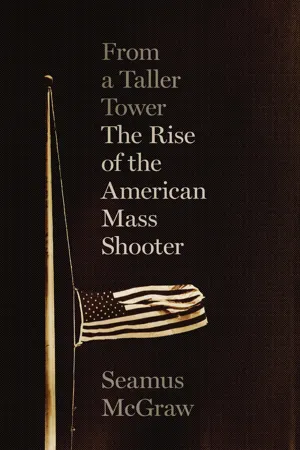
A history of the American mass shooter since 1966, and an analysis of how the nation makes sense of the senseless violence. We, as a nation, have become desensitized to the shock and pain in the wake of mass shootings. In the bottomless silence between gunshots, as political stalemate ensures inaction, the killing continues; the dying continues. From a Taller Tower attends to the silence that has left us empty in the aftermath of these atrocities. Veteran journalist Seamus McGraw chronicles the rise of the mass shooter to dismantle the myths we have constructed around the murderers and ourselves. In 1966, America's first mass shooter, from atop the University of Texas tower, unleashed a new reality: the fear that any of us may be targeted by a killer, and the complicity we bear in granting these murderers the fame or infamy they crave. Addressing individual cases in the epidemic that began in Austin, From a Taller Tower bluntly confronts our obsession with the shooters?and explores the isolation, narcissism, and sense of victimhood that fan their obsessions. Drawing on the experiences of survivors and first responders as well as the knowledge of mental health experts, McGraw challenges the notion of the "good guy with a gun, " the idolization of guns (including his own), and the reliability of traumatized memory. Yet in this terrible history, McGraw reminds us of the humanity that can stop the killing and the dying. "An important and extraordinary book that takes us into the mind of the mass shooter and also explores our own complicity in the numbing tragedies that have become far too routine in America. Still, Seamus McGraw manages to leave us with hope that there's a way out of the despair." —Perri Pelitz, director and producer, Axios on HBO "A meditative history of mass murder by gunfire.... A memorable, necessary contribution to the national conversation on gun violence." — Kirkus Reviews "[ From a Taller Tower ] traces the history of the American mass shooter and the troubling ways we make sense of senseless violence... There's a tragic timeliness to McGraw's book." — InsideHook "One of the most important books you can read this or any year. It's impossible to read this work without nodding or wincing or even crying." —Patrick Skinner, detective, Savannah, Georgia " From a Taller Tower is a careful, even cathartic, look at mass shooters and the culture that ushers them forth. McGraw dispels the myths "forged in gunfire" with a riveting examination of the before, during, and after of mass shootings." —Amye Archer, co-editor, If I Don't Make It, I Love You: Survivors in the Aftermath of School Shootings
- 232 pages
- English
- ePUB (mobile friendly)
- Available on iOS & Android
eBook - ePub
About this book
Information
CHAPTER 1
The Texas Sharpshooter Fallacy
There was a rumor
about a tumor
nestled at the base of his brain . . .
Laughing wildly as he bagged them
Who are we to say the boy’s insane?
Kinky Friedman
THERE WERE, ACCORDING to the Vital Statistics of the United States, 14,170 deaths linked to tumors in Texas in 1966.1 But there is no evidence that even one of those deaths occurred on the University of Texas campus on the first day of August that year, nor in the cramped Austin apartment the killer shared with his wife before he murdered her in her sleep, nor in his mother’s apartment where she too was slain.
Indeed, there is no conclusive evidence that any of the seventeen people who were murdered that day died as a result of a tumor. Not theirs, not the killer’s.
And yet, even now, five decades and counting after the murders, a great many people still take it as an article of faith that a pecan-sized tumor nestled between the killer’s thalamus, hypothalamus, and amygdala—the last one, the portion of the brain that controls emotions and behavior—was somehow the cause of all the bloodshed.
It is, perhaps, understandable that so many people still point to the killer’s tumor as a possible factor driving him to carry out the atrocity he committed. After all, even the Connally Commission—a blue-ribbon panel of giant brains, neurosurgeons and psychiatrists among them, who studied every aspect of the massacre—could not conclusively rule out that the tumor played a role. They sliced the killer’s brain, placed it on slides like some kind of grotesque miniature monstrance, and studied it under a microscope. They found evidence of the tumor, though there are some still today who dispute that the damaged tissue proved its existence conclusively. They allowed that it might explain the excruciating headaches the killer wrote about in his obsessively meticulous diary. But whether it—or some other pathology that couldn’t be measured in centimeters and weighed in grams—was the root of what the killer himself described in his diary as his “many unusual and irrational thoughts” remains an open question.
The commissioners wrote, in a section of the report that has been widely reprinted, that the tumor “conceivably could have contributed to his inability to control his emotions and his actions” before concluding, with a virtual shrug of their shoulders, that “the application of existing knowledge of organic brain function does not enable us to explain the actions of [the killer] on August first.”2
And it would be almost comforting to imagine that there was one, easily identifiable cause that could explain the malevolence that was unleashed that day. Maybe if we could find the first cause of that first modern mass public shooting, we might hope that we could find the first cause of all the massacres that have followed.
If only it were that easy.
If only the malignancy could be spotted on an X-ray or a CT scan, then we could send in teams of surgeons to cut it out. We could be done with it. But mass shootings, even in the term’s narrowest definition—a single event in which at least four people are killed, not counting the gunman, that is unrelated to crime or overtly political motives—have killed at least 1,203 Americans since the Tower massacre.3
And excising it is not that easy.
Because whatever invisible malignancy afflicts these murderers, it seems to have metastasized in us as well. We are, as a nation, among the most violence-prone people on earth, both against others and against ourselves. An estimated 15,129 murders were committed in the United States in 2017 (the last year for which FBI statistics are available), not to mention the 47,173 suicides that year. (Suicide numbers have been increasing in the United States for the last twenty years even as global suicide rates have declined.) These numbers have earned us the distinction among developed nations as the place where you’re most likely to meet a violent end.4
It’s not that our crime rate is any higher than those elsewhere in the first world. As Franklin Zimring and Gordon Hawkins note in their book Crime Is Not the Problem (1997), a treatise that has remained remarkably durable over the years, our rates of common property crimes are well within the norm for affluent countries.5
Our body count is not. But why?
It may be partly because we are a technologically proficient people who are simply better equipped to kill and maim. Of those murders in 2017, 72.6 percent were committed with firearms.6 More than half of all the suicides committed in this country that year were committed with guns.7 We are, as has often been pointed out, awash in firearms in America. About 40 percent of all the privately owned small arms in the world belong to Americans, according to the Swiss-based Small Arms Survey. There are an estimated 393 million guns, according to the government’s 2018 SAS report, in a country of 329 million people, or 120.5 firearms for every one hundred people.8
That’s one gun for every man, woman, and child in America, with enough left over to give one to everyone in Canada and Australia if we were feeling generous and they didn’t have such rigorous gun regulations. But not every man, woman, and child in America owns a gun. In fact, as of 2014, only about 31 percent of Americans lived in a household that owns firearms, and gun ownership has generally declined over the past forty years.9 It’s just that those who still cling to them cling to them by the armload.
Our records are incomplete. But according to the National Shooting Sports Foundation, about 8.5 million of those weapons manufactured or imported into the United States between 1990 and 2012 are so-called “modern sporting rifles,” among them the lightweight, semiautomatic, rapid-fire spiritual descendants of the M-1 the killer carried with him up the Tower that day so long ago in Austin.10 This class of weapons can easily be fitted with extended magazines, enabling even the least competent shooter to squeeze off two rounds a second for the eight to ten minutes it can often take for police to respond to a 911 call about shots fired. As many as two million more weapons have been manufactured or imported every year since 2012, according to the nonprofit news organization the Trace, founded by seed money from the gun control advocacy group Everytown for Gun Safety.11
It is true, as gun rights advocates so often point out, that such weapons are rarely used to commit crimes. Although it’s admittedly an incomplete accounting, according to the FBI’s 2017 Uniform Crime Report (UCR), if you were the target of an aggravated assault that year, it was three times more likely that your attacker would have come at you with a knife, a blunt object, or his bare hands than with a firearm of any description, let alone a semiautomatic rifle or handgun.12
But when an active shooter—and it is most often a male—does get his hands on a semiautomatic rifle, the results are catastrophic. According to a 2018 report compiled by Brigham and Women’s Hospital and published in the Journal of the American Medical Association, active shooters armed with any kind of semiautomatic rifle are likely to kill or wound nearly twice as many people as killers armed with firearms that fire off far fewer rounds before needing to be reloaded.13
Just ask the twenty-six people who were shot with a semiautomatic rifle at Sandy Hook Elementary School in Connecticut in 2012, most of them children, most of them slain in the first seven minutes of the massacre by a killer who had first shot his mother to death. Or the thirty-four people who were killed or wounded by a shooter at Marjory Stoneman Douglas High School in Parkland, Florida, on Valentine’s Day 2018. Or the 471 people who were shot five months later when a killer with an arsenal of semiautomatic weapons, perched in a hotel high-rise and situated a hundred feet higher than the University of Texas shooter, rained gunfire on a crowd of country music fans in Las Vegas. You can ask them. But 102 of the people targeted by those killers are no longer alive to answer.
And what of semiautomatic handguns, like the ones used when a gunman killed eleven people at a nightclub in Thousand Oaks, California, in November 2018, or the Glock 19 and the Walther P22 a student used to murder thirty-two people and wound seventeen more at Virginia Tech in 2007, or the silencer-equipped handgun used to kill eleven municipal workers and a private contractor trying to obtain a permit at a municipal building in Virginia Beach, Virginia, in June 2019? There’s no telling how many weapons like those are privately owned in the United States. Records are incomplete. We do know that handguns of every description accounted for nearly half (46.4 percent) of the murders committed in the United States in 2017.14 We also know that about 5.5 million new pistols and revolvers were manufactured in 2016, according to figures compiled by the federal Bureau of Alcohol, Tobacco, Firearms and Explosives,15 and in recent years at least two-thirds of the handguns entering the market have been semiautomatics.16
We are indeed a nation awash in guns. Throughout our history they have been both a tool and a talisman, says David Snyder, now a professor of history at Delaware Valley University in Pennsylvania, who has had a longstanding interest in gun violence ever since one of his former students murdered dozens at his old school in Virginia. Throughout our history, guns have been a totem of independence for some folks, usually white males, he says. Indeed, it was at least in part to protect the privileges of white slave owners in the early days of our country that the Second Amendment was written, says Snyder. And as we’ll see in chapter 8, the precious right to bear arms is, for many Americans, not just a civil sacrament; in some quarters it’s been invested with a religious significance—a belief that gun ownership is a natural right derived from heaven.
In times of stress, personal or public, firearms are often what many Americans turn to for a sense of security. It’s no surprise that in March 2020, when a deadly pandemic spread across the country and the world, when most of the country was locked down and most of our shops and businesses were closed, gun stores in many places were considered essential businesses, and federal authorities reported doing a record 3.7 million background checks in that one month alone.17 Similar but smaller spikes have been recorded after many moments of social disruption or in times of uncertainty and fear. Well before the coronavirus-fueled run on guns, America boasted the largest number of gun-toting residents in the developed world. And there is evidence that our easy access to firearms may be a significant factor in cementing our unenviable status when it comes to mass public shootings. According to a 2013 study of mass shootings at schools, churches, mosques, movie theaters, and workplaces, about a third of the active shooters in the world since that first mass public shooting at the University of Texas were active in the United States, even though we account for only 5 percent of the world’s population.18 The one variable that sets us apart, the study finds, is our staggeringly high rate of gun ownership, almost double the rate in any other nation.
But we are not the only nation with large numbers of firearms in private hands. Australia, Canada, and New Zealand all have at least a million firearms in circulation, yet their homicide rates are far lower than ours. Atrocities like the mass public shootings that have seemingly become routine in this country are rarer in those nations, and when they do occur—as happened in the bloody rampage by a murderer masquerading as a racial warrior and armed with several semiautomatic weapons who gunned down worshippers at two New Zealand mosques in March 2019—as often as not the killer pays homage to the darkest depths of American culture while at the same time trying to supplant American killers as the world’s most terrible monster.
Even when these mass slayings occur elsewhere around the globe—in Norway or Quebec or Christchurch—there is something distinctly American about them.
Perhaps that’s not surprising.
This is, after all, the country where the modern mass public shooter first materialized, and we are still, by far, the nation with the largest number of casualties resulting from those atrocities.
Certainly, the ease with which singularly efficient weapons can be obtained in the United States is a unique and significant factor contributing to the epidemic of gun violence in this country, say experts like David Chipman, a former agent with the Bureau of Alcohol, Tobacco, Firearms and Explosives and now a senior policy advisor for the organization known as Giffords Courage to Fight Gun Violence. But is it the only factor? Are there perhaps other aspects, peculiar to our history and our culture, that combine in a lethal, distinctly American cocktail—each element reinforcing the other—that makes us more vulnerable to these kinds of atrocities? Could it be that in our desperation to find a single silver bullet—whether it’s guns or tumors or violent video games—that would explain away all the deadly lead ones, we are missing the big picture? Are we missing precious opportunities not just to reduce the number of mass public shootings, but to use what we could learn to save some of the thousands who die every year by their own hands, or at the hands of their spouses or partners, or at the hands of comparative strangers?
What research there is suggests that many of the same impulses and traits we find in mass public shooters are also frequently in evidence in men who kill their wives and children, and to some degree among those who put their guns to their own heads.
The phenomenon is called the Texas Sharpshooter Fallacy.
It’s a concept used by statisticians to explain how easy it is to focus on a cluster of specific data points that support a particular, foregone conclusion while ignoring an equally significant number of data points that challenge it. It conjures the image of an imaginary marksman, looking at a target, counting his hits and ignoring his misses. It can, perhaps, be applied to one murderous sharpshooter in Texas in particular, and to our p...
Table of contents
- Cover
- Series Page
- Title Page
- Copyright
- Contents
- Author’s Note
- Prologue: The Deepest Silence There Is
- Chapter 1: The Texas Sharpshooter Fallacy
- Chapter 2: Deliver Us from Evil
- Chapter 3: To Kill the Last Killer
- Chapter 4: “’Tis Not Alone My Inky Cloak”
- Chapter 5: Jokers Wild
- Chapter 6: If You See Something, Say Something
- Chapter 7: A Good Guy with a Gun
- Chapter 8: I Cling to My Gun, You Cling to Yours
- Chapter 9: The Fog of War in Peacetime
- Chapter 10: From a Taller Tower
- Epilogue: The Silence Between Gunshots
- Acknowledgments
- Notes
- Index
Trusted by 375,005 students
Access to over 1.5 million titles for a fair monthly price.
Study more efficiently using our study tools.
Frequently asked questions
Yes, you can cancel anytime from the Subscription tab in your account settings on the Perlego website. Your subscription will stay active until the end of your current billing period. Learn how to cancel your subscription
No, books cannot be downloaded as external files, such as PDFs, for use outside of Perlego. However, you can download books within the Perlego app for offline reading on mobile or tablet. Learn how to download books offline
Perlego offers two plans: Essential and Complete
- Essential is ideal for learners and professionals who enjoy exploring a wide range of subjects. Access the Essential Library with 800,000+ trusted titles and best-sellers across business, personal growth, and the humanities. Includes unlimited reading time and Standard Read Aloud voice.
- Complete: Perfect for advanced learners and researchers needing full, unrestricted access. Unlock 1.5M+ books across hundreds of subjects, including academic and specialized titles. The Complete Plan also includes advanced features like Premium Read Aloud and Research Assistant.
We are an online textbook subscription service, where you can get access to an entire online library for less than the price of a single book per month. With over 1.5 million books across 990+ topics, we’ve got you covered! Learn about our mission
Look out for the read-aloud symbol on your next book to see if you can listen to it. The read-aloud tool reads text aloud for you, highlighting the text as it is being read. You can pause it, speed it up and slow it down. Learn more about Read Aloud
Yes! You can use the Perlego app on both iOS and Android devices to read anytime, anywhere — even offline. Perfect for commutes or when you’re on the go.
Please note we cannot support devices running on iOS 13 and Android 7 or earlier. Learn more about using the app
Please note we cannot support devices running on iOS 13 and Android 7 or earlier. Learn more about using the app
Yes, you can access From a Taller Tower by Seamus McGraw in PDF and/or ePUB format, as well as other popular books in Social Sciences & North American History. We have over 1.5 million books available in our catalogue for you to explore.