eBook - ePub
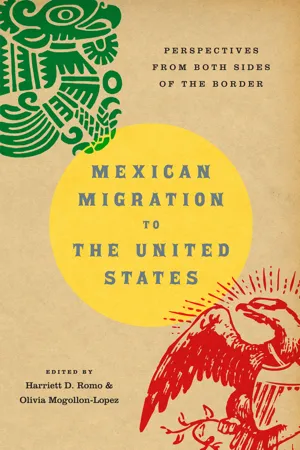
Mexican Migration to the United States
Perspectives From Both Sides of the Border
- 326 pages
- English
- ePUB (mobile friendly)
- Available on iOS & Android
eBook - ePub
About this book
This anthology examining borderlands migration brings together the perspectives of Mexican and US scholars from a variety of fields.
Gathering a transnational group of prominent researchers, including leading Mexican scholars whose work is not readily available in the United States, this collection brings together an array of often-overlooked viewpoints, reflecting the interconnectedness of immigration policy. These essays reveal significant aspects of labor markets, family life, and educational processes. They capture the evolving legal frameworks and economic implications of Mexico-US migrations at the national and municipal levels, as well as the experiences of receiving communities in the United States.
The volume includes illuminating reports on populations ranging from undocumented young adults to elite Mexican women immigrants, health-care rights, Mexico's incorporation of return migration, the impact of Deferred Action for Childhood Arrivals on higher education, and the experiences of young children returning to Mexican schools after living in the United States.
Reflecting a multidisciplinary approach, the list of contributors includes anthropologists, demographers, economists, educators, policy analysts, and sociologists. Underscoring the fact that Mexican migration to the United States is unique and complex, this timely work exemplifies the cross-border collaboration crucial to the development of immigration policies that serve people in both countries.
Information
PART 1
MEXICO-US MIGRATION: LEGAL FRAMEWORKS AND THEIR IMPLICATIONS
The first section of the book includes chapters by Francisco Alba, Jorge Durand, and Liliana Meza González and Michael Feil discussing Mexican perspectives on Mexico-US migration, while from the US side, Pia Orrenius, Jason Saving, and Madeline Zavodny suggest a labor-market approach to immigration policy, and Frank Bean, Susan Brown, and James Bachmeier explore how Mexican migration affects US workers. These chapters provide a basis for understanding the complexity of immigration policymaking and the manner in which policies implemented in one country affect both countries. What Mexico does as a nation-state regarding relations with the United States, whether Mexico decides to focus extensively on internal economic development to keep potential migrants at home, and how Mexico controls its own southern border have implications for the United States.
Francisco Alba, a researcher at El Colegio de México, provides a brief historical overview of approaches to handling migration from both the United States and Mexico and analyzes the diverging paths of Mexican and US migration policies, especially since the terrorist attacks of September 11, 2001, which caused the United States to heighten border security and tightly control immigration. Offering suggestions for pragmatic and accommodating migration reform in both countries, he calls for some processes of “earned regularization.” Avenues for earned regularization seem to be absent from most efforts of US legislation to reform immigration, although such processes were included in early versions of the Bush immigration proposals and in some versions of the proposed Development, Relief, and Education for Alien Minors (DREAM) Act. Alba argues for temporary worker programs and measures to regularize a portion of the existing undocumented immigrant population currently residing in the United States. Although Mexico has passed legislation to address Central American migrants and refugees, the Mexican southern border is still a policy issue. Alba suggests that the United States and Mexico are taking diverging paths to immigration, to the disadvantage of both nations. He cites the need for greater binational collaboration to address regional labor migrations that affect not only the United States, but also Mexico and the countries of Central America. Refuting racist and xenophobic rhetoric from both sides of the border, Alba criticizes nonconstructive approaches to unavoidable global processes and argues for more bilateral, informed, pragmatic, and gradual responses to migration.
Pia Orrenius and Jason Saving, researchers at the Federal Reserve Bank of Dallas, and their colleague Madeline Zavodny at Agnes Scott College explore United States visa policies and immigration priorities and how they have, in many cases, impeded the US economy. They present a detailed assessment of US immigration policy and critique US visa guidelines, which prioritize uniting families rather than focusing on labor needs. As these scholars demonstrate clearly, the type of migrants granted US visas and the US economic sectors with the greatest labor demands significantly affect which migrants may arrive in the United States with appropriate legal documents and which migrants have few or no options to cross the border legally.
Jorge Durand explores the history of Mexico-US migrations and argues that demographics, legislation, and political and economic factors influence migration patterns. Durand analyzes changes in migration dynamics as a result of the economic recession in the United States, efforts to grow the Mexican economy, and Mexico’s emphasis on population control, all of which have resulted in a leveling off of Mexican migration to the United States (see Massey, Durand, and Pren 2014; Passel et al. 2014). At the present time, as Massey, Durand, and Pren (2014) note, it is difficult to determine whether this is a temporary decrease in migration or whether, as the United States economy becomes more robust, immigrants will again fill needed gaps in agricultural, service, construction, and caretaking sectors of the US labor market, with or without appropriate legal status.
These chapters provide historical context for current US-Mexico migration policies and make suggestions and speculations about future trends. Both Alba and Durand argue that despite the centrality of Mexico-US migration policies prior to and after the terrorist attacks on the United States on 9/11, other policies, such as those related to trade in the North American Free Trade Agreement (NAFTA), have been most dominant in negotiations between the two countries. NAFTA has affected the ability of many rural inhabitants of Mexico to make a living off their small farms or ranches, resulting in male heads of households migrating to the United States for economic reasons.
Increasing violence related to organized crime and drug trafficking in rural and border areas has also forced people to leave their homes. Liliana Meza González and Michael Feil, in the chapter “Public Insecurity and Inter national Emigration in Northern Mexico,” recognize the influence of social networks in migration patterns but argue that, increasingly, insecurity in Mexico drives people to the United States and deters them from returning to their communities of origin. The authors acknowledge the long history of Mexican migration to the United States, traditionally driven by economic and social factors such as social mobility and family reunification.
Meza González and Feil point out many areas throughout the world where violence and unrest are driving people from their home countries. Although the authors do not claim that conditions in Mexico have reached the extreme that causes people to become refugees, the chapter shows that a perception of insecurity may be promoting emigration from conflicted areas. Using data on homicide rates in Mexico, the researchers argue that these homicides are not randomly distributed throughout Mexico, but are mostly concentrated in a few Mexican states.
The authors concede that international migration is a complicated global phenomenon involving many different types of migrants with varied reasons for leaving their home communities. They argue that the concept of “environment of insecurity,” first applied to the Kurdish conflict in Turkey and expanded to explain the international migration of Turkish Kurds, is related to sets of factors that may increase the chances of migration. Thus, an environment of insecurity may not necessarily influence those in greatest danger, but may trigger migration from relatively secure areas because people react to levels of direct and indirect violence.
Despite the limitations of linking an environment of insecurity to migration decisions, Meza González and Feil argue that it is worth analyzing data from Mexico and exploring correlations between violence and international migration. According to their analyses, migration and insecurity are positively correlated, and environments of insecurity are affecting migration patterns in Mexico. These findings suggest that effects on migration are factors that should be considered in Mexican policies in the war against drugs. Migration resulting from environments of insecurity will also have to be considered in US immigration policies and in future collaborations with Mexico.
Bean, Brown, and Bachmeier analyze data that show the extent of US economic expansion, the rapidity of US population growth, and the degree of educational upgrading in the US native-born population that, they argue, largely account for the demand for lesser-skilled Mexican labor. The children of unauthorized Mexican workers do obtain considerably more schooling than their parents because of the availability of public schooling in the United States, but the authors argue that this group of youth remain behind in educational attainment compared to their white US-born counterparts. As a result, they may count as a “drag” on socioeconomic incorporation for those of Mexican origin.
This chapter is an important addition to the discussion of upward mobility of the Mexican immigrant and Mexican American population, as the researchers discuss the advantages and disadvantages of using generational groups, cross-sectional analyses, or longitudinal studies to determine assimilation. The authors clearly show that educational gains are influenced by whether immigrants enter the country legally or are able to achieve legal status later. Their results emphasize the importance of opportunities for immigrants to legalize for maximizing the educational success of their children. They also discuss whether the availability of migrant workers willing to work for lower wages displaces US workers, especially African Americans and Mexican Americans.
These economic consequences of migration have been debated by other economists, some of whom demonstrate that certain sectors of the US workforce are affected by available immigrant workers. Others have shown that immigrants take jobs that US workers have left as they acquire higher levels of education. Immigrants also create new jobs that serve the immigrant community’s needs (Griffith 2006). In fact, the Immigration Policy Center in Washington, DC, argues that high-skilled foreign workers do not harm native-born workers’ job opportunities, are not poorly compensated, and are not “cheap foreign labor,” and that their presence often leads to higher wages and more job opportunities for US citizens (Immigration Policy Center 2014). Lowell (2001) notes that unauthorized immigrants are typically low-skilled and are viewed as adversely affecting low-skilled US natives. His analysis of the literature suggests that if there is an effect of immigrants on natives in the labor market, it must be subtle, for it does not appear immediately in the data (Lowell 2001, 38). Harrison and Lloyd (2013) suggest that employers do engage in subtle practices that contribute to workplace inequalities, such as trying to maintain profits, managing their own concerns about immigration policing, asserting their own class identity, justifying the privileges that they and their US-born employees enjoy, and maintaining their own advantages. In their chapter, Bean, Brown, and Bachmeier expand this discussion about job displacement and assess the economic influence of unauthorized Mexican migration and the implications for the incorporation of later generations of Mexican Americans.
References
Griffith, David. 2006. American Guestworkers: Jamaicans and Mexicans in the U.S. Labor Market. University Park: Pennsylvania State University Press.
Harrison, Jill L., and Sarah E. Lloyd. 2013. “New Jobs, New Workers, and New Inequalities: Explaining Employers’ Roles in Occupational Segregation by Nativity and Race.” Social Problems 60(3):281–301.
Immigration Policy Center. 2014. “High-Skilled Workers and Twenty-First Century Innovation: The H-1B Program’s Impact on Wages, Jobs, and the Economy.” Washington, DC: American Immigration Council. Retrieved April 16, 2014, from http://www.americanimmigrationcouncil.org/just-facts/h-1b-program%E2%80%99s-impact-wages-jobs-and-economy).
Lowell, B. Lindsay. 2001. “Skilled Temporary and Permanent Immigrants in the United States.” Population Research and Policy Review 20(1–2):33–58.
Massey, Douglas S., Jorge Durand, and Karen A. Pren. 2014. “Explaining Undocumented Migration to the U.S.” International Migration Review, 1–34. doi:10.1111/imre.12151.
Passel, Jeffrey S., D’Vera Cohn, Jens Manuel Krogstad, and Ana Gonzalez-Barrera. 2014. As Growth Stalls, Unauthorized Immigrant Population Becomes More Settled. Washington, DC: Pew Research Center’s Hispanic Trends Project. Retrieved December 18, 2014, from http://www.pewhispanic.org/2014/09/03/as-growth-stalls-unauthorized-immigrant-population-becomes-more-settled/.
CHAPTER 1
Evolving Migration Responses in Mexico and the United States: Diverging Paths?
FRANCISCO ALBA
The US approach to managing Mexican migration changed radically after the attacks on US soil on September 11, 2001. Before the attacks, expectations were high, particularly among Mexican political leaders, that a long-term, mutually agreed-upon strategy could finally be implemented to manage the flows of Mexican migrants to the United States. Those expectations were based on multiple suppositions shared by policy makers and leaders of both the United States and Mexico. Assumptions included, among others, the advantages to key economic interests operating on both sides of the border of regularizing immigration flows; the important role played by Mexican migrants in the labor markets of both countries; the strategic and geopolitical conditions linking the two neighboring countries; and the existence of strong social networks supporting migration.
These ideas emerged from a realistic appraisal of the strong migratory pressures prevalent in the region. In such an environment, it appeared that the United States was willing to make significant concessions to Mexican migrants. That was the context in which, under the leadership of US president George Bush and Mexican president Vicente Fox, a high-level dialogue on migration between the United States and Mexico took place in early 2001 (Davidow 2004; Alba 2010a). Negotiations ended abruptly when the US World Trade Center Towers collapsed. After the September 11, 2001, terrorist attacks, the saliency of security concerns and the focus on border controls and antiterrorism measures emerged as main US policy priorities. In the United States after 9/11 the topic of migration became captive to a new reality and a new discourse. Immediately thereafter, “anti-immigration” forces toughened their actions and initiatives, precluding subsequent attempts to pass any broad immigration reform.
Meanwhile, Mexico tried to keep avenues open for its workers in the United States in a new, less accommodating migration environment. In view of the rising pressures and difficulties faced by migrants in transit through Mexico, in 2011 the Mexican government passed a new Migration Law.1 This new Migration Law, an amended General Population Law, and a new Refugees and Complementary Protection Law would constitute Mexico’s migration policy for the twenty-first century (Gonzalez-Murphy and Koslowski 2011).
The great recession that began in the United States in late 2007, followed by a fragile and tepid recovery, brought about a significant reduction in migration flows. This situ...
Table of contents
- Cover
- Title Page
- Copyright
- Contents
- Acknowledgments
- Introduction: Policies, Dynamics, and Consequences of Mexican Migration to the United States
- Part 1. Mexico-US Migration: Legal Frameworks and Their Implications
- Part 2. Incorporation into Receiving Communities in the United States
- Part 3. Return Migration and Reincorporation
- Epilogue: Continuing Immigration Developments
- Conclusion: Is Mexican Migration to the United States Different from Other Migrations?
- Contributors
- Index
Trusted by 375,005 students
Access to over 1.5 million titles for a fair monthly price.
Study more efficiently using our study tools.
Frequently asked questions
Yes, you can cancel anytime from the Subscription tab in your account settings on the Perlego website. Your subscription will stay active until the end of your current billing period. Learn how to cancel your subscription
No, books cannot be downloaded as external files, such as PDFs, for use outside of Perlego. However, you can download books within the Perlego app for offline reading on mobile or tablet. Learn how to download books offline
Perlego offers two plans: Essential and Complete
- Essential is ideal for learners and professionals who enjoy exploring a wide range of subjects. Access the Essential Library with 800,000+ trusted titles and best-sellers across business, personal growth, and the humanities. Includes unlimited reading time and Standard Read Aloud voice.
- Complete: Perfect for advanced learners and researchers needing full, unrestricted access. Unlock 1.5M+ books across hundreds of subjects, including academic and specialized titles. The Complete Plan also includes advanced features like Premium Read Aloud and Research Assistant.
We are an online textbook subscription service, where you can get access to an entire online library for less than the price of a single book per month. With over 1.5 million books across 990+ topics, we’ve got you covered! Learn about our mission
Look out for the read-aloud symbol on your next book to see if you can listen to it. The read-aloud tool reads text aloud for you, highlighting the text as it is being read. You can pause it, speed it up and slow it down. Learn more about Read Aloud
Yes! You can use the Perlego app on both iOS and Android devices to read anytime, anywhere — even offline. Perfect for commutes or when you’re on the go.
Please note we cannot support devices running on iOS 13 and Android 7 or earlier. Learn more about using the app
Please note we cannot support devices running on iOS 13 and Android 7 or earlier. Learn more about using the app
Yes, you can access Mexican Migration to the United States by Harriet D. Romo in PDF and/or ePUB format, as well as other popular books in Social Sciences & Immigration Policy. We have over 1.5 million books available in our catalogue for you to explore.