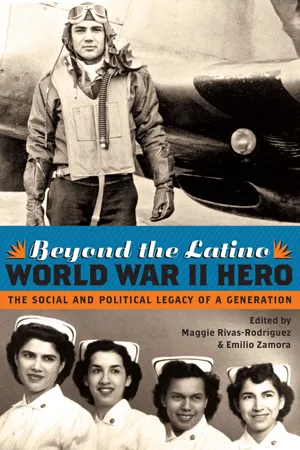
Maggie Rivas-Rodríguez 's edited volume Mexican Americans & World War II brought pivotal stories from the shadows, contributing to the growing acknowledgment of Mexican American patriotism as a meaningful force within the Greatest Generation. In this latest anthology, Rivas-Rodríguez and historian Emilio Zamora team up with scholars from various disciplines to add new insights. Beyond the Latino World War II Hero focuses on home-front issues and government relations, delving into new arenas of research and incorporating stirring oral histories. These recollections highlight realities such as post-traumatic stress disorder and its effects on veterans' families, as well as Mexican American women of this era, whose fighting spirit inspired their daughters to participate in Chicana/o activism of the 1960s and 1970s. Other topics include the importance of radio as a powerful medium during the war and postwar periods, the participation of Mexican nationals in World War II, and intergovernmental negotiations involving Mexico and Puerto Rico. Addressing the complexity of the Latino war experience, such as the tandem between the frontline and the disruption of the agricultural migrant stream on the home front, the authors and contributors unite diverse perspectives to harness the rich resources of an invaluable oral history.
One of the themes running through the more than six hundred interviews gathered by the U.S. Latino & Latina World War II Oral History Project at the University of Texas at Austin is that of struggle against poverty, discrimination, and the perception of Mexican Americans as foreigners and outsiders during the Great Depression and World War II. Largely because of this experience, many Mexican Americans developed a life philosophy that enabled them to cope with harsh realities. World War II also afforded them the opportunity to put that philosophy to the test: they were called upon to sacrifice for their country, a nation that increasingly came to represent freedom, tolerance, and human dignity for them. This conflicted consciousness of being a patriotic American while experiencing second-class citizenship led to the formation of a tough and resilient worldview, one that would make Mexican Americans a backbone of what came to be called middle America.
This chapter explores the ways in which Mexican American men and women remembered their youthful experience with racism and discrimination while molding an American identity, one that incorporated patriotism and an abiding belief in the American dream. It also suggests that the U.S. Latino & Latina World War II Oral History Project archive deserves closer examination by scholars who seek to explain what has been termed “the Mexican American generation.”1
When the United States entered World War II, about three and a half million people of Mexican descent lived in the United States. They represented a diversity of backgrounds, ranging from families who had lived within the present-day United States for centuries to those who had recently crossed the border to find new and promising jobs in the factories and fields of their adopted country. According to the 1940 count of the U.S. Bureau of the Census, a majority of them were U.S.-born for the first time in their history. Most were sons and daughters of the immigrants who crossed the border during the period between 1910 and 1930, the years of the great migration from Mexico.2
Despite their status as citizens and the internal differences that they exhibited in appearance, status, and regional affiliation, most were classified as “Mexican” by the U.S. Census and by public opinion. Moreover, their Spanish language, skin color (typically brown) and working-class status—resulting from a century of economic and political submersion—made them visible and subject to continued discrimination and segregation. Suspected of being disloyal to the United States, in part because they were perceived as foreigners, most Mexican Americans lived in the shadows of their barrios, or segregated communities, and in forgotten rural enclaves, hardly noticed except when needed for low-wage work or subject to the prejudiced watch of law enforcement officials. During the 1920s and 1930s they grew up expecting hard work, poverty, hunger, and rejection, but they learned to survive.3
The life stories that follow, taken from the U.S. Latino & Latina World War II Oral History Project, illustrate how Mexican American youth emerged from the hard times of the Great Depression and used their sense of patriotic sacrifice, born out of the war emergency of the 1940s, to redefine themselves as men and women who expected fair treatment and impartial justice.
Antonio Campos is a case in point. He was raised in Houston, Texas, during the 1930s. Campos vividly recalled the discrimination that Mexican Americans faced in restaurants: “If you wanted to get fed you had to go in the back. Mexicans and dogs were in the back. You had to get a sandwich and go home.”4
As a child, he joined a segregated Boy Scouts troop with secondhand uniforms, and he joined a Mexican high school band after being rejected by the all-Anglo band. Campos volunteered for the U.S. Army and served as a para-trooper in France. After the war, he received his undergraduate education with the help of the GI Bill of Rights and later attended Baylor Law School. When he finished law school, Campos organized an English-teaching campaign for U.S.-and foreign-born Mexican youth. He also ran for mayor and for a position on the city council but was defeated after a bitter contest. He remembered that a local government official taunted him: “If you don’t like it why don’t you go back to Mexico?”5 The remark triggered a response that defined Campos’ new sense of self: “I was born here in Texas. I went overseas and put my life on the line so you people can make decisions.”6
Campos believed that he was a patriot who had earned the right to expect and demand respect, and he found himself demonstrating that belief often. Even after he had served his country willingly and honorably, he did not feel that he was valued or that he could give up his fight for recognition and respect. Later, Campos, using his wartime confidence and personal resolve, led a coalition of activists to end discrimination in the public establishments of Baytown, Texas.7
Mexican veterans like Moisés Flores often expressed a patriotism that mixed with a Mexican identity in complicated ways. Flores was born in the Colonia Dublán of Chihuahua, Mexico. He crossed the border to join the U.S. Army and served in the Pacific theater, where he was wounded in action. After the war, he settled in El Paso, where he expressed the new identity that he had adopted: “I am very proud to be American. Sometimes I even call myself ‘gringo,’ which I’m not. I’m still Mexican, but I’m an American first.”8
Flores’ mestizaje, or mixture of ideas, reflects the impact of a war that recast Mexicans as Americans and led some of them to occasionally blur the difference between “gringos” and Mexicans, if only to claim a changed identity.
For some, including Andrew Tamayo, the war experience accentuated resentments and even anger over the persistent social inequality at home. Tamayo was raised in San Antonio by a single mother. He recalled that the discrimination continued after he completed military service. “I remember how they used to treat us over here,” he said.9
Tamayo served with distinction in the Thirty-ninth Field Artillery Battalion, Third Infantry Division of the U.S. Army. He earned a Bronze Star, a Purple Heart, and eight bronze campaign stars. When he finished his military service, Tamayo returned to San Antonio to find that conditions were relatively the same. He became bitter over the years, to the point of becoming angry about “helping the gringos” in their war. Tamayo, unlike some of his fellow Mexican veterans, used this anger to explicitly define his new defiant sense of self. His new identity, however, was also born out of military service.
Mexican veterans like Luis Leyva also experienced betrayals that contributed to a conditional form of American identity. Leyva was born in Mexico and grew up in Laredo as an adopted orphan. Since he had grown up in an all-Mexican neighborhood and attended all-Mexican schools, he never felt that he had experienced discrimination. An undocumented resident, Leyva was not drafted into the military; he volunteered soon after the Pearl Harbor attack. He explained, “I know no other country. . . . This is my country; this is where I live.”10 Leyva, however, witnessed discrimination when he asked some African American cooks to come into his barracks to see a photograph of his girlfriend and they told him that they were not allowed to enter the segregated building.
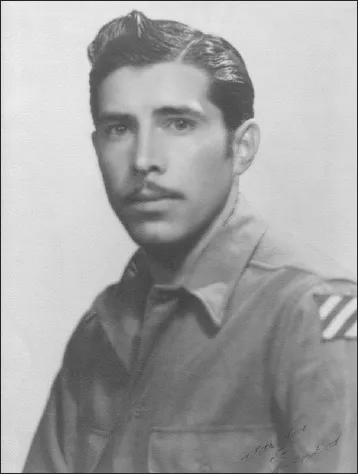
Andrew Tamayo, 1943. Courtesy of the U.S. Latino & Latina World War II Oral History Project.
“I couldn’t understand it,” he recalled. “I was in the U.S. Army fighting for the freedom of people in Europe, and we were having the same problem here in the United States.”11 His more immediate concern involved a promise of citizenship that was never kept. Leyva had been assured citizenship if he served in the U.S. military. For some unexplained reason, he did not receive his citizenship papers. The bitter disappointment that he has carried all his life limited and impaired his Americanized identity.
For soldiers like Raymond J. Flores, the war experience strengthened a politicized identity previously shaped by his family’s involvement in struggles against discrimination that stretched back over generations. He was born in the mining town of Miami, Arizona, one of seventeen brothers and sisters. His mother encouraged him to fight for his beliefs, including equality for his community. Not one to simply “do as I say,” she modeled behavior for him.12 Raymond joined his mother as well as his brothers and sisters to fight for the integration of an all-White class in the local elementary school. In high school, Flores also led a walkout of Mexican students to protest the school’s decision to schedule the taking of the class picture according to the students’ national origin. Flores described his resolve in no uncertain terms: “It was a period of racism to the extreme when I was growing up. If you get accustomed to it, it doesn’t hurt as much. But we didn’t want to be accustomed to that. It was just not our way.”13
While in the military, Flores also encountered racial discrimination. He noted, “I hate to discredit different parts of the military, but racism was rampant.”14 Even in the military, Flores used his ability to teach by helping non-English-speaking Latino soldiers from Texas to learn “Army English.” For two hours every morning, he taught the grateful soldiers the words they needed to understand in order to follow basic commands and avoid punishment. After the war, Flores continued with his activism against discrimination, including boycotts in college. He used the educational benefits of the GI Bill to become a teacher and took the opportunity while working in schools to challenge inequality and injustice everywhere.
María Elisa Rodríguez represented yet another case of a newfound identity. She was born into a Mexican immigrant family of nine children in Waco, Texas. Her father was a day laborer who encouraged his children to secure an education because he believed that this would protect them from prejudice and discrimination. Rodríguez remembered Waco had “lots of prejudice and that’s the reason my dad always emphasized education.”15 She felt discrimination as a little girl, recalling, “We couldn’t even belong to the Girl Scouts or anything like that. There was a lot of discrimination. So we couldn’t even get into the public swimming pools.”16 As a teenager, she decided to become a secretary even though she knew that Mexican girls did not usually secure those kinds of jobs; they were expected to be maids and cooks. When she applied for the job, the interviewers questioned her citizenship and made her feel like a foreigner. She was forced to identify herself as an American of Mexican descent:
There were very few secretaries at that time. . . . In fact I was the first secretary to come here and be hired . . . and they would see my name and the patient would say, “What nationality are you?” I’d say, “I’m Mexican and I am an American of Mexican descent.” And they’d say, “Well, I’ve never seen a Mexican in an office.” And I’d say, “Well, you’re seeing one now.” Because most of them [Hispanic women] were working in clothing stores because that was as high as you could get. There weren’t too many opportunities offered to Mexican American women.17
Rodríguez worked as a civilian clerk for the army during the war. She...
Table of contents
Cover
Copyright
Title Page
Dedication
Contents
Foreword
Acknowledgments
Introduction
1. The Paradox of War
2. Embracing the Ether
3. “Now Get Back to Work”
4. The Latinas of World War II
5. Mexican Nationals in the U.S. Military
6. The Color of War
7. God and War
8. Silent Wounds
9. Mother’s Legacy
Notes
Selected Bibliography
Index
Trusted by 375,005 students
Access to over 1.5 million titles for a fair monthly price.
Study more efficiently using our study tools.
Frequently asked questions
Yes, you can cancel anytime from the Subscription tab in your account settings on the Perlego website. Your subscription will stay active until the end of your current billing period. Learn how to cancel your subscription
No, books cannot be downloaded as external files, such as PDFs, for use outside of Perlego. However, you can download books within the Perlego app for offline reading on mobile or tablet. Learn how to download books offline
Perlego offers two plans: Essential and Complete
Essential is ideal for learners and professionals who enjoy exploring a wide range of subjects. Access the Essential Library with 800,000+ trusted titles and best-sellers across business, personal growth, and the humanities. Includes unlimited reading time and Standard Read Aloud voice.
Complete: Perfect for advanced learners and researchers needing full, unrestricted access. Unlock 1.5M+ books across hundreds of subjects, including academic and specialized titles. The Complete Plan also includes advanced features like Premium Read Aloud and Research Assistant.
Both plans are available with monthly, semester, or annual billing cycles.
We are an online textbook subscription service, where you can get access to an entire online library for less than the price of a single book per month. With over 1.5 million books across 990+ topics, we’ve got you covered! Learn about our mission
Look out for the read-aloud symbol on your next book to see if you can listen to it. The read-aloud tool reads text aloud for you, highlighting the text as it is being read. You can pause it, speed it up and slow it down. Learn more about Read Aloud
Yes! You can use the Perlego app on both iOS and Android devices to read anytime, anywhere — even offline. Perfect for commutes or when you’re on the go. Please note we cannot support devices running on iOS 13 and Android 7 or earlier. Learn more about using the app
Yes, you can access Beyond the Latino World War II Hero by Maggie Rivas-Rodríguez, Emilio Zamora, Maggie Rivas-Rodríguez,Emilio Zamora in PDF and/or ePUB format, as well as other popular books in Social Sciences & North American History. We have over 1.5 million books available in our catalogue for you to explore.