eBook - ePub
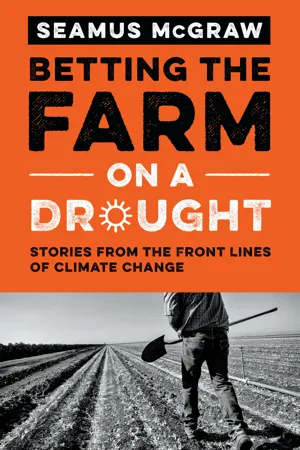
Betting the Farm on a Drought
Stories from the Front Lines of Climate Change
- 191 pages
- English
- ePUB (mobile friendly)
- Available on iOS & Android
eBook - ePub
About this book
A lively, thought-provoking overview of climate change from the perspectives of people who are dealing with it on the ground.
Climate change has become one of the most polarizing issues of our time. Extremists on the left regularly issue hyperbolic jeremiads about the impending destruction of the environment, while extremists on the right counter with crass, tortured denials. But out in the vast middle are ordinary people dealing with stronger storms and more intense droughts than they've ever known. This middle ground is the focus of Betting the Farm on a Drought, a lively, thought-provoking book that lays out the whole story of climate change—the science, the math, and most importantly, the human stories of people fighting both the climate and their own deeply held beliefs to find creative solutions to a host of environmental challenges.
Seamus McGraw takes us on a trip along America's culturally fractured back roads and listens to farmers and ranchers and fishermen, many of them people who are not ideologically, politically, or in some cases even religiously inclined to believe in man-made global climate change. He shows us how they are already being affected and the risks they are already taking on a personal level to deal with extreme weather and its very real consequences for their livelihoods. McGraw also speaks to scientists and policymakers who are trying to harness that most renewable of American resources, a sense of hope and self-reliance that remains strong in the face of daunting challenges. By bringing these voices together, Betting the Farm on a Drought ultimately becomes a model for how we all might have a pragmatic, reasoned conversation about our changing climate.
"This title deserves a wide and varied readership; it has the power to change minds." — Booklist
"Seamus McGraw has created not just an important document regarding climate change and the future of our planet but a wonderful and truthful portrait of America. You feel like you're on the road with him, cruising down little-traveled streets to meet fascinating characters whom you'd never see on Fox News or CNN. A terrific book." —A. J. Baime, author of White Lies: The Double Life of Walter F. White and America's Darkest Secret
"Effectively blending story, science, and context, this engaging, readable book will be invaluable for those studying or working on issues associated with climate change, especially those with a social science or policy focus." — Choice
Information
ONE
Sundance
IT HAD BEEN WEEKS SINCE I HAD BEEN THERE, and now, as my young son, Liam, and I rounded the corner of Ellsworth Hill Road near the edge of my family farm in my rattletrap old Chevy Blazer, it loomed into view, a massive cloud of dust and sand and diesel exhaust billowing up into the sky and all but blotting out the moon. Backlit by what must have been a hundred high-powered lights atop the seventy-foot-tall, hundred-yard-square Mayan pyramid the drillers had carved into our hillside, it looked as if some sort of bizarre ritual—a sacrifice, perhaps—was playing out in front of us.
Maybe it was.
Two years earlier, Liam had been with me when we walked that ground with the surveyors for Chesapeake Appalachia, pacing out what they thought would be the perfect place to site the first of what they anticipated would be six mile-and-a-half-deep natural gas wells that would then snake out a mile and a half to suck out as much gas as they could from the Marcellus Shale beneath our little corner of northeastern Pennsylvania. The lead surveyor, a tall man with a deep-fried Texas accent, had tried his best to persuade my son to drive in the first stake, but when he offered the six-year-old boy the four-pound mallet, Liam hightailed it behind a blackberry bramble. A look of confusion and maybe a little bit of fear etched its way across my son’s brow.
I glanced in the rearview mirror as I pulled into the long dirt driveway. I could see that look cross his face again. And then I glanced at my own reflection. The look was carved onto my brow, too.
Staring at this massive, churning industrial operation in what used to be my family’s pasture, the place where as a boy I chased Angus cross cows on horseback pretending to be a cowboy, I listened to the otherworldly roar of the diesel engine that powered it all, the earth literally pulsing beneath me. I was surprised by my own feelings.
I’d thought I was prepared for it. I had seen this operation before—the military precision of the small army of roughnecks and technicians as they revved up the intimidating array of high-tech equipment, including the forty-foot-long battleship of a machine that would blast a toxic cocktail of water and sand containing up to a dozen chemicals, some of them kept secret even from the landowner, deep into the earth at more than 9,400 pounds of pressure per square inch to pry open tiny fissures in the rock and release the natural gas trapped inside it.
But now that it was happening here, on my land, I could understand my own son’s wordless confusion. I could appreciate in a visceral way, maybe for the first time, why the word to describe this process—fracking—stirs such fear. I could even feel the stirring of that fear myself.
Truth be told, that sense of unease had been gnawing at me for a while, ever since we had first signed the contract to allow the drillers onto our land. And while it was still unformed, it had taken on a kind of urgency the summer before, when I started out on the road to promote my last book, The End of Country, which detailed the difficult issues my family and my neighbors faced as we grappled with the question of whether to risk all we had and allow the drillers to bore their way into our lives.
In town after town, at college after college, every place I was invited to speak, I saw the deep fractures that this process had exacerbated. It was as polarized and polarizing an issue as any I’ve ever encountered. But more than that, I came to see it as a kind of metaphor. It was, in miniature, a portrait of all the deep divisions that snake through our political and social discourse. It is no exaggeration to say that when talking to the vast majority of people I had met on the road—and there were a couple of thousand of them—if I could tell where they stood on the issue of fracking, I could tell with an alarming degree of accuracy where they stood on a half dozen or so other contentious issues, from abortion and gun rights to the growing gulf between the haves and the have-nots in this country. Nowhere was that rift more jagged than on the question of the risks and possible responses to the changing climate, an issue that may be the most consequential of our time.
It is, of course, perfectly understandable that people tend to cluster in almost tribal groups when faced with issues that are so multifaceted and so complex, so full of nuance and uncertainty, every element of them fraught with both promise and peril. Hell, even scientists who spend their entire professional lives studying the risks associated with the changing climate admit that they sometimes have a hard time wrapping their minds around the magnitude of it all.
After all, insulated as we are, it’s no surprise that most harried Americans find little time to ponder the complex network that links their consumption of everything to the rising sea levels that threaten to erase from the map some South Pacific island nation they’ve never heard of before. To a nation that for the most part knows polar bears only as furry computer-generated pitchmen who turn up on television between Thanksgiving and New Year’s to sell them Coca-Cola, the whole idea of melting ice caps is, to borrow a phrase used by New Jersey governor Chris Christie in the wake of Hurricane Sandy, a little “esoteric.”
Americans, who are by the millions treading water just trying to keep pace with their mortgages and their rising grocery bills, would rather not think about the issue at all. And if they are prodded to take a position, they’ll likely take the one espoused by the coven of talking heads they usually trust, be it Fox News or MSNBC.
Nor is it any surprise that in the chaotic maelstrom that is modern media, only the most strident voices are heard above the din, and so when we manage to find any discussion about this at all, the few words we catch are the most divisive.
The tragedy of it is that across the whole cultural landscape of this country, all of those factors are conspiring to make the fractures deeper and wider. It has become almost clichéd to say that the country is now more divided than it has been at any time since perhaps the Civil War, but the evidence of that, and the consequences of it, becomes clearer with each passing year.
There’s a line I often use when I’m speaking: “If the melting ice caps and the rising oceans don’t get us, we’re all going to drown in the viscera of each other’s gored oxen.”
It usually elicits a rueful chuckle from the audience. Sometimes you can get a laugh just by stating the obvious.
But there is a part of me—call it naive, if you like—that can’t help but believe that somewhere out there in America, all but drowned out by the din, is a native strain of reason that could be cultivated, a peculiarly American kind of common sense and courage that would give us the strength to at least begin an honest discussion about the challenges we face.
I don’t know. Maybe that’s what I was looking for when I drove to the farm that day with Liam.
Maybe I was looking for it in the contours of the changing land itself. Maybe I was looking for it in my son’s expression. Maybe I was looking for it in myself.
It had not been an easy decision to let the drillers onto our land a few years earlier. Not for me. Not for my family. Not for our neighbors, most of them former dairy farmers who had been on this land for generations and who, one by one, had eventually been forced out of business, strangled almost to death by the twin tendrils of bad farm policy and spiraling energy prices. To us, this land was more than the sweet spot on some U.S. Geological Survey map of the gas-rich Devonian shales that underlie most of northern Appalachia. It was home. The sum of who we were. The place where I used to chase cows on horseback.
My family had been there for more than four decades. What started out as a weekend retreat quickly became an obsession, and before long it became a full-time job as my father indulged his dream of becoming a gentleman farmer and my mother chased her dream of becoming a character in one of those frontier romance novels—buckskin bodice rippers, she called them—that she so adored. Mom managed to achieve her dream; Dad, not so much, and eventually, he quit trying.
As for me, when I turned eighteen I shook the dust of that place off my boots, headed away to college for a while, failed at that, and then failed at a series of jobs and marriages until I accidentally stumbled into journalism and never figured out how to drift back out of it. And yet the place was always with me. It defined me. I went back every chance I got. My sister was married there. So was I, the third time. My father died there.
It was there, at my father’s deathbed, that I learned fractures can be deepened and widened, but they can also be closed. I learned it in his room with him just two nights before he finally succumbed to the pancreatic cancer that, unbeknownst to either of us, had already been eating away at him just months earlier when he and I had silently worked up a sweat while building a bluestone patio beside the barn for my wedding. I had been at work, three and a half hours away, at a newspaper in New Jersey—my sister and I would work all day and then drive to the farm each evening to maintain a vigil before turning the hospice duties back over to my mother—when my mother called me, frantic and out of breath.
“Your father wants to go down and sit on the porch,” she said, her voice cracking. “He’s seventy pounds. I can’t do it; I can’t carry him. I’ll kill him. But he’s yelling at me.”
I tried to calm her down, and told her I was on my way. I made it to the farm in record time. And when I walked into the room, he was, as my mother had warned me, on a tear. I looked at him. Lying there, in that hospice bed, he looked so small and frail, and yet he was full of rage and, I have no doubt, fear. A bit of fear infected me as well.
Things hadn’t always been easy between my father and me. Maybe the pieces of us that were different were just too different. Maybe the pieces of us that were similar were just too similar. We were both proud and headstrong, and had certainly both made our share of mistakes, and there were long periods during my younger years when the disappointment we felt toward each other got the best of us. We once went for two years without speaking to each other. But time and age have a way of changing your expectations, and eventually my father and I rediscovered each other and settled into a rhythm. We stopped wishing the other would be something else and came to respect and love each other for who we were, or at least, for who it was that we wanted to be. And for the rest of my father’s life, we maintained—no, we nurtured—that relationship, talking, when we talked, about those things we shared and carefully tending the silences when necessary. Or at least we did until the day my mother called.
“I want to go downstairs,” my father demanded, his voice surprisingly strong for a man in his condition.
“You can’t,” I said firmly. “You’re too weak. She couldn’t carry you,” I said, pointing to my mother, who was now sobbing in a corner of the room. “And if I try to carry you down, there’s a good chance I’ll kill you.”
“Goddamn it,” my father croaked back. “Take me downstairs!” “No,” I said, just as firmly.
My father reached up with a skeletal hand and grabbed the side railing of the hospice bed and began violently tugging at it. “Listen, you little son of a bitch,” he sputtered, “take me downstairs or I’ll rip this goddamned thing off and wrap it around your neck!”
“Dad!” I said, with as much forced joy as I could muster. “Where have you been? I’ve missed you!”
The old man stopped and cocked an eyebrow at me. And then a smile crossed his face. It was the last time I ever saw my father laugh.
That moment, like so many others from the time I first set foot on the land, was frozen forever for me, part of a place that I would always picture in my mind’s eye as being the way I remembered it. But I knew it wasn’t that way anymore.
As the dairy farms that once surrounded us failed, those who could leave did, selling their acreage, often in small chunks, to people from New York and New Jersey who imported with them a fantasy of country living. Little by little, the whole way of life I had known as a boy was vanishing. It was, as one of my neighbors put it, “the end of country.”
And now, the drillers were here.
The way I saw it then, and the way I still see it, there was a sense of inevitability to it all. It wasn’t just about the money. Although some of us, like my own family, were offered hundreds of thousands of dollars to lease our land, with the promise of perhaps millions more when and if the wells came in, others, like my neighbor across the road who signed with a smooth-talking land man who turned up before the full potential of the Marcellus was really understood, got a pittance, just enough to pay their property taxes.
No, it was about something more important. The way we saw it, maybe the gas in the Marcellus could buy us one more chance.
Sure, there were risks. They were real and they were profound. There was the risk that fracking fluid could either spill on the surface or—though most analysts agree it’s far less likely—migrate up from deep underground to possibly contaminate groundwater and aquifers. There was the risk that methane, the key component of natural gas, could waft up into drinking-water supplies as a result of carelessness, recklessness, bad cement, or just bad luck. In fact, that had happened, repeatedly—most famously just a few miles away in the little village of Dimock, Pennsylvania, a place that has become in many respects, ground zero for the debate over fracking. There was the threat that the whole thirsty process—it takes millions of gallons of water to break up the shale, and at least 30 percent of it remains underground, lost to the water cycle forever—would tax water supplies. There were risks associated with disposing of the water, not just the water that flowed back from the fracking operation but the even more noxious witch’s brew that the earth itself cooks up in the shale, a slightly radioactive, highly saline and heavy-metal-laden water that flows up to the surface for the lifetime of the well, still seeping up decades hence, when not as many people are watching as closely. Some of that water was treated and recycled. Some was treated and released. Some was pumped into deep-injection wells, many of them in Ohio, in a process that on rare occasions had triggered earthquakes like the series of small tremors, up to magnitude 4.0, that rattled Youngstown, Ohio, in 2011 after deep-well injection operations began there, forcing state officials to shut down the facility. There was also the risk to the air: methane leaking from wellheads, and pipelines, and compressor stations, and the steady noxious cloud of diesel fumes produced at virtually every step of the drilling process. For all the grand talk about how much better for the environment natural gas is than oil as a fuel, drillers still rely heavily on good old-fashioned diesel to get it.
Those risks, the industry and its boosters insisted, were mechanical, and were therefore manageable.
But there were other risks that were far less easy to predict, and far more difficult to contain.
When the drillers showed up, so, too, did the advocates on both sides of the issue—movie stars, activists, industry shills, and self-promoting documentarians. In much the same way that the process of fracking injects astounding amounts of pressure into the deeply buried rock to exploit existing fractures, well-funded pseudo-grassroots organizations blasted their people and resources into these already wounded communities to exploit the social fractures that had long divided them.
Nowhere was that more evident than on Carter Road, a little dirt track that snaked behind a hillside in Dimock, a place where fifteen families had found their water tainted by methane after drilling had begun nearby. The Pennsylvania Department of Environmental Protection (DEP) had laid the blame squarely at the driller’s feet. The driller was ordered to shut down operations in that area, and for a while the driller, Cabot, had provided water to the affected residents. A lawsuit filed by the families had forced the company to do so. But when that lawsuit was settled, and when the DEP decided to lift its ban on Cabot’s operation, the water deliveries stopped.
When they did, the battle lines were drawn. Prodded by activists who argued that the water was contaminated by more than just methane, the federal Environmental Protection Agency stepped in, but when the agency could find no evidence of significant contamination beyond what the DEP had found, it stepped aside. In its wake, the activists on both sides stepped in, lining up neatly and orderly on their respective sides of the fractures in the community.
By late 2011, it was not at all unusual to drive down Carter Road, a place that ordinarily might see no more than an occasional rabbit cross the road, and find it choked with cars and trucks and buses and news vehicles, as a throng of true believers clustered around Gasland auteur Josh Fox and actor Mark Ruffalo in front of a house festooned with “Ban Fracking” signs, or one house ove...
Table of contents
- Cover
- Title Page
- Copyright
- Dedication
- Contents
- 1. Sundance
- 2. Comfortable in Our Ignorance
- 3. Kindergarten in a Fallout Shelter
- 4. Preaching to the Choir
- 5. Running from a Grizzly in Your Slippers
- 6. The Other White Meat
- 7. Flying by Wire
- 8. Notes from the Ivory Clock Tower
- 9. “I Never Met a Liberal Before”
- 10. The Year the Creeks Stopped Freezing
- 11. “It’s What I Do”
- 12. Penguins Tumbling Off an Ice Sheet
- Acknowledgments
- About the Author
- Notes
- Bibliography
- Index
Trusted by 375,005 students
Access to over 1.5 million titles for a fair monthly price.
Study more efficiently using our study tools.
Frequently asked questions
Yes, you can cancel anytime from the Subscription tab in your account settings on the Perlego website. Your subscription will stay active until the end of your current billing period. Learn how to cancel your subscription
No, books cannot be downloaded as external files, such as PDFs, for use outside of Perlego. However, you can download books within the Perlego app for offline reading on mobile or tablet. Learn how to download books offline
Perlego offers two plans: Essential and Complete
- Essential is ideal for learners and professionals who enjoy exploring a wide range of subjects. Access the Essential Library with 800,000+ trusted titles and best-sellers across business, personal growth, and the humanities. Includes unlimited reading time and Standard Read Aloud voice.
- Complete: Perfect for advanced learners and researchers needing full, unrestricted access. Unlock 1.5M+ books across hundreds of subjects, including academic and specialized titles. The Complete Plan also includes advanced features like Premium Read Aloud and Research Assistant.
We are an online textbook subscription service, where you can get access to an entire online library for less than the price of a single book per month. With over 1.5 million books across 990+ topics, we’ve got you covered! Learn about our mission
Look out for the read-aloud symbol on your next book to see if you can listen to it. The read-aloud tool reads text aloud for you, highlighting the text as it is being read. You can pause it, speed it up and slow it down. Learn more about Read Aloud
Yes! You can use the Perlego app on both iOS and Android devices to read anytime, anywhere — even offline. Perfect for commutes or when you’re on the go.
Please note we cannot support devices running on iOS 13 and Android 7 or earlier. Learn more about using the app
Please note we cannot support devices running on iOS 13 and Android 7 or earlier. Learn more about using the app
Yes, you can access Betting the Farm on a Drought by Seamus McGraw in PDF and/or ePUB format, as well as other popular books in Biological Sciences & Ecology. We have over 1.5 million books available in our catalogue for you to explore.