"Incorporate[s] a multitude of theoretical approaches about Hopi sociological life . . . Ranging from prehistoric times until contemporary times." —
Indigenous Nations Studies Journal
All anthropologists and archaeologists seek to answer basic questions about human beings and society. Why do people behave the way they do? Why do patterns in the behavior of individuals and groups sometimes persist for remarkable periods of time? Why do patterns in behavior sometimes change?
A Hopi Social History explores these basic questions in a unique way. The discussion is constructed around a historically ordered series of case studies from a single sociocultural system (the Hopi) in order to understand better the multiplicity of processes at work in any sociocultural system through time. The case studies investigate the mysterious abandonments of the Western Pueblo region in late prehistory, the initial impact of European diseases on the Hopis, Hopi resistance to European domination between 1680 and 1880, the split of Oraibi village in 1906, and some responses by the Hopis to modernization in the twentieth century.
These case studies provide a forum in which the authors examine a number of theories and conceptions of culture to determine which theories are relevant to which kinds of persistence and change. With this broad theoretical synthesis, the book will be of interest to students and scholars in the social sciences.
"A foundation for general discourse on anthropological theory and explanation . . . Covering the prehistoric, Spanish, early historic, and contemporary periods." —
American Indian Quarterly
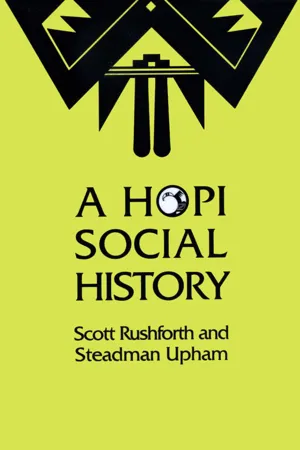
- 320 pages
- English
- ePUB (mobile friendly)
- Available on iOS & Android
eBook - ePub
A Hopi Social History
About this book
Information
Table of contents
- Cover
- Title
- Copyright Page
- Contents
- Preface
- Part One. Persistence, Change, and History
- Part Two. A Hopi Social History
- Part Three. Process, Explanation, and Social History
- Notes
- References
- Index
Trusted by 375,005 students
Access to over 1.5 million titles for a fair monthly price.
Study more efficiently using our study tools.
Frequently asked questions
Yes, you can cancel anytime from the Subscription tab in your account settings on the Perlego website. Your subscription will stay active until the end of your current billing period. Learn how to cancel your subscription
No, books cannot be downloaded as external files, such as PDFs, for use outside of Perlego. However, you can download books within the Perlego app for offline reading on mobile or tablet. Learn how to download books offline
Perlego offers two plans: Essential and Complete
- Essential is ideal for learners and professionals who enjoy exploring a wide range of subjects. Access the Essential Library with 800,000+ trusted titles and best-sellers across business, personal growth, and the humanities. Includes unlimited reading time and Standard Read Aloud voice.
- Complete: Perfect for advanced learners and researchers needing full, unrestricted access. Unlock 1.5M+ books across hundreds of subjects, including academic and specialized titles. The Complete Plan also includes advanced features like Premium Read Aloud and Research Assistant.
We are an online textbook subscription service, where you can get access to an entire online library for less than the price of a single book per month. With over 1.5 million books across 990+ topics, we’ve got you covered! Learn about our mission
Look out for the read-aloud symbol on your next book to see if you can listen to it. The read-aloud tool reads text aloud for you, highlighting the text as it is being read. You can pause it, speed it up and slow it down. Learn more about Read Aloud
Yes! You can use the Perlego app on both iOS and Android devices to read anytime, anywhere — even offline. Perfect for commutes or when you’re on the go.
Please note we cannot support devices running on iOS 13 and Android 7 or earlier. Learn more about using the app
Please note we cannot support devices running on iOS 13 and Android 7 or earlier. Learn more about using the app
Yes, you can access A Hopi Social History by Scott Rushforth,Steadman Upham in PDF and/or ePUB format, as well as other popular books in Social Sciences & Cultural & Social Anthropology. We have over 1.5 million books available in our catalogue for you to explore.