- 146 pages
- English
- ePUB (mobile friendly)
- Available on iOS & Android
eBook - ePub
About this book
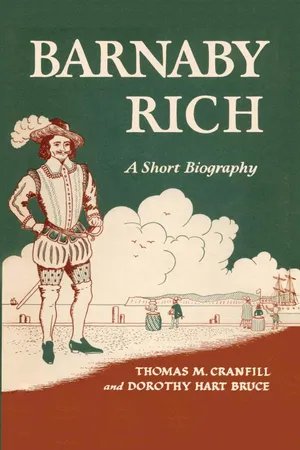
Soldier, sea captain, freebooter, courtier, writer, reformer, and informer, Barnaby Rich was a man of his time. In the service of Queen Elizabeth, Rich took part in numerous campaigns fraught with hardship and disaster in France, the Low Countries, and Ireland. After twenty years of soldiering, he wrote Riche His Farewell to Militarie Profession, which attracted the attention of the Queen herself, as well as William Shakespeare and many of the lesser among his contemporaries. "I have preferred to be rich rather than to be called so," punned the Captain ruefully on his title pages, for he was usually in want and as often in trouble. The source of both misfortunes was his disdain for dodging a fight, and much that is known of his life comes from unpublished records of legal actions in which he was involved. Rich directed his satire primarily against the sinecures of the Anglican clergy in Ireland and against the papacy. "Sworne man" of both Elizabeth and James, he protested near the end of his life that his assaults with pike and pen were but the promptings of a "true harted subjecte." Born in an age bright with stars, Rich must be considered a "minor" Elizabethan. Therein lies the novelty of this study: it treats the not-so-great, using unpublished court records to enrich our knowledge of Great Britain's grandest era. But the story of the man is not lost in the background of the period. With freshness and charm the present volume disinters Barnaby Rich from the footnote crediting him as Shakespeare's source for the plot of Twelfth Night and fleshes him forth a live Elizabethan.
Trusted by 375,005 students
Access to over 1.5 million titles for a fair monthly price.
Study more efficiently using our study tools.
Information
I
A Major “Minor Elizabethan”
THE FAME of Barnaby Rich is secure. Shakespeare conferred immortality on him by borrowing from at least two and probably three of his short stories.1 So long as Shakespeare’s plays attract students, critics, and editors, Rich’s name will appear and reappear in theses, articles, introductions, and commentaries. He merits a better fate, however, than to be remembered only as the author of tales that Shakespeare found attractive. For the man whom many now recall dimly, if at all, only as a name to be mentioned in the same breath with Arthur Brooke and the Ur-Hamlet was a figure of considerable note in his own day, and his long life was fraught with adventure and misadventure, color and strife.
Like his friend Thomas Churchyard, he was, for an Elizabethan, almost immortal. He lived, a military and literary Old Parr, during the reigns of five English monarchs and died at seventy-five. Two of his sovereigns, Elizabeth and James, knew him personally and made him their sworn servant. Both further demonstrated their esteem by improving his financial lot, Elizabeth in 1587 and James, almost thirty years later, in 1616. For over fifty years their servant busied himself with things military, either as a captain fighting in France, the Low Countries, and Ireland or as a commentator on martial affairs. The fruits of this vast experience and industry are, in the opinion of one authority, “contributions to military literature … historically speaking every bit as important as Shakespeare’s to drama.”2
Not content with writing about or fighting wars, Captain Rich also labored to serve England—and to supplement the income which he derived from his profession—in interesting and sometimes dangerous ways as diverse as playing the courtier3 and serving as an informer. Most of the energy he could spare from soldiering, however, he obviously devoted to writing. His first publication appeared in 1574, his last in 1617. “It is a thriftless and thankless occupation, this writing of books,” he complained in 1610,4 when he was sixty-eight; yet in 1617, seven years and seven books later, he was able to boast that he had produced twenty-six works.5
In addition to his contributions to military lore, these comprise short stories, long prose romances, character sketches, intelligence reports, mordant prose satires, pamphlets about Ireland, bitterly anti-Roman Catholic tracts, and verse. One of his poems found its way into the 1580 edition of that popular Elizabethan miscellany The Paradise of Dainty Devices,6 and two of his books were unquestionably best sellers: Riche His Farewell to Militarie Profession (1581, 1583, 1594, 1606), the collection of tales from which Shakespeare borrowed, and The Honestie of This Age (1614, 1615, 1616), which achieved a publication in Scotland apart from three London editions.7 Even after his death in 1617 several of his works continued to appear. Forty-eight years after his early military pamphlet, Allarme to Englande (1578), was first printed, it came out again, as Vox Militis (1625) by one G. Marcelline; his New Description of Ireland (1610) reappeared as A New Irish Prognostication in 1624; and the publisher of The Irish Hubbub (1617), the Captain’s swan song, produced other editions in 1619 and 1622. Evidently Rich’s reputation as a military scientist and satirist of Irish affairs did not die with him. Indeed even today certain of his efforts are to be deemed “masterpieces of satire, comparable to the best in Dekker and Nashe,” according to a recent critic.8
Rich’s literary excursions into such a variety of genres over a period of forty-three years of course attracted an astonishing variety of Elizabethan and Jacobean readers. In 1579 a fashionable physician quoted him in support of a long, earnest prescription that infants should be fed plentifully and only by breast,9 and in 1616 a prominent Royalist divine reinforced his preachments against cosmetics with an extensive passage by Rich on the same subject.10 Before 1587, Queen Elizabeth favored Rich with “manie gratious wordes for … his writinges.”11 In the 1590’s both Gabriel Harvey and Thomas Nashe, marvelous to relate, accorded Rich’s works more or less honorable mention.12 Sometime between 1610 and 1650, Sir Robert Gordon, a great favorite of James I and a bibliophile of renown, took the pains to collect ten works by Rich.13 And James himself vouchsafed a reading of at least two of Rich’s outpourings, as we shall see later.
Among Elizabethan, Jacobean, and Caroline playwrights Shakespeare was not alone in perusing some of Rich’s works and paying them the ultimate in compliments by borrowing from them. In John Webster’s The White Divel (1612) one scholar has detected “repeated borrowings from Rich’s A New Description of Ireland” (1610).14 From the tales in Rich’s Farewell came the plots and sometimes the dialogue of a large assortment of dramas: two highly popular, widely imitated comedies, The Weakest Goeth to the Wall (1600), variously attributed to Webster and Thomas Dekker and to Anthony Munday, and How a Man May Chuse a Good Wife from a Bad (1602), usually attributed to Thomas Heywood;15 James Shirley’s first comedy, Love Tricks (licensed 1625, published 1631); the weird Scottish comedy Philotus (1603,1612); and the weirder German comedy Tugend-und Liebesstreit (performed 1608, published 1677).16 Unlike some of their fellows in Elizabethan fiction that was less in demand than Rich’s the characters in the Farewell were not, it seems, doomed to begin and end their careers in London. On the contrary, they flourished as far north as Edinburgh and as far south as Dresden, Graz, and Güstrow—not to mention Illyria.
Although not all of Rich’s books enjoyed the success of the Farewell, none could have failed for want of impressive chaperonage. Few of his contemporaries managed to secure a galaxy of literary patrons more resplendent than his. Among them were Elizabeth, James, all three of James’s children, and an array of royal favorites, privy councilors, and military and political magnates in both England and Ireland. Rich dedicated his first book to Elizabeth’s favorite, Ambrose Dudley (1528?–90), the “Good Lord Warwick,” and his last to James’s favorite, Sir Oliver St. John (1559–1630), lord deputy of Ireland and eventually Viscount Grandison and Baron Tregoz.
Other patrons included Sir Oliver’s wife, Lady St. John; those powerful favorites of the Queen, Sir Christopher Hatton, Elizabeth’s “mutton,” vice-chamberlain, and lord chancellor, Sir Francis Walsingham, Her Majesty’s principal secretary, and Sir Robert Cecil, Viscount Cranborne, Earl of Salisbury, Elizabeth’s “little elf” and James’s “little beagle”; Sir Thomas Ridgeway, Earl of Londonderry, vice-treasurer, treasurer at wars, and treasurer in Ireland; Ridgeway’s wife Cicely, sometime maid of honor to Elizabeth; Sir Arthur Chichester, Lord Chichester of Belfast, lord deputy of Ireland, and member of both the English and the Irish privy councils; Sir George Carew, Baron Carew of Clopton, Earl of Totnes, favorite of both Elizabeth and Anne of Denmark, treasurer at wars and lord justice of Ireland; Joyce Aston, Rich’s “cosyn” and daughter of one of the richest men in England, Sir Edward Aston; and Sir Thomas Middleton, lord mayor of London.17 Had editions of Who’s Who been available to Elizabethans and Jacobeans, one might almost suspect Rich of scanning copies systematically and overlooking few likely personages of affluence and power in English and Anglo-Irish military, governmental, and court circles who might qualify as patrons and to whom his career in the army or in Ireland might somehow gain him access.
The roster of his friends among literary notables is scarcely less impressive than the list of his patrons. He went on a journey with the great translator Sir Thomas North, and together they shared a series of remarkable experiences at Chester.18 In a commendatory poem prefacing Rich’s The Straunge and Wonderfull Adventures of Don Simonides (1581) Thomas Lodge speaks affectionately of the “willyng mynde” of “Good Riche” and says he has “mended” certain errors in “your Booke.” Greater love hath no man of letters for another. For his pains Lodge may have felt repaid by verses prefixed to his own An Alarum against Usurers (1584) in which Rich calls attention to the estimable “birth and life” of “good Lodge,” praises his “pleasant stile and method,” and attacks his archenemy, Stephen Gosson. Like Lodge, Lodowick Bryskett, Spenser’s close friend, also seems to have rendered Rich a signal literary service by lending him translations of three Italian tales for inclusion in the Farewell.19
The most thoroughly commended of all Rich’s works was his Allarme to Englande (1578), which was sped on its way with verse tributes by Lodowick Lloyd, author of The Pilgrimage of Princes (1573), Thomas Lupton, author of Siuquila (1580), and Thomas Churchyard and with a prose epistle addressed “To my very louing friend, Captaine Barnabe Riche,” by Barnaby Googe. Another of Rich’s literary acquaintances was Richard Stanyhurst, the translator of Virgil, whom Rich confessed knowing in Antwerp after 1582, though a loving friendship between them could scarcely have blossomed after Stanyhurst embraced Roman Catholicism and Rich offered caustic criticisms of what Nashe called Stanyhurst’s “foul, lumbring, boystrous, wallowing measure.”20 With Churchyard, however, Rich obviously enjoyed a long and cordial relationship, since the former acknowledged that he owed a section of a book published in 1602 to notes Rich had taken on a campaign in the Low Countries in 1572.21 Among the captains ...
Table of contents
- Cover
- Title
- Copyright
- Preface and Acknowledgments
- Contents
- List of Abbreviations
- 1. A Major “Minor Elizabethan”
- 2. Out of Essex into English
- 3. From Pike to Pen
- 4. The Passionate Archbishop and That Rascal Dean Jones
- 5. Rich v. the Archbishop and St. Peter
- 6. A Fayre Cypress Hatt Band
- 7. The Service of the Gentleman Is Used Here
- 8. A Privat Quarrel about a Kisse?
- 9. Dim of Sight and Lame of Limbs
- Index
Frequently asked questions
Yes, you can cancel anytime from the Subscription tab in your account settings on the Perlego website. Your subscription will stay active until the end of your current billing period. Learn how to cancel your subscription
No, books cannot be downloaded as external files, such as PDFs, for use outside of Perlego. However, you can download books within the Perlego app for offline reading on mobile or tablet. Learn how to download books offline
Perlego offers two plans: Essential and Complete
- Essential is ideal for learners and professionals who enjoy exploring a wide range of subjects. Access the Essential Library with 800,000+ trusted titles and best-sellers across business, personal growth, and the humanities. Includes unlimited reading time and Standard Read Aloud voice.
- Complete: Perfect for advanced learners and researchers needing full, unrestricted access. Unlock 1.5M+ books across hundreds of subjects, including academic and specialized titles. The Complete Plan also includes advanced features like Premium Read Aloud and Research Assistant.
We are an online textbook subscription service, where you can get access to an entire online library for less than the price of a single book per month. With over 1.5 million books across 990+ topics, we’ve got you covered! Learn about our mission
Look out for the read-aloud symbol on your next book to see if you can listen to it. The read-aloud tool reads text aloud for you, highlighting the text as it is being read. You can pause it, speed it up and slow it down. Learn more about Read Aloud
Yes! You can use the Perlego app on both iOS and Android devices to read anytime, anywhere — even offline. Perfect for commutes or when you’re on the go.
Please note we cannot support devices running on iOS 13 and Android 7 or earlier. Learn more about using the app
Please note we cannot support devices running on iOS 13 and Android 7 or earlier. Learn more about using the app
Yes, you can access Barnaby Rich by Thomas Mabry Cranfill,Dorothy Hart Bruce in PDF and/or ePUB format, as well as other popular books in History & Historical Biographies. We have over 1.5 million books available in our catalogue for you to explore.