- 485 pages
- English
- ePUB (mobile friendly)
- Available on iOS & Android
eBook - ePub
About this book
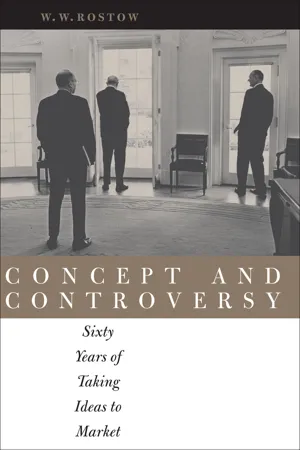
The noted economist and former National Security Advisor shares lessons learned from decades of national policymaking in this insightful memoir.
A trusted advisor to Presidents Eisenhower, Kennedy, and Johnson and one of America's leading professors of economic history, W. W. Rostow helped shape the intellectual debate and governmental policies on major economic, political, and military issues from World War II to the dawn of the twenty-first century. In this thought-provoking memoir, Rostow discusses his analysis of—and involvement with—eleven key policy problems. In the process, he demonstrates how ideas flow into concrete action and how actions taken or not taken in the short term actually determine the long run that we call "the future."
Rostow examines such varied issues as using airpower in 1940s Europe; early attempts to end the Cold War; the economic revival of Korea; attempts to control inflation in the 1960s; the Vietnam War; and the challenges posed by declining population in the twenty-first century. In discussing these and other issues, Rostow builds a compelling case for including long-term forces in the making of current policy. He concludes his memoir with provocative reflections on the twentieth and twenty-first centuries and on how individual actors shape history.
Information
One
A BACKWARD GLANCE
1916–1938
My parents, Victor and Lillian, born respectively in 1886 and 1894, belonged to the generation before the First World War. They communicated their values and concerns to their three sons without pressure or preaching, mainly by how they lived. My elder brother, Eugene, was born in 1913; I came along in 1916; and my younger brother Ralph in 1920. Each of our parents had been the eldest child of a fairly large family: five children on my father’s side, six on my mother’s. They met their responsibilities, conventional at the time, as the first children of their respective families.
A word about Ralph, who appears infrequently in this largely academic and policy-oriented book. He early showed an aptitude for business—unlike his older brothers but following a path pursued by a number of our uncles. During World War II, Ralph volunteered to serve as a spotter for artillery, slogging across France from Cherbourg to the edge of the Siegfried Line where the Seventy-ninth Division bogged down for the winter of 1944–1945. There his unit of three men was hit by German artillery. His two colleagues were killed; Ralph was seriously wounded. Evacuated via Italy, he recovered slowly, but was able in time to start a business career. He ended up owning his own small department store and retiring relatively early to Florida, where winters are not as hard on the residual shrapnel he carries in his body. He and his wife, Millie, have two talented children: Victoria, a Washington lawyer and public servant, and Ron, a health-care administrator. A fine man, Ralph, and a good brother.
Both Victor and Lillian Rostow were interested in ideas; their house was filled with books. An academic strand runs through our family. For example, my cousin Robert Rosenbaum, once my roommate at Yale, went on to become a Henry Fellow at Cambridge, England, a distinguished mathematician and a respected university administrator. Now emeritus, he teaches math to promising students from the underdeveloped part of Middletown, Connecticut. But not all our relatives appeared to share a passion for learning. Perhaps the best way to put it is that academic pursuits were regarded as respectable.
Our parents represented a fusion of different waves of emigration from eastern Europe. Victor, born in Russia, came to America at the age of eighteen in 1904, already independent and mature. As a boy, he had worked in my grandfather’s soap factory where he picked up the rudiments of chemistry, a field he was to pursue in the United States. He also worked on the family farm—without developing any notable attachment to the soil.
Life for a young Jew was not always peaceful. One story Victor told on himself may have been typical. When he was about sixteen, some households in his village were attacked one Saturday night by drunken Cossacks from a nearby town. Outraged, young Victor next morning rode the family horse into the Cossack domain, where he upbraided any male he could spot for attacking defenseless people. Instead of getting the angry response he was inviting, he was met with sullen silence; the Saturday-night marauders were nursing world-class hangovers. The deflated hero turned around and went home.
Soon, however, Victor was caught up in a larger struggle, the fight against both absolutist czarist rule and the local communists. Associated with a group of democratic socialists, he argued against the communists over Lenin’s pamphlet What Is to Be Done? The crux of the matter was whether, as Lenin insisted, the Communist Party, a minority of dedicated revolutionaries, on its own should define the “correct” historical line without regard to the opinions of the majority.1 Victor, then and always, believed in majority rule and tried to make his case. He didn’t win. It was from this early exposure to Leninists that Victor derived his lifelong aversion to communism. I remember asking Father what he thought of a young Soviet citizen whom someone had brought to our house in Irvington, New Jersey, in the 1920s. His reply was categorical: “In politics, the objectives you seek are not determined solely by your formal pronouncements but by the methods you use. The Bolsheviks are worse than the czars. Czars sent to Siberia only the dissidents; Communists send whole families. No good will ever come of them.”
Despite this retrospectively dispassionate view of “the Tsars,” it was their police who triggered Victor’s hasty departure from Russia. Word from the underground indicated that demo-socialists were to be rounded up. A family decision determined that Victor and two of his cousins, Misha and Grisha, should leave for America at once.
Embarking from a Black Sea port via Scotland, the trio arrived at Ellis Island. (1904 was a good year to travel: some foreign steamship lines had just cut steerage rates for immigrants to the United States to $10.) Victor and (I believe) both his cousins found work as waiters—an occupation for which Father later said he had absolutely no aptitude. Was he fired? Possibly. At any rate, his career turned up when he was admitted to Pratt Institute in Brooklyn, where he studied metallurgical chemistry. At the same time, a benign Columbia University professor allowed the young immigrant to use his laboratory. There Victor concentrated on white metals: lead, tin, and antimony. He must have done well, both academically and financially, for he was soon able to help bring his whole family to America. They settled on a substantial farm in Bloomfield, Connecticut, near Hartford.
My grandfather, former soap-factory owner and Russian farmer, somehow mutated into a New Englander. I have a small boy’s memory of going with him to a swimming hole on his land, picking tomatoes, plums, or carrots to eat along the way. Later I accompanied him behind a blind, well-loved horse to market in Hartford to sell whatever was in season.
Misha and Grisha found life less satisfactory in the Northeast and soon moved away. Misha got as far as Terre Haute, Indiana, where he set up a general store. Grisha, even more adventurous, put down roots in Melbourne, Australia, where his watchmaking shop formed the fulcrum of a dynasty that produced a spate of academicians, lawyers, public servants, and businessmen. I met with some twenty-five of them in Melbourne in 1983.
To an American child, Victor’s Russian past was exotic, even romantic. Perhaps for that reason I recall more about it than I do about Lillian’s more familiar upbringing. Her parents were also immigrant Russian Jews, but their six children were all born in this country. Lillian, the firstborn, apparently took seriously her responsibilities to help rear the younger ones. An ambitious student, with a passion for reading that lasted until her death, she hoped to go to college, and in fact won a scholarship. Her high school record was good; she was articulate, a competent athlete, and possessed a nice sense of humor. But her parents decided that she had to contribute to the support of the five siblings who trailed behind her. As a secretary and a bookkeeper she did just that. When my wife once asked her if there was anything in her life she would have liked to change, she replied with uncharacteristic bitterness: “Yes. I should have gone to college!” Lillian’s devoted support of her sons’ academic careers may have been, in part, wish fulfillment. It was she who put into my head, for example, the thought of applying for a Rhodes scholarship. But her sacrificial career as a secretary paid off too. In what I now regard as an excess of maternal zeal, she typed my first academic papers at Yale.
As for Victor and Lillian’s courtship I know little. I believe they met at the farm run by Victor’s aunt and uncle—Rose and Mendel Schaenen. This may account for the deep tie to the Schaenen family. Their sons, who were to go to Cornell, became older role models for us. My great uncle and his elder son were, among other things, the first exurbanites I ever knew: they commuted for many years between their work in New York City and their 160-acre farm in Basking Ridge (near Morristown), New Jersey. The family lore, as I remember it, was that Victor stole Lillian from a young man who was courting her, a fact the latter never forgot. The courtship of my parents evidently went forward briskly. The only comment Lillian ever made was that she regarded it—smiling—as somewhat arrogant that Victor, in advancing his case, said: “Think of what wonderful children we will have.” What they read and talked about is indicated by the names given to their sons: Eugene Victor, named for Debs as well as his father; Walt Whitman, and Ralph Emerson. Lillian was not only a devoted mother but she corresponded with and knew a great deal about both sides of our large family.
The most important thing to convey about Victor and Lillian as parents doesn’t lend itself to anecdote. They were much in love. This was a fact—an atmosphere that permeated all our lives. We would hear them laughing behind their bedroom door. It was a bit lonely for children to realize that we were not wholly the center of our parents’ lives; but it also was a reminder of what maturity might bring—if one was lucky.
Second, perhaps because Victor and Lillian had a life of their own, perhaps because they were simply wise, they never pressed their ideas upon us. Although they encouraged us to make our way, we were supported in every way by them. There was not a sense of being pushed out of the nest too soon. But I can still hear my father’s voice: “Make up your own mind. I shall have my opinion, and I will tell you what it is. But make up your own mind.” As a result, I don’t remember a period of revolt against received family views.
IRVINGTON, NEW JERSEY
I was born in Brooklyn in 1916; but we moved to Irvington, New Jersey, when I was one year old. Our active young mother (she was eighteen when she married) kept notes on all three of her boys. She ended her meticulous account of our weight and other aspects of our first year with bold and quite accurate predictions on what kind of men we would be. Although she later showed us these memoirs and her conclusions, the texts were somehow lost, at least mine. Later, one of my colleagues at MIT, Elting Morison, propounded a theory (for which he had thin statistical evidence); that middle sons like ourselves had an easier time. Subsequent research has tended to bear this out. In any case, I was from all accounts a cheerful baby—blond, chubby, and spared the burdens and responsibilities of being the firstborn.
We stayed in Irvington until I was nine years old. It was—at least in retrospect—a pleasantly rural period. We had a car, I recall, a Buick touring car with celluloid curtains we put up if it rained. We went almost every weekend to the Schaenen home in Basking Ridge. It was there I learned something of the round of life on a farm; for the Rostow boys were put to work no doubt to give the grown-ups some quiet time to talk. The tasks varied with the seasons and our ages. (I remember weeding the family garden in the late spring.)
At school Gene and I spent only half a year each in the first three grades. This was mainly due to our early instruction at home, which included reading and arithmetic from our parents. From the fourth grade on we stayed with our respective classes. This resulted in my elder brother and I graduating from Yale at 19. (I wouldn’t recommend this procedure to anyone else; but it did us no harm because we were both tolerably good athletes and were quite comfortable with children a bit older than we were.)
Irvington, New Jersey, was then a small town on the outskirts of Newark. Our parents had the Old and New Testaments among our books but had no formal religious ties—as befitted democratic socialists. My only marginally religious memories of those days are two.
After school one day, the brother of my brother Gene’s best friend called him a “dirty Jew.” A fight followed. My brother clearly won, but he emerged with a cut in his eyebrow that required some attention. We went home together. I played Sancho Panza to the great warrior. Our mother patched Gene up without fuss. When my father came home from work, we told him about the fight and showed off the wound. He surprised us by laughing gently and explaining: “Look, if anyone calls you a ‘dirty Jew’ that’s his problem not yours. I’m glad you can look after yourself. But you would be wiser to ignore that kind of talk.”
The only other Jewish memory I can recall was a Sunday trip to a synagogue in Newark. The occasion, however, was a lecture by a Norwegian explorer on summer in Alaska. All I remember was that, with the sun out a good part of the long day, the flowers and vegetables were big—as well as the mosquitoes.
Gene was memorably chivalrous. Three years older than I, he taught me to play tennis. (There were grass courts in Irvington’s park.) He took me on the handlebars of his bike to play baseball and football with his friends. He would let me play a bit while keeping a shrewd eye on me. This rather sophisticated mixture of support and encouragement continued through my freshman year at Yale when he was a distinguished senior.
In the Irvington years Father rose to be head of the laboratory at Federated Metals, a firm specializing in white metals, where he designed an application to white metals of the method created by Frederick Gardener Cottrell for iron and steel. This method extracted by electric current metal particles from the smoke going up in chimneys. One of my most vivid memories of these years was Father taking me up a ladder outside a chimney at his plant to show me his adaptation in operation. I climbed the ladder, straddled by my Father, until the machine was reached, perhaps halfway up, emplaced inside the chimney. After coming down I was rewarded with a Hershey bar.
In 1926, the whole family was shaken when Federated Metals was bought out by another firm. It had its own chemist to take over what had been my father’s laboratory. Father, aged forty, was fired. However, he soon received an offer from a Detroit firm at an equivalent salary. After consideration with Mother, he announced his decision to his two older sons. He would not accept the offer from Detroit; he would set up an independent firm in New Haven, where he had learned that there were eight full tuition scholarships from Hillhouse High to Yale. Mother and he thought we both would qualify. Father added that he might be the last member of the family who would have his own firm; but that is what he wanted.
I would record one more memory of Irvington. Mother and Father subscribed to the Theater Guild in New York. Among the plays was a visit of the Moscow Art Theater, which performed in Russian. I remember one night my brother Gene and I stole down to the landing on the staircase to hear Father speaking in Russian. He was translating Chekhov’s Cherry Orchard from Russian to English, preparing Mother to see the show. The only other memory of Father using Russian was a nightly ritual when we were small. Often arriving home when we were already in bed, he would recite a round: “A priest had a dog. The dog ate a piece of meat that was poisoned. The dog died. The priest put on his tombstone: ‘A priest had a dog etc., etc….’ “I sometimes astonished Russians who asked me at diplomatic gatherings if I spoke Russian. I replied, “No, but I know a round.” A surprising number knew this round and recited it correctly in Russian.
NEW HAVEN
WORTHINGTON HOOKER AND HILLHOUSE
In New Haven I entered Worthington Hooker Grammar School in the seventh grade just before my tenth birthday and graduated from Hillhouse High School at fifteen.
During these years I became conscious—even fascinated—with events in the wider world. Like other boys in the 1920s I was much interested in airplanes and read everything I could find on flying. I knew precisely when the two major airplane magazines arrived at the New Haven Library. Therefore, I followed with excitement the flight of Lindbergh across the Atlantic to Paris in May 1927. Lindbergh was in competition with Admiral Byrd (who flew with a substantial crew in a multiengine Fokker) as well as with Chamberlain and Levine (in a Bellanca); Lindbergh flew alone in a Ryan. When I met Lindbergh in the White House many years later, despite all that had happened that lowered the Colonel in my eyes, I could still feel echoes of a young boy’s hero-worship.
I also remember the family’s deep concern with the trial of Sacco and Vanzetti and its denouement in August 1927. They didn’t follow the details of the evidence, but as social democrats they sympathized instinctively with the prisoners.
The third memory of a large outside-the-family event sparked breakfast debates between Father and Gene. The subject was the 1928 race for the presidency between Herbert Hoover and Al Smith. Gene was an ardent and hopeful supporter of Al Smith. Father, while he sympathized with Gene’s advocacy, explained that the New York governor’s chances were slim: (a) because he was a Catholic, and (b) because the country was prosperous. As I worked in support of John Kennedy in 1960, I remembered this family discussion; for Kennedy wanted to prove that a Catholic could not only win but be a great president.
From ten to fifteen I was a voracious reader of novels. (I kept notes at the time but they are now lost.) As best I remember the list included the works of Thomas Hardy, Somerset Maugham, the Russian classics, Thomas Mann,2 the early works of James Joyce, Mark Twain—in short, a fairly conventional list. They taught me something of the human condition; and what it was like to live in another society, in another time, in another skin.
It was in this period that my father made a decision affecting my education. It came when in my last year of grammar school, I was awarded a fulltuition scholarship to the Hopkins Grammar School. I was quite excited. Father explained to me that the students at this private school were a fine group, and the school had a good reputation. But they reflected a rich minority of the American population. I would do better to go to New Haven’s Hillhouse High School. There I would encounter a cross section of my contemporaries. At the time I felt a bit of disappointment, but I soon learned that Hillhouse, indeed, contained an excellent cross section of my contemporaries, and I never looked back. I think that the experience of Hillhouse led to an abiding view of the American people as “we,” not “they.”
At Worthington Hooker there occurred an incident long remembered in the family. I played the clarinet in a small band of which the father of one of my friends was the pianist. I brought the clarinet to the third floor homeroom of the high-ceilinged school building before playing basketball in the schoolyard. Leaving my homeroom I peered over the banister and fell three stories. I missed by a small margin a bust of Julius Caesar, hit the last step a glancing blow on my back, and ended up on the carpet at the bottom of the stairs out of breath. Pop Sullivan, the school janitor, saw the last stage of my descent. He found me alive and recovering my wind; and after telling me to lie still he summoned Miss Betts the principal, an authority figure of consequence. They walked me gingerly to her car and drove me to the New Haven hospital.
My mother was there paying the bill for my younger brother’s appendectomy. He was about to be released. A member of the hospital staff came up to her and said, “Your son Walt is arriving at the hospital. You will wish to see him.” My mother said, “Yo...
Table of contents
- Cover
- Title
- Copyright
- Dedication
- Contents
- Preface
- 1. A Backward Glance: 1916–1938
- 2. The Use of Air Power in Europe, 1942–1945: Should the Allies Have Won the War in Europe in 1944?
- 3. The United States and the Soviet Union, 1945–1989: The Hinge Was Poland
- 4. The Death of Stalin, 1953: The Timing May Have Been Off
- 5. Open Skies, 1955: A Useful Failure
- 6. Eisenhower and Kennedy on Foreign Aid, 1953–1963: The White Hats Triumph after a Fashion
- 7. The Republic of Korea: My Marginal Association with a Miracle
- 8. The Eisenhower, Kennedy, and Johnson Efforts to Control Inflation, 1957–1972: Innovations Should Be Institutionalized
- 9. China, 1949–: Waiting for a Democratic Revolution
- 10. Vietnam and Southeast Asia: Should the Ho Chi Minh Trail Have Been Cut?
- 11. The Urban Problem, 1991–: Prevention versus Damage Control
- 12. Population, Modern Japan’s Fourth Challenge: The Central Problem of the Twenty-first Century
- 13. The Long and Short Periods: A Possible Binding Thread
- 14. Two Final Reflections: One about the Twentieth and Twenty-first Centuries, the Other about the Individual and History
- Appendix A. Draft of Proposed U.S. Plan for a European Settlement: February 1946
- Appendix B. The Question of East Germany Immediately after Stalin’s Death
- Appendix C. Text of W. W. Rostow’s Seoul National University Speech
- Appendix D. Andrews and Ortega Elementary Schools: Texas Academic Achievement Analysis, 1994–2001
- Notes
- Index
- Illustrations
Trusted by 375,005 students
Access to over 1.5 million titles for a fair monthly price.
Study more efficiently using our study tools.
Frequently asked questions
Yes, you can cancel anytime from the Subscription tab in your account settings on the Perlego website. Your subscription will stay active until the end of your current billing period. Learn how to cancel your subscription
No, books cannot be downloaded as external files, such as PDFs, for use outside of Perlego. However, you can download books within the Perlego app for offline reading on mobile or tablet. Learn how to download books offline
Perlego offers two plans: Essential and Complete
- Essential is ideal for learners and professionals who enjoy exploring a wide range of subjects. Access the Essential Library with 800,000+ trusted titles and best-sellers across business, personal growth, and the humanities. Includes unlimited reading time and Standard Read Aloud voice.
- Complete: Perfect for advanced learners and researchers needing full, unrestricted access. Unlock 1.5M+ books across hundreds of subjects, including academic and specialized titles. The Complete Plan also includes advanced features like Premium Read Aloud and Research Assistant.
We are an online textbook subscription service, where you can get access to an entire online library for less than the price of a single book per month. With over 1.5 million books across 990+ topics, we’ve got you covered! Learn about our mission
Look out for the read-aloud symbol on your next book to see if you can listen to it. The read-aloud tool reads text aloud for you, highlighting the text as it is being read. You can pause it, speed it up and slow it down. Learn more about Read Aloud
Yes! You can use the Perlego app on both iOS and Android devices to read anytime, anywhere — even offline. Perfect for commutes or when you’re on the go.
Please note we cannot support devices running on iOS 13 and Android 7 or earlier. Learn more about using the app
Please note we cannot support devices running on iOS 13 and Android 7 or earlier. Learn more about using the app
Yes, you can access Concept and Controversy by W. W. Rostow in PDF and/or ePUB format, as well as other popular books in Politics & International Relations & Political Biographies. We have over 1.5 million books available in our catalogue for you to explore.