This book is for anyone who wants to gain an understanding of Blockchain technology and its potential. The book is research-oriented and covers different verticals of Blockchain technology. It discusses the characteristics and features of Blockchain, includes techniques, challenges, and future trends, along with case studies for deeper understanding.
Blockchain Technology: Exploring Opportunities, Challenges, and Applications covers the core concepts related to Blockchain technology starting from scratch. The algorithms, concepts, and application areas are discussed according to current market trends and industry needs. It presents different application areas of industry and academia and discusses the characteristics and features of this technology. It also explores the challenges and future trends and provides an understanding of new opportunities.
This book is for anyone at the beginner to intermediate level that wants to learn about the core concepts related to Blockchain technology.
N Ramachandran, N K Shiju, Salini Suresh and Anubha Jain
DOI: 10.1201/9781003138082-1
Contents
1.1 Introduction
1.2 Overview of Blockchain
1.2.1 Major Benefits of Blockchain
1.3 Myths versus Reality
1.3.1 Blockchains Are Public
1.3.2 Blockchain Is the Same as Cryptocurrencies
1.3.3 Blockchains Can Never Be Tampered With
1.3.4 Free Blockchain
1.3.5 Smart Contracts Have the Same Legal Value as Regular Contracts
1.3.6 Blockchain Is Going to Change the World
1.3.7 There Is Only One Blockchain
1.3.8 Blockchain Is a Cloud-based Database
1.3.9 Blockchain Is Used for Nefarious Purposes
1.3.10 Blockchain Is Only Used for Cryptocurrencies
1.3.11 Blockchain Is “Trustless”
1.3.12 Blockchain Is a “Truth Machine”
1.3.13 Only Leading Developers Can Create Their Blockchains
1.3.14 Blockchains Can Be Used for Anything
1.3.15 Blockchain Transactions Are Anonymous
1.3.16 Blockchain Can Power the Global Economy
1.3.17 The Blockchain Ledger Is Locked and Irrevocable
1.3.18 Blockchain Is Designed for Business Interactions Only
1.3.19 Blockchain Will Remove All Intermediaries
1.3.20 Transactions on a Blockchain Are Automatically Immutable
1.3.21 Distributed Ledger Technology and Blockchain Are Synonymous
1.3.22 Blockchain Is a Database
1.3.23 Blockchain Coins Have Physical Equivalents
1.3.24 Blockchain Is a Fad
1.3.25 Blockchain Augments Cyber Crimes
1.4 Future Scope
1.5 Conclusion
References
1.1 Introduction
When an innovative technology grows by leaps and bounds, it also attracts an equal amount of speculation. The buzz word “blockchain technology” – a distributed, immutable ledger for recording transactions, tracking assets and building trust – is no exception to this phenomenon.
Blockchain is still in its exploratory stages. It is not just limited to cryptocurrency, contrary to popular perception, but extends beyond that. The fear factor associated with blockchain technology has also now spread into its use in cryptocurrency. Nevertheless, myths about distributed ledger technology (DLT) impede companies from leveraging its far-reaching potential and limit its positive impact on change. One cannot help but draw comparisons with the advent of cloud technology and the myths and misconceptions around this when it was touted to be just a bubble, susceptible and volatile. And yet, slowly, it gained momentum and captured the entire virtual world. Like the cloud process, blockchain has several positive aspects, but there is also a great deal of misunderstanding and scepticism about its purpose.
This study contributes to a greater understanding of this impending technology, which can no longer be kept at bay. And this chapter attempts to unravel the DNA of the most common misconceptions that persist about blockchain, distinguishing the myths from reality.
To achieve this objective, in Section 1.2, we give an overview of blockchain technology; in Section 1.3, we describe various myths about this technology and the facts about the myths; finally, in Section 1.4, we point to the conclusion of the study we have carried out.
1.2 Overview of Blockchain
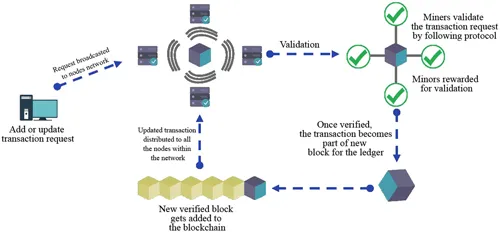
In simple terms, blockchain is a distributed digital ledger; each transaction in the ledger is cryptographically signed and grouped as a block. When a new transaction happens, the new block is cryptographically connected to the previous block after proper validation, and it will be replicated to all nodes within the network. Once the new block is appended, we cannot modify the previous block, as shown in Figure 1.1 [1].
FIGURE 1.1 Overview of blockchain. (From Hileman, G. and Rauchs, M. Global Blockchain Benchmarking Study, Cambridge Centre for Alternative Finance, 2017. Available at: https://ssrn.com/abstract=3040224.)
Since each block is cryptographically connected, it is tamper-evident, and it creates tamper resistance because we cannot modify the previous block once a new block is added. Moreover, the blockchain technology transaction happens without a central repository and a central authority or trusted third party such as a company, bank, government, etc.
1.2.1 Major Benefits of Blockchain
As the blockchain uses only an appending ledger format, therefore easily tracks the entire transactions, and cannot be modified like traditional databases.
Blocks in the blockchain are cryptographically secured; this ensures that the blockchain data cannot be tampered with.
Since the ledger is shared with all nodes within the network, it ensures transparency, and it avoids a single point of failure.
Blockchain technology works without intermediates; therefore, the transaction happens fast without charge or with a very nominal charge.
Some organizations tend to adopt new technology without understanding it, even if it is not necessary, due to overhype of the technology. Many organizations are afraid to implement the new technology due to misconceptions revolving around the technology, and blockchain has not been immune to this. The next section will reveal the facts of the myths revolving around blockchain technology.
1.3 Myths versus Reality
1.3.1 Blockchains Are Public
When we define blockchain as a global peer-to-peer network with transactions stored as blocks of chains across the network, we may think that it is a public platform and that since these blocks of nodes are spread out on a global scale, the data is accessible to all, and every activity happening in the network is visible to all. This is wrong; different security measures within the blocks and network, and even organizational-level accessible settings, are there.
There are different types of blockchain implementations, such as public, where data is visible to all in the network; private, in which data is structured and accessible to only designated people in the network; permissions, which are defined roles and accessibility levels with network usage regulations; and permission-less, where there are no regulations on network usage. [2]
1.3.2 Blockchain Is the Same as Cryptocurrencies
We have all heard the jargon of blockchain and cryptocurrencies like bitcoin. Most of us have a feeling that both are the same. But the fact is that cryptocurrency is an application of blockchain. Bitcoins use blockchain as the core technology for implementation. In the blockchain, everything is decentralized; we can also see it as peer-to-peer connections and transactions stored as blocks [3].
Bitcoins are cryptocurrencies for making electronic payments without involving banks or real cash by using virtual wallets. These currencies started to be used in 2009. Tracking of bitcoins is transparent, as it is a public ledger and uses blocks to store each transaction. These blocks are connected as a chain with timestamps of transactions. These ledgers are permanent, and no one can alter them. Not all cryptocurrencies use blockchain for their operations, but blockchain is ideal for cryptocurrencies [3].
1.3.3 Blockchains Can Never Be Tampered With
Most blockchain mythologies paint blockchain as an unhackable system, which is the main selling point of this technology. Unlike the traditional methodologies, the data is not stored in a single server but across the network as packets. Each transaction has also undergone different hash calculations, making it strong and resistant to tampering. But the fact is that no system is fully proof against hacking. If a group of nodes is malicious in a blockchain, the miners may rewrite the ledger, altering the smart contracts written or introducing new smart contracts.
The developers can take some steps to control tampering and make the blockchain private or permission, in which miner nodes will always be trusted nodes. Only these nodes should be allowed to perform actions like creating new nodes, setting up smart contracts, etc. There is no way trustless nodes can tamper with the state. The suggestion is to use the Proof of Authority (PoA) protocol [4]. This is a simple protocol to authorize signers to seal blocks or create a block by a voting technique. One more suggestion is to publish the hash status to an external node periodically. An auditor or an automaton can verify the previous hash and detect any tampering on nodes.
It is complicated to compromise the security features of blockchains, so the number of possible attacks aimed at this technology will be lower than with traditional systems. Still, we cannot say that blockchains can never be tampe...
Table of contents
Cover
Half-Title
Series
Title
Copyright
Dedication
Contents
Preface
Acknowledgements
Editor biographies
Contributors
Chapter 1 Blockchain: Distinguishing Facts from Myths
Chapter 2 Blockchain Technology and Cryptocurrency: Current Situation and Future Prospects
Chapter 3 Security and Privacy Issues in Blockchained IoT: Principles, Challenges and Counteracting Actions
Chapter 4 Survey of Blockchain Techniques for IoT Device Security
Chapter 5 Digitized Land Registration Using Blockchain Technology
Chapter 6 Towards a Regulatory Framework for the Adoption and Use of Cryptocurrencies in Zimbabwe
Chapter 7 Blockchain Technology in the Energy Industry: A Review on Policies and Regulations
Chapter 8 Exploring Blockchain-based Government Services in India
Chapter 9 Role of Blockchain in the Music Industry
Chapter 10 Blockchain Technology: Myths, Realities and Future
Chapter 11 Application and Challenges of “Blockchain Technology” in the Oil and Gas Industry
Chapter 12 Blockchain Technology in the Banking System in Developing Countries: Potential and Future Trends
Chapter 13 Decentralizing Finance: Cryptocurrencies, ICOs, STOs and Tokenization of Assets
Chapter 14 Role of Blockchain Technology in Digital Forensics
Chapter 15 A Study and Experimentation on Bitcoin Price Forecasting with Time Series Analysis and Recurrent Neural Network (RNN)
Chapter 16 Blockchain versus IOTA Tangle for Internet of Things: The Best Architecture
Index
Trusted by 375,005 students
Access to over 1.5 million titles for a fair monthly price.
Study more efficiently using our study tools.
Frequently asked questions
Yes, you can cancel anytime from the Subscription tab in your account settings on the Perlego website. Your subscription will stay active until the end of your current billing period. Learn how to cancel your subscription
No, books cannot be downloaded as external files, such as PDFs, for use outside of Perlego. However, you can download books within the Perlego app for offline reading on mobile or tablet. Learn how to download books offline
Perlego offers two plans: Essential and Complete
Essential is ideal for learners and professionals who enjoy exploring a wide range of subjects. Access the Essential Library with 800,000+ trusted titles and best-sellers across business, personal growth, and the humanities. Includes unlimited reading time and Standard Read Aloud voice.
Complete: Perfect for advanced learners and researchers needing full, unrestricted access. Unlock 1.5M+ books across hundreds of subjects, including academic and specialized titles. The Complete Plan also includes advanced features like Premium Read Aloud and Research Assistant.
Both plans are available with monthly, semester, or annual billing cycles.
We are an online textbook subscription service, where you can get access to an entire online library for less than the price of a single book per month. With over 1.5 million books across 990+ topics, we’ve got you covered! Learn about our mission
Look out for the read-aloud symbol on your next book to see if you can listen to it. The read-aloud tool reads text aloud for you, highlighting the text as it is being read. You can pause it, speed it up and slow it down. Learn more about Read Aloud
Yes! You can use the Perlego app on both iOS and Android devices to read anytime, anywhere — even offline. Perfect for commutes or when you’re on the go. Please note we cannot support devices running on iOS 13 and Android 7 or earlier. Learn more about using the app
Yes, you can access Blockchain Technology by Sonali Vyas, Vinod Kumar Shukla, Shaurya Gupta, Ajay Prasad, Sonali Vyas,Vinod Kumar Shukla,Shaurya Gupta,Ajay Prasad in PDF and/or ePUB format, as well as other popular books in Technology & Engineering & Computer Science General. We have over 1.5 million books available in our catalogue for you to explore.