The Ten Commandments are more than a list of ancient rules. Beneath the surface, they offer a profound invitation to healing and transformation. In this unique Bible study, readers will discover that the Ten Commandments are words from the heart of God, given to reconcile creation to Creator and God's people to one another. In Words of Love, Eugenia Anne Gamble dives into each of the Ten Commandments and examines their application for modern-day Christians, going beyond the letter of the law to a spiritual truth pointing us toward wholeness and well-being. Each chapter includes a spiritual practice and questions for reflection and discussion to help readers engage deeply with the message of each commandment, whether individually or in a group.
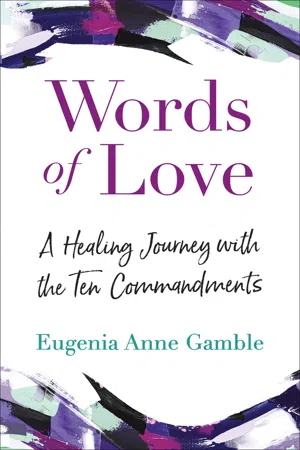
- 200 pages
- English
- ePUB (mobile friendly)
- Available on iOS & Android
eBook - ePub
About this book
Information
Topic
Theology & ReligionSubtopic
Biblical StudiesCHAPTER 1

GREETING THE GOD OF LOVE
Addressing Hurtful Views of God
Then God spoke all these words: I am the Lord your God, who brought you out of the land of Egypt, out of the house of slavery; you shall have no other gods before me.
Exodus 20:1–3
Several years after my experience in Nova Scotia, I moved from my home in Birmingham, Alabama, to the central coast of California. In those intervening years, I went through a very painful divorce. I felt that failure, as my dad used to say, like a dead weight sinker. I was fifty years old and had a string of failed relationships with men in that half century. I had had a wonderful ministry during all that time, amazingly enough, due to the grace of God alone. Still, I was flailing around internally. I knew clearly who I was as a pastor. I knew my gifts for ministry and many of my limitations. I was full of confidence in that arena. But at home, alone, it was different. During the day, when I was doing my work, I was focused and content. At night, when the meetings were done, when the to do list was as complete as it was going to get, then, I was restless and frightened. I felt guilty and lonely and like something essential had been lost, amputated, and I could no longer dance.
So, I took a geographic cure, packed up my beautiful loft in downtown Birmingham, said good-bye to a church I adored, and headed west to a little cottage half a block from the Pacific Coast. I worked part-time at a neighboring church and spent the rest of my days working on a book project on the first millennium women martyrs, mystics, and reformers.
After I had been in California a short time, I met the man who is now my husband. Robbie grew up in New York and came to California immediately after returning from his tour of duty in Vietnam. He married and raised a family. He had been divorced for more than ten years when we met, I for only two. He was over it. I was not. But he sure was cute, blue eyes, infectious grin, and the gentlest soul I’ve ever known. I remember thinking, “Well, what can it hurt to go out to dinner with him?” So, I did, and we began to see each other regularly.
The problem came about a year and a half into our relationship, when he wanted to get married. I did not. I was terrified, certain that I was not good at it and never wanted to go there again. He asked. I said no. Things went on as they had before. About three months later, he asked again. I said no again. Another three months passed. Same thing. Then another three.
One day, we were sitting on a bench by the ocean sharing a sandwich. The sky was bright blue, and the waves crashed powerfully on the rocky coast. Otters played. Herons fished. He asked again. I could feel myself backing up on the bench. He felt it too. Then, he took my face in both of his hands. “Genie,” he said. “I am not that other guy. I’m your guy and you are safe with me.” Now, Robbie is quick to say that I still turned him down that day. But it was a turning point. We were married within the year.
Why do I begin a conversation about the First Word with that story? Because that is how God begins the story, with a powerful declaration of love, of a love that changes everything. Much like a suitor in former times might declare intentions to a dearly loved one, God in the beginning of this new beginning, declares God’s self to us. I am your God.
Our Divine Love Story
Love, for humans, always has a history. It sometimes hits in a flood of endorphins. Often, though, it hums into our lives like a barely heard vibration of the soul, small experience by small experience. Both of these dynamics can be seen in our love story with God in Scripture.
By the time that Moses makes his trek to the holy mountain to get advice from God about what to do with his unruly, wilderness-weary people, the people of Israel had a centuries-long history of both joy and disappointment in their relationship with God.
Jealousy in the family of Jacob fractured the family and led to Joseph winding up in prison, and then in power in Egypt. Reconciliation between the twelve brothers allowed the family to reunite there and to prosper. But that was long ago. As the people grew in numbers and influence, a new Pharaoh arose who did not remember the old relationships and who saw in the people only what he could get out of them. They became units of productivity and eventually slaves. Life was hard. Scholars disagree about how long this situation lasted. It is clear, in any case, that it lasted for generations.
Moses was born into the harshness of that life of oppression. As is so often the case, oppressors are easily threatened and murder often follows. Pharaoh decided that the sheer numbers of the Hebrew people posed a demographic shift that was a threat to his power. So, he ordered the male children of the Hebrews to be executed. This edict was both diabolical and short-sighted. He was, after all, eliminating his future work force. Still, it is not unheard of in human history for unscrupulous leaders, when frightened, to do cruel things that, in the long run, are not even in their own self-interest.
God is always present and working in circumstances of oppression, even when the evidence is not clear in the moment. In Moses’ case, God was at work through the determination, wits, and courage of a remarkable group of women: his mother, sister, two amazing midwives, and a compassionate princess. Moses was spared and grew up in the palace itself as the child of the Egyptian princess.
As a young adult, the streams of Moses’ own history came together in another tragedy that changed the trajectory of his life. He saw an Egyptian soldier brutally beating a Hebrew slave. Moses, overcome with rage, killed the soldier. Once he realized what he had done, he buried the soldier in the sand and fled the city for a new life in the wilderness. There he met his wife and went to work for his father-in-law. It was while doing that work that Moses was met with the voice of God calling out to him from a burning bush.
God had work for Moses to do. God wanted him to go back to Egypt, back to the home he had fled in fear, and tell Pharaoh to set the people free. Moses was stunned and reluctant. To do what God desired, he would have to face his past. He would have to go back to the families he had left behind. He would have to risk the consequences of facing his lost loves, his worst failures, and his own murderous impulses. That is the path to transformation for many of us. Still, it is more amazing that he agreed than that he resisted.
In this encounter with the voice of God in the burning bush, Moses made an audacious request. He asked for the gift of God’s name. We will talk about the importance of the name in chapter 3, however, at this point, it is important to remember that God said yes to this request and gave Moses the divine name, YHWH (vocalized, when appropriate, as Yahweh). It means being itself—“I am who I am” (Exod. 3:14).
Rabbi Rachel Mikva, in Broken Tablets: Restoring the Ten Commandments and Ourselves, shares that the early rabbis and scholars of Torah found the word YHWH to be an ecstasy in itself.1 To hear the word whispered is to be transported out of oneself into the realm of perfect love.
This is how God begins the Ten Words. I am (YHWH) yours. Like Robbie taking my face in his hands, the story turns on love. It is God’s love that gives us the courage to confront the past, to stand up to the powers, and to move into a different way of life.
Love Is a Journey
Moses, despite his fear and reluctance, did return to Egypt and, by the power of God, he did lead the people out. By the time Moses heads up Mount Sinai for help from God, the people have been in the wilderness for many years. They had, in their opinion, as the old saying goes, traded a headache for an upset stomach. They found fault with nearly everything that God tried to do for them on their journey. Freedom was harder than they thought. So hard that they even began to view slavery in Egypt through rose-colored glasses. At least, they reminisced, we had meat to eat. And weren’t the onions in Egypt grand? To ease their hunger and calm their spirits, God sent bread from heaven and quails to eat. Rather than trust God for daily provision, they hoarded what they came to think of as their resources and made themselves sick on it.
Not only are the people moaning, griping, and complaining, enemies are finding them even in the wilderness. After a battle with the Amalekites, Moses sends his wife, Zipporah, and their two sons back to her father, Jethro. When they return to the wilderness for a visit, they find Moses completely exhausted from sitting as a judge and arbiter of all of the complaints of the people. Then they come to Sinai.
That is the context for the gift of the Ten Words. Moses is worn out. The people have lost vision. God has so much more for them and us than that. When Moses ascends the mountain, breaks through the clouds and mists, what he finds is more remarkable than he could have dreamed. In the midst of the clouds of power and holiness lies a God who says, “I am yours.”
We, too, may know what it is like to find ourselves stuck in places we never intended to stay. We know what it is like to wish for things to go back to the way they were, even while we rewrite that old history to make it seem better than it was. We know what it is like to dismiss or despise the gifts God gives us because they are not the ones we thought we wanted. We know what it is like to feel unsure that God will be there for us each and every day, and so we hoard what resources we are given until they make us sick—literally or spiritually. We know what it is like to want to please God and to also wonder if God is trustworthy at the same time. The wilderness time is not foreign to us.
It is astounding that it is into those times of fear, fatigue, and disillusionment that God moves and says, “I am yours. I belong to you. I declare myself yours.” God’s self-giving love is the container, a frame within which the Ten Words and all of life are to be understood.
God’s love is more, however than a simple frame. It is, perhaps, a mandorla. A mandorla is an ancient sacred symbol that gained prominence in Christian art in the Middle Ages. It is that almond shape that is created when two circles intersect. Mandorlas invite us to look deeply through them at those moments when the human and the divine, the mundane and the sacred, intersect. It is the mandorla that holds everything within it together. It provides a boundary, although a mysterious one, and is the context for all that is pictured within it.
Divine Love holds the pieces of life together. Divine Love makes the mundane sacred. Divine Love holds the Ten Words together as one great vision of human and divine life intersecting. Nothing about the Ten Words will be ultimately transformative until we understand that it begins with love, ends with love, and is framed with love. Everything else distorts.
Love Frees
Not only does God declare Godself to us, and in so doing make the new and special relationship a reality, God immediately, upon making that declaration, reminds us of who God really is. “I am the LORD your God, who brought you out of the land of Egypt, out of the house of slavery” (Exod. 20:2).
What must Moses have thought? Did he think that God was simply clarifying which god he was speaking with, lest Moses confuse God with some other divine being that he had heard of, or perhaps wished for, over the years? Or was God, as I believe, reminding Moses of the central characteristic of God for us?
God begins this divine encounter by declaring Godself to us and reminding us that God is the one who sets us free. God is not a god like Pharaoh, whose entire goal is to be worshiped, served, and enriched. Divine Being, Divine Love, is devoted to setting the beloved free from every bondage that keeps us from the life of promised blessing for which we were created. The freedom Divine Love declares is not just from something. It is also to something. It is freedom into love, and the resulting life of love, that the Words describe.
In saying that God is the one who brought us out of slavery, God reminds us that what God did for the Hebrew people long ago, God is still doing right here and right now. The organizing intention of Divine Love is always liberation. That liberation mirrors God’s own freedom and Jesus’ central purpose. In Galatians 5:1, Paul reminds us that it was for freedom that Christ set us free.
How is it that over the centuries so many of us have come to see God differently from that? When presented with God reaching into the muck and mess of human life and offering love and freedom, how is it that we so often choose to focus on God as fierce and disappointed with us instead? Why? Perhaps that, too, has a long history.
Jonathan Edwards, the British colonial pastor and theologian of the Great Awakening in mid-eighteenth century New England, wrote a widely distributed sermon called “Sinners in the Hands of an Angry God.” This sermon was filled with images of hell and God’s fury with human recalcitrance. It is powerful stuff and a telling glimpse into the theology of God’s vengeance as motivation for repentance and change. The image of sinners being dangled by a fierce God over the pits of hell has stuck in our psyches more than we might imagine, leaving us often with a cowering approach to God, if we dare approach at all.
It is not just the fiery ...
Table of contents
- Cover
- Half Title
- Title Page
- Copyright
- Dedication
- Contents
- Introduction
- 1. Greeting the God of Love: Addressing Hurtful Views of God
- 2. Looking for a God that Sparkles: Addressing Destructive Allegiances
- 3. Language That Lifts: Addressing the Trivializing of God
- 4. Just Stop: Addressing Toxic Doing
- 5. It Takes a “Crash”: Addressing the Power of Family Pain
- 6. Murder Most Foul: Addressing the Tendency to Violence, Anger, and Cruelty
- 7. Worthy Companions: Addressing the Core Qualities of Intimacy
- 8. To Catch a Thief: Addressing Theft from God, Self, and Community
- 9. Living with Integrity: Addressing the Lies That Destroy Us
- 10. Enough: Addressing Desires That Substitute for Life
- Conclusion
- Notes
Trusted by 375,005 students
Access to over 1.5 million titles for a fair monthly price.
Study more efficiently using our study tools.
Frequently asked questions
Yes, you can cancel anytime from the Subscription tab in your account settings on the Perlego website. Your subscription will stay active until the end of your current billing period. Learn how to cancel your subscription
No, books cannot be downloaded as external files, such as PDFs, for use outside of Perlego. However, you can download books within the Perlego app for offline reading on mobile or tablet. Learn how to download books offline
Perlego offers two plans: Essential and Complete
- Essential is ideal for learners and professionals who enjoy exploring a wide range of subjects. Access the Essential Library with 800,000+ trusted titles and best-sellers across business, personal growth, and the humanities. Includes unlimited reading time and Standard Read Aloud voice.
- Complete: Perfect for advanced learners and researchers needing full, unrestricted access. Unlock 1.5M+ books across hundreds of subjects, including academic and specialized titles. The Complete Plan also includes advanced features like Premium Read Aloud and Research Assistant.
We are an online textbook subscription service, where you can get access to an entire online library for less than the price of a single book per month. With over 1.5 million books across 990+ topics, we’ve got you covered! Learn about our mission
Look out for the read-aloud symbol on your next book to see if you can listen to it. The read-aloud tool reads text aloud for you, highlighting the text as it is being read. You can pause it, speed it up and slow it down. Learn more about Read Aloud
Yes! You can use the Perlego app on both iOS and Android devices to read anytime, anywhere — even offline. Perfect for commutes or when you’re on the go.
Please note we cannot support devices running on iOS 13 and Android 7 or earlier. Learn more about using the app
Please note we cannot support devices running on iOS 13 and Android 7 or earlier. Learn more about using the app
Yes, you can access Words of Love by Eugenia Anne Gamble in PDF and/or ePUB format, as well as other popular books in Theology & Religion & Biblical Studies. We have over 1.5 million books available in our catalogue for you to explore.