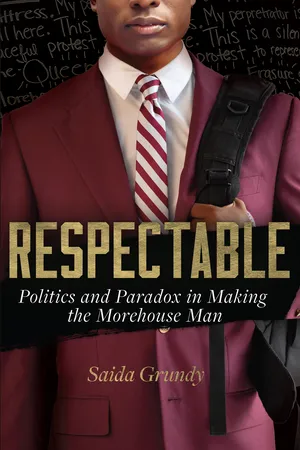
The making of a culture of Black male respectability at Morehouse that underlines conservative notions of gender and class—by a former Spelman student who was once "Miss Morehouse."
How does it feel to be groomed as the "solution" to a national Black male "problem"? This is the guiding paradox of Respectable, an in-depth examination of graduates of Morehouse College, the nation's only historically Black college for men. While Black male collegians are often culturally fetishized for "beating the odds," the image of Black male success that Morehouse assiduously promotes and celebrates is belied by many of the realities that challenge the students on this campus. Saida Grundy offers a unique insider perspective: a graduate of Spelman college and a former "Miss Morehouse," Grundy crafts an incisive feminist and sociological account informed by her personal insights and scholarly expertise.
Respectable gathers the experiences of former students and others connected to Morehouse to illustrate the narrow, conservative vision of masculinity molded at a competitive Black institution. The thirty-two men interviewed unveil a culture that forges confining ideas of respectable Black manhood within a context of relentless peer competition and sexual violence, measured against unattainable archetypes of idealized racial leadership. Grundy underlines the high costs of making these men—the experiences of low-income students who navigate class issues at Morehouse, the widespread homophobia laced throughout the college's notions of Black male respectability, and the crushingly conformist expectations of a college that sees itself as making "good" Black men. As Morehouse's problems continue to pour out into national newsfeeds, this book contextualizes these issues not as a defect of Black masculinity, but as a critique of what happens when an institution services an imagination of what Black men should be, at the expense of more fully understanding the many ways these young people see themselves.
- 356 pages
- English
- ePUB (mobile friendly)
- Available on iOS & Android
eBook - ePub
About this book
Information
Publisher
University of California PressYear
2022Print ISBN
9780520340381
Edition
1eBook ISBN
9780520974517
1
The Masculine Arc of Uplift
The torrent poured on mercilessly. Hundreds of families huddled under umbrellas or held futilely soaked commencement programs over their heads. They had not the slightest intention of leaving or waiting it out in their cars. Sunday, May 19, 2013, was far too important to miss. On this historic occasion, the sitting president of the United States, Barack Obama, addressed the Morehouse College graduating class of 2013. The wide stage that sheltered faculty and prominent administrators had been erected in the heart of the campus yard, positioned as though it were at the head of a table of simple but enduringly proud classroom buildings and dormitories that looked back at it. Some parents had waited hours for the best seats from which to witness it all. Laughingly, they jested over their shoulders to each other that they had waited twenty-two years.
The president’s signature charisma helped to make up for the weather. As he asked the nearly 570 graduates and their families to take their seats, someone shouted “I love you!” from the crowd. Without skipping a beat, he boomed back “I love you, too! That’s why I’m here!” Obama’s ground team had done their homework, and he spoke with such warm and detailed familiarity about the college that an outsider could have easily mistaken him for an alumnus. Perhaps this was the intention: to nod to the Black men in soaked-through gowns and regalia who looked up from rows before him that he, in essence, was them, so they could become him. Like so many African Americans, I watched the live stream of the speech with the same sort of giddy pride that had the starstruck faculty seated behind the president hoisting up their cell phones to record the moment like teenagers awing the presence of a pop star. From the bright glare of my laptop screen in my humble graduate school apartment in Ann Arbor, my feeling then was that even from hundreds of miles away I was sharing in this undeniably proud moment for our people—one of those occasions in which African Americans pause to take inventory that we were actualizing our ancestors’ dreams. Given the stony road that had been trod in little over a century since Reconstruction, I thought to myself on watching that field of smiling brown faces that even with my criticisms of the president and the college, this moment felt like I was witnessing some sort of mile marker being placed for our people. The faces of all I watched in attendance looked awash with a beaming pride that seemed to say the same.
Unlike any commencements before it and all other commencements across the nation that season, this moment was distinguished by the only Black male president addressing the graduating class of the nation’s only historically Black college for men. The graduates and the president fed off their mutual uniqueness. As his oration got underway, his message leaned heavily into what exceptionalism means in the life of a Black man. I listened intently as the cadence of raindrops on the graduates’ mortarboards seemed to punctuate each of his words.
Your generation is uniquely poised for success unlike any generation of African Americans that came before it. But that doesn’t mean we don’t have work—because if we’re honest with ourselves, we know that too few of our brothers have the opportunities that you’ve had here at Morehouse. In troubled neighborhoods all across this country—many of them heavily African American—too few of our citizens have role models to guide them. Communities just a couple miles from my house in Chicago, communities just a couple miles from here—they’re places where jobs are still too scarce, and wages are still too low; where schools are underfunded, and violence is pervasive; where too many of our men spend their youth not behind a desk in a classroom but hanging out on the streets or brooding behind a jail cell.1
The message was familiar to the crowd that day, as it was to anyone raised in an African American community: the recycled trope that nested the often-hazy post-civil-rights-era struggle for Black advancement within a belief that racism—in the absence of the blatant legal discrimination facing the previous generation—could be offset by education and individual achievement against all odds. That this missive to young Black male America was being delivered by the beau ideal of Black male achievement-via-respectability, and one who epitomized the college’s doctrine, elevated the words to a sermon-like quality based in moral authority. Throughout his address, the then president enjoined the graduates to practice personal responsibility and to consider the outcomes of their lives as consequences of their choices and work ethic. Riven by internal contradictions, this message speaks to the disparities of structural disadvantages yet suggests that the “brooding” Black men “hanging out” in these impoverished communities are at least partly responsible for their perilous state. While lauding the graduates as having more opportunities for achievement than any generation before them, Obama’s warning is clear: as Black men, their lives are only a few poor choices away from marking the stain of the race. “We have individual responsibilities,” the president continued. “There are some things, as Black men, we can only do for ourselves. There are some things, as Morehouse men, that you are obliged to do for those still left behind. As Morehouse men, you now wield something even more powerful than a diploma you’re about to collect—and that’s the power of your example.”
The audience received these words with rounds of affirmations and applause. The loudest cheers greeted the individual graduates who rose from their seats to the whoops of their classmates as the president acknowledged them for their odds-defying stories. One graduate had dropped out of Morehouse and worked as a custodian to provide for his pregnant girlfriend before returning to finish college. Another was a former foster child headed toward Harvard Law School and a career of legal advocacy for youth who are involved in the social service system. Obama used both examples to underscore his directive that “excuses are the tools of the incompetent” and are meaningless for those entering the new and hypercompetitive global workforce. “Nobody cares how tough your upbringing was. Nobody cares if you suffered from discrimination,” he declared. “Whatever you’ve gone through pales in comparison to the hardships previous generations endured.”
The crowd surrounding them continued to roar in applause, but the good-humored levity that had greeted Obama vanished from the graduates as they listened to these sobering words. While straining to make out the brief camera cutaways to their crowded faces, I noticed the rain now took on a different mood. For as much as Obama praised them, he also admonished them for the shortcomings of their brethren and impressed on them that to meet the benchmarks of masculine respectability as fathers, husbands, and role models they must escape the pitfalls that trapped so many other Black men. The message was clear: racial advancement is an outgrowth of the individual advancement of African Americans who are propelled to achievement. For educated Black men, the daunting task before them was a clean-up job of the embarrassment caused by their counterparts who would see a courtroom before they saw a college classroom.

FIGURE 2. Graduating students listen to Obama as the rain warps their mortarboards. MANDEL NGAN/AFP/Getty Images.
In office, President Obama demonstrated his earnest belief in these ideals. A year after the commencement speech, his administration unveiled My Brother’s Keeper (MBK), a White House initiative targeted at African Americans and Latino young men and boys. In its official literature, the White House described its purpose as addressing “persistent opportunity gaps” facing this group by focusing on K–12 education, college readiness, and career preparation, including education and workforce training for incarcerated youths. These programs were not federally subsidized government policies, however; they depended mainly on local public-private partnerships, voluntary organizations, and the individual mentoring of struggling Black boys by college educated Black men.
In the years since Obama’s presidency, however, critics representing Black communities have pointed out that his administration largely ignored the policies and practices that devastated Black households during the Great Recession. MBK’s individual-based initiative presented an effort to address the plight of young Black men and boys as an opportunity to deflect from the administration’s notable lack of response toward African Americans during a sluggish economic recovery. In the years leading up to the economic crash of 2008, long-standing wealth disparities between Black and white families showed signs of narrowing. Since home value disproportionately accounts for the wealth of Black households (compared to whites),2 the collapse of the housing market and the foreclosure crisis hit Black homeowners especially hard. Low- and middle-income Black households, which had been targeted by discriminatory housing and predatory lending practices, suffered a 40 percent drop in their median wealth; by 2015 they were, on average, $98,000 poorer than they would have been without the Great Recession. Throughout Obama’s two administrations and thereafter, Black households recovered slower because they had fewer opportunities to rebuild wealth than white households.3 Black women heads of household, who had been disproportionately represented among first-time home buyers before the crash, lost even the small gains in wealth they had previously made. As the Black middle class was catapulted into a precarious position, many of Obama’s Black supporters, as well as his detractors, harshly criticized the administration for not taking a direct policy approach to ameliorating the structural and economic conditions of African Americans. In that context, My Brother’s Keeper stood out as Obama’s only race-based initiative at a time of historic Black economic setbacks. It also focused on Black young men and boys, a group that was not in an exceptional state of decline in that historical moment, over Black women, who had disproportionately taken the economic blow to African Americans households during the housing crash.
MBK’s origin story is little known by the public. While the emphasis on high school completion and college readiness led many to assume that it was born in the Department of Education, the initiative began as the brainchild of Eric Holder, the nation’s first African American attorney general. Through its incubator in the Department of Justice, it expanded as an alliance between several federal agencies (including the Department of Energy) and the White House with the help of its principal architects, which included Morehouse alumni and affiliates. In the wake of dozens of high-profile police shootings of young African Americans, Holder initially imagined a “Smart on Crime” program that would “restore broken bonds” between Black neighborhoods and law enforcement. His goal was to improve community policing by shouldering part of the responsibility onto the very Black male youth that discriminatory police practices were targeting. On the one-year anniversary of MBK, Holder explained how the aims of the initiative originated in his vision for enhancing policing and the penal system:
I launched a new “Smart on Crime” initiative to help strengthen communities, to improve public safety, and to make America’s criminal justice system more effective—and more equitable. Our actions under this initiative are born of the crucial recognition that growing both tougher and smarter on crime means investing in innovations; striving for more just and equal outcomes; and rejecting any policy or practice that has the potential to undermine law enforcement—or erode the sense of trust that must always exist between police officials and the citizens they serve. . . . As the My Brother’s Keeper Task Force reported to the President last May—months before events in Ferguson captured headlines—we need to do more to strengthen the relationships between law enforcement and their communities. America’s law enforcement leaders must ensure that every community can see that we are firmly committed to the impartial and aggressive enforcement of our laws—and the unbiased protection of everyone in this country. Bonds that have been broken must be restored. And bonds that never existed must now be created—because this is the fundamental promise that lies at the core of who we are, what we do, and what so many brave law enforcement officers sacrifice so much, every day, to achieve.4
In its rhetoric and policies, the Obama administration and the president himself had delivered an unmistakable message to Black men. While thousands of Black households floundered amid the economic crisis, the tonic for Black communities’ ills seemed to lie in the ability of young Black men and boys to do better. For African Americans to advance, the cultural prescription of respectable masculine behavior was given priority over remedying material and structural inequalities.
Repeatedly I have asked myself the question: how did we arrive at this moment? Why has the arc of racial advancement ideologies since the end of slavery brought us to its current iteration as a clear yet contradictory edict that Black men are simultaneously the saviors of the race and the cause of its downfall? As historians have consistently shown, the project of racial uplift has been gendered since its inception in the late nineteenth century. While this burden of moral respectability, personal achievement, and gender conformity has been visited on both Black men and women, Black men have generally been imagined as the yardstick for the race’s progress. Since the mid-1920s our racial attention focused particularly on the upward m...
Table of contents
- Imprint
- Subvention
- Title
- Copyright
- Dedication
- Contents
- Preface
- Introduction
- 1 The Masculine Arc of Uplift
- 2 Branding the Man
- 3 Of Our Sexual Strivings
- 4 Who among You Will Lead?
- Conclusion: The Journey Back
- Acknowledgments
- Appendix A: Respondent Demographics
- Appendix B: Participant Screening Questionnaire
- Appendix C: Informed Consent Contract
- Notes
- Index
Trusted by 375,005 students
Access to over 1.5 million titles for a fair monthly price.
Study more efficiently using our study tools.
Frequently asked questions
Yes, you can cancel anytime from the Subscription tab in your account settings on the Perlego website. Your subscription will stay active until the end of your current billing period. Learn how to cancel your subscription
No, books cannot be downloaded as external files, such as PDFs, for use outside of Perlego. However, you can download books within the Perlego app for offline reading on mobile or tablet. Learn how to download books offline
Perlego offers two plans: Essential and Complete
- Essential is ideal for learners and professionals who enjoy exploring a wide range of subjects. Access the Essential Library with 800,000+ trusted titles and best-sellers across business, personal growth, and the humanities. Includes unlimited reading time and Standard Read Aloud voice.
- Complete: Perfect for advanced learners and researchers needing full, unrestricted access. Unlock 1.5M+ books across hundreds of subjects, including academic and specialized titles. The Complete Plan also includes advanced features like Premium Read Aloud and Research Assistant.
We are an online textbook subscription service, where you can get access to an entire online library for less than the price of a single book per month. With over 1.5 million books across 990+ topics, we’ve got you covered! Learn about our mission
Look out for the read-aloud symbol on your next book to see if you can listen to it. The read-aloud tool reads text aloud for you, highlighting the text as it is being read. You can pause it, speed it up and slow it down. Learn more about Read Aloud
Yes! You can use the Perlego app on both iOS and Android devices to read anytime, anywhere — even offline. Perfect for commutes or when you’re on the go.
Please note we cannot support devices running on iOS 13 and Android 7 or earlier. Learn more about using the app
Please note we cannot support devices running on iOS 13 and Android 7 or earlier. Learn more about using the app
Yes, you can access Respectable by Saida Grundy in PDF and/or ePUB format, as well as other popular books in Social Sciences & African American Studies. We have over 1.5 million books available in our catalogue for you to explore.