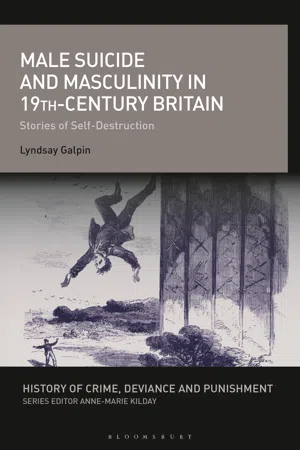
This book shows how interpretations of suicidal motives were guided by gendered expectations of behaviour, and that these expectations were constructed to create meaning and understanding for family, friends and witnesses. Providing an insight into how people of this era understood suicidal behaviour and motives, it challenges the assertion that suicide was seen as a distinctly feminine act, and that men who took their own lives were feminized as a result. Instead, it shows that masculinity was understood in a more nuanced way than gender binaries allow, and that a man's masculinity was measured against other men.
Focusing on four common narrative types; the love-suicide, the unemployed suicide, the suicide of the fraudster or speculator, and the suicide of the dishonoured solider, it provides historical context to modern discussions about the crisis of masculinity and rising male suicide rates. It reveals that narratives around male suicides are not so different today as they were then, and that our modern model of masculinity can be traced back to the 19th century.
eBook - ePub
Male Suicide and Masculinity in 19th-century Britain
Stories of Self-Destruction
- 200 pages
- English
- ePUB (mobile friendly)
- Available on iOS & Android
eBook - ePub
About this book
Information
1
Love and jealousy
It is admitted, by almost universal consent, that there is no affection of the mind that exerts so tremendous and influence over the human race as that of love.
– Forbes Winslow, The Anatomy of Suicide1
On 15 July 1825 a young man named Sydney Walsh shot himself through the chest with a rifle pistol. The inmates of 11 East-street, where he was living, heard the report of a pistol and rushed to his apartment to find him lying on his bed in a pool of blood, the pistol lying next to him. The shot had pierced his lung and the ball was lodged in his body, and despite his best efforts the surgeon, Mr Swift, was unable to remove the ball or save the young man’s life. He lingered for a while and when his friends asked him what his motives were for ‘so rash an attempt upon his own life’, Walsh directed them to a letter in his pocket. The letter was from a young girl, Mary Keep, to whom, with the approval of her mother, he had proposed. In it, she stated that she ‘had taken a sudden dislike to him’ which she could not account for, and that ‘she could never marry any body unless she loved him’. In concluding the letter she thanked him for the kindness he had showed her and begged him ‘not to suffer foolish despondency to operate too much upon his mind’ and he would always be her friend.2 Sydney Walsh was not the only man who decided that his disappointment in love was too much for him to bear, and it was by no means an uncommon narrative of male suicide. Nineteenth-century newspaper reports of suicides attributed to love appear to bear out Forbes Winslow’s observation above, and it would appear that men were particularly affected. The popular refrain ‘She died for love and he for glory’ was inaccurate.3 Whether it was romantic rejection, jealousy, the breakdown of a relationship or the death of a loved one, love was a frequently attributed motive to suicide throughout the nineteenth century.
Whilst some early cultural histories of suicide in the nineteenth century have identified the love-suicide as one of the most well-established narratives of suicide, the primary focus here has been on the fallen or lovesick woman.4 The love-madness of men has largely been ignored. These assertions that the love-suicide of women embodied Victorian conceptions of the tragic act are not without cause. Arguably the most potent image of suicide during this century was that of Ophelia, and by 1850, no less than fifteen paintings depicting Ophelia had been exhibited at the Royal Academy.5 Thomas Hood’s ‘Bridge of Sighs’ offers another popular depiction of suicide in the shape of the ‘fallen woman’, who plunges herself into the river after being seduced and betrayed. There can be little doubt that the lovesick woman was a popular trope throughout the late eighteenth and nineteenth centuries, but the frequency of reports in which men’s suicides were attributed to romantic difficulties warrants discussion. As Margaret Higgonet acknowledges in her work on the feminine representation of suicide, ‘the most famous literary suicide of the pivotal period’ was not, in fact, a woman, but Goethe’s Werther. Describing him as ‘a Man of Sensibility whose virtues turn out to be symptomatic of his fatally feminine susceptibility’, Higgonet suggests that a man who killed himself for love was characterized by stereotypically feminine weaknesses, ‘hypersensitive … unable to control his feelings or to consider the pragmatic situation in shaping his behaviour’.6 In what follows I argue that, contrary to Higonnet’s interpretation, the representation of Wertherism embodies a more complex and nuanced debate about nineteenth-century masculinity.
Historians such as James Eli Adams, Linda Dowling, Andrew Dowling and John Tosh have demonstrated how, throughout the century, masculinity was nuanced and complex, often dependent on factors such as nationality, class, religion and sexuality. Rather than being defined along a masculine/feminine binary, masculinity was measured against other men. In this more nuanced framework, descriptors such as unmanly and effeminate did not necessarily equate to feminine. As historians have noted, the meaning of ‘effeminate’ was traditionally associated with inactivity and luxury, rather than being a signifier of being feminized. In this way, effeminacy did not signal a binary opposite femininity but acted as a more nuanced ‘other’ to traditional forms of masculinity.7 Although Werther’s masculinity certainly came under fire, nineteenth-century discussions of ‘Wertherism’ focused more on his ‘un-English’ qualities than on his supposedly feminine ones.
The reports of love-suicides used throughout this chapter reveal a variety of ways in which a man’s masculinity might be found lacking. Beginning with a discussion of romantic suicide narratives, I draw on the work of Kelly McGuire and Michèle Cohen to highlight the implications that these men failed to live up to an idealized English manliness, and associated them with an effeminate European masculinity akin to Goethe’s Werther. Moving onto the narratives of jealous murder-suicides, discussions around state of mind often served to ‘other’ these men in reaching a verdict. Symptoms of psychological troubles could portray a man as unmanly through their inability to carry out typical masculine tasks such as attending to business, whilst a frenzied loss of control was equally damaging to masculine character. In these cases, I suggest that, although insanity verdicts were returned mostly as a matter of course, the masculinity of these men was brought into question through evidence given to support this verdict. On the other hand, I show how a felo de se verdict might be used as a punitive measure when the inquest revealed behaviour that did not live up to expected standards of masculinity at the time. Ultimately, I suggest that the reports of suicide inquests reveal complicated, sometimes conflicting and usually highly contextualized attitudes around masculinity and the kind of behaviour that was acceptable for men.
The romantic character
In looking at nineteenth-century representations of male love-suicides, it is important to acknowledge the role of the eighteenth-century cult of sensibility, which found a hero in the ‘man of feeling’. This ‘man of feeling’ was exquisitely in tune with his feelings, overtly emotional and, as Inger Sigrun Brodey describes him, ‘valued the moment over future plans, the unspoken over the spoken, the felt over the reasoned, and process over product’, all of which stood in opposition to the normative ‘man of the world’ model of masculinity.8 The figure was famously embodied by the protagonist of Goethe’s The Sorrows of Young Werther (1774), who, after falling in love with the already-engaged Lotte, goes on to commit suicide at the end of the novel in order to resolve the pain of unrequited love. Werther fit ‘comfortably’ into what Robyn Schiffman describes as a ‘taxonomy of men of feeling’ in England, with Henry Mackenzie’s novel The Man of Feeling having been published in 1771, and Werther became a popular character for the English. The popularity of Goethe’s novel is evidenced not only through continued reprints into the late nineteenth century, but also through the adoption of Werther himself into British literary tradition.9 With the novel’s popularity, Werther became a ‘cult hero’, and his suicide became the ultimate symbol of sensibility. The novel’s popularity also became a growing concern for many who saw the novel as an apology for suicide, particularly in England.10 As a Werther mania erupted across Europe, fear was sparked over the novel’s potential to influence others to follow the example of Werther’s suicide.11 In November 1784, the Gentleman’s Magazine published a report of a young girl who had died suddenly, a copy of Werther was found under her pillow, which, the magazine added, was ‘a circumstance which deserves to be known in order, if possible to defeat the evil tendency of that pernicious work’.12 As Kelly McGuire has noted, whilst there was no substantive evidence to support what is now termed the ‘Werther-effect’, Goethe’s novel gave rise to fears of social, and textual, contagion.13
Charles Moore’s A Full Inquiry into the Subject of Suicide (1790), raised these concerns in a chapter devoted to criticizing Werther, describing the effects of the novel as ‘highly mischievous’, confounded by the fact that ‘many a wretched victim to his passions’ had been found with copies of the book on their person at the time of their suicide. Moore’s concern was the way in which Werther is presented as an object of pity and sympathy. He believed that ‘the more distinguished the character of Werter is described to be for taste, abilities, and improvements, and the more innocent his previous life, the more dangerous and fatal is the example of his death’.14 These concerns surrounding Werther’s potential for contagion persisted well into the nineteenth century, and discussions could still be found at the fin de siècle. In Forbes Winslow’s Anatomy of Suicide (1840), he lamented how works such as Werther had ‘unhinged the minds of thousands, before they were aware of its impoisoned and insidious tendency’.15 As late as 1893 the Birmingham Daily Post ran an article about ‘Wertherism in England’, which complained of ‘sentimental suicides’, branding them as cowardly and criticizing the attempts to make suicide stagey as hiding ‘cowardice under an aesthetic veil’.16
As Brodey has argued, these eighteenth-century men of feeling did not present a ‘revolution in the concept of masculinity’, but an alternative and conflicting model, which hovered ‘on the edge of illness, madness, impotence, inactivity, silence, and death’.17 Charles Moore’s critique of Werther went beyond derision of the novel itself and lambasted Werther’s character for the way in which he indulged his passions, describing them as ‘unlawful and uncontrolled’.18 For Moore, the ‘ungovernable’ passions were, more often than not, passions that had gone on ‘ungoverned’, with the blame falling on the man who, like Werther, allowed himself to indulge them.19 Wertherism, like melancholia or hysteria, was a disease that needed to be cured. The most effective ways to curb this ‘exquisite sensibility’, according to the physician Dr William Rowley, was ‘a masculine habit of body and mind’.20 Medical discussions of Wertherism clearly placed the man of feeling at odds with normative masculinity, and evidence of this attitude can be found well into the nineteenth century. The press placed Wertherism in opposition to traditionally masculine habits of work and rationality. Benjamin Disraeli, whose ‘heroic courage’ and ‘example of fortitude’ were laudable, and Thomas Carlyle were both held up as examples of traditional English masculinity, both having ‘supplied a powerful counteraction to the Wertherism which threatened to become an overwhelming force in the early part of this century’.21 In 1878 The Times ran an article about a recent volume on the life of Baron Von Stein, describing him thus:
When half of his friends were bitten with Wertherism, and a great many of the other moiety were mooning about in philosophy, he kept to the world of facts as firmly as an English statesman who had been to Eton and played cricket and rowed in his youth could have done …22
The contrast drawn between Von Stein and his friends places Wertherism in opposition to ‘facts’, rationality and the values of normative English masculinity inculcated in public schools. And as late as 1895, the Illustrated London News commented how the ‘practical duties … that Goethe had to perform as an administrator at Weimar … cured him of Wertherism. The lesson thus learned was embodied in the career of Wilhelm Meister, reconciled as he becomes, after many illusions, to effort and action in this workaday world’.23 Work, then, was the cure for Wertherism. This placed Werther outside of traditional masculine characteristics; hard-working, practical and rational. The persistent interest in Wertherism a century later can be contextualized against the rise of aestheticism at the fin de siècle, bringing with it another model of masculinity that ran counter to hegemonic models and echoed the sensibility of the previous century. With it came a renewed debate about the diverse forms of masculinity and disrupted fixed ideas of gender norms and a renewed interest in Werther. Massenet’s operatic adaptation of Goethe’s novel premiered in England in 1894 and depicted Werther as an infantile ‘crybaby’, a characterization that emasculated the sentimental hero.24
Werther is a prime example of how a more general ...
Table of contents
- Cover
- Halftitle Page
- Title Page
- Contents
- Acknowledgements
- Introduction
- 1 Love and jealousy
- 2 Poverty and unemployment
- 3 Fraud and speculation
- 4 Military trauma and dishonour
- Conclusion
- Bibliography
- Index
- Imprint
Trusted by 375,005 students
Access to over 1.5 million titles for a fair monthly price.
Study more efficiently using our study tools.
Frequently asked questions
Yes, you can cancel anytime from the Subscription tab in your account settings on the Perlego website. Your subscription will stay active until the end of your current billing period. Learn how to cancel your subscription
No, books cannot be downloaded as external files, such as PDFs, for use outside of Perlego. However, you can download books within the Perlego app for offline reading on mobile or tablet. Learn how to download books offline
Perlego offers two plans: Essential and Complete
- Essential is ideal for learners and professionals who enjoy exploring a wide range of subjects. Access the Essential Library with 800,000+ trusted titles and best-sellers across business, personal growth, and the humanities. Includes unlimited reading time and Standard Read Aloud voice.
- Complete: Perfect for advanced learners and researchers needing full, unrestricted access. Unlock 1.5M+ books across hundreds of subjects, including academic and specialized titles. The Complete Plan also includes advanced features like Premium Read Aloud and Research Assistant.
We are an online textbook subscription service, where you can get access to an entire online library for less than the price of a single book per month. With over 1.5 million books across 990+ topics, we’ve got you covered! Learn about our mission
Look out for the read-aloud symbol on your next book to see if you can listen to it. The read-aloud tool reads text aloud for you, highlighting the text as it is being read. You can pause it, speed it up and slow it down. Learn more about Read Aloud
Yes! You can use the Perlego app on both iOS and Android devices to read anytime, anywhere — even offline. Perfect for commutes or when you’re on the go.
Please note we cannot support devices running on iOS 13 and Android 7 or earlier. Learn more about using the app
Please note we cannot support devices running on iOS 13 and Android 7 or earlier. Learn more about using the app
Yes, you can access Male Suicide and Masculinity in 19th-century Britain by Lyndsay Galpin in PDF and/or ePUB format, as well as other popular books in History & 19th Century History. We have over 1.5 million books available in our catalogue for you to explore.